





Voice communication powered through platforms such as Twilio has undergone major regulatory changes in recent times. From necessary caller verification to trust product requirements, such updates have a direct influence on how businesses handle their outbound calls. In this blog, let us understand all you must know, what has changed, why it is important, and how you can correctly set it up to meet regulatory standards.
1. Mandatory Caller Verification: SHAKEN/STIR
Twilio supports SHAKEN/STIR framework for all eligible outbound calls in United States. This is a direct response to the regulatory push driven by the FCC and the TRACED Act, both focused on minimizing the robocalls and phone number spoofing.
What does this mean for your business?
- All calls that are unverified are likely to be blocked or spam labeled.
- Verified calls might be displayed with a badge "Caller Verified,” ensuring trust with the recipients and improved answer rates.
2. Attestation Levels: A, B, and C
Twilio now scores outbound calls with attestation levels based on how well the phone number and business can be verified. Such attestation levels will help in defining how receiving carriers treat the call.
- Level A (Full Attestation): The business is verified and owns the used number.
- Level B (Partial Attestation): The business is verified. However, the number ownership cannot be ascertained.
- Level C (Gateway Attestation): Very low trust, generally applied to all international calls.
Higher levels of attestation levels directly lead to higher call answer rates. Getting Level A attestation must be a priority for any business depending on voice communications.
3. Trust Hub Is Now Needed
All compliance, whether for SMS, voice calls, or any other channels, now flows through Trust Hub of Twilio. It works as the central layer of compliance for all trust-related and verification activities.
Trust Hub handles the following:
- Business verification (Know Your Customer — KYC)
- Trust products such as SHAKEN/STIR, A2P 10DLC, and Voice Integrity
If the Trust Hub is not properly configured:
- Calls can be flagged as spam or downgraded in trust score by the receiving networks.
4. Voice Integrity: Additional Protection Layer
Voice Integrity is the latest addition to the compliance toolkit of Twilio. It works along with SHAKEN/STIR to boost the credibility of your outbound calls further.
- Reduces the likelihood "Spam Likely" labeling by carriers.
- Enables you to track the reputation of your numbers actively.
SHAKEN/STIR Onboarding: Step-by-Step Console Guide
A lot of users face friction during the process of console setup. Let us see a sequential and clear walkthrough to finish your SHAKEN/STIR onboarding in a correct way.
Step 1: Create a Business Profile
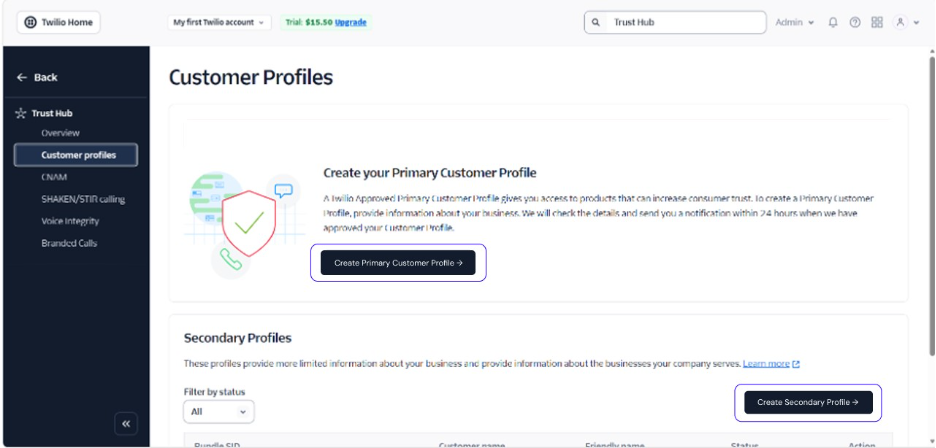
- Go to “Console”, then “Trust Hub”, and then “Customer Profiles”.
- If you are using a free version, you might have to upgrade before you can use “Trust Hub Customer Profiles.”
- Fill the form and create a Primary Business Profile.
- Submit the profile for vetting (KYC).
While filling the form, you will be required to enter the following details:
- Legal business name
- Contact details
- Business address
Typical vetting time: Around 24 hours for business profile approval.
Step 2: Assign Phone Numbers to the Business Profile
- Connect your Twilio phone numbers to the verified “Business Profile.”
- This step sets up the identity-to-number relationship.
This is a required step before SHAKEN/STIR can be applied to your calls.
Step 3: Create a SHAKEN/STIR Trust Product
- Now, go to “Trust Hub”, and then select “Trust Products.”
- Create a new “SHAKEN/STIR” profile.
- Submit for vetting. The approval process can take up to 72 hours.
Step 4: Link Your Phone Numbers to the Trust Product
- Assign same phone numbers (used in Step 2) to the “SHAKEN/STIR Trust Product”.
- Once you are done with this, Twilio will then sign calls coming from those numbers cryptographically.
What You Get After Approval
Once you see that all the steps have been approved, calls from the assigned numbers get Level A attestation. However, this only happens when you see all the following conditions have been met:
- “Business Profile” is approved.
- “SHAKEN/STIR Trust Product” is approved.
- Phone numbers are assigned to both the “Business Profile” and the “Trust Product.”
Also Read: Simple Guide to Setup Interactive Voice Response with Twilio
5. Direct Customer vs. ISV: A Significant Distinction
The compliance needs change depending on whether you are directly making calls or operating as a platform (ISV/SaaS) via which your customers can make calls:
Direct Customer:
- You directly make all calls.
- Only the main Business Profile is needed.
ISV / SaaS Platform:
- Your customers dial calls through your platform.
- You require a Primary Business Profile (for your own business).
- You also require Secondary Profiles for all your customers.
6. Prevalent Mistakes That Break Onboarding
A lot of businesses experience incomplete or failed SHAKEN/STIR onboarding because of avoidable errors. The most frequent mistakes are as follows:
- Phone numbers are not assigned to both the “Trust Product” and “Business Profile.”
- Utilizing unverified caller IDs for outbound calls.
- Business vetting process is entirely skipped.
- Mixing subaccounts without creating proper profiles for each.
7. Checklist for Quick Compliance
Before your calls can be categorized as trusted, you need to confirm that all the following conditions have been met:
✔ Business Profile is approved through Trust Hub.
✔ SHAKEN/STIR Trust Product is approved.
✔ Phone numbers are linked to both the Business Profile and the Trust Product.
✔ All outbound calls come from the numbers that are verified.
8. Pro Tip: Integrate Tools for Total Trustworthiness of Call
To get maximum call answer rates and prevent spam flags, you must think about combining the three tools mentioned as follows:
- SHAKEN/STIR — Establishes verified caller identity.
- Voice Integrity — Tracks and secures the reputation of your number.
- CNAM (Caller Name) — Shows the business name on the screen of the recipient.
Using all three of them together is the most efficient strategy for preventing spam flags and improving call pickup rates.
Conclusion
Twilio latest voice call regulations are important for business that depend on outbound calls. They are the direct outcome of federal mandates specialized to secure customers from spoofing and robocalls. Businesses that set up SHAKEN/STIR verification proactively, correctly set up Trust Hub, and ensure high levels of attestation will see higher call delivery, improved answer rates, and better overall trust with their audience.
On the other hand, non-compliance creates risks of your calls being blocked entirely or flagged as spam. This impact business operations and customer communications directly.
Take some time to understand and follow the onboarding steps carefully, avoid doing the mistakes mentioned above, and utilize the given checklist to verify that everything is in the right order before going live.
Also Read: Twilio AI-powered Dialer for SuiteCRM