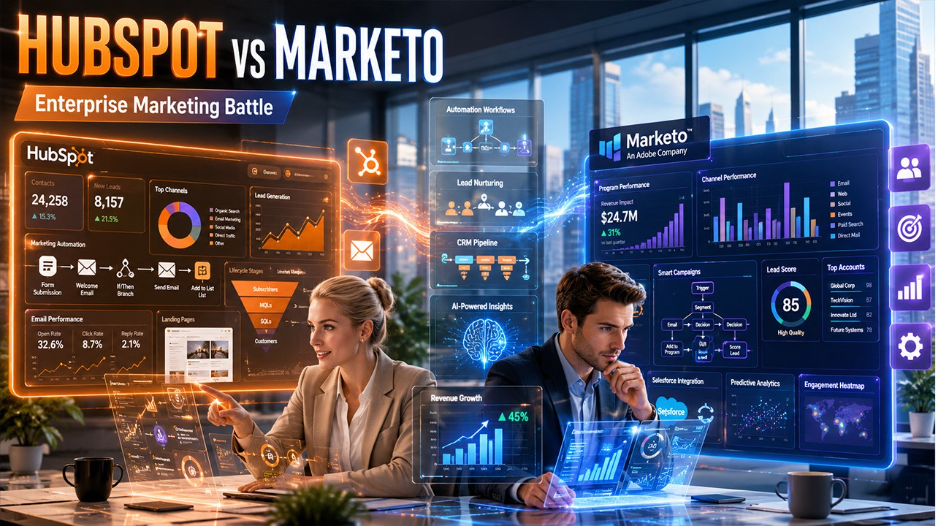

Enterprise marketing teams often reach a decision point where the comparison comes down to HubSpot vs Marketo. The basic features, such as email marketing, lead nurturing, lead scoring, and analytics, are covered by both platforms, and they also offer more advanced features for larger teams. But they do have different approaches to the same issues.
While HubSpot has an all-in-one inbound journey built around their native CRM, Marketo (now Adobe) are known for their enterprise-grade, in-depth automation for complex B2B journeys. The selection of the appropriate option is dependent on team size, technical knowledge, sales cycle complexity and budget.
Let's take a side by side of both HubSpot and Marketo, and see how they compare to each other, and which one is better for your team. Let's first look at both tools in more detail.
Understanding HubSpot and Marketo
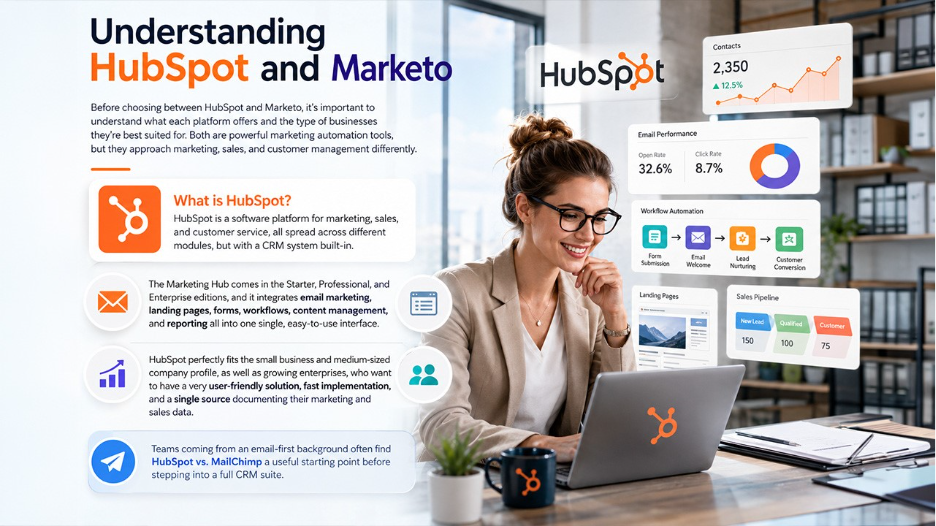
In fact, before coming to the HubSpot vs Marketo battle, it would be wise to know what each software provides and the type of business they are best compatible with. Both are tools for marketing automation, however, they handle marketing, sales, and customer management differently.
What is HubSpot?
HubSpot is a software platform for marketing, sales, and customer service, all spread across different modules, but with a CRM system built-in.
The Marketing Hub comes in the Starter, Professional, and Enterprise editions, and it integrates email marketing, landing pages, forms, workflows, content management, and reporting all into one single, easy-to-use interface.
HubSpot perfectly fits the small business and medium-sized company profile, as well as growing enterprises, who want to have a very user-friendly solution, fast implementation, and a single source documenting their marketing and sales data.
Teams coming from an email-first background often find HubSpot vs. MailChimp a useful starting point before stepping into a full CRM suite.
What is Marketo?
Marketo, established in 2006, is a robust marketing automation software, that excels in lead management, segmentation, and orchestrating campaigns across multiple channels. Their first product was a platform for managing leads, and after a few years, the company evolved into an marketing automation solution for enterprises. Today, after being acquired by Adobe, the system is known as Marketo Engage.
Marketo mainly caters to medium to large B2B companies managing long sales cycles and high-volume campaigns. The platform is widely leveraged for tasks such as lead scoring, lead nurturing, account-based marketing, workflow automation, email marketing, digital advertising, and detailed reporting. Especially, it is highly favored by companies having dedicated marketing operations teams that require advanced segmentation, multi-channel campaign management, seamless Salesforce integration, and revenue-focused analytics.
HubSpot vs Marketo: Quick Comparison Table
| Feature | HubSpot | Marketo |
| Best For | Small to mid-sized businesses | Mid-market and enterprise B2B teams |
| Ease of Use | Beginner-friendly | Steeper learning curve |
| CRM | Built-in CRM | Requires external CRM |
| Automation | Visual workflow builder | Advanced campaign automation |
| Lead Management | Strong | Very advanced |
| Analytics | Easy-to-read reports | Deep revenue analytics |
| Integrations | Wide range of integrations | Strong enterprise integrations |
| Customer Support | Fast chat and phone support | Community and email support |
| Free Trial | Free CRM +14 days free trial available | No free trial |
| Pricing | Lower starting cost | Premium pricing |
HubSpot vs Marketo: A Feature-by-Feature Comparison
The HubSpot vs Marketo battle typically boils down to four things such as, Automation capabilities, reporting, integrations, and usability. Depending on the size and stage of the marketing team, each pillar will have a story to tell.
1. Ease of Use and Onboarding
HubSpot is known for its user-friendly interface and low learning curve. It can take only days to create workflows, forms, and email campaigns for new users, with complimentary training available via HubSpot Academy. Marketo, on the other hand, is more complex to learn, and can be more challenging to operationalize with a marketing operations team or specialist.
Teams that prioritize fast onboarding often find themselves also looking at HubSpot vs Freshsales, since Freshsales targets a similar audience with a sales-first setup.
2. Automation and Customization
HubSpot's personalization and automation tools are also excellent, enabling marketing teams to deliver more personalized experiences to their customers. With personalization tokens and dynamic content, businesses can customize emails, landing pages and campaigns for certain contacts or companies. It also provides rich customer behavior data and customer journey visibility to better connect with customers at various points in the sales cycle with relevant messaging. Along with its visual workflow builder and lead nurturing features, HubSpot is more suitable for teams who specialize in inbound and content marketing.
However, Marketo's strength lies in its enterprise functionality, particularly for complex prospects. It offers sophisticated branching logic and sophisticated lead scoring models and dynamic segmentation that can power highly tailored customer journeys. These features make it particularly ideal for organizations that run larger B2B campaigns, with several touchpoints and longer sales cycles. For teams that need heavier automation without jumping to enterprise pricing, HubSpot vs ActiveCampaign sits in a similar space but goes deeper on the automation side.
3. Reporting and Analytics
One of the important features of any CRM system that enable businesses to gain greater clarity about the performance of their campaigns and customer engagement is reporting and analytics. HubSpot and Marketo offer comprehensive reporting features to help marketers gain visibility into marketing performance, lead activity and the entire buyer journey. These insights help to assess the success of the marketing efforts, understand what needs to be done to improve, and develop a better marketing strategy that is more customer-focused over time.
4. Integrations and Ecosystem
Integrations are crucial when you're picking a B2B marketing platform and within businesses that are already using a number of tools in sales, marketing, and operations. Marketo and HubSpot are both compatible with popular integrations like Salesforce, Microsoft tools, Google apps, webinar software and more. In most cases, integration requirements are crucial for any business or enterprise team that is expanding in size.
HubSpot has over 1,000 native app integrations that are available in the CRM, sales, analytics, and productivity categories. Marketo also integrates widely, especially with Salesforce, which has a comprehensive bi-directional integration, as well as a good API for custom integration. Like most integrations, though, Marketo integrations can require more technical effort. Teams that are implementing more complicated API integrations should consider extra development time and maintenance, particularly when connecting several enterprise systems together.
5. Pricing and Scalability
Price is frequently a key consideration in the HubSpot vs Marketo debate, and it's more than just a monthly subscription price. Implementation, onboarding, training, API usage, database growth, and continuous operational needs are also key factors for businesses to consider.
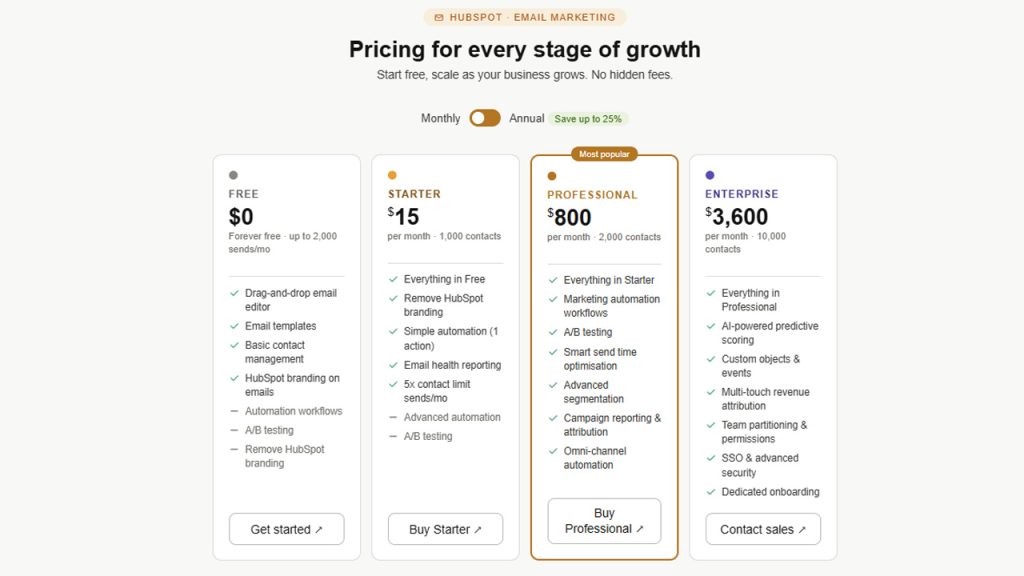
HubSpot offers flexible pricing options, such as its individual hubs or packages of all HubSpot Marketing, Sales, Service and CRM. The Professional suite costs about 1.6K USD for a month and the Enterprise suite begins at 5K USD per month. Depending on the number of contacts, workflows, custom properties and advanced features you've accumulated over the years, prices are calculated. Businesses that are budget-conscious at this stage have a few strong alternatives — HubSpot vs Zoho CRM is one of the more direct cost comparisons you can make at the mid-market level.
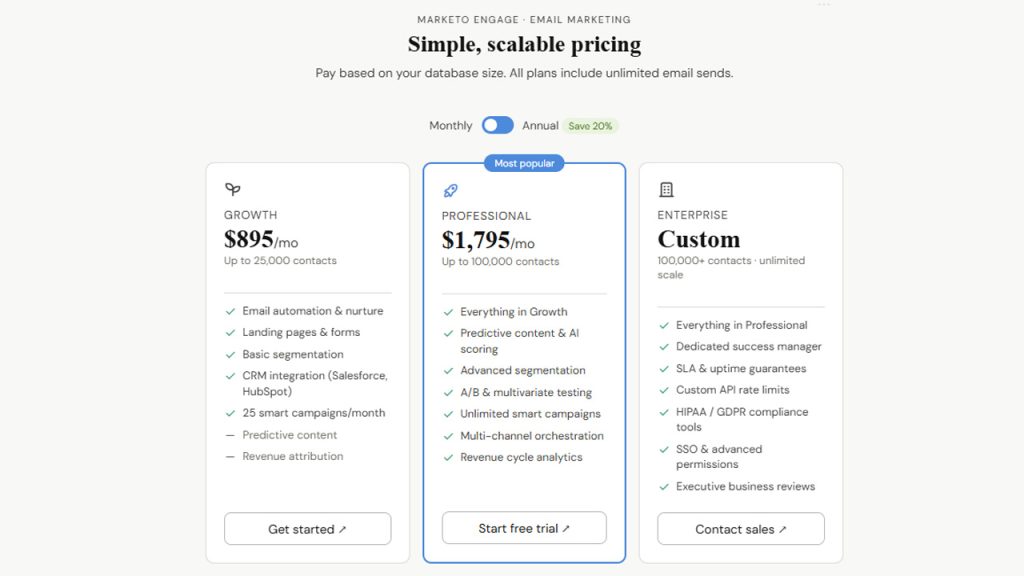
Marketo Engage's pricing structure is tiered from Growth to Select, Prime and Ultimate. API calls, users, custom data objects, records and content assets are some of the factors that impact pricing. The more that is used, the more it will cost. Marketo does not offer a free plan or a public pricing plan, so businesses typically need to contact the sales team for a quote. Marketo is not a free thing or has a public pricing plan, so businesses have to contact the sales team for a custom quote.
When it comes to Marketo, the implementation and scalability can come with a higher initial expense for training, set-up, and marketing operations support. However, it's an appropriate solution for businesses that have a large database and lengthy multi-channel campaigns. However, Marketo typically comes with a higher level of complexity and challenges in terms of implementation and scalability for larger companies or organizations with specific requirements that may require greater flexibility than that of HubSpot.
Also Read - Best HubSpot Alternatives (Compared by Pricing & Features)
Which Platform Fits Your Enterprise? Choosing Between HubSpot and Marketo
Choosing the right platform, when it comes to HubSpot vs Marketo debate totally depends on your business requirements, budget, and team resources. HubSpot is ideal for companies looking for an easy-to-use, all-in-one platform with faster onboarding and strong inbound marketing capabilities. Marketo is better suited for larger B2B organizations that need advanced automation, deep segmentation, and complex campaign management. Both platforms offer strong CRM and marketing features, but the right choice should align with your long-term growth plans and daily workflows. When evaluating either platform, it is also important to consider how CRM marketing automation fits into your broader customer data and engagement strategy.
Frequently Asked Questions : HubSpot vs Marketo
1. Which platform is better for enterprise marketing, HubSpot or Marketo?
In the HubSpot vs Marketo debate, Marketo suits complex B2B enterprises, while HubSpot balances enterprise features with ease of use.
2. Is HubSpot cheaper than Marketo?
Yes, HubSpot is generally more affordable, with free and lower-cost plans, while Marketo starts at higher enterprise-level pricing.
3. Can Marketo and HubSpot be integrated with Salesforce?
Both support Salesforce integration, but Marketo offers deeper enterprise-level sync, while HubSpot covers most mid-market needs well.
4. How long does it take to implement HubSpot vs Marketo?
In the HubSpot vs Marketo comparison, HubSpot deploys faster, while Marketo takes longer due to complex enterprise setup needs.
5. Which platform is better for B2B SaaS companies?
For B2B SaaS, HubSpot suits growing teams, while Marketo fits larger companies with complex journeys and advanced automation needs.