
If you have been looking for a serious software platform, chances are you’ve come across HubSpot vs ActiveCampaign. On the surface, both tools seem to do similar things such as managing contacts, sending emails, and automating tasks. So, what’s the difference?
When you look more closely, it becomes clear that these two are very different tools that are built around two very different priorities. HubSpot was built as a CRM first. Over time, it grew into a full suite covering sales, marketing, and service. ActiveCampaign went the other way; it started as a marketing automation tool and added CRM features later. Same surface, very different foundations.
This blog breaks down HubSpot vs ActiveCampaign across features, pricing, and real-world use cases. By the end, you'll know which one fits your business or whether an open-source alternative might be the smarter move.
HubSpot vs ActiveCampaign: At-a-Glance Comparison
| Feature | HubSpot CRM | ActiveCampaign |
| Primary Focus | CRM + Full Business Suite | Marketing Automation + Email |
| Free Plan | Yes | No (15-day Trial Only) |
| Starting Price | $9/mo (Marketing Starter) | $15/mo (Starter 1,000 contacts) |
| Sales Automation | Advanced (Paid Tiers) | Available as paid add-on |
| Marketing Automation | Advanced (Expensive Tiers) | Advanced (All Paid Plans) |
| AI Capabilities | Breeze Copilot, Breeze AI | AI Automation Builder, Win Probability |
| Email Marketing | Moderate (Free Plan Limited) | Strong across all plans |
| Deliverability Score | 4.0 / 5 | 4.0 / 5 |
| Integrations | 1,500 + apps | 900 + apps |
| Self-Hosting | No | No |
| Data Ownership | Vendor Controlled | Vendor Controlled |
| Best For | Sales + Marketing + Service Teams | Email Marketers and Automation-focused Teams |
What Is HubSpot CRM?
HubSpot is a comprehensive CRM platform where every customer-facing team lives and works from a single, shared system. It supports sales, marketing, customer services and operations; all under one roof. It's divided into Hubs, each handling a specific part of the business.
Key Features of HubSpot
Sales Hub: Manages your pipelines, tracks contacts, handles meeting scheduling, and automates repetitive sales tasks, so your team can focus on selling.
Marketing Hub: Takes care of email campaigns, landing pages, ad tracking, SEO, and lead generation; all from one place.
Service Hub: Your support team's home base. Ticketing, live chat, a knowledge base, and customer surveys live here.
Operations Hub: Keeps your data clean and your workflows synced across different business tools.
Breeze AI: It is HubSpot's AI layer. It helps with email writing, contact enrichment, lead scoring, and forecasting, and it's built into the platform, not a separate add-on.
Free CRM: This one is worth highlighting. It's genuinely free with unlimited users, up to one million contacts, and basic pipeline management. Ther is no time limit.
HubSpot vs Zoho CRM breakdown helps teams see how HubSpot all-in-one approach holds up against another popular CRM suite.
What Is ActiveCampaign?
ActiveCampaign is a marketing automation and email marketing platform built specifically to help businesses engage with their customers at every stage of the buyer journey. It started as an email marketing tool and later evolved into a powerful automation engine with a CRM layer added for sales teams. If HubSpot leads with CRM and expands into marketing, ActiveCampaign leads with automation and reaches into sales.
Key Features of ActiveCampaign
AI Automation Builder: Builds complex, multi-step marketing workflows with AI assistance. It's a genuine time-saver for campaign setup.
Email Marketing: Professionally designed templates, a drag-and-drop builder, and advanced segmentation are available on all paid plans.
Lead and Contact Scoring: Contacts get scored automatically based on their behavior and engagement levels. With this, your sales team always knows what to prioritize.
Win Probability Scoring: Uses predictive analytics to estimate the likelihood of closing a deal, helping teams allocate their effort more effectively.
CRM and Sales Add-on: Provides pipeline management and sales engagement tools as an add-on, available for B2B teams through the Sales Engagement product and for B2C teams through the Pipelines product.
Site and Event Tracking: Monitors how contacts move through your website and triggers follow-ups based on specific actions that they take.
HubSpot vs ActiveCampaign: Comparison of Features
Understanding the differences between HubSpot and ActiveCampaign requires a closer look at how each platform handles the tasks that matter most to growing businesses. Here is a category-by-category breakdown:
Ease of Use
HubSpot is one of the most accessible platforms on the market. It offers a clean interface, guided onboarding, and live chat support from the start. You can customize your CRM dashboard as per your business needs and switch between different hubs naturally without feeling disjointed.
ActiveCampaign is intuitive too, but the sheer depth of its automation features can be overwhelming for new users. The search bar and the structured menu are helpful, but the volume of options can feel dense at times. For teams without a dedicated technical person, HubSpot is the gentler starting point.
Pipeline and Contact Management
Both platforms offer you a visual, drag-and-drop pipeline with customizable stages. HubSpot CRM has more filter options and lets you build reporting dashboards from scratch. It is great for sales managers who want a full view of team performance. That said, the free plan limits you to one pipeline, and Starter gives you two.
ActiveCampaign offers fully customizable pipelines on all CRM-enabled plans, which works well when you're running different products or sales processes at the same time. One frustrating thing is worth noting that it doesn’t support multiple email addresses for the same contact. It can get messy when you're managing complex accounts.
Marketing Automation
This is ActiveCampaign's strongest suit. It offers enterprise-grade automation features such as segmentation, dynamic content, site tracking, split automations and behavior triggers on entry-level plans which is accessible to small and mid-size business plans.
HubSpot CRM software, too, offers automation, but the advanced capabilities are locked behind the Professional plan, which starts at $890 per month for 2,000 contacts. For most growing businesses, that price gap is difficult to ignore, and ActiveCampaign delivers comparable automation depth at a fraction of the cost.
Email Marketing
ActiveCampaign was built for marketers. It offers a broad library of templates, strong segmentation, and a sending limit of ten times your contact list on most plans.
HubSpot's free plan allows up to 2,000 promotional emails per month, though design templates are reserved for paid users. The Marketing Starter plan at $20 per month provides access to templates and increases the send limit. For teams whose primary goal is running sophisticated email campaigns, ActiveCampaign provides more out of the box at the lower price points.
Teams narrowing down purely on email capabilities may compare HubSpot vs MailChimp for additional context.
Email Deliverability
Both platforms score 4.0 out of 5 in independent deliverability assessment. HubSpot offers built-in monitoring, sender reputation scoring, bounce suppression, and IP warmup guidance. ActiveCampaign covers feedback loop data, list cleaning integrations, and dedicated IP support.
Honestly, neither platform has a clear advantage here. Both offer a solid foundation for consistent inbox placement.
Integrations
HubSpot CRM connects with over 1,500 apps through its App Marketplace. It covers everything from e-commerce platforms and CMS tools to analytics software and management apps. Additionally, HubSpot integrations span everything from WhatsApp and Zoom to Stripe and Slack.
ActiveCampaign supports over 900 integrations and handles them well with a solid connectivity to most marketing and sales tools. If you’re running a complex tech stack and need broad connectivity, HubSpot is the ideal option.
Artificial Intelligence
HubSpot’s Breeze Copilot comes with a free plan. It assists with email drafting, contact management, predictive lead scoring, and sales forecasting. This is particularly useful for small businesses that want to integrate AI into their businesses without investing in it.
ActiveCampaign’s AI focuses on automation. AI Automation Builder, Win Probability Scoring, Predictive scoring, and sentiment analysis are pretty useful for teams that are running large campaigns. HubSpot wins on accessibility. ActiveCampaign wins on automation intelligence.
Pricing Plan Comparison: HubSpot vs ActiveCampaign
Pricing is one of the most critical differences between these two platforms, and it is important to understand exactly what you are paying for at each level.
HubSpot CRM Pricing
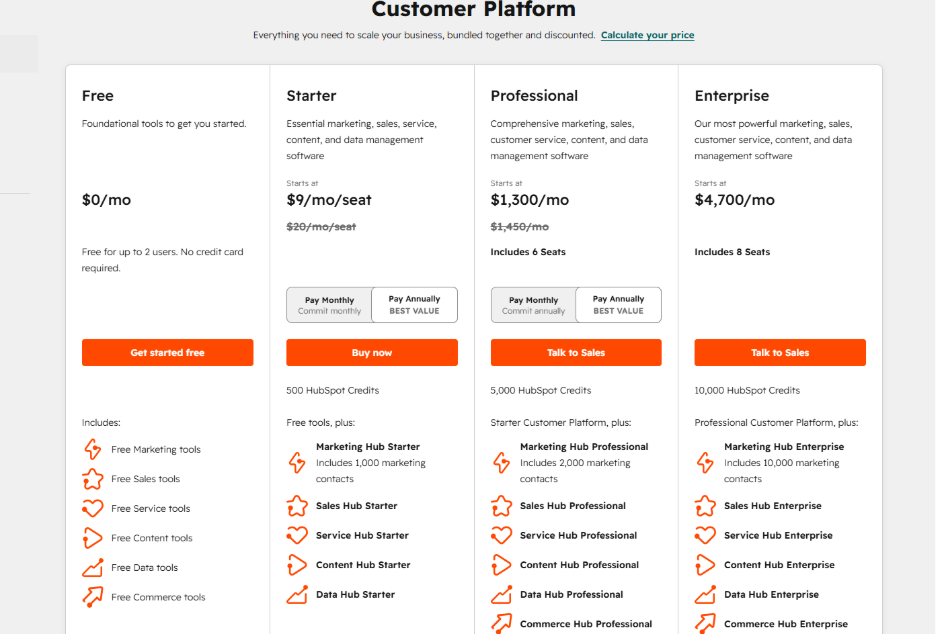
HubSpot's pricing is divided across its different Hubs, and costs can grow quickly depending on which products you need.
ActiveCampaign Pricing
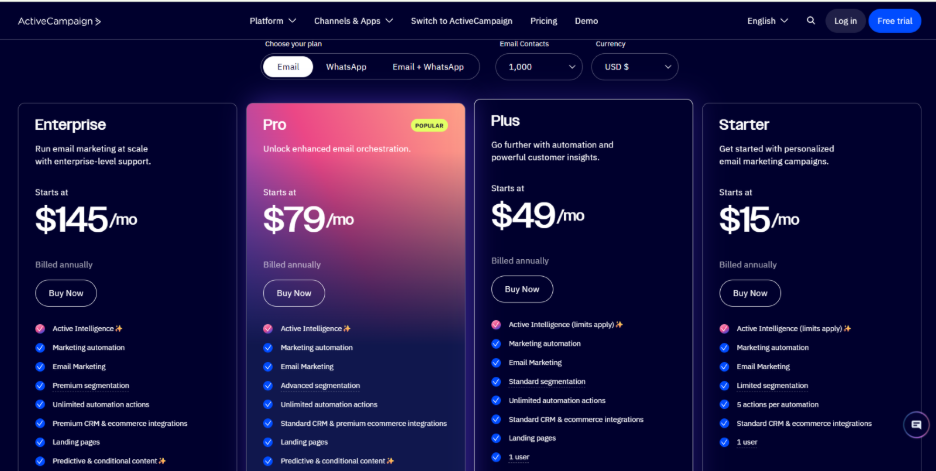
ActiveCampaign recently restructured its plans to separate marketing and sales features. The marketing plans are contact based, with prices scaling as your list grows:
HubSpot vs ActiveCampaign: A Quick Decision Guide
Choosing between these two platforms comes down to understanding which capability your business needs to lead with. Here is a concise guide:
Choose HubSpot CRM If:
- Your business needs a single platform for sales, marketing, and support teams to work together.
- You want to start free and grow into paid features over time.
- A large, diverse integration ecosystem matters to your team.
- You need built-in SEO, content management, and blogging tools alongside your CRM.
- You have the budget for Professional or Enterprise plans.
- AI-assisted CRM features at no extra cost are a priority.
Sales-focused teams also comparing other CRM options may find the HubSpot vs Freshsales breakdown a useful next step.
Choose ActiveCampaign If:
- Your primary focus is advanced email marketing and marketing automation, not CRM management.
- You need enterprise-level automation capabilities without the enterprise price tag.
- Your team runs complex, multi-step campaigns with behavioral triggers and dynamic content.
- Budget efficiency matters and you want strong features without paying for capabilities you will never use.
- You are scaling a contact list and need predictable, transparent pricing as it grows.
Final Thoughts
HubSpot is an ideal choice for those businesses that need a centralized, all-in-one CRM platform to align their sales, marketing, and service operations. It offers a polished interface, a generous free tier, and a huge integration marketplace. Whereas ActiveCampaign is a stronger choice for teams that focus entirely on marketing automation and email marketing and need advanced behavioral triggers without committing to the high costs that HubSpot’s higher tiers demand. v
The comparison between HubSpot vs ActiveCampaign is not about which platform is superior. It is about which discipline your business needs to lead with right now. Assess your team's technical capacity, budget, and growth plans carefully before committing. The best platform is the one that supports not just where your business is today, but where you need it to be tomorrow.
Frequently Asked Questions (FAQs) : HubSpot vs ActiveCampaign
Is HubSpot a CRM or a marketing automation platform?
HubSpot is primarily a CRM platform designed to manage sales, customer relationships, and business operations. It also includes marketing automation, customer service, and content management tools within the same ecosystem.
What is ActiveCampaign mainly used for?
ActiveCampaign is mainly used for email marketing, customer journeys, and advanced marketing automation. It helps businesses automate campaigns, segment audiences, and improve engagement through behavioral triggers.
Which platform is better for small businesses?
ActiveCampaign is often better for small businesses that need affordable email marketing and automation features. HubSpot is better for businesses that want an all-in-one CRM platform with room to scale across departments.
Does HubSpot offer free CRM features?
Yes, HubSpot offers a free CRM plan with contact management, deal pipelines, and basic reporting tools.
Can ActiveCampaign replace a full CRM system?
ActiveCampaign includes CRM and pipeline management tools, but its main strength is marketing automation. If businesses need deep sales, support, and operations management; a full CRM like HubSpot is usually more suitable.