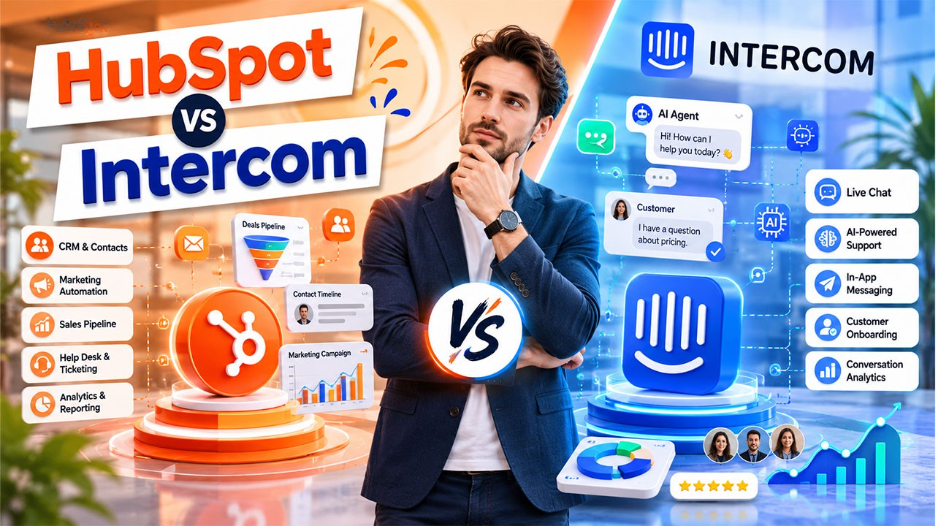

HubSpot vs Intercom - HubSpot is a comprehensive CRM solution integrating sales, marketing, and customer service, while Intercom excels in AI-powered messaging and real-time conversational support. The best choice depends on your requirements. HubSpot is well-suited for complete CRM and multi-channel growth, Intercom for chat-based customer engagement.
- HubSpot is an all-in-one Customer Relationship Management (CRM) and marketing automation platform that is perfect for B2B companies that need a single system to handle marketing, sales, and customer service.
- Intercom is a customer communication and support system that was made especially for real-time messaging, live chat, and AI-assisted conversation support.
- HubSpot offers a very comprehensive CRM and marketing automation platform, so it has a big lead in terms of features and all-in-one value. On the other hand, Intercom's chat user interface, in-app messaging, and proactive customer support are strong points.
- HubSpot's lowest plan costs $12/month while Intercom's entry-level plan starts at $29/seat/month. When you are growing, HubSpot is likely to be the cheaper option.
- If you want a single platform for your GTM team, then go for HubSpot. But if real-time, conversational support is a must for you, then you should make Intercom your choice.
If you have researched customer-facing software, there may be chances that you may have heard of HubSpot and Intercom. At first glance, they might sound the same but the two platforms are quite different. HubSpot's customer platform integrates marketing, sales and customer service features into a single hub that all rely on a single CRM. Intercom's emphasis is mainly on customer interaction and conversations in real time.
This HubSpot vs Intercom comparison article will take a look at the features, pricing, automation, integrations, and usability of both platforms to help businesses select the platform that's best suited for their customer support and growth goals.
What Is HubSpot?

HubSpot was established in 2006 and has emerged as one of the premier CRM platforms, with seamless marketing, sales, and customer service tools. The Service Hub is designed to optimize customer experience by providing personalized customer support, omnichannel help desk, AI-driven self-service, and support management capabilities. The platform also allows for teams to monitor customer activity and gain insights into service trends, while providing ongoing support in an efficient manner.
HubSpot competes with CRM across several categories. For teams weighing pipeline-focused tools, HubSpot vs Monday CRM shows how HubSpot holds up against a more workflow-centric platform.
What Is Intercom?

Intercom is an AI-powered customer service platform that specializes in conversational support and customer engagement, established in 2011. It provides AI agents, multi-channel messaging, shared inboxes, and workflow automation to help optimize customer support. Intercom also utilizes AI-powered analytics to offer customer insights, enabling companies to enhance their customer service, streamline support staff and provide more personalized customer experiences.
HubSpot vs Intercom: A Quick Comparison Table
| Category | HubSpot | Intercom |
| Starting Price | Free plan available | Starts at $29/user/month |
| Best For | Businesses needing CRM + service suite | Messaging-first customer support teams |
| Integrations | 1,000+ integrations | 450+ integrations |
| Customer Support | Chat, email & phone support | Chat & email support |
| Security Features | SSL, SSO, 2FA, encryption | SSO, 2FA, encryption |
| Omnichannel Support | Email, chat, Messenger & more | Strong messaging-focused support |
| AI Capabilities | AI chat & automation | AI-powered support tools |
| CRM Functionality | Fully integrated CRM | Limited CRM capabilities |
| Analytics & Reporting | Advanced reporting & service analytics | Conversation insights & reporting |
| Automation | Ticketing & workflow automation | Automated customer messaging |
| Surveys & Feedback | NPS & custom surveys | Customer feedback tools |
Key Features of HubSpot
Here are the Features of Hubspot CRM
- CRM and Contact Management: One of HubSpot's greatest features is its built-in CRM and contact management system. It automatically records contacts activity, monitors deal stages, and integrates all contact interactions from marketing, sales and service. The CRM is complimentary and significantly more effective coupled with Sales Hub or Marketing Hub.
- HubSpot's Marketing Hub: It is a comprehensive marketing automation platform for email marketing, lead nurturing, ad management, landing pages and multi-step workflows. This is created for demand generation teams who want to have full control over the entire funnel: from awareness to close.
- Live Chat and Messaging: HubSpot also has live Chat and a shared team Inbox in Service Hub which is not quite as sleek and powerful as Intercom's Chat feature. If chat is the main means of communication for teams, then Intercom gets the win. Teams evaluating automation-heavy alternatives might also find HubSpot vs ActiveCampaign useful for understanding where each platform's messaging capabilities diverge.
- Chatbots and AI Automation: HubSpot has integrated Breeze AI throughout its entire platform, including AI-powered content, summarizing emails, and deal intelligence. Chatbot flows in HubSpot are decent but mainly focused on capturing leads and deflecting inquiries through FAQs.
- Help Desk and Ticketing: HubSpot's Service Hub offers a comprehensive ticketing system, with pipeline views, SLA management, customer portals and CSAT surveys. It is a proven help desk platform that's suitable for B2B help desks supporting account-level support.
- Knowledge Base: Both platforms have a self-service knowledge base. HubSpot's knowledge base is seamlessly connected with its chatbot and ticketing platform.
Key Features of Intercom
- Contact Management & CRM: Intercom also keeps contact history, but they're behavior-based. It gathers information on how users are interacting with your product, website or app and applies this to customise the messaging. Don't approach your sales pipeline through the sales lens, but rather the user behavior lens.
- Marketing Automation: The automation of Intercom is more surgical. It is based on messages triggered by behaviour, product tours and targeted in-app campaigns. It's very strong in the product-led segment of the marketing funnel but doesn't quite have the same outbound marketing capabilities provided by HubSpot.
- Live Chat and Messaging: This is where Intercom really shines. Its live chat product offers a minimalist, user-friendly interface, intelligent routing, and AI-driven response suggestions, which are all class-leading. All conversations are consolidated with the Intercom Inbox, across email, chat, and in-app messages.
- Chatbots and AI Automation: Intercom has made it deep into AI, with its own Fin AI Agent that can handle customer queries on its own with the help content. Intercom also has an AI Copilot that helps human agents in real-time conversations. Where the need is to have the AI-powered support resolution feature, Intercom is ahead of the game.
- Help Desk and Ticketing: Replace tickets with conversations in Help Desk and Ticketing. It's great for high-volume consumer support but may not be as organized for teams that use ticket SLAs and workflows. Teams often compare HubSpot with Freshworks. However, HubSpot edges ahead because of its deep CRM connection instead of support features alone.
- Knowledge Base: It is closely integrated with the Fin AI Agent, and articles provide real time training for the AI to answer questions. This compact loop provides Intercom's knowledge base a cutting-edge advantage.
HubSpot vs Intercom: Pricing
HubSpot's product line includes several different pricing tiers, including a free tier that provides access to its basic features. Quickly check out Service Hub pricing and the content of each plan.
- Free: CRM, live chat, basic forms, ticketing tools, up to 5 users, free templates and support.
- Starter: Begins at $15 per user per month and includes Service Hub Starter and the Starter Customer Platform, which includes marketing, sales, content and operations tools.
- Professional: $90/user/month, with a one-time onboarding fee, with automation, service analytics, customer portals, feedback surveys, and up to 300 workflows.
- Enterprise: Starts at $150/user/month with advanced permissions, AI-powered conversation insights, custom records, SSO, and up to 1000 workflows.
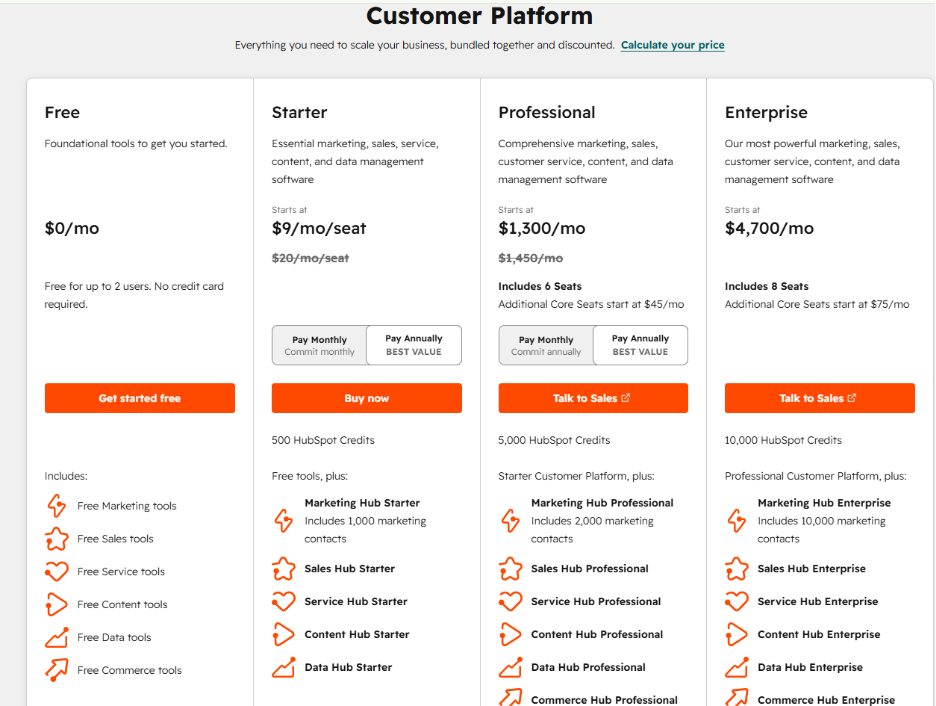
In addition, some of Intercom's AI capabilities are priced according to usage. For instance, when the volume of support is high, businesses can have a variable monthly cost due to the Fin AI resolution charges. Here are the several pricing tiers for Intercom.
Also Read - HubSpot Pricing: Complete Guide to Plans
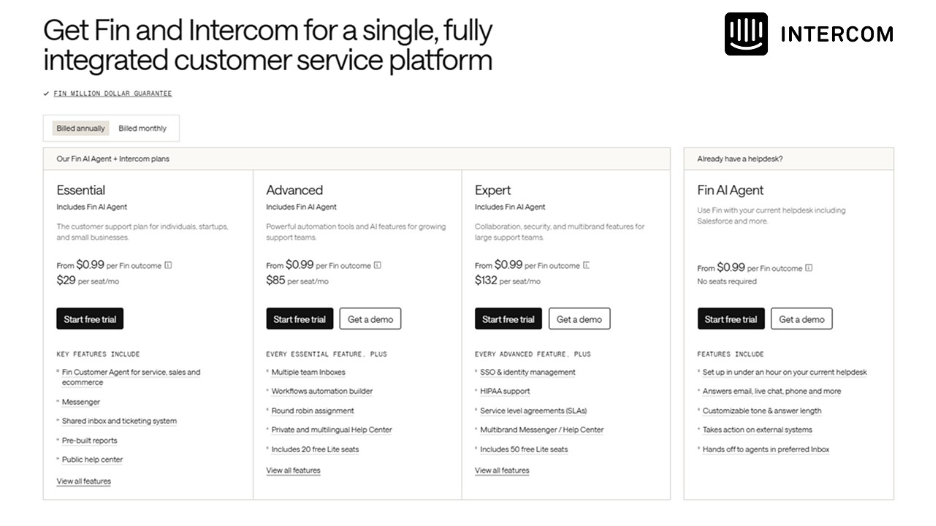
- Essential: Price starts at $29/user/month, features shared inbox, ticketing, Fin AI Agent, Copilot, and automation features.
- Advanced: Starts at $85/user/month, the team inboxes, AI summaries, help centers, and more advanced automation.
- Expert: It starts at $132/user/month and includes single sign-on, workload management, multibrand messaging and advanced dashboards.
HubSpot pricing is more predictable compared to platforms such as Infusionsoft (Keap), where costs can significantly vary as per the contact list size and feature tiers. To know what is better between HubSpot and Keap, check out our dedicated HubSpot Vs Keap.
HubSpot vs Intercom: Integrations
With over 1,000 integrations available on the HubSpot App Marketplace, HubSpot can integrate with Outlook, Gmail, Slack, Google Calendar, Mailchimp, and a variety of other popular platforms. Intercom integrates with more than 450 applications, such as Jira, Salesforce, Google Analytics, Instagram and other customer support and collaboration software.
For teams specifically comparing email marketing stacks, HubSpot vs Mailchimp is worth a look to see where HubSpot's native email tools stand against a dedicated platform.
HubSpot vs Intercom: Security and Compliance
HubSpot has a number of security and privacy controls in place to safeguard customer data, including SSL encryption, single sign-on, two-factor authentication, password-protected pages, and user access controls. The platform also meets compliance needs for companies that process some sensitive information. Similar features to Intercom include data in-transit and at-rest encryption, single sign-on, two factor authentication and advanced levels of permission management. It also gives tools that assist organizations meet regulatory and compliance requirements.
HubSpot vs Intercom: Customer Support
HubSpot offers chat, email, and phone support for Professional and Enterprise customers, and chat + email support for Starter users. It also has a knowledge base, community forum, and video training resources that can help users make the most of the software. Intercom offers customers Chat and email support. Users can also find a help center, community discussions, guides, articles, and free education courses for learning, onboarding.
HubSpot vs Intercom: Which Is Right for Your Business?
There is no single winner. However, the correct decision will be based on your team organization, business model, and main use case.
Choose HubSpot if:
- You want a comprehensive CRM that links marketing, sales, and service data
- Your team is involved in multi-channel demand generation campaigns
- You require clear and predictable pricing for a growing GTM team
- You are in sectors such as B2B SaaS, professional services, real estate, or consulting
- You desire a single platform that can grow with you from a startup to an enterprise
Choose Intercom if:
- Live customer chat and in-app messaging are fundamental to your product experience
- You are a SaaS business with a strong focus on proactive onboarding and user engagement
- You aim for AI-driven support that is capable of independently resolving a high percentage of customer queries
- Your support team manages a large volume of conversations and requires a top-notch inbox UX
- You already have a CRM (e.g., Salesforce or HubSpot) and are looking for a specialized messaging layer
Can Businesses Use Both?
Yes, a lot of SaaS companies operate HubSpot for CRM, marketing, and pipeline management, and Intercom for initial customer conversations and in-app support. The close integration between the two platforms makes this a viable and even a very popular arrangement. Intercom team members can view HubSpot contact information directly in their message center, and new leads obtained via Intercom can be automatically synchronized back to HubSpot.
Final Verdict: HubSpot vs Intercom
So, when it comes to HubSpot vs Intercom, HubSpot is an excellent option for companies that need an all-in-one platform to support marketing, sales, and customer service through one integrated CRM. Intercom would be a good option for companies who mostly work with conversational support, in-app messaging, and AI-based customer engagement. The ideal platform depends on your company's key focus areas, workflow, and growth plan. Lots of rapidly expanding SaaS companies even use HubSpot for CRM management and Intercom for customer interactions to deliver a more seamless customer experience.
Frequently Asked Questions : HubSpot vs Intercom
Is HubSpot better than Intercom for customer service?
HubSpot is the right tool for structured B2B support with ticketing and SLA, whereas Intercom is suitable for real-time SaaS support and AI-based chat.
Can HubSpot and Intercom be integrated together?
Absolutely. HubSpot and Intercom can be integrated without using any third-party apps, allowing CRM data to be synced on a real-time basis so that the team can manage support and customer data jointly.
Which is more affordable in HubSpot vs Intercom?
HubSpot offers more cost-effective solutions, with a free plan available and lower prices for the starter package, while Intercom is generally more expensive due to AI features that require extra payments and the fact that there is no free plan option
Is Intercom good for B2B companies?
Intercom would be the right choice for B2B SaaS support and onboarding while HubSpot is more geared towards handling complicated sales, CRM, and multi-channel marketing requirements.
Does HubSpot have live chat?
Yes. HubSpot does provide live chat for free, chatbots, and the shared inbox feature. However, Intercom offers a more advanced messaging experience.