
HubSpot vs Keap - Adopting the best CRM and marketing automation solution is one of the most critical decisions a business can make. In the debate between HubSpot Vs Keap, both platforms bring good capabilities to the table. However, they cater to entirely different business requirements. Irrespective of whether you own a small business and need a cost-effective and full-funnel solution or an evolving enterprise looking for a scalable solution, this comparison will enable you to make the best decision.
What Is HubSpot?
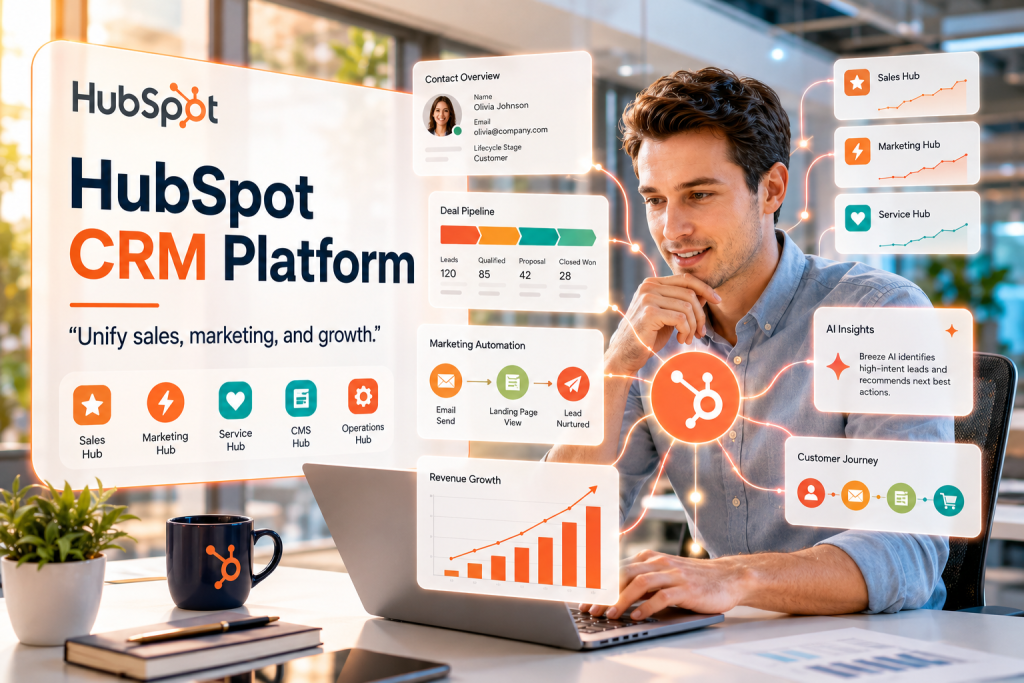
HubSpot is an end-to-end customer platform founded by Brian Halligan and Dharmesh Shah in 2006. It is currently headquartered in Cambridge, Massachusetts. It centralizes marketing, CRM, sales, customer service, and operations into one ecosystem. Its core capabilities exist in:
- Unified reporting and centralized customer data.
- Sophisticated marketing automation and AI-based insights (powered by Breeze AI)
- A modular "Hub" structure including Sales Hub, Marketing Hub, CMS Hub, Service Hub, and Operations Hub.
- A free CRM plan provides support to unlimited users and up to 1,00,000 contacts.
HubSpot is broadly utilized by small-and-medium-businesses, mid-market organizations, and enterprise-based businesses alike. This makes it one of the most flexible solutions in the market today. Businesses frequently compare HubSpot vs Mailchimp to know which one is better suited for their business needs.
What Is Keap (Formerly Infusionsoft)?
In 2001, Keap was founded by brothers Eric Martineau and Scott Martineau, with Clate Mask working as Chief Executive Officer. Named as Infusionsoft Originally, the organization rebranded itself as Keap in 2019 to showcase a wide assortment of product lines mainly targeting small business automation. It is currently headquartered in Chandler, Arizona. The company currently serves a wide customer base of around 26,000 customers.
The main features of Keap involves the following:
1.Email and SMS marketing automation.
2. Contact and lead management
3. Calendar integration and appointment scheduling.
4. Payment processing, invoicing, and quotes.
5. Builder of visual campaign for automated sequences of follow-up.
At its core, Keap is a full-funnel marketing and sales automation solution purpose-built for small businesses and solopreneurs who want to efficiently run operations without recruiting a large team.
HubSpot vs Keap: Head-to-Head Comparison
1. Automation Capabilities
When we compare HubSpot vs Keap in terms of automation, both solutions provide a wide range of powerful features. However, they provide a different level of complexity.
HubSpot delivers enterprise-based marketing automation that covers the complete inbound lifecycle, ranging from content generation and lead generation to attribution of content and multi-channel workflows. Those evaluating workflow depth often look at HubSpot Vs Active Campaign as another benchmark for comparing automation maturity across platforms. Its Breeze AI assistant enables teams to create email copy, blog outlines, landing page content, and customized subject lines within the platform directly. Workflow triggers are based on different factors on lifecycle stages, user behavior, deal changes, and more.
On the other hand, Keap provides a visual campaign builder that is specifically valuable for small businesses. It enables users to:
- Create automated follow-up sequences which is triggered by customer actions.
- Launch SMS and email campaigns with drag-and-drop simplicity.
- Utilize lead capture forms and landing pages with in-built automation.
- Ensure payment reminders and invoice follow-ups automatically.
For businesses that require action-triggered and simple automation without the complexity of enterprise workflows, Keep ensures reliable outcomes with reduced clicks.
Winner: HubSpot for sophisticated automation; Keap for setup speed and simplicity. Businesses comparing HubSpot vs Marketo often use the same criterion of automation depth versus ease of deployment.
2. Ease of Use
HubSpot is broadly recognized for its innovative and clean interface. Its dashboard is neatly organized and users can explore different features, ranging from handling contacts to creating marketing campaigns with minimum onboarding friction. It is widely considered to be one of the most user-convenient solutions in the CRM space.
Keap has made phenomenal progress in enhancing user experience from the start of initial Infusionsoft days. However, the learning curve for the platform is still moderate. It can prove to be tricky for beginners, especially when they are setting up advanced sequences of automation. Keap does render complete onboarding resources, which includes video tutorials, webinars, and a customized implementation package (a one-time cost of $1,500 is needed for all new customers).
Winner: HubSpot for simplicity; Keap provides robust support for the ones who is willing to invest more time in onboarding. Similarly, those evaluating HubSpot vs Freshsales frequently rank ease of use as a deciding factor between the two platforms.
3. Pricing
Pricing is generally the deciding factor in the HubSpot vs Keap (Infusionsoft) comparison. It shapes decisions of businesses with budgetary constraints. Let us look at the pricing plan for each platform.
HubSpot Pricing:
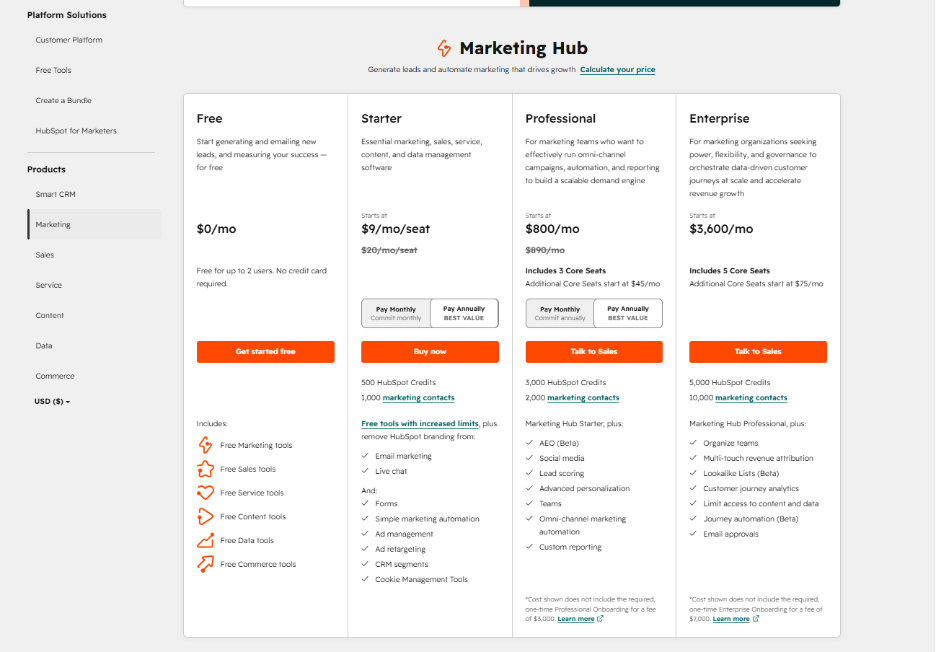
Free CRM: Free Up to 2 users. No credit card is needed.
Starter: Vital features for sales, marketing, service, and data management software. Ranges between $9-$50/month.
Professional: Run omni-channel automation, campaigns, and reporting to create a scalable demand engine. Includes 3 seats. Starts at $800/month.
CRM Suite Enterprise: Higher flexibility, power, and governance to facilitate data-based customer journeys to accelerate revenue growth at scale. Begins at $2,000/month.
The entry-level pricing of HubSpot is quite attractive. However, the costs rise sharply as teams adopt sophisticated features. Upgrading from the Starter tier to Professional tier can see an approximately rise to 18 times the cost.
Keap Pricing:
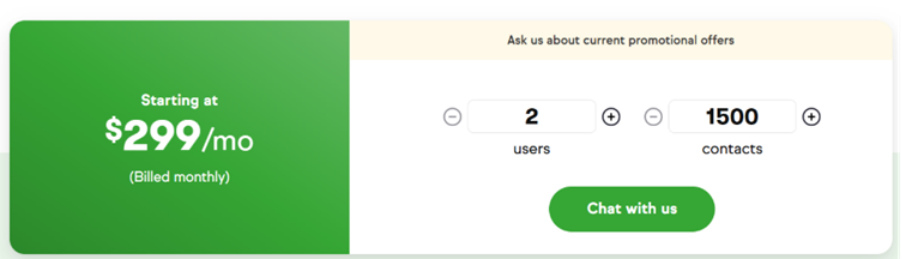
Keap does not keep any pricing tiers. Instead, it allows you to check the pricing plan from its official pricing dashboard. You can provide your number of users and contacts, and it will give you a precise monthly estimate of US dollars.
Winner: The winner is also Keap, providing you with good business value at a reasonable price. However, you can also go to HubSpot if you like its entry-level pricing and flexibility.
4. Integrations
HubSpot provides close to 1,500 native integrations through its App Marketplace, connecting with platforms such as Microsoft Teams, QuickBooks, Salesforce, LinkedIn Sales Navigator, and more. This wide ecosystem makes it a top choice for businesses that operate complex tech stacks. Teams that have also evaluated HubSpot vs Monday CRM often cite integration breadth as a key differentiator between the two.
Also Read - Best HubSpot Integrations
Keap links with 5,000 apps, mainly through Zapier, providing an excellent breadth. Native integrations are fewer than HubSpot’s. However, for workflows in small businesses, the existing connections are more than sufficient. Keap also provides an API for custom integrations.
Winner: HubSpot for ecosystem depth and native integrations; Keap for Zapier-powered flexibility.
5. Analytics and Reporting:
The reporting capabilities of HubSpot are its strongest points. Through an intuitive dashboard, users can monitor email open rates, revenue attribution, website traffic sources, and campaign Return on Investment, all of them from within one dashboard. Customer forecasting tools and reports are available on higher pricing tiers.
The reporting feature of Keap, though it remains function, is quite limited in terms of its scope. It encompasses core campaign metrics and sales. However, it lacks customization and depth available on HubSpot. This is a common limitation noted by users whose workflow needs outgrow the platform.
Winner: The winner is quite clearly HubSpot.
Which Platform You Need to Choose?
The answer entirely depends on the goals, size, and business’ budget.
Go for a HubSpot if you:
- Are an evolving enterprise or mid-market business.
- Requires advanced analytics, multi-channel marketing, and AI-driven tools.
- Need a scalable solution that incorporates across various departments.
- Need detailed reporting and revenue attribution.
Choose Keap if you:
- Operate a small business or work as a solopreneur.
- Require email marketing, CRM, invoicing, and automation in one cost-effective package.
- Go for a straightforward setup with robust customer support.
- Do not need enterprise-based reporting or multi-department workflows.
Also Read - Best HubSpot Alternatives (Compared by Pricing & Features)
Conclusion
Comparing HubSpot vs Keap lets us know that no platform can fulfill all requirements. Ultimately, it boils down to the particular interests, requirements, and priorities of the business. HubSpot has made its name as a feature-packed and scalable platform suitable for all businesses that provide sophisticated automation, long-term growth, and an unmatched integration environment. On the other hand, Keap (formerly Infusionsoft) remains a compelling option for small businesses that require an affordable, focused, and practical automation solution without the overhead of an enterprise platform.
Assess the budget, your team size, and automation needs carefully before choosing a plan. Both platforms provide good trial options, so hands-on testing is always an intelligent first step.
Frequently Asked Questions: HubSpot vs Keap
Q. Who is HubSpot’s biggest competitor?
A- There are many competitors of HubSpot, namely ActiveCampaign, Zendesk, Salesforce, Keap, Pipedrive, Mailchimp, and Zoho.
Q. What are the limitations of HubSpot?
A- In the free version of HubSpot CRM, sales teams can face a few limitations such as limited automation, low ceiling calls and emails, and practically non-existent support.
Q. Which is better in HubSpot Vs Keap comparison?
A- Neither can be considered universally better. HubSpot is mostly preferred for scalable marketing, in-depth analytics, and larger teams. Keap (formerly Infusionsoft) is the right choice for small businesses and solo operators requiring an all-in-one with in-built payments, invoicing, and SMS.
Q. Which is cheaper: HubSpot or Keap?
A- HubSpot offers a free plan, but its pricing grows rapidly as your contact list evolves. Keap does not offer any free plan but offers more predictable pricing for smaller contact sizes.