
If you have spent any time researching CRM software, you already know how quickly the options blur together. Every platform claims to do everything; every comparison chart looks nearly identical, and somehow you end up more confused than when you started.
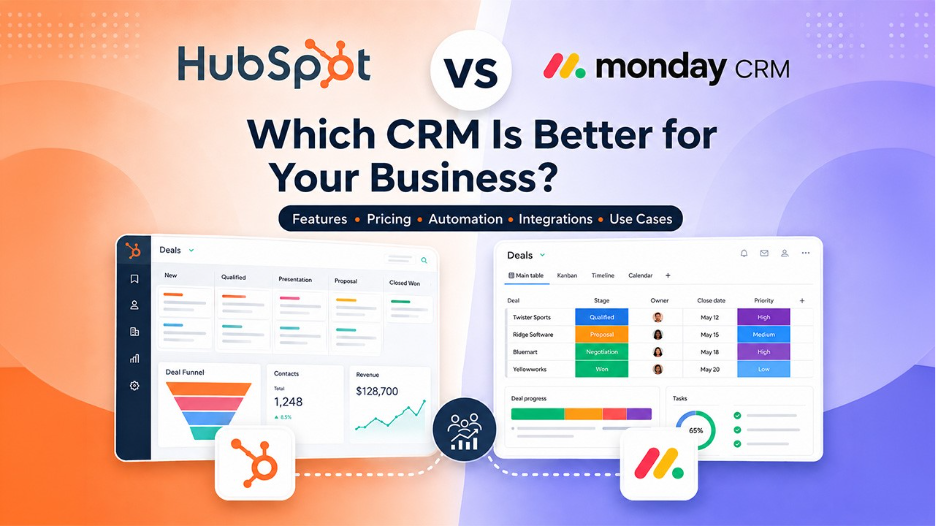
HubSpot vs Monday CRM are two that come up constantly, and on the surface, they look like they are competing for the exact same customer. They offer same clean interfaces, promise of organized pipelines, and integrations list. But spend a week inside both of them and you realize they were built by people solving completely different problems. One was built for teams obsessed with their customers. The other was built for teams obsessed with their workflows. Which one fits your business depends entirely on which of those things keeps you up at night.
This blog breaks down both platforms across their features, pricing, and ideal use cases so you can make a clear and confident decision.
HubSpot vs Monday CRM: At-a-Glance
| Feature | HubSpot CRM | Monday CRM |
| Primary Focus | CRM, Sales, Marketing, Service | Sales CRM with Work Management |
| Free Plan | Yes, generous free tier | Yes, limited free tier |
| Starting Price (Paid) | $15/seat/month | $12/seat/month (min. 3 seats) |
| Sales Pipeline | Advanced, multi-pipeline | Visual, highly customizable |
| Marketing Automation | Advanced (paid tiers) | Basic |
| Project Management | Basic (paid plans only) | Strong, built-in |
| AI Features | Breeze Copilot, predictive scoring | Monday Sidekick AI assistant |
| Integrations | 1,500+ apps | 200+ apps |
| Email Marketing | Yes, built-in | Limited |
| Reporting | Advanced, customizable dashboards | Good, visual dashboards |
| Best For | Sales, marketing, and service teams | Sales teams needing collaboration tools |
What is HubSpot?
HubSpot CRM is a cloud-based platform that brings together sales, marketing, customer service, and operations into one connected system. It is built around the idea that all customer-facing teams should work from a single shared view of the customer. It was originally launched as an inbound marketing tool; but has grown into one of the most comprehensive CRM platforms available today. It offers a free tier that is genuinely functional and paid plans that scale significantly as your business grows.
Key Features of HubSpot
Sales Hub: It handles deal pipelines, contact records, meeting schedules, email sequences, and sales automation. Basically, it supports everything that a sales team needs to stay organized.
Marketing Hub: It covers Email marketing, landing pages, ad tracking, lead capture forms, and campaign management. It's built to help you attract and convert leads.
Service Hub: It offers various customer support tools including help desk ticketing, live chat, a knowledge base, and feedback surveys.
Operations Hub: It also connects your third-party tools to keep your data clean and synced across the organization.
Breeze AI: It is known as HubSpot's AI layer. It assists you in drafting emails, predicting lead scoring, and forecasting sales. It is available across all paid plans.
Free CRM: A permanently free plan with unlimited users, basic pipeline management, contact tracking, and core reporting. There is no trial period or expiry.
What is Monday CRM?
Monday CRM is built on the foundation of Monday.com. It is one of the most popular work management tools available on the market. It was designed specifically for sales teams who want something flexible and visual to effectively manage contacts, track deals, and coordinate work without having to juggle between multiple apps.
Key Features of Monday CRM
Visual Pipeline Management: Yiu can choose form over 27 different views including Kanban, Timeline, Calendar, and Map. Choose how you want to see your pipeline.
Custom Automations: Teams can build sales automations without writing a single line of code. Repetitive tasks such as follow-up reminders, status changes, and client notifications can all be automated.
Contact and Deal Management: It stores all contact details, communication history, and deal activity in one centralized record, keeping the entire team aligned on every account. Everyone stays on the same page.
Pre-Built Templates: It provides a wide library of CRM and sales workflow templates, so you don’t have to start from scratch.
Monday Sidekick AI: It is an AI assistant that handles natural language prompts. It helps you with tasks such as generating sales email content, drafting emails, extracting contact data from third-party web sources, and summarizing deal activity.
Collaboration Tools: It offers built-in features for team collaboration such as task assignments, comment threads, file sharing, and real-time notifications. Sales activity connects directly to what the rest of the team is doing.
HubSpot vs Monday CRM: Feature-by-Feature Comparison
Let's explore in detail what capabilities each CRM offers and how both platforms perform across the area that matters most to sales and business teams:
Ease of Use
HubSpot offers a clean and organized interface. It provides guidance for smooth setup processes and live chat support from the beginning. Depending on your business and team needs, you can easily customize your dashboard and choose what to show your team.
On the other hand, Monday CRM is also at the same level as HubSpot CRM in an intuitive interface. However, it is a bit more visually appealing. Anyone who is already familiar with project management software can easily use its drag-and-drop feature. It offers a minimal learning curve. It is comparatively easier for teams who are not very tech-savvy.
Smaller teams shopping in this space also tend to put HubSpot vs Freshsales on their list, since Freshsales sits in a similar ease-of-use bracket with a stronger sales-first focus.
Pipeline and Contact Management
HubSpot gives you multi-pipeline management with advanced filtering, custom properties, and detailed contact profiles that automatically logs every customer interaction. You can track calls, emails, and meetings without any manual input.
Monday CRM also has a strong and easy-to-navigate visual pipeline. It allows your team to create multiple boards for different sales processes and also link them together for a comprehensive view. However, HubSpot leads in terms of its contact records. It logs more activity automatically and supports multiple email addresses per contact.
Sales and Marketing Automation
This is probably the biggest difference between the two. HubSpot offers advanced marketing automation such as behavioral triggers, dynamic content, lead nurturing sequences, and full campaign management. But there’s a catch. It gatekeeps most of it behind the Professional plan, which starts at $800 per month.
Monday CRM handles sales automation well by covering basics such as Reminders, status updates, and workflow triggers. But it doesn't do marketing automation at all. If you need sales and marketing automation under one roof, HubSpot wins. If you only need sales workflows, Monday CRM does the job at the lowest cost.
Teams that want stronger automation without enterprise pricing often add HubSpot vs ActiveCampaign to their shortlist before making a final call.
Email Marketing
HubSpot has a proper email marketing engine built right in. Even on lower-tier plans, you get templates, a drag-and-drop editor, and basic campaign reporting. While higher-tier plans add segmentation, A/B testing, and personalization. On the other hand, Monday CRM lets you track emails and send them from within the platform. It's not built for running campaigns or managing large-scale email marketing.
If email marketing is a growth channel for your business, HubSpot is the obvious choice here. Teams moving from a standalone email tool often find themselves weighing HubSpot vs. MailChimp first, since that's usually where the gap between email marketing and a full CRM becomes most obvious.
Collaborations and Project Management
Monday CRM has a real advantage in this area. Because it's built on the Monday.com work management platform, it connects CRM activity directly to broader team and project operations. It enables sales teams to manage deals while also handling onboarding tasks, delivery timelines, and internal approvals on the same platform.
HubSpot does have some project management tools, but they're basic and only available on higher-tier plans. For teams where sales and project delivery are closely linked, Monday CRM gives you a more unified experience.
Integrations and AI
HubSpot’s App Marketplace connects with over 1,500 third-party apps. Its Breeze Copilot AI is free to use, and it helps you with email writing, lead scoring, and forecasting.
Monday CRM supports around 200 integrations. It is mostly focused on the tools sales and operations teams use most. Its Sidekick AI is useful but isn't as deeply embedded across the platform as HubSpot's AI layer.
If you work with complex tech stacks or heavy AI-driven workflows, HubSpot is a better option. Larger B2B teams running high-volume campaigns often outgrow both platforms and land on HubSpot vs Marketo as the next logical step.
Also Read - HubSpot Integrations to Streamline Your Business
Pricing Plan Comparison
Pricing is one of the most practical factors in any CRM decision, and it is worth examining closely because both platforms structure their costs differently. Budget-conscious teams evaluating HubSpot at this stage frequently bring HubSpot vs Zoho CRM into the same conversation, since Zoho competes directly on price at the mid-market level.
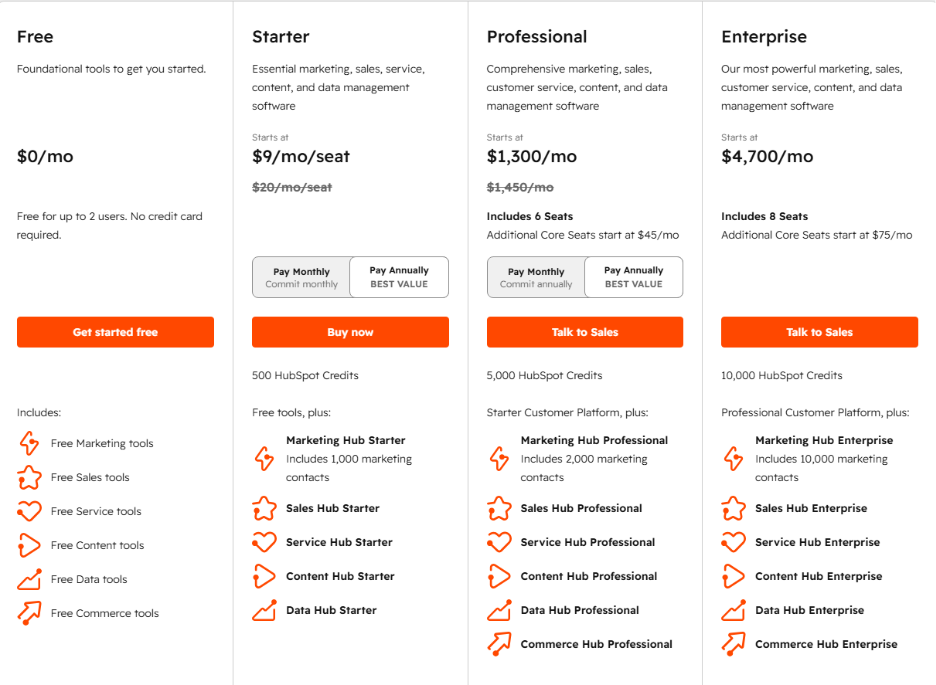
HubSpot Pricing
Get a detailed breakdown of HubSpot Pricing, including free and premium plans across its CRM suite. Compare features, user limits, and subscription costs to choose the plan that aligns with your business goals.
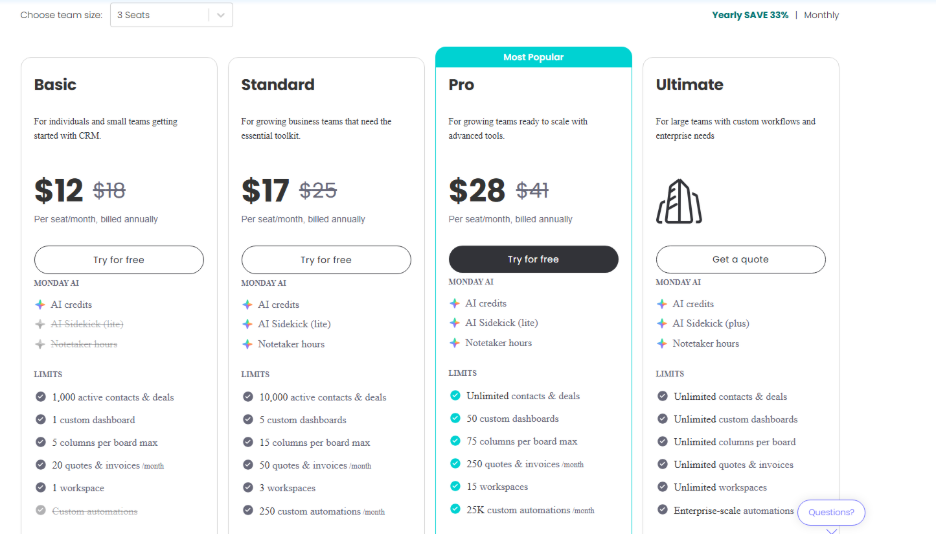
Monday CRM Pricing
Discover monday CRM Pricing and see how its plans scale with your team’s needs. Compare features, automation limits, and customization options before choosing the best package for your workflow.
HubSpot vs Monday CRM: A Quick Decision Guide
It is obvious, but most businesses skip it entirely. Remember that choosing the right platform always comes down to your business and team’s primary needs. Here's how to decide between the two platforms:
Choose HubSpot If:
- You need sales, marketing, and service working together on one platform.
- Email marketing and lead nurturing are central to how you grow.
- You need advanced reporting across multiple departments.
- You have the budget for Professional or Enterprise, including onboarding fees.
- You work with a large and diverse set of third-party tools.
- You want AI features available from day one, even on the free plan.
Choose Monday CRM If:
- Your sales work is closely tied to project management and team collaboration.
- You want something visual, flexible, and fast to set up.
- Budget efficiency matters, and you don't need a built-in marketing suite.
- You're a small or mid-sized team looking for straightforward per-seat pricing.
- Pipeline flexibility matters more than marketing depth.
Final Thoughts
HubSpot CRM is the better fit if your business needs sales, marketing, and service connected in one place especially if email marketing and automation are central to how you generate and convert leads. Whereas Monday CRM is the stronger choice if your team wants something visual, flexible, and collaborative, without the high cost that comes with HubSpot's upper-tier plans.
There is no platform that is objectively better between HubSpot vs Monday CRM. It comes down to how your team works and what you actually need. Before committing to a single platform, assess your budget, your team’s technical capacity, their primary needs, and what you aim to achieve. The ideal platform is the one that supports your business for a long time.
Frequently Asked Questions (FAQs) :HubSpot vs Monday CRM
1. Is HubSpot CRM better than Monday CRM?
It depends on your needs. HubSpot wins on marketing depth, while Monday CRM wins on flexibility and collaboration.
2. Can Monday CRM replace HubSpot for a small business?
Yes, if your team primarily needs pipeline management and project coordination without a built-in marketing suite.
3. Does Monday CRM have email marketing?
No, Monday CRM supports basic email tracking but is not built for running full email marketing campaigns.
4. Is HubSpot CRM free to use?
Yes, HubSpot offers a permanently free plan with unlimited users, basic pipeline management, and contact tracking without any expiry.
5. Which CRM is easier to set up for a non-technical team?
Monday CRM has a slightly lower learning curve, especially for teams who are already familiar with project management tools.