





In 2026, one of the useful and time-efficient ways to extract data from websites is web scraping. Websites are rich in data that can be invaluable for competitor analysis and marketing strategies. You can extract a variety of data from websites such as product details, stock prices, sports statistics, company contacts, etc. If you want to access this data, you have two ways: you can either manually copy and paste the entire details that would take a lot of time and reduce your productivity, or you can use an automation tool to extract the data and store it in your preferred database. In this blog, we will dissect web scraping in detail and understand what it is.
What Is Web Scraping?
Often, web scraping is misspelt as “web scrapping.” It is the process of data extraction from a website. The data is collected and exported into a preferable format for the user. It can be an API, a spreadsheet, or a CRM. There are automated tools that enable users to perform web scrapping. Such tools efficiently scrap data within minutes if not seconds and export it into your chosen database. Some of these tools even allow you to set up custom mapping rules, so you get the data in the right structure. Using cost-effective and quick web scraping tools is beneficial because it can help you save time and improve accuracy in data extraction.
However, web scraping is a more complicated process than it appears. You need a reliable tool that is legally compliant, fulfils your purpose, and is cost-effective. Since each website is different in terms of its structure and the volume of data it holds, web scraping tools also vary with respect to their functionality and features.
Is Web Scraping Legal?
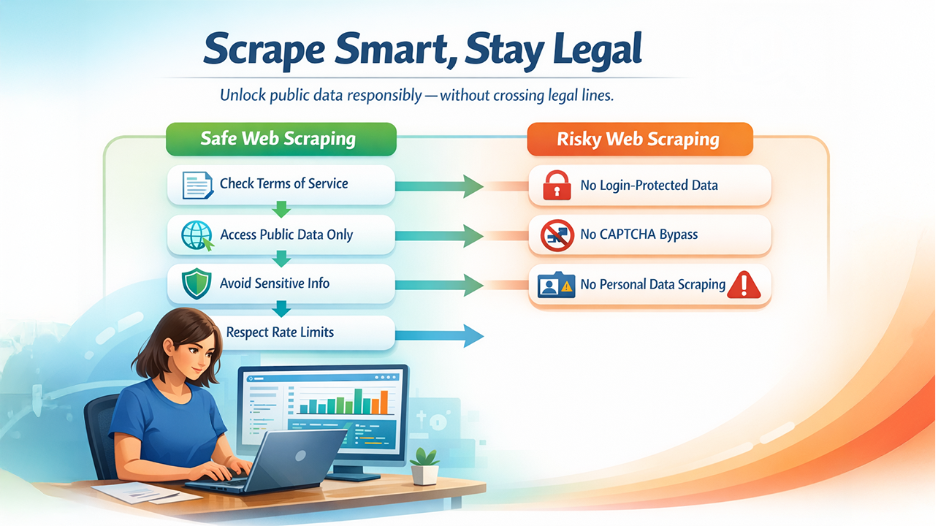
Web scraping takes a very nuanced legal space. In general, there is no legality issues with respect to scraping publicly available data as long as it mirrors what users would anyhow access using a browser. However, there are some specific conditions using which web scraping can cross legal boundaries.
You cannot scrap private data protected by login, circumvent security measures such as CAPTCHAs, or extract personally identifiable information. They can violate laws such as GDPR and Computer Fraud and Abuse Act (CFAA). In addition, violating Terms of Service of a website via web scrapping can expose you to certain legal risks, even if the data is visible publicly.
To be more legally compliant, you need to always review Terms of Service of a website before scrapping, do not collect sensitive or private data, and respect rate limits. When it is responsibly done, web scraping becomes a legally sound and effective method for collecting valuable data.
What Are the Uses of Web Scraping?
Price Intelligence:
One of the biggest use cases of web scraping comes in the context of price intelligence. Extracting price and product data from e-commerce websites, then converting it into intelligence is a significant facet of modern e-commerce companies that want to make smarter marketing or pricing decisions as per data. The benefits of price intelligence and web pricing data are as follows:
- Revenue Optimization
- Dynamic Pricing
- Competitor Tracking
- Product Trend Tracking
- MAP and Brand Compliance
Market Research:
Market research is vital, and the focus should be on the latest market trends and accurate data. With the help of data scraping, you get top-volume, high-quality, and extremely insightful web scraped data of every size and shape. It is fueling business intelligence and market analysis across the world. Let us why marketers choose web scraping for market research:
- Market pricing
- Market trend analysis
- Optimizing entry point
- Development and research
- Competitor Tracking
Read More: One of the tools that can help you in your market research is Analytical CRM tools.
Alternative Data for Finance:
Find suitable investors and give them market and financial insights powered by web scraping data tailored specifically for them. The process of decision-making for businesses has never been informed and data driven. The leading organizations across the world have started to rely on web scraped data increasingly given its tremendous strategic value:
- Estimating Company Fundamentals
- Extracting Insights from SEC Filings
- Public Sentiment Integrations
- News Tracking
News and Content Monitoring:
Irrespective of your niche, as a business, you should remain up to data with what is being said about you in the media and major stories that directly impact your industries. Whether you are a firm that relies on timely news analysis, or an emerging company investing in PR, or a startup tracking industry trends, web scraping is the ultimate solution for you. It helps you track, aggregate, and parse the most vital stories from your industry. Here is how scraping data from the web can help you:
- Competitor Tracking
- Investment Decision Making
- Online Public Sentiment Analysis
- Sentiment Analysis
- Political Campaigns
Lead Generation:
Lead generation is one of the most important marketing/sales operations for different businesses. According to the 2026 HubSpot Report, 30% marketers feel that generating leads is one of the top challenges. However, 56% marketers report that generating leads is now easier than it was 10 years ago. And one of the smart solutions that has transformed lead generation in 2026 is web data scraping.
Read More: If you need a smart solution to extract data from emails and store it in your SuiteCRM or SugarCRM, you can use an extension called SuiteCRM Email to Lead.
Real Estate:
The online transformation of real estate in the last two decades has disrupted the industry, forcing old players to adjust quickly and at the same time, it has introduced new and powerful firms. By integrating web-scrapped data into routine business, brokerages and agents can safeguard themselves from top-down digital competition and make data-driven decisions within the real estate industry.
- Tracking Vacancy Rates
- Appraising Property Value
- Estimating Rental Yields
- Understanding Market Direction
How Do Web Scrapers Work?
The way automated web scrapers work is extremely simple:
- First, web scrapers are provided with one or more URLs to load.
- The scraper then loads the complete HTML code of the given URLs.
- Most of the advanced automated web scraper tools will render the complete website, including JavaScript and CSS elements.
- Then, the scraper will then either scrap the entire data on the page or specific data as defined by the user.
- Ideally, the user chooses a specialized tool to extract specific information from the page. For example, Ultimate Email Finder of ExtractMails allows users to extract emails from a particular URL, website, or multiple websites at once.
- Then, finally, the tool provides the required data in the format as preferred by the user.
- Most web scrapers will output the data to an Excel or CSV file. However, there are also advanced options that will provide support to other formats such as JSON, which can be utilized for an API.
Different Types of Web Scrapers
The functionality of web scrapers can differ on a case-by-case basis. For the sake of simplicity, let us break it down into 4 categories:
- Pre-built or Self-built
- Browser Extension Vs Software
- User Interface
- Local vs Cloud
Pre-built Vs Self-built:
Just as it is possible for someone to create their own website, people can build their own web scrapers as well. However, the tools available to you to create your web scraper still need some advanced knowledge of programming. The overall scope of this knowledge also rises based on the number of features you would want your scraper to have.
On the other hand, there are diverse pre-developed web scrapers that you can easily download and use instantly. In some of these off-the-shelf scrapers, you might get some advanced functionalities such as JSON, scrape scheduling, Google Sheets exports, and more.
Browser Extension Vs Software:
Generally, web scrapers come in two main forms: computer software or browser extensions.
Browser extensions can be defined as app-like programs that can be included in your browsers like Firefox or Google Chrome. A few popular browser extensions involve ad blockers, themes, messaging extensions, and more. Users generally prefer web browsers because they are easy to run and can be added right into your browser.
However, a lot of these browser-based extensions are limited because they live in your browser. This means they will not have any advanced features that would require the tool to work outside the scope of the browser. For instance, IP Rotation would be impossible in this kind of rotation.
On the other hand, you would have to download web-scrapping software and store it natively into your system. The downside is they are slightly more complex than browser extensions, but they make up for it by offering advanced features.
User Interface:
The interface of these scrappers can vary greatly. For instance, a few of the web scraping tools can run with minimum UI and command line. Some users consider it to be confusing and unintuitive. On the other hand, you will find web scrapers with a complete user interface where the user interface is completely rendered for the user to select the data they want to scrape. Such web scrapers are often simpler to work with. Even users with limited technical knowledge can work with it.
Local Vs Cloud:
Local web scrappers will work on your computer through its internet connection and resources. This implies that if your web scraper has utilization of RAM or CPU, your computer can become slow as your scrape runs. With a long list of scraping tasks, this can put your computer out of commission for hours. In addition, if your scraper is set to operate on a large volume of URLs (like product pages), it can have an impact on the data caps of your ISP.
Cloud-based web scrappers operate on an offsite server, which is generally provided by the company that created the scraper itself. This means that resources of your company are freed up while you run scrapers and collect data. You can then work on other tasks and be notified once you are ready to export your scrape.
This enables simple integration of sophisticated features like IP rotation. This can help you save your scraper from being blocked by different websites because of the scraping activity.
Conclusion
Web scraping has become a crucial tool for organizations looking for a competitive edge via data-backed decisions. From market research and price intelligence to real estate and lead generation, its apps cover essentially every industry. Selecting the best scraper, whether it is local or cloud-based, or custom or pre-built, minimum or full UI, depends on your specific requirements and technical capacity. When they are responsibly practiced with legal compliance, web scraping can be highly useful for you, giving you access to a top-volume of accurate and valuable data. Such data can help you in your strategic planning and can maximize your productivity in 2026.