






Product management is a structured practice that guides the lifecycle of a product through planning, research, development, product launch, support, and optimization to create products that align with business goals and meet customer requirements. It refers to both a practice and a function executed by product managers who focus on market demands and user experience. Contrary to project managers who create daily workflows for creating a product, product managers focus on the overall vision and strategy of a specific product.
In creating a strategy for a product, product managers have to work in tandem with cross-functional teams that include business analysts, teams, developers, UX designers, sales teams, and marketers. A product management strategy involves carrying out market research, creating a roadmap for the product, collaborating with development teams and other relevant stakeholders, and integrating customer feedback through product updates.
Product management emphasizes customer experience and positions positive user feedback as an important metric for a successful product.
What Does a Product Manager Do?

Product managers strategize and supervise the process of product development and remain engaged throughout the lifecycle of a product, playing an important role in product lifecycle management. The product details and scope depend on the enterprise’s vision and goals and the complexity of the product. However, collaboration across different teams through the entirety of the process, from ideation to release, as well as optimization. It is a significant component in the majority of scenarios.
The key responsibilities of a product manager are as follows:
- Carrying out market-research
- Creating a product vision
- Cross-team collaboration on product development
- Post-launch Product Optimization
Conduct Market Research
An in-depth analysis of customer surveys, competitor data, focus groups, and internal data from marketing and sales teams to aid in guiding the development of the product. Product managers remain up to date with the present-day business trends and technological developments by reading newspapers, blogs, reports, and news articles from reputable sources. New features or products are created to address the technological gaps in the market, address the pain points of the customers, and improve what the competitors are doing already. Researching into what is successful and what is not is also an important aspect of making this possible.
Create Product Vision
With knowledge and insights gained from market and product research, product managers create a long-term vision for the product. Product managers need to have the creativity to understand the patterns that shape market developments and how a certain product fits into the enterprise’s future. In creating a vision for the product, product managers also take into account how the product interacts with the available services or products. They ensure that the business offerings are consistent with the mission and objectives of the enterprise.
Collaborate on Product Development
Product managers work alongside developers to ensure that the product features align with the customer and business requirements. Product managers work as a bridge between distinct departments, including development teams, business teams, and marketing and sales teams.
Throughout the process of development, they advocate for characteristics that enhance the customer experience and ensure that the stakeholders are in alignment. Product managers are involved in both back-end and front-end development, meaning they create strategies for both the technical aspects, product design, and UX elements. Product managers help in negotiating and balancing numerous factors such as available resources, budget, release dates, and stakeholder input throughout the process of development.
Optimize Products After the Launch
The process of product development does not end once the product has been launched, nor does with the involvement of the product. When a product arrives in the market, product managers have numerous responsibilities that help in enhancing the product, managing its promotion, and performance. Notably, product managers help in collecting and assessing performance analytics and user feedback to recognize optimization opportunities. They also coordinate with QA teams for product testing and identify bugs that might trigger issues or outages for users.
Also Read: Production management software: A practical overview
What are Product Management Tools and Key Features
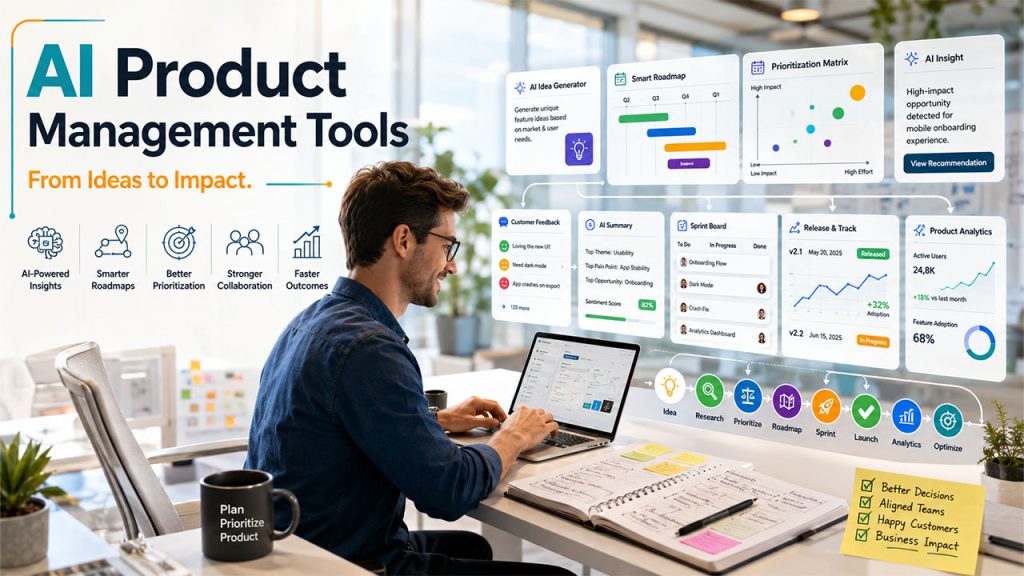
Product management tools are software solutions that aid product managers in planning, prioritizing, and implementing work across the complete product lifecycle, from capturing ideas to release and post-launch analysis. Instead of monitoring needs, roadmaps, and feedback across chat threads and scattered spreadsheets, such platforms simplify the workflows in a single place so that teams can move from strategy to delivery without losing context.
Modern product management tools typically fall into a few categories depending on where they sit in the workflow:
- Road mapping platforms – Group initiatives by theme, visualize timelines, and create audience-specific views (high-level for executives, detailed engineering).
- Discovery and Feedback Tools- Centralize customer input from sales calls, support tickets, and user interviews into a searchable and single repository.
- Prioritization Frameworks – Leverage scoring models, impact-versus-effort matrix, and compared and graded factors to push decisions beyond gut instinct.
- Monitoring and Execution Tools – Tether roadmaps for managing backlogs, sprint planning, and release tracking so plans remain associated with actual delivery work.
- Analytics platforms – Keep track of user behavior, feature adoption, and engagement metrics to reduce the loop between what shipped and what is working.
Here are the important characteristics to look for in a product management solution:
- Centralized Input Collection – Centralizes stakeholders, customers, and internal team feedback into a single place instead of chat messages or email threads.
- Roadmap Visualization – Clearly display strategy and goals, with space for adjustments as priorities evolve.
- Goal Monitoring and OKR – Connects key results and objectives to roadmap items so teams can track progress against business outcomes.
- Sprint and Backlog Integration- Tethers strategic planning to the daily engineering work, moving it forward.
- Capacity planning – Ensures real-time allocation so workloads remain manageable and projects do not fall behind.
- AI-assisted workflows – Greatly common in 2026 platforms, providing support to tasks such as drafting needs, summarizing feedback, and surfacing prioritization insights.
- Integrations – Tethers with design, engineering, and communication tools like Slack, Jira, Figma, and GitHub to ensure that the work remains synchronized across teams.
When assessing product management tools, most product operations professionals suggest keeping the tool stack as small as possible, since a well-integrated and smaller set of tools often outperforms a fragmented or larger one. The best combination depends on the size of the team, the maturity of the product, and how closely the product work needs to connect with engineering execution.
Important Factors That Drive Product Management Success
Product managers depend on the frameworks to ensure structured discovery and delivery. Such approaches aid teams in emphasizing work, verifying assumptions, and shipping quickly without compromising quality.
The right framework depends on the maturity of the team, organizational constraints, and product stage. Here are a few frameworks that are worth knowing:
- Agile: Creates products through repeated development cycles and consistent input from stakeholders and users. Teams work in the form of short sprints, reassess priorities consistently, and adjust based on their learnings.
- Scrum: A specific implementation of Agile that leverages defined roles (Product Owner, Scrum Master), ceremonies (retrospectives, standups), and artifacts (burndown charts, sprint backlogs) to organize work.
- Kanban: Visualized work as it moves through stages, restricting work in progress to avoid bottlenecks. This framework is quite effective for teams managing consistent streams of work instead of fixed sprints.
Jira Product Discovery provides support to such frameworks by offering flexible workflows and views that adjust to the working of your team. Irrespective of whether you are implementing Scrum sprints or handling a consistent flow of feature requests, you can set up the tool to align with the process instead of forcing your team into rigid templates.
What Are Different Career Paths in Product Management?
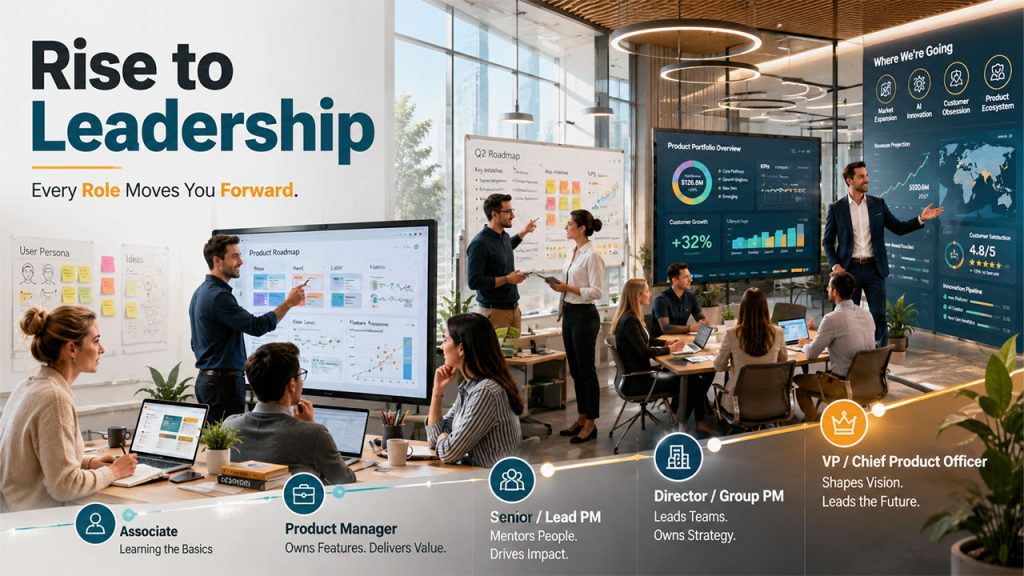
Product management provides distinct career trajectories as per the interests and strengths. Prevalent paths are as follows:
- Junior PM or Associate Product Manager: Understand the fundamentals while providing support to the senior team members.
- Product Managers: Own particular products, features, or problem areas.
- Lead PMs or Senior Product Managers: Mentor junior PMs or take on larger product areas.
- Director or Group Product Manager: Supervise different products or product managers.
- Chief Product Officer or VP of Product: Shape product strategy at the level of the organization.
- Specialist Roles: Emphasize areas such as product marketing, product operations, growth, strategy, or product management tools that aid teams in strategizing, prioritizing, or scaling their work.
Product Management Vs Project Management
Product managers closely work with project managers during the process of product development. They set the initiatives that a business undertakes to build new products and optimize the present ones. However, assigning tasks or tracking daily work is not the job of the product manager. It is the job of the project manager.
A project manager takes on the roadmap built by the project manager and ensures that every project has the resources, personnel, and support to complete the project on time. Project managers set up deadlines and track them to ensure that the delivery of each project is on time. Project managers can aid product managers in communicating data on evolving priorities and goals so that the entire team is on the same page.
Product Management vs. Project Management
| Aspect | Product Management | Project Management |
|---|---|---|
| Main Focus | Overall strategy and vision for a particular product | Routine workflows and implementation of tasks required to create the product |
| Core Responsibility | Establishes the initiatives a business undertakes to create new products and optimize the present ones. | Manages the roadmap created by the product manager and ascertains appropriate personnel, resources, and support in proper place. |
| Time Horizon | Long-term lifecycle and product vision | Delivery timelines and deadlines for individual projects. |
| Key Activities | Product vision, market research, post-launch optimization, cross-team collaboration | Deadline tracking, task assignment, and resource coordination |
| Success Metric | Product which fits market and customer experience. | On-budget and on-time delivery of project. |
| Relationship | Communicates changing goals and priorities to project managers. | Manages the roadmap created by the product manager and ascertains appropriate personnel, resources, and support in the proper place. |
Conclusion
Product management centralizes research, strategy, and cross-functional collaboration to create products that align with business goals and customer requirements. From market research and vision-setting to selecting the right frameworks and platforms, product managers oversee a product throughout its complete lifecycle while closely working with project managers to ensure that the execution remains on track. Irrespective of whether you are beginning as a Junior PM or going for a VP of a product role, success boils down to remaining close to customer feedback, selecting a well-integrated and lean tool stack, and adjusting frameworks such as Scrum, Agile, or Kanban to align with the maturity and workflow of your team.