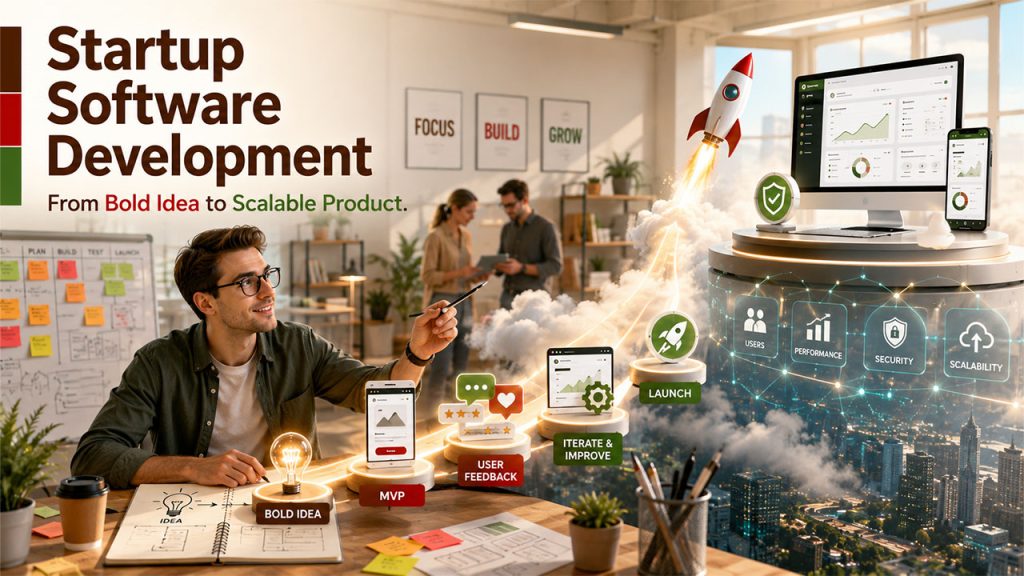






Every startup founder hears the same advice from people around them, which is to move fast. It's true that speed matters when you’re racing against a shrinking bank balance and competitors who are just as motivated to move forward. However, nobody tells you that moving fast without any structure has its risks. Software development for startups isn't really about choosing between speed and quality. It's about knowing exactly what to build, focusing on building only that, and staying ready to change course the moment reality tells you something different.
That tension, between moving quickly and moving wisely, sits at the center of almost every early-stage tech company. Let's see how you can actually manage it.
What Is Software Development for Startups?
Software development for startups is the process where you turn a business idea into a working product. However, in this process, you face a very different set of constraints than a large organization faces. You have a small team, limited budget, and very little time to prove that your idea will work.
Good software is essential for a startup. It is the very foundation on which an entrepreneur builds. It solves a specific customer problem, helps the company stand out from the crowd, and allows the team to test and improve the product based on real user feedback instead of just guesswork.
In its early days, the startup audience and their needs keep changing, so it is imperative for software to be flexible enough to adjust to rapid changes without falling apart. This is also where custom software development really earns its value over generic, off-the-shelf tools.
The Role of Software Development in Startup Success
Strong software does more than power your product; it shapes how your startup grows, competes, and earns customer trust.
- Stand Out with a Unique Product: Anyone can have an idea, but having an idea is not enough. Well-built software is what can actually bring that idea to life in a way users prefer it over other alternatives.
- Faster Feedback Loop: Agile development allows startups to launch quickly. They can collect real user input and adjust before a competitor gets there first. Staying aware of current software development trends also helps startups make smarter technology choices early on.
- Better User Experience: No matter how brilliant your idea is, it’ll lose to a competitor who has a smoother and more intuitive product. So, keep usability in mind.
- Improved Operational Efficiency: Good software automates repetitive tasks, which frees up a small team so that they can focus on work that actually needs human attention.
- Secure Software Development: Startups that handle user data need to build with strong security and compliance in mind from day one, not as a fix after something goes wrong.
How to Approach Software Development for Startups Effectively

Getting this right takes more than good intentions. It takes a structured, deliberate approach. Here's how that generally plays out:
- Define Clear Product Goals: Before you start writing a single line of code, define clearly what the software actually needs to accomplish and how it supports your business goals. To do this, talk to your real users about what they want; don’t just assume. This step matters even more in app development for startups, where every early decision affects budget and speed.
- Manage Budget and Resources Wisely: Don't leave room for any surprises. Plan your upfront budget, stick to it, and prevent anything that can drain the company’s resources.
- Build the Right Software Development Team: You need people who understand the tools and technologies your product depends on, not just who can code. A small, skilled team almost always outperforms a large, mismatched one.
- Adopt an Agile Development Approach: Start by focusing on delivering a Minimum Viable Product first. Launch it, assess real user feedback, and refine it. This is also where investing early in solid UI/UX design pays off.
- Build for Scalability and Security: Even if your target audience is 100 people, build architecture that doesn’t collapse when you hit ten thousand. Treat security is an essential part of the startup plan, not an afterthought.
- Prioritize Testing and Quality Assurance: A mix of automated and manual testing catches problems before your users do, which matters enormously when your reputation is still being built.
- Plan for Launch, Support, and Continuous Improvement: A good launch strategy covers marketing, onboarding, and PR, but the work doesn't stop there. Ongoing support after launch is what keeps small issues from turning into major ones. Choosing the right deployment strategies also plays a big role in how smoothly that launch actually goes.
Key Benefits of Software Development for Startups
When approached strategically, software development creates long-term advantages that extend far beyond launching a product.
- Competitive Market Advantage: If there is a custom software is built to target your specific audience, your startup will stand out in a crowded market instead of getting buried in it, which people won’t even notice.
- Full Product Ownership and Control: Owning your own software, including its intellectual property, gives you full control over its direction and real long-term value as your company grows.
- Smarter Decisions with Customer Insights: Software’s built-in analytics let you understand your user behavior instead of shooting arrows in the dark. This helps you make sharper and more informed decisions.
- Seamless Integration and Future Compatibility: Software that is designed to work well with your existing systems and can adapt to future technology helps you move forward without getting stuck with something that will be replaced in a year or two.
- Reduced Costs with Efficient Development: Options like offshore development can give startups access to skilled talent at a more manageable cost, which matters a lot when every dollar is doing double duty.
Common Software Development Mistakes Startups Should Avoid
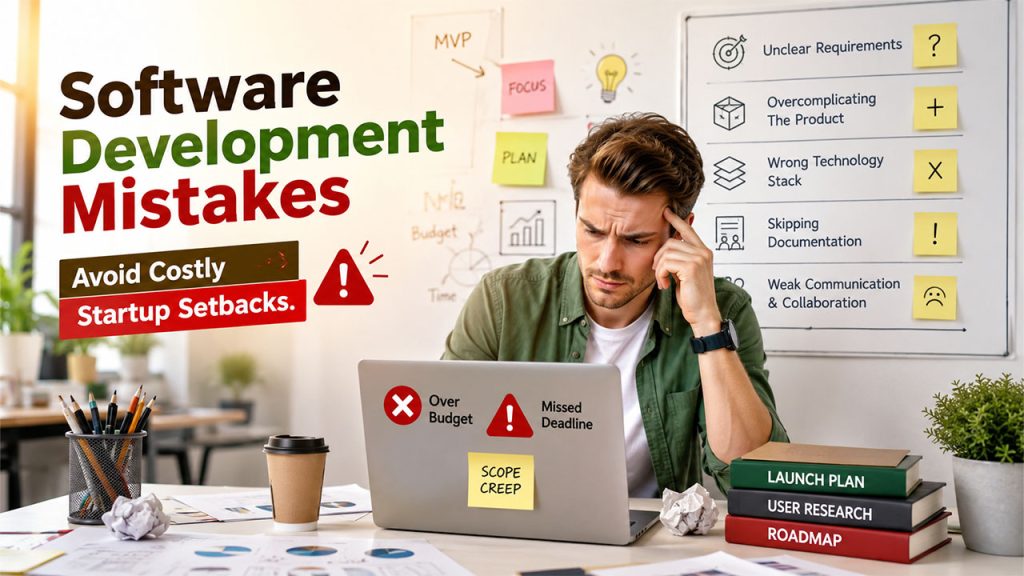
Many startup setbacks are avoidable when you recognize these common development mistakes before they become costly problems.
- Unclear or Changing Requirements: Without clarity of what you are building will lead to blown budgets, missed deadlines, and missed opportunities. Clearly outline your goals, plans, and strategies before starting development. If you keep changing directions mid-project, it’ll make things worse, not better.
- Overcomplicating the Product: Do not overload with features. A lot of founders try to launch with every possible feature they can think of, which dramatically fails. In contrast, a focused MVP with core functionality performs far better. Adding more features in initial stages means inviting more bugs, costs, and a longer road to launch.
- Choosing Wrong Technology Stack: Picking tools that don't fit your project's current or future needs can box you into an expensive rebuild down the line.
- Skipping Documentation: You might skip this entirely or forget to jot things down in the moment because of other more important tasks. But poor documentation makes onboarding members and maintaining the product far harder than it needs to be. It’ll take time and energy to explain everything from scratch to each new person.
- Weak Communication & Collaboration: This becomes especially costly with offshore or remote teams, where miscommunication can cause a lack of teamwork, and a small misunderstanding can quietly turn into weeks of wasted work.
It is worth noting that changing strategies or products doesn’t necessarily classify as a failure. Some of the most well-known products today, like Instagram or Slack, aren’t what they started as. Their team figured out what their users wanted and made changes accordingly. The startups that survive tend to be the ones willing to listen and change course when the evidence tells them to.
Software Development Best Practices for Startups
Following proven development practices helps startups build reliable products while staying flexible enough to grow and adapt.
- Establish a clear vision from the outset and make sure your development goals actually align with your broader business strategy.
- Design with the user in mind at every stage. Collect user feedback and refine strategy or product accordingly rather than just assuming things on your own.
- Use clear roadmaps, defined milestones, and realistic deadlines that the team can actually meet to manage the project effectively.
- Use analytics and monitor performance continuously to keep an eye on how things are moving forward and catch immediately when something seems off.
- Hire developers based on both technical skills and softer qualities like adaptability, communication, and cultural fit, especially if you're working with an offshore or remote team.
Conclusion
Software development for startups isn't about picking between fast and careful. It's about building with intention, staying close to your users, and being honest with yourself when something isn't working. The startups that make it aren't necessarily the ones with the flashiest idea. They're the ones that treat software development as a strategic tool, not just a technical checkbox, and stay flexible enough to adjust when the market tells them something they didn’t expect. When you get the foundation right, everything else, such as growth, funding, and user trust, tends to follow.
It's the process of building a tailored software product designed around a startup's specific goals, users, and constraints.
It shapes differentiation, user experience, operational efficiency, and how quickly a startup can respond to market feedback.
Overcomplicating the product instead of launching a focused MVP first.
It depends on budget and skill needs, though offshore development is often a cost-effective option for early-stage teams.
It varies widely based on features, technology stack, and team location, so getting a direct estimate from a development partner is the best approach.