





Customer information is abundant in today’s business landscape. The information flows through marketing campaigns, sales activities, customer service interactions, product usage, and so on. Without a coherent way of capturing, connecting, and acting on this information, teams are unable to provide a consistent experience to their customers, resulting in an inability to build sustainable growth. This is where CRM (Customer Relationship Management) becomes valuable. At its core, CRM is more than software; it’s a solution which helps companies acquire their customers, serve them, and develop long-term customer loyalty.
CRM isn’t just advanced software; it’s the backbone of how companies connect with their customers. This guide breaks down what CRM really does and why it matters, whether
you’re building your business from scratch or looking to tighten up your current approach. If you understand these objectives right, you’re positioning yourself for success.
What Is CRM and Why It Matters
What is CRM? CRM is how a business keeps track of every interaction with its customers, from the first contact to long-term engagement. Without CRM, information ends up all over the place—buried in emails, hidden in spreadsheets, or locked inside someone’s notebook. A good CRM system pulls all that together. It allows everyone on the team to see the same information so that nothing slips through the cracks.
When you integrate CRM into your workflow, you provide your team with one centralized place to track everything: conversations, purchase history, preferences, and even potential leads. It makes it easier to interact with customers and make data-driven decisions because everyone is working with real, up-to-date data. That’s how you move faster, communicate better, and make smarter choices that actually drive growth. Understanding the different types of CRM available helps businesses choose the right solution for their specific needs.
Core Objectives of CRM
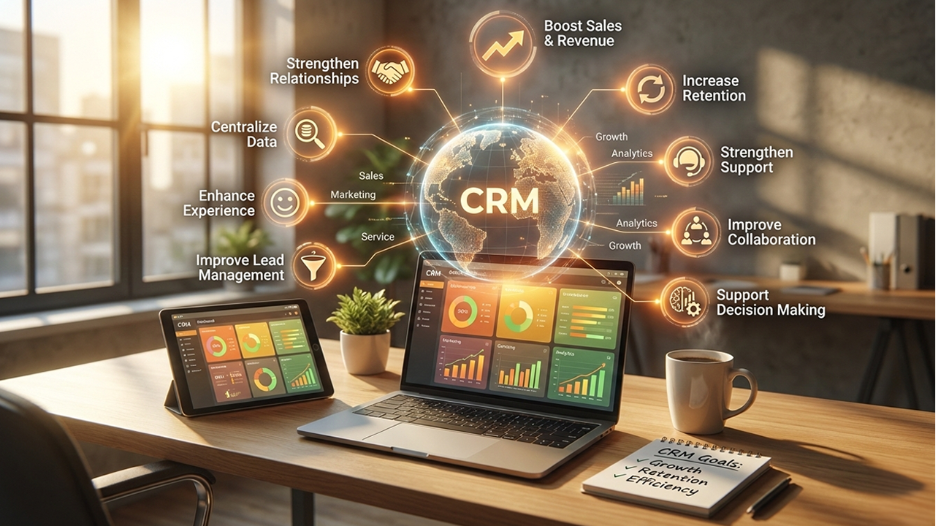
CRM isn’t just about storing data. Its objectives are strategic: they shape how customer-focused work gets executed every day. Below are the 10 essential objectives of CRM that help organizations improve performance, strengthen relationships, and grow profitably.
1. Strengthen Customer Relationship Management
CRM goes way beyond just tracking who you talked to last. It’s about making sure every conversation turns into real action. When teams log calls, add notes, set up follow-ups, or flag support issues, they’re building a running story for each customer. Nobody has to guess what happened before; just pull up the CRM records, and it shows what actions were taken and what comes next. Nothing gets lost, and customers feel important at every step of the way.
2. Centralize Customer Data
Without CRM, customer data lives in silos: marketing tools here, spreadsheets there, service scripts somewhere else. The objective of CRM is to remove these silos by centralizing every piece of customer information in a unified record. Phone calls, emails, orders, support tickets — all live in one place. This makes data reliable, consistent, and accessible to every team.
3. Enhance Customer Experience
Customer experience includes all contacts with a customer; for example: the first advertisement they see to the support they receive months later. CRM's objective is to make customer interactions as easy and consistent as possible. The benefit of having a complete view of a customer's contact history allows teams to respond in a timely manner and provide relevant answers to customer questions. This consistency establishes trust and minimizes frustration for customers who would otherwise need to repeat details or receive conflicting information.
4. Improve Lead Management and Conversion
Lead management turns interest into opportunity, and CRM makes it easy to predict. Instead of relying on memory or ad-hoc judgments, CRM systems define how leads enter the system, how they qualify, and how they move through stages. B2B CRM platforms excel at managing complex, multi-stakeholder sales cycles, while B2C CRM systems handle higher volumes with faster conversion paths. Response timing, lead scoring, and structured follow-ups increase the chances that a lead becomes a paying customer.
5. Boost Sales Productivity and Revenue
Sales teams often juggle dozens of deals at various stages. The objective of CRM here is to make pipeline visibility clear. CRM solutions enable sales personnel to see which deals are on the right track, which ones need immediate assistance, and where they might be stuck. This level of insight helps prioritize high-impact tasks, predict more accurately and close more deals which result in increased revenues.
6. Increase Customer Retention
Retaining existing customers is more feasible than scoring new ones. CRM also allows organizations to determine trends, such as lower engagement or churn signals, enabling them to intervene and prevent a loss of customers before it is too late. B2C CRM systems are particularly effective at tracking engagement patterns across large customer bases to identify at-risk segments. By linking engagement and service history to lifecycle stages, companies can intervene proactively, driving long-term loyalty.
7. Strengthen Customer Support and Service Efficiency
Great service depends on context. Support agents need to see past issues, resolutions, and products purchased before offering help. CRM centralizes these details in one timeline, reducing redundant questions and speeding up resolution times. Customers feel heard and valued, and service teams operate more efficiently.
8. Improve Cross-Team Collaboration
CRM breaks down barriers between sales, marketing, and support teams. When everyone uses the same system, customer ownership, status, and history are transparent. This eliminates friction during handoffs and keeps teams aligned on shared objectives rather than conflicting views or disconnected tools.
9. Gain Actionable Customer Insights and Analytics
Raw data only helps if it translates to insight. One objective of CRM is to connect actions to outcomes. Tracking activities such as lead responses, deal stage progressions, and support trends through CRM systems can help teams develop a comprehensive view of their customers’ behaviors, track how well they performed, and confidently make changes to their strategies.
10. Support Data-Driven Decision Making
At the leadership level, CRM provides a single source of truth. Decisions made with CRM data reflect real activity instead of anecdotes or spreadsheets shuffled together. This reduces bias and improves organizational agility because decisions are anchored in observable performance.
How CRM Objectives Translate into Business Growth
A successful implementation of a CRM includes developing objectives to improve internal operations. These objectives enhance overall business performance:
- Increased revenue through reliable sales pipelines.
- Reduced customer acquisition costs from effective lead qualification.
- Quicker resolution times and greater customer satisfaction.
- Consistent experience across multiple channels and teams.
- Improved brand loyalty and long-term repeat purchases.
By aligning CRM objectives with company strategy, even small teams can act like large organizations with mature customer operations.
Key Metrics to Measure CRM Success
CRM objectives are best evaluated with measurable indicators that reflect process execution and outcomes. Here are some essential metrics:
Lead and Acquisition Metrics
- Lead response time tracks how quickly new leads get contacted
- Lead-to-opportunity conversion rate shows quality of qualification process
- Lead source effectiveness helps decide which channels deliver valuable leads
Sales Performance Metrics
- Stage conversion rates shows where deals advance or stall
- Sales cycle length measures efficiency from contact to close
- Pipeline velocity combines deal size, conversions and cycle time to reveal revenue flow health
Retention and Loyalty Metrics
- Customer retention rate shows the proportion of returning customers
- Churn rate measures customer loss rate
- Customer lifetime value (CLV) estimates total long-term revenue per customer
Service and Support Metrics
- Improves first response time (time taken to acknowledge a request)
- Support resolution time (time taken to solve issues)
- Repeat issue frequency shows gaps in support quality
Collaboration and Execution Metrics
- Handoff completion rate indicates smooth transitions between teams
- Data completeness score reflects consistency of records
- Record update frequency shows system usage and trustworthiness
Using these metrics helps teams assess whether CRM objectives are working in practice, not just theory.
Challenges in Achieving CRM Objectives
Practical and operational barriers prevent many organizations from fully realizing the value of CRM. Below are the most common challenges and the reason why they are important:
Low user adoption
If sales, marketing, or support teams do not use the CRM, then data will remain outdated and incomplete. Therefore, if CRM is not used consistently, it loses value and thus creates barriers to making proper decisions.
Poor data quality
Outdated, duplicated, or inaccurate customer data weakens personalization, reporting, and forecasting. CRM systems are only as effective as the data they contain.
Lack of clear CRM objectives
When businesses implement CRM tools without defined goals, the system turns into a data repository rather than a growth driver. Clear objectives are essential for meaningful outcomes.
Integration challenges
CRMs that are not properly integrated with email, marketing, or support platforms create information silos. This breaks the unified customer view CRM is meant to provide.
Insufficient training and onboarding
Without proper guidance, teams often misuse CRM features or avoid them entirely. Training ensures the system supports workflows instead of slowing them down.
Best Practices to Achieve CRM Objectives
CRM success doesn’t begin with tools; it begins with people and processes. Some best practices include:
- Define clear ownership for CRM processes
- Map real customer journeys before configuration
- Standardize fields and definitions across teams
- Review execution regularly, not just outcomes
- Automate only after processes are stable
- Treat CRM as a “living system” that evolves with your business
These practices help ensure CRM tools support actual work rather than creating friction.
Final Thoughts
The objectives of CRM go far beyond storing customer data. They shape how teams collaborate, how decisions are made, and how customers feel at every stage of their journey. When organizations align their CRM strategy with clear objectives from enhanced relationships to data-driven decisions; they can grow business, build loyalty with customers, and increase operational efficiency. B2B or B2C CRM tools help achieve predictable success. They are not just tools but also a means of making disciplined, transparent, and customer-centric decisions.
CRM is not simply a destination, but rather a continuous process that encourages organizations to think about new ways to constantly improve their practices and processes to achieve their goals.