






Imagine a soccer team where each player is following its own playbook. No player knows what to do with the ball or what other player is supposed to do with the ball. There is no teamwork. Total chaos. This is what happens when your customer data exists in silos. Integrating a Customer Relationship Management (CRM) platform that centralizes all your customer data and helps your company work like champions. But anyone can purchase the CRM software. Does that alone fix the problem right away? The answer is no. What you really need is CRM best practices. You will work effectively with the same dataset and support your customers in a better way.
A study suggests that an average company utilizes around 70% of apps. The problem with these apps is the fact that they do not work well together as per the Salesforce Connectivity Report.
It is difficult to ensure effective customer experiences and boost your relationships when you do not have a clear view of your customer data and interactions across your diverse business. Even if you integrate separate solutions for every team, such apps are generally disconnected and lead to data silos causing disjoined customer experiences. A CRM that is implemented well solves this problem. It gives everyone in your team a centralized view of your customer data.
It is quite helpful because when customers contact your company, they do not go over everything from scratch. They want updates, continuity in conversation, and a particular solution to the problem at hand. In this blog, let us go over the best 10 CRM tips that will allow you to be more effective and derive maximum value out of your investment.
1. Select a CRM That Aligns with Your Requirements-
Not every customer relationship management platform is equally created. If you select a CRM without researching its capabilities and advantages well, then you might end up with a platform that does not help you with your particular objectives.
Key questions you can ponder over:
- Would you want a CRM that needs a service contract or the one that requires more upfront costs for installation?
- Does your business require highly personalizable and in-depth capabilities, or will the basic functionality be sufficient?
- Will your CRM be scalable and improve your business?
- Will you need another solution in just a few years?
Take all the time you need and measure all the options and understand what you need before making your final decision. Moreover, you can also know the key CRM statistics to further your CRM knowledge. Being well-informed about the CRM industry allows you to choose the right platform for your business.
2. Set Your CRM Objectives-
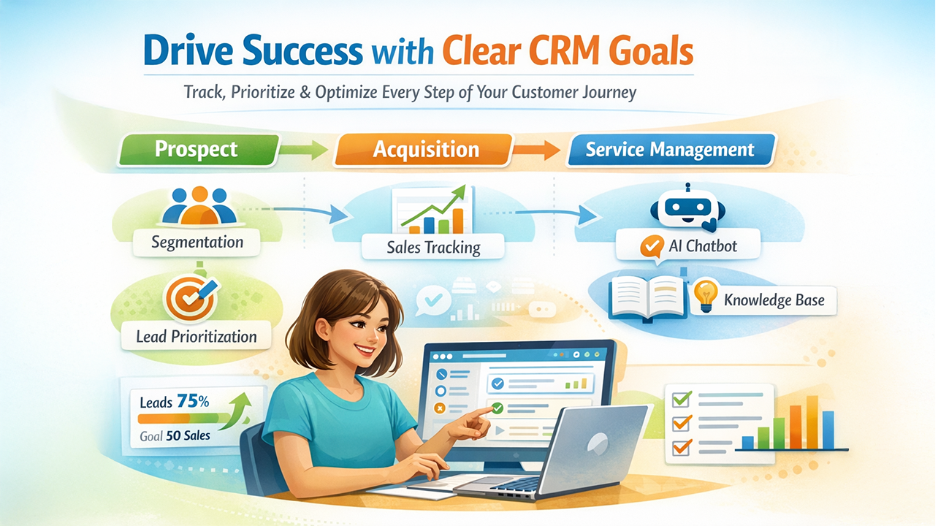
Once you have selected a CRM software, it is time to make sure that your CRM objectives are aligned with your overall business goals. Determine your realistic and measurable goals for how you want your CRM to drive your team toward success. Over the course of time, you can monitor those objectives and adjust them as required. For example, a CRM can help you enhance your buyer journey, from the perspective stage, customer acquisition, to customer service management. Once this journey has been mapped in your CRM, you can monitor whether you are attaining your objectives or not and how much you are off target.
Key advantages of setting your CRM goals-
- Notice how segmentation and customization improve responses in marketing campaigns.
- Get performance insights on your sales team, specifically how many deals are they closing and how soon they are closing.
- Your customer service department can prioritize leads or cases and focus on the high-priority ones. AI CRMs such as OutRightCRM help you smoothly prioritize leads and cases.
- AI-powered chatbots and knowledge base articles help manage minor tasks and review case histories quickly to simplify service interactions.
3. Make a Detailed Plan for Implementation-
Before your business starts utilizing the CRM, you need to create an implementation strategy. This plan must involve a defined scope, a timeline, and the resources you have allocated to execution and the metrics that you are monitoring. Next, you can personalize your CRM as per your requirements and transfer your data to the new platform. This makes sure relevant items such as sales records, customer histories, and service interactions are migrated.
Once your CRM is live and you are utilizing it as instructed, ensure to assess performance and listen to the feedback from your team. It is not about creating new accounts as well as passwords. An implementation partner customizes the CRM to your standards and ensures that your employees get training. It helps you design your workflows in a way that helps you strengthen your customer relationships.
4. Personalize Your CRM-
A CRM is an important asset to your organization that propels your business forward. However, you must personalize it to your workflows and processes to maximize benefits. Your CRM can combine with other programmes your teams utilize on a daily basis such as calendar, email, automation, and customer service tools. You can easily modify the settings, create personalized fields, and configure dashboards, so each team has a quick and simple view of key metrics. If you are adopting open-source CRM like SuiteCRM, then it is wise to integrate AI-powered plugins to boost the functionalities and capabilities of your CRM.
Ensure CRM customization in the initial stage of CRM integration. In this way, your teams do not have to scramble through spreadsheets or search through siloed systems to find the data they need to perform their duties well.
5. You Can Train Your Workforce Well-
Once your CRM system is in place, it is now high time to make sure that your teams have the right training before they start utilizing it. A right implementation partner can help you with this; it can give you complete documentation, hands-on training, case studies and walkthroughs showcase how other companies have utilized the CRM. Once your implementation process is complete, you can carry on with that momentum so that your team becomes familiar with the CRM. The last thing you need is for your team to go back to disconnected systems or spreadsheets before they do not understand the value of using the CRM regularly.
- Make use of programmes such as Trailhead to ensure comprehensive and consistent training.
- Create a company policy that every lead, no matter big or small, must be processed through the CRM.
- Make a cheat sheet about the most common areas in your CRM that employees can refer to.
- Add CRM reviews to your weekly, monthly, or quarterly meetings.
- Have a one-on-one conversation with individual team members to see how they are adjusting to the CRM.
- Establish clear goals and metrics to monitor adoption like the percentage of people using it or the projects that have been added to the CRM.
6. Rely on Artificial Intelligence and Automation-
CRMs are purpose-built to streamline your business by automating the bulk of the task related to your customer relationships. When you have CRM enhanced with automation and AI features, you will see tremendous efficiency improvements throughout the organization. Automation can be defined as a process that completes task automatically with minimum human input. It empowers your employees to get things done more quickly. If your teams get familiar with workflows that they can repeat on a daily basis, CRM automation can manage those tedious tasks. It frees up your employees to concentrate more on that customized care that customers can expect.
For instance, your sales team can automate lead management. Having an advanced plugin such as Email to Lead can help you automatically create records from an email. Once you activate this extension in your SuiteCRM or SugarCRM, it can extract the data from your email and create a record by following pre-defined rules.
7. Ensure That Your Data Is Organized and Clean-
An AI-powered CRM can give you in-depth insights on your present customer data. To get precise and clear insights, you will have to make sure that the data is organized, clean, and accurate. Data cleaning can be defined as the process of removing or fixing incorrectly formatted, corrupted, or incomplete data within a dataset. It is one of the most critical CRM best practices that you can follow. With an AI-powered CRM generating insights based on your customer data, ensuring that the data is clean will allow you to make more effective decisions as per precise information.
However, clean data can only do so much if it exists in a disconnected app. A CRM can help you remove those silos and provides you with a single data source that your whole company can trust. For a higher level of accuracy, you can create a process that helps you to consistently clean data of your customers. Ensure that your team continues to audit to find any inaccuracies as more data is added to the CRM.
8. Emphasize on Collaboration-
If your sales representative utilizes a distinct customer data platform than your marketing or service team, then you will have duplicate or contradictory details for the same customers. With everyone focusing on their platform, trying to get accurate insights on your customers’ journey can feel a little chaotic. Lack of collaboration leads to a workplace that almost feels like an average football team that just cannot complete a pass. Disconnected teams can lead to embarrassing situations such as contacting a lead that has already been converted, your tech support team calling a customer to follow-up on a service inquiry that has been managed already, or your delivery teams delivering the product at the wrong address.
With the help of collaborative customer relationship management software, your sales agents can access the purchase history of your customers. Service interactions can see the sales interactions record, instantly getting more knowledge about your customers. Your marketing team can gain insights on how people are purchasing and engaging with your products, creating messages that resonate.
9. Track and Assess Your CRM Performance-
Consistently monitoring your CRM performance is vital to make sure you are maximizing the returns of your investment. Set up KPIs (Key Performance Indicators) that complement your business objectives like sales cycle duration, customer retention rates, lead conversion rates, and customer satisfaction scores. Leverage the in-built analytics and reporting characteristics of your team to create consistent reports that recognize bottlenecks, highlight trends, and showcase opportunities for enhancement. Schedule quarterly or monthly reviews with your team to assess these metrics and find out what is working and what requires adjustment. This data-based approach allows you to make data-driven choices, streamline your processes, and consistently fine-tune your CRM strategy to get top results.
10. Keep Your CRM Updated and Evolving-
Your business requirements will evolve over time, and it is important to make sure that your CRM moves alongside them. Consistently review the features and functionalities of your CRM to make sure that they resonate with your present objectives. Remain informed about new features, updates, and integrations that your CRM provider releases, as these can provide crucial enhancements to your workflows and help you improve your CRM strategy. Collect consistent feedback from your team related to their pain points and experiences with the system. Then, depending on his evolving business needs and feedback, ensure required adjustments to workflows, custom fields, and automations. Carry out yearly audits of your CRM setup to recognize main areas of improvement. An evolving CRM platform that adjusts to your business makes sure that there is continued support and sustained efficiency for your evolving customer relationships.
Conclusion
Executing CRM best practices revolutionizes your customer relationship management from a straightforward software platform into a valuable business asset. By choosing the right platform, establishing clear goals, comprehensively training your team, and ensuring clean information, you can set up a right foundation for top-level customer experiences. Fostering collaboration, adopting automation, and consistent tracking performance makes sure that your CRM evolves with your business requirements. Keep in mind that a CRM will only be useful if you know how to use it. Implement such practices to boost your customer relationships, simplify processes, and ensure sustainable growth for your business.