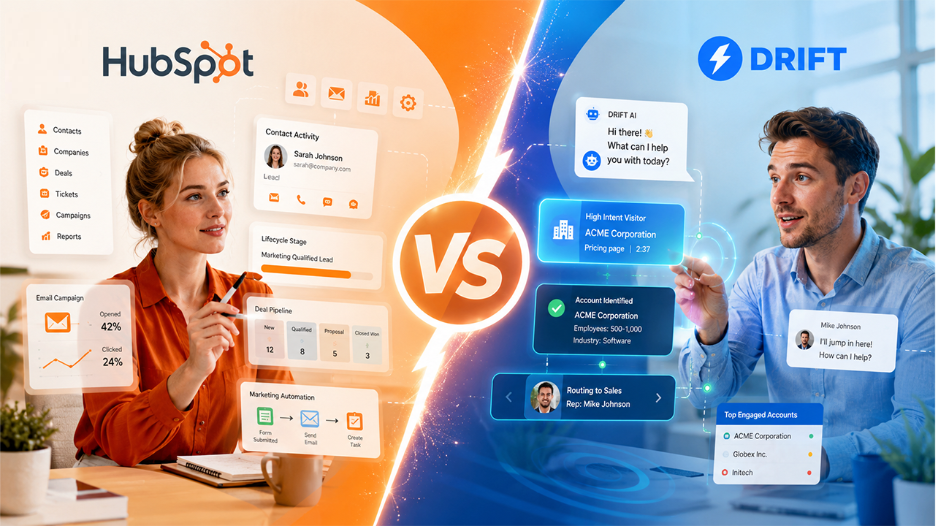

The blog covers the detailed HubSpot vs Drift comparison, which includes comparing chatbots and conversational marketing, CRM and contact management, ABM capabilities, integrations, user reviews, and pricing of each platform.
HubSpot vs Drift is one of the most important software comparisons that B2B marketing and sales teams will have to make in 2026. While each software emphasizes real-time buyer engagement, their ways are different. HubSpot is a complete CRM and marketing platform that supports the overall management of the inbound customer journey. Drift, recently merged with Salesloft, is a conversational marketing and sales engagement platform focused on helping companies promptly connect to their highest-intent website visitors.
This comparison guide of HubSpot and Drift show the strengths in features, chatbots, CRM software, ABM, integrations, and pricing, to assist companies in finding the suitable platform.
HubSpot vs Drift: Key Differences at a Glance
Here's a brief overview of where each of these two platforms stands with the features that really count.
| Feature | HubSpot | Drift |
| Core Focus | Inbound marketing, sales, and service CRM | Conversational marketing, ABM, and sales routing |
| Chat & Bots | Built-in chat, email replies, and standard playbooks | Advanced, high-intent targeting and real-time visitor de-anonymization |
| Integrations | Deep, native ecosystem (everything lives in one CRM) | Integrates well; works as an overlay with native connections to platforms like Salesloft |
| Ideal Deal Size | Best for standard inbound and mid-market deals (<$25k) | Best for larger enterprise deals and heavy Account-Based Marketing (ABM) |
| Pricing Model | Tiered; free plan available; scales with contacts & features | Custom enterprise pricing; no public pricing after Salesloft acquisition |
| Lead Scoring | Native lead scoring built into CRM | Intent-based scoring powered by real-time visitor data |
| Email Marketing | Full email marketing suite included | Limited; designed to complement existing email tools |
| Ease of Use | Moderate learning curve; comprehensive onboarding | Steeper learning curve; best with a dedicated RevOps team |
| Best For | SMBs and mid-market inbound-led teams | Enterprise B2B teams with ABM and pipeline-velocity focus |
What Is HubSpot?

Since its launch in 2006, HubSpot has been a stronghold in the inbound marketing strategy world and is an all-in-one CRM and marketing platform. It offers you an all-in-one marketing automation, sales pipeline management, customer service, CMS and operations toolset. All in one ecosystem with a common contact database.
HubSpot has an email campaigns feature, landing pages, SEO tools, social publishing, ads management, and a native live chat and bot builder for marketing teams. For sales teams, it offers deal pipelines, meeting scheduling, sequence automation and advanced reporting. Service teams get a ticketing system, knowledge base, and customer portal.
HubSpot's true power lies in its CRM foundation. Automatic logging means that every interaction, whether it's a form fill, chatbot interaction, or an email open, gets recorded against the contact record. This gives a single perspective of all the leads and customers. When it comes to any of those three metrics such as, visibility, attribution accuracy, or operational simplicity, HubSpot vs Drift will likely feel like HubSpot is on top.
What Is Drift?

Drift launched in 2015 as a pioneer in the world of conversational marketing, popularizing the concept of replacing static lead capture forms with real-time chat experiences. Today, Drift's acquisition by Salesloft puts it in a bigger revenue orchestration stack as the conversational layer.
Drift excels in three areas, such as Intent-based lead qualification, routing using AI-chatbots, and account-based marketing engagement tools that detect target accounts visiting your website live, and revenue orchestration workflows that connect your marketing handoffs to your sales process within Salesloft. For teams also comparing broader sales automation platforms, HubSpot vs ActiveCampaign offers a useful side-by-side on marketing automation depth.
One of the most powerful features of Drift is its ability to de-anonymize visitors. It can recognize a website visitor's company even before they complete a form, so sales representatives can start a personalized chat for high-value customers.
HubSpot vs Drift: A Side-by-Side Feature Comparison
HubSpot and Drift are both excellent customer engagement tools, with different motivations behind their development. HubSpot's main focus is on providing an all-in-one CRM, marketing and sales suite, whereas Drift's emphasis is on conversational marketing, real-time engagement and enterprise account-based experiences.
1. Chatbots and Conversational Marketing
HubSpot and Drift both offer excellent tools for conversational marketing; however, they are used differently by people. HubSpot live chat and chatbot builder are integrated in the CRM, so that they are easy to use, especially for inbound lead qualification and customer support.
However, Drift has more advanced AI-powered chat features, along with better behavioural targeting, ABM integration, and lead routing. Drift is perfect for enterprise teams focused on personalization and speeding up the sales pipeline, while HubSpot is better suited for simplicity and cost-effectiveness.
Verdict: Drift wins on sophistication; HubSpot wins on simplicity and value.
2. CRM and Contact Management
In a nutshell, HubSpot could be regarded as a complete CRM offering, including features such as contact management, deal tracking, activity timelines, segmentation, and sales automation, all rolled into one single platform. It allows users to have the whole picture of engagement and customer data in one place, which is highly suitable for businesses looking for an all-in-one solution.
Meanwhile, Drift isn't a CRM by itself and needs to be used in conjunction with CRM systems like Salesforce, HubSpot, or Salesloft to get chat and lead details synchronized. If you've got an existing CRM setup, Drift will be a great addition to that setup, acting as a conversation layer that complements the CRM functionalities. Teams evaluating CRM-first alternatives might also find HubSpot vs Freshsales a helpful comparison for sales-focused use cases.
Verdict: HubSpot is the clear winner whereas Drift isn't a CRM, plain and simple.
3. Account-Based Marketing (ABM) Capabilities
Both HubSpot's and Drift's account-based marketing features target different strengths in the HubSpot vs Drift comparison. HubSpot provides native ABM capabilities, such as creating target account lists, scoring ideal customers, and campaigning on the account level within the HubSpot CRM suite.
Drift is made with ABM engagement in mind, it's built for real time. It can recognize target accounts coming into your web site, set up custom chat experiences and alert sales teams immediately. In addition to intent data integrations such as 6sense and Bombora, when added to Drift, it creates more powerful real-time targeting and engagement opportunities, particularly for enterprise-scale ABM. If project management and pipeline tracking are also part of the conversation, HubSpot vs Monday CRM covers how HubSpot compares to a more workflow-centric tool.
Verdict: Drift leads for real-time ABM; HubSpot is solid for mid-market teams.
4. Integrations and Tech Stack Compatibility
When it comes to integrations, HubSpot and Drift both have a very high level of integration capability, although they are suitable for two very different technology ecosystems in the HubSpot vs Drift comparison. HubSpot is connected with over 1,500 integrations such as marketing, CRM, analytics, and productivity solutions, making it ideal for companies that desire a single solution. For teams comparing email-first marketing stacks, HubSpot vs Mailchimp is a relevant read on where HubSpot's native email tools stand.
Drift focuses more on enterprise revenue operations and includes integrations (connectors) for Salesforce, Salesloft, Outreach, 6sense, Bombora, and Marketo. Furthermore, if you’re managing sales operations within HubSpot's CRM platform, then Drift will be a more valuable tool. If you are utilizing Salesforce, then HubSpot will be more beneficial for teams focused on conversational engagement and sales orchestration.
Also Read - 9 Best HubSpot Integrations
Verdict: HubSpot for an all-in-one setup; Drift if you're already in a Salesforce or Salesloft ecosystem.
5. User Reviews & Reputation
When real users weigh in, both platforms hold their ground pretty well.
Where they differ is in what users' praise. Drift users consistently highlight its chatbot quality, lead routing, and real-time engagement as standout strengths. Complaints tend to centre around the pricing and the learning curve without a dedicated RevOps team.
HubSpot users love the all-in-one convenience, the free CRM, and how well everything connects across hubs. The most common gripe? It can get expensive fast once you start adding multiple hubs or scaling your contact list.
Verdict: A tie-on ratings, but the reasons people love each platform are very different; pick the one whose strengths match your actual priorities.
HubSpot vs Drift: Pricing Comparison
Both platforms take very different approaches to pricing. One is refreshingly transparent, the other requires a conversation first.
HubSpot Pricing
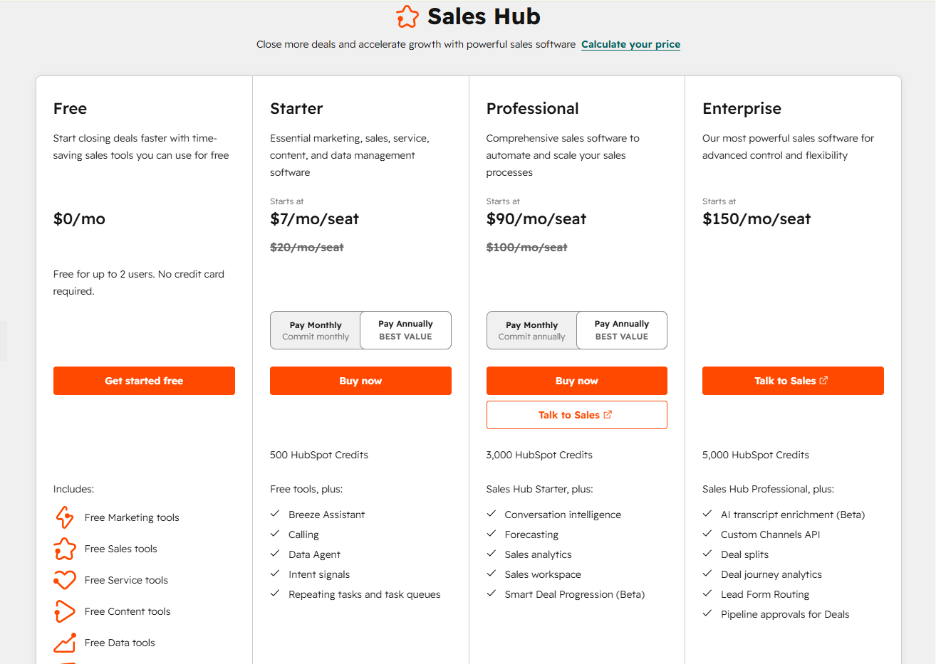
HubSpot Pricing: Complete Guide to Plans, Features, and Cost
Drift Pricing
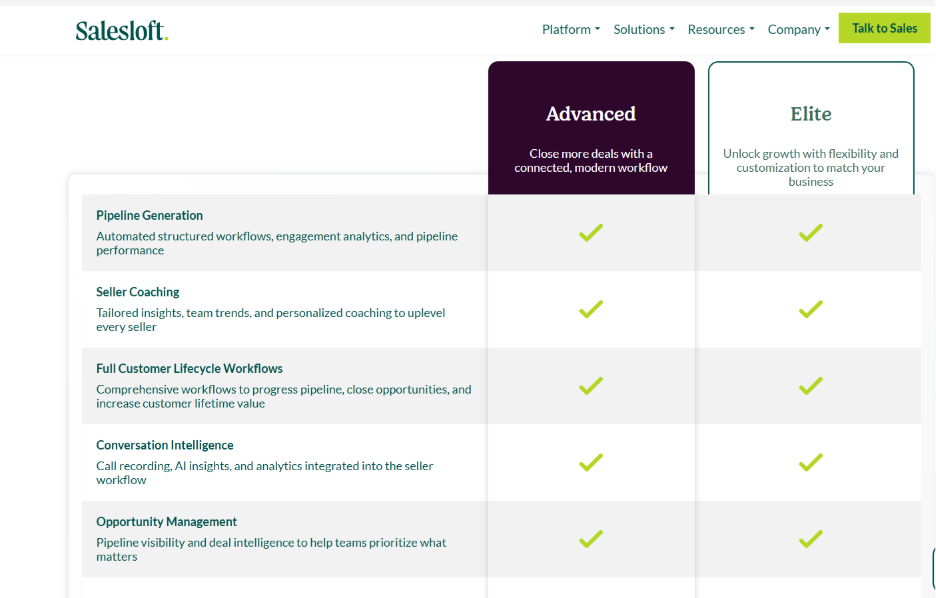
Drift's pricing isn't publicly listed following its acquisition by Salesloft. To get a quote tailored to your team's needs, you'll need to reach out to their sales team directly at salesloft.com/pricing.
Which Platform Should You Choose: HubSpot or Drift?
Choose HubSpot if:
- You want an all-in-one platform where your CRM, email marketing, chat, and reporting all live under one roof.
- You're an SMB or mid-market team that needs something scalable but doesn't want to blow the budget before you've even closed a deal.
- Inbound marketing is your primary growth engine.
- You don't have a dedicated RevOps team; HubSpot is far easier to set up and manage without heavy technical support.
- You want pricing clarity upfront so you can actually plan your budget without jumping on a sales call first.
Choose Drift if:
- Your team runs serious enterprise ABM campaigns and you need to identify and engage high value accounts the moment they land on your site.
- You're already working within a Salesloft or Salesforce ecosystem
- Speed-to-pipeline is your top priority. Drift's real-time routing and AI chat are built specifically to get the right rep in front of the right buyer, fast.
- You're dealing with large, complex deal cycles where personalized, account-level engagement makes a measurable difference to conversion.
- You have a dedicated RevOps or sales ops team that can actually get the most out of Drift's more advanced configuration and targeting features.
Final Verdict: HubSpot vs Drift
The HubSpot vs Drift choice will rely upon a number of factors, for example, business size, sales methodology, and the stage of business development. For SMBs and mid-market teams, HubSpot is a more appropriate option, as it unifies the CRM, marketing, lead nurturing and conversational capabilities in one scalable platform, at a more affordable cost. But Drift is designed for enterprise companies with sophisticated ABM and RevOps plans, which demand real-time interaction and more comprehensive conversational intelligence.
However, for companies with complex sales processes and larger deal sizes, Drift is more suited to enterprise needs, whereas HubSpot provides greater value and ease of use for growing businesses. And if you're still comparing HubSpot across the broader CRM landscape, HubSpot vs Freshworks is another solid comparison to have on your radar.
Frequently Asked Questions : HubSpot vs Drift
1. Is Drift still a standalone product or part of Salesloft?
In 2023, Salesloft acquired Drift and it is now part of the Salesloft ecosystem but still a stand-alone conversational marketing product.
2. Can HubSpot replace Drift for conversational marketing?
Yes, for most SMB and mid-market teams. While HubSpot can manage chat, lead qualification, meeting booking, and FAQs, Drift is better suited for enterprise ABM targeting.
3. Which platform is better for lead generation?
If you're looking to generate leads across the entire funnel, HubSpot is the better tool, whereas if you're trying to turn enterprise visitors into meetings faster, Drift is the better choice.
4. Does Drift integrate with HubSpot?
Yes. Drift also natively integrates with HubSpot so that teams can get contacts, conversations, and meetings synced and merge both platforms.
5. What is the pricing difference between HubSpot and Drift?
HubSpot's pricing is free and clear, beginning at approximately $20/month, whereas Drift has enterprise-level pricing, which typically begins at around $2,500/month.