





Let’s be honest — picking the right platform for your online presence feels overwhelming. You research, open a dozen tabs, read success stories, and still end up asking the same question: WordPress or ClickFunnels? Both seem powerful, both have loyal user base, and both promise to fuel your growth. But here’s the catch: these two tools are designed for completely different jobs, and choosing wrong can mean wasting months of your time and burning through money.
This guide isn’t about hype or hidden affiliate links. It’s a straight break down of WordPress vs ClickFunnels — pricing, ease of use, customization, SEO, eCommerce features, and more. The goal? By the end, you’ll have a clear picture of which platform actually fits your needs.
What Is WordPress?
WordPress is an open-source Content Management System (CMS), and it runs more than 43% of all websites. WordPress powers everything from tiny personal blogs to massive Fortune 500 sites. It’s kind of a backbone of a massive chunk of web.
You can download and use WordPress for free, but you’ll need web hosting and a domain name to get your site online. The real power, though, is its ecosystem. There are more than 60,000 plugins and thousands of themes. You want a blog, a business site, a portfolio, an online store, a membership site, or even a sales funnel? You can build all of that. Out of the box, WordPress isn’t really a funnel builder, but with the right plugins, it absolutely can be.
What Is ClickFunnels?
ClickFunnels isn’t just another website builder—it was built with one clear goal: to turn visitors into customers through a structured sales process and convert them into paying clients. Russell Brunson launched it back in 2014, and from the start, it was all about sales funnels, not blogging or regular websites.
Now there’s ClickFunnels 2.0, an upgraded version of ClickFunnels. It’s no longer just a funnel but a full website builder, blog, email marketing (with their tool named “Follow-Up Funnels”), CRM features, online course builder (LMS), affiliate management, and eCommerce built-in tools. Basically, it wants to be the only thing you need for your online business.
WordPress vs ClickFunnels: A Detailed Comparison
1. Pricing
This is one of the most important factors most people look at first, especially if you’re just starting out.
WordPress:
WordPress is technically free. You can download and install the software without spending a dime. But actually getting your site live? That’s where the real costs start coming in:
- Domain name: Usually around $10–$20 per year
- Web hosting: Anywhere from $3 to $75 a month, depending on what you need
- Premium theme: $30 to $100, a one-time price or a yearly fee
- Plugins: Some are free, others can cost you hundreds of dollars a year
If you’re willing to do the setup yourself, you can launch a solid WordPress site for about $50–$100 a year. Even if you add something like a premium page builder and a sales funnel plugin—let’s say CartFlows for $79 per year—you’re still paying way less than what ClickFunnels charges.
ClickFunnels:
ClickFunnels runs on a subscription model:
- Startup Plan: $97 a month (or $81 if you pay for a year upfront)
- Pro Plan: $297 a month (or $248 a month billed annually)
That’s $972 to $3,564 a year just for access. And that’s before you factor in any add-ons. They’ll give you a 14-day free trial, but after that, the fees add up fast.
Bottom line: WordPress clearly comes out ahead on price. ClickFunnels only makes sense if your funnels actually bring in enough revenue to cover that ongoing cost.
2. Ease of Use
WordPress has come a long way, especially since they introduced the Gutenberg block editor, but it still requires a learning curve. You have to figure out hosting, themes, plugins, and how everything fits together. For absolute beginners, the setup process can feel overwhelming at first. But once you’ve understood the basics, WordPress becomes extremely user-friendly. Additionally, if you get stuck, there’s a lot of tutorials and a huge community support is available to help.
ClickFunnels was primarily built for non-technical users in mind. The drag-and-drop editor is clean, simple, and actually beginner-friendly. You can publish your first funnel page in less than an hour. They handle all the behind-the-scenes stuff, like hosting, updates, security—so you don’t have to think about it. If you’re starting from scratch and want something live, fast, ClickFunnels has a clear edge.
If you've never built a website before and need to launch fast, ClickFunnels has a real advantage here.
Bottom line: Undauntedly, ClickFunnels wins, especially if you’ve never built a website before. WordPress is more flexible and powerful, but there’s definitely a steeper learning curve.
3. Customization and Flexibility
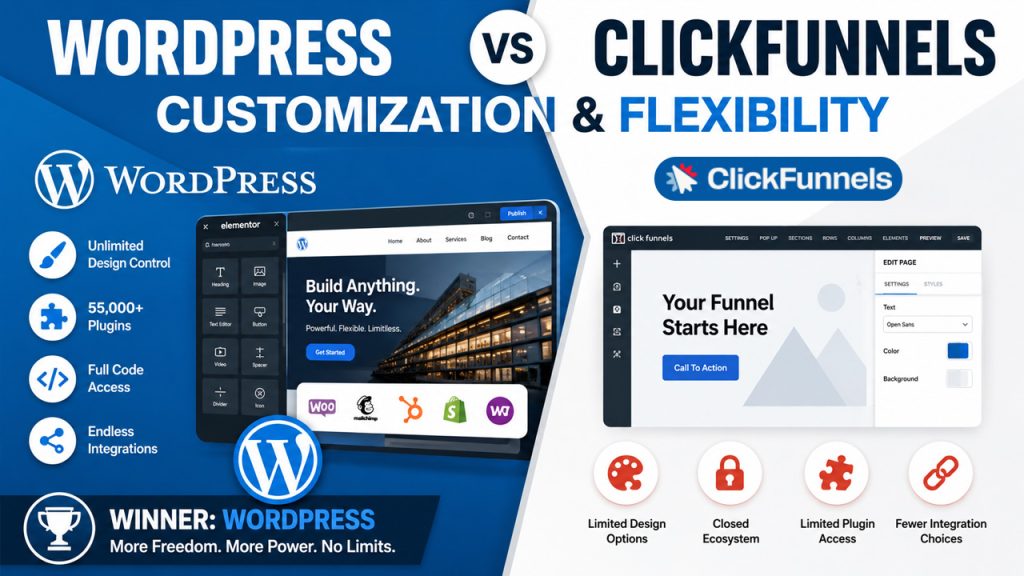
When it comes to customization, WordPress absolutely dominates.
WordPress provides total control—design, features, code, integrations, and more. If you want to lay out your site visually, use something like Elementor, Divi, or Beaver Builder. Or if you need a specific feature, dive into thousands of plugins until you find exactly what you want. If you know how to code, you can basically build anything. And if you don’t? There’s almost always a plugin for almost everything.
ClickFunnels lets you customize, but only within its own ecosystem. You can change colors, fonts, layouts, and connect a few third-party tools— but you're still confined toto its closed system. Conversely, WordPress makes those same tasks straightforward, provides you more flexibility that ClickFunnels doesn’t give.
Bottom line: WordPress takes the win here. If you want to build something unique, scaling up, or nailing your brand, you’ll get a lot more freedom with WordPress.
4. SEO Capabilities
If you’re after organic traffic (and really, who isn’t?), pay attention here.
WordPress is a SEO powerhouse. With plugins like Yoast SEO or Rank Math, you get fine-tuned control over meta titles, descriptions, schema, sitemaps, canonical URLs—the list goes on. You can boost your site speed with caching plugins like WP Rocket and optimize those Core Web Vitals to target Google’s ranking standard. Agencies who work with large content sites or B2B clients consistently report WordPress sites get better search rankings than ClickFunnels.
Now, ClickFunnels 2.0 has made some progress, but it’s still trailing behind. Basic meta tags and page titles are editable, but advanced SEO tweaks aren’t part of the package. Funnel pages are not usually designed for long-form content or building up the kind of site authority that Google’s looking for.
Bottom line: WordPress wins this round, easy. If you’re serious about SEO or content marketing, WordPress is the go-to option.
5. Sales Funnels and Conversion Tools
Here's where ClickFunnels shines.
This is ClickFunnels’ turf. It was designed with funnels in mind, so you get ready-made templates for lead capture, webinars, product launches, and sales pages right inside the platform. It offers some built-in features, such as one-click upsells, order bumps, countdown timers, and even A/B testing. No need to install a ton of plugins or connect together different tools.
WordPress is built to design sales funnels, but you need the right plugins. Tools, like CartFlows, ThriveCart, WooCommerce Funnels can cover most features ClickFunnels offers. Unlike ClickFunnels, you have to set everything up yourself, and often you’re juggling separate tools. It takes more time and a bit more patience to get everything working as one system.
Bottom line: If you care about launching funnels fast and with minimal hassle, ClickFunnels has the edge. It stands out as an out of the box funnel builder.
7. Security
ClickFunnels manages critical infrastructure tasks easily, including SSL certificates, security patches, updates, and malware scans. This eliminates the need for manual intervention, minimizes operational overhead, and reduces risks.
WordPress, on the other hand, takes security as a responsibility. You’ll need to install a security plugin like Wordfence or Sucuri, keep everything updated, and ideally use hosting that backs up and monitors your site. It’s manageable with minimal oversight.
Bottom line: ClickFunnels is the go-to for hands-off security. WordPress can be equally safe, but you’ll spend more time managing it.
8. Integrations and Third-Party Tools
WordPress basically connects to everything. Such as Email marketing services, CRM systems, social platforms, payment gateways, analytics tools, and many more APIs. Since WordPress is open source, developers just keep adding more connectors.
ClickFunnels links up with plenty of popular tools too: Mailchimp, Zapier, ActiveCampaign, Stripe, PayPal, and a few others. But honestly, its integrations don’t come close to WordPress. It’s a much smaller library.
Bottom line: WordPress wins on integrations.
Who Should Choose WordPress?
Go with WordPress if you’re aiming to:
- Build long-term authority with blogging and SEO
- Create a full website, not just a funnel
- Keep costs low and want maximum control
- Run a full-scale eCommerce store with multiple products
- Customize heavily for branding or special features
- Spend a little time learning something new
Who Should Choose ClickFunnels?
ClickFunnels makes sense if you:
- Need to get a funnel live fast, without massive technical setup
- Only sell a few products via direct sales processes
- Don't want to deal with hosting, security, or plugins
- Have a business model where the funnel ROI manages monthly expenses
- Launching short-term campaigns or a new product
Can You Use Both Together?
A common setup is required to run WordPress sites for SEO, blogging, and brand presence, while using ClickFunnels (or a WordPress funnel plugin) for focused campaign landing pages and checkout flows. This hybrid approach offers the benefits of both models but adds additional layers of complexity that need careful management.
Final Verdict: WordPress vs ClickFunnels
Let’s be real—there’s no one-size-fits-all winner in the WordPress vs ClickFunnels debate. It depends completely on your goals.
If you’re all about content creation, long-term growth, SEO visibility, and gaining full control over online presence, WordPress is your best option. It’s more affordable, ridiculously flexible, and reliable for the long term.
If you want to launch a funnel fast, sell a course, or manage everything in one place (without touching code), ClickFunnels is solid—as long as you’re comfortable with the monthly fee. Don’t choose a platform just because it’s popular. Find a platform that matches your business model, your budget, and where you want to be a year from now.
Still confused? ClickFunnels gives you a 14-day free trial. WordPress is free—most hosts even offer one-click installation. Try them both out, see what feels right, and then go with what fits your vision.
Frequently Asked Questions About WordPress vs ClickFunnels
Yes, if you want a quick launch. ClickFunnels is super beginner-friendly and lets you launch a funnel quickly. While WordPress takes more time to learn but pays off massively in the future.
Absolutely. With plugins like CartFlows, WooFunnels, or Thrive Suite, WordPress can replicate most of the functionalities that ClickFunnels offers at a fraction of the cost.
WordPress itself is free. You just pay for hosting and a domain, and it's usually much cheaper—around $50 to $100 a year, compared to ClickFunnels’ starting $97 a month.
WordPress wins, easily. Its SEO plugin ecosystem and full control over technical optimization make it the preferred choice for organic search growth.
ClickFunnels doesn’t offer a free plan, but it does offer a 14-day free trial for new users.