






Businesses today collect data from business applications, mobile apps, IoT devices, social media, and streaming sources. Much of this data arrives in different formats and at a large scale. Storing it in separate systems creates silos, slows down analysis, and increases costs.
A data lake addresses this problem by bringing all of that data into one central location. Many teams now ask what is data lake technology, how it is built, and when it should be used instead of a traditional database. This guide answers those questions in a clear, structured way, covering the definition, layers, comparisons, benefits, and challenges.
What is Data Lake?
To answer what is data lake in simple terms: a data lake is a centralized repository that stores large volumes of data in its original form. It accepts structured data such as database tables, semi-structured data such as XML files, and unstructured data such as images, audio files, and documents. The data is stored without first defining a formal structure.
A data lake relies on a method called schema-on-read. The structure of the data is applied only when the data is read for analysis, not when it is stored. It also uses a flat architecture with object storage, where each data item carries metadata tags and a unique identifier. This makes the data easier to locate and retrieve.
Key characteristics include:
- Stores all data types in raw format
- Scales to any volume at a relatively low cost
- Supports analytics, business intelligence, and machine learning
- Allows different teams to use their own tools on the same data
A data lake suits the volume and variety of large datasets. Readers who want background on this subject can first review what is big data.
Data Lake Architecture
A data lake is, at its core, a storage repository with no fixed architecture of its own. Its value depends on the tools and compute engines placed around it. A typical data lake architecture is organized into the following layers:
- Ingestion layer: Collects data from databases, sensors, logs, real-time streams, APIs, and files. Tools such as Kafka, AWS Kinesis, Flume, and Sqoop are commonly used here.
- Storage layer: Holds raw files in formats such as CSV, Parquet, ORC, and JSON. Common storage options include Hadoop HDFS, AWS S3, Azure Data Lake Storage, and Google Cloud Storage.
- Processing layer: Cleans, transforms, and prepares data using technologies such as Apache Spark, Hadoop MapReduce, Flink, and Presto.
- Cataloging and metadata layer: Maintains information about the files so that data can be found and trusted. AWS Glue Catalog and Apache Hive Metastore are examples.
- Consumption layer: Serves dashboards, SQL queries, and machine learning models. Power BI, Tableau, Spark SQL, and Python or R notebooks are typical tools.
Different users prefer different data analysis tools, and a data lake lets each of them work on the same stored data without moving it to a separate system.
Data Lake Zones
A well-designed data lake architecture also divides data into logical zones:
- Raw zone: Stores unprocessed data exactly as received
- Cleansed zone: Holds data that has been cleaned, validated, and standardized
- Curated zone: Contains analytics-ready data, often converted to formats such as Parquet
- Sandbox zone: Gives data scientists space to experiment without affecting production data
Data Lake vs Data Warehouse
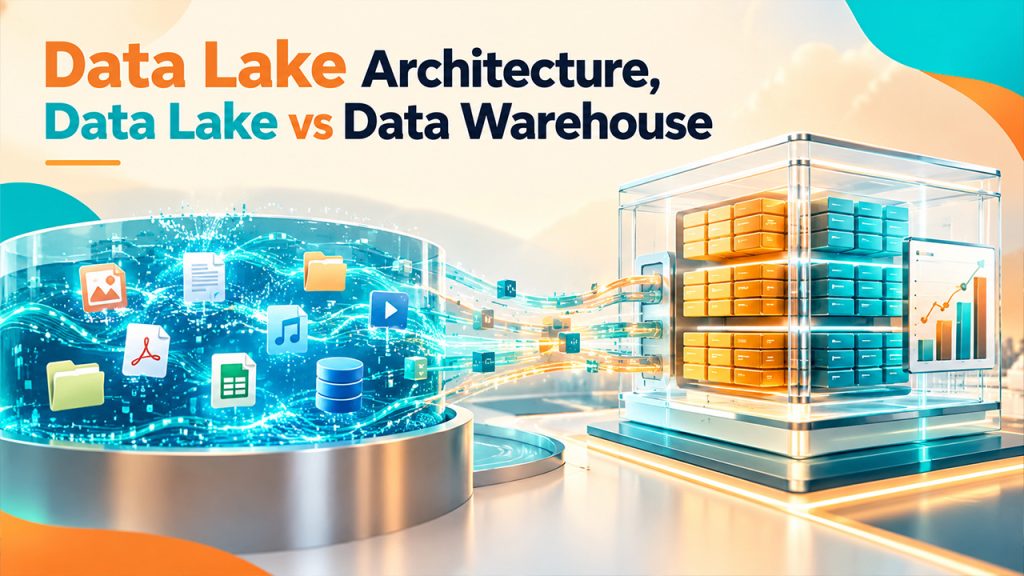
The comparison of data lake vs data warehouse is one of the most common questions in data management. Both store and process data, but they serve different needs.
A data warehouse is relational. Its structure is defined in advance and optimized for fast SQL queries, and the data is cleaned and transformed before storage. For a deeper explanation, readers can review what is a data warehouse as a separate topic.
Here are the main differences in data lake vs data warehouse:
- Data types: A data lake holds structured, semi-structured, and unstructured data. A data warehouse holds structured data.
- Schema: A data lake uses schema-on-read. A data warehouse uses schema-on-write.
- Data format: A data lake keeps raw, unfiltered data. A data warehouse keeps processed, vetted data.
- Processing approach: A data lake typically follows ELT (extract, load, transform). A data warehouse typically follows ETL (extract, transform, load).
- Scalability and cost: A data lake is easier and cheaper to scale. A data warehouse is more expensive to scale.
- Typical users: Data scientists and data engineers work mostly with data lakes. Business analysts work mostly with data warehouses.
- Primary use cases: Data lakes support machine learning, predictive analytics, and real-time analytics. Data warehouses support core reporting and business intelligence.
The two are not rivals. Many enterprise organizations use both in one analytics ecosystem. A newer approach, the data lakehouse, adds a transactional storage layer on top of a data lake so that analytics and machine learning can run on the same data.
Benefits, Use Cases, and Challenges
Key Benefits
- Centralized data: One location removes silos and duplicate copies
- Flexibility: Raw data can be kept and used later for new analytics needs
- Scalability: Storage can grow with data volume at a lower cost than most warehouse systems
- Broad access: Data scientists, engineers, and analysts can use their preferred tools
Common Use Cases
- Streaming media: Analyzing customer behavior to improve recommendations
- Finance: Using real-time market data to manage portfolio risk
- Healthcare: Reviewing historical data to improve patient pathways
- Retail: Consolidating data from mobile, social, chat, and in-person touchpoints
- IoT: Storing sensor data for future analysis
Challenges to Manage
A data lake without oversight can turn into a data swamp, where data cannot be found or trusted. Other challenges include data quality issues, security concerns, metadata management, integration complexity, and the need for specialized skills.
Good practices help reduce these risks:
- Catalog data at the point of ingestion
- Mask personal information before it enters the lake
- Apply role-based and view-based access controls
- Maintain governance and stewardship policies
Conclusion
A data lake gives organizations a flexible, scalable home for raw data of every type. Once the answer to what a data lake is clear, the next step is planning a strong data lake architecture with defined layers, zones, cataloging, and security. Comparing data lake vs data warehouse shows that each has its own strengths, and many businesses benefit from using both. With proper governance, a data lake becomes a dependable foundation for analytics, reporting, and machine learning.