






The guide explores what is a data warehouse, what its benefits are, how it works, its key components, and its real-world applications.
In the current digital landscape, businesses generate enormous amounts of information from multiple sources, such as websites, mobile applications, customer relationship management (CRM) systems, enterprise resource planning software, and sales transactions. However, the real challenge appears after collecting data. Organizing, analyzing, and transforming that data into meaningful insights that can support better business decisions is essential for businesses. This is where a data warehouse becomes essential.
A data warehouse helps organizations consolidate information from multiple sources into a centralized repository that is especially designed for reporting, analytics, and business intelligence. Businesses can use a data warehouse to access consistent, historical, and reliable information, instead of analyzing scattered datasets across different systems.
What is a Data Warehouse
A data warehouse can be explained as a centralized data management system that can collect, integrate, and store data from multiple sources for reporting, analysis, and decision-making. A data warehouse is designed to analyze large volumes of historical and current data efficiently, unlike operational databases, which primarily support everyday business transactions.
Businesses that want to understand how customer information can be consolidated for analysis can explore the role of a CRM data warehouse in creating a unified view of customer data.
A data warehouse typically has four key characteristics:
- Subject-oriented: Data is organized around important business areas, such as customers, sales, products, and finance.
- Integrated: Data from different sources is standardized and combined into a consistent format.
- Time-variant: Historical data is maintained so organizations can analyze trends and compare performance over time.
- Non-volatile: Data is generally loaded and retained for analysis rather than continuously changed through individual business transactions.
Benefits of a Data Warehouse
A data warehouse helps organizations transform raw data into meaningful insights that can support better decision-making, improve operational efficiency, and drive business growth. Some of the key benefits of a data warehouse are as follows:
- Centralized Data Management
One of the major benefits of a data warehouse is that it combines data from multiple sources into a centralized repository. A data warehouse integrates relevant information into one analytical environment, making it easier for employees to access and analyze data.
- Better Decision-Making
A data warehouse helps organizations make informed decisions by providing reliable, consistent, and well-organized information. With a data warehouse, businesses can make decisions based on historical trends and measurable results, instead of relying entirely on assumptions.
- Improved Data Quality and Consistency
Data collected from different sources might contain duplicate records, missing values, inconsistent formats, and conflicting information. A data warehouse uses data integration and transformation processes to clean, validate, and standardize information before it is used for analysis.
- Historical Data Analysis
A data warehouse can retain historical information, allowing organizations to examine business performance over extended periods. Businesses can use historical data to understand growth patterns, evaluate past decisions, and identify recurring trends.
By combining customer and sales information, businesses can use CRM data analytics to identify sales trends, understand customer behavior, and improve marketing decisions.
Components of a Data Warehouse

Some of the key components of a data warehouse are as follows:
- Data Sources: Systems that generate the information being analyzed.
- ETL or ELT Pipelines: Processes that move and prepare data.
- Staging Area: A temporary or intermediate location where incoming data can be validated and processed.
- Warehouse Storage: The environment where integrated analytical data is maintained.
- Metadata Repository: Information describing datasets, columns, transformations, ownership, and data lineage.
- Data Marts: Focused collections of data designed for particular departments or business functions.
- Query and Analytics Tools: Applications that allow users to explore data and create reports.
- Governance and Security Controls: Policies and technical safeguards that manage access, quality, privacy, and compliance.
Types of Data Warehouse
There are various types of data warehouses, from which organizations can choose based on their size, infrastructure, and analytical requirements.
1. Enterprise Data Warehouse
An enterprise data warehouse (EDW) consolidates information from across an organization into a shared analytical environment. An enterprise data warehouse supports company-wide reporting and provides consistent data for departments such as finance, sales, marketing, and operations.
2. Operational Data Store
An operational data store (ODS) integrates current or frequently updated information from multiple operational systems. An operational data store is commonly used for operational reporting and near-current views of business activity. Unlike a traditional enterprise data warehouse, an ODS is not primarily designed for extensive long-term historical analysis.
3. Data Mart
A data mart is a smaller, subject-specific collection of data designed for a particular department or business function. Data marts can simplify access to relevant information and reduce complexity for business users.
4. Cloud Data Warehouse
A cloud data warehouse runs on cloud infrastructure and is typically managed through a cloud service provider. These platforms often offer elastic computing resources, managed maintenance, integration capabilities, and usage-based pricing.
How Does a Data Warehouse Work?
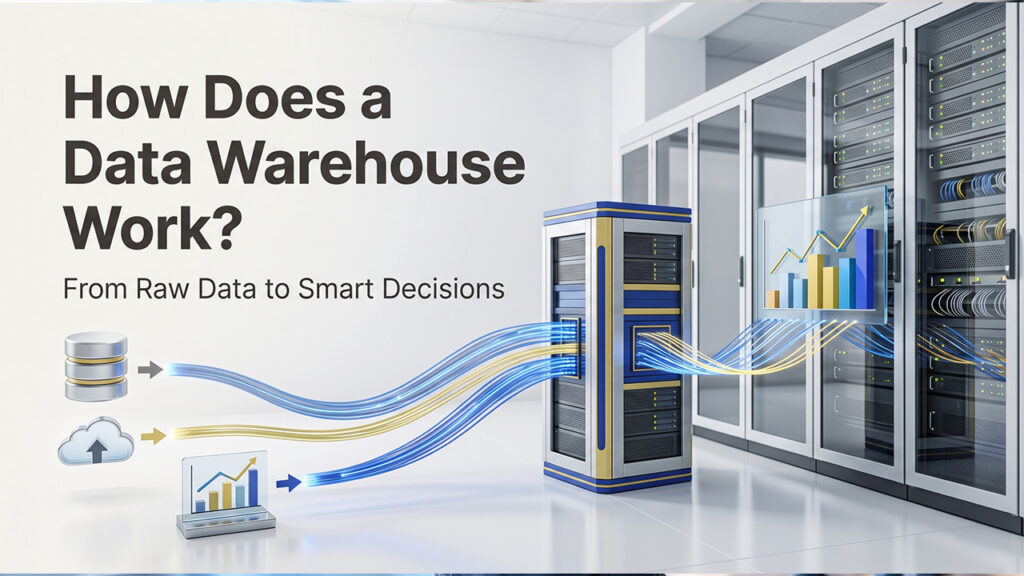
A data warehouse operates through a series of processes that can easily transform raw data into useful information for the users.
The working process of a data warehouse is as follows:
- Step 1: Data Collection
The process begins by collecting data from multiple sources, such as relational databases, spreadsheets, cloud applications, APIs, website analytics platforms, and business software.
- Step 2: Data Extraction
After data collection, relevant information is extracted from source systems using connectors, APIs, database queries, or data integration tools.
- Step 3: Data Transformation
The extracted data is processed, cleaned, standardized, and prepared for analysis. This may involve removing duplicates, correcting inconsistent formats, handling missing values, converting currencies, and combining related records.
- Step 4: Data Loading
The prepared data is loaded into the data warehouse or a designated storage layer. Organizations can use batch loading, incremental loading, or streaming ingestion depending on their business requirements.
- Step 5: Data Analysis and Reporting
Once the data is available, users can easily query using SQL, create dashboards, generate reports, and build analytical models.
Applications of a Data Warehouse
A data warehouse supports a wide range of business functions, which include:
- Retail and E-commerce: Businesses analyze product sales, inventory levels, customer purchases, seasonal demand, and marketing performance.
- Banking and Finance: Financial institutions use integrated data for reporting, profitability analysis, risk assessment, and regulatory reporting, subject to applicable controls.
- Healthcare: Organizations can combine operational and administrative information to analyze resource utilization, costs, and service performance while protecting sensitive patient data.
- Telecommunications: Telecom companies examine customer usage, service quality, churn patterns, and network performance.
- Manufacturing: Manufacturers analyze production output, quality metrics, supply chains, equipment performance, and operational costs.
- Marketing and Sales: Teams combine campaign, website, customer, and sales information to evaluate conversion rates, customer acquisition costs, and return on marketing investment.
Conclusion
A data warehouse plays a major role in helping businesses manage, analyze, and interpret large volumes of data from various sources. By offering centralized data storage, improved data quality, historical analysis, and reliable reporting, a data warehouse helps organizations make informed decisions and improve operational efficiency. As businesses continue to become more data-driven, implementing an effective data warehouse can help transform raw data into actionable insights, support strategic planning, and drive long-term growth.
The main components include data sources, ETL or ELT pipelines, a staging area, warehouse storage, metadata repositories, data marts, analytics tools, and data governance and security controls.
A data warehouse generally stores integrated and structured data optimized for reporting and analytics. A data lake can store structured, semi-structured, and unstructured data, often in its original or minimally processed form.
ETL stands for Extract, Transform, Load. It is a data integration process in which information is extracted from source systems, transformed through cleaning and standardization, and loaded into the data warehouse for analysis.
A data mart is a focused collection of data designed for a specific business department or subject area, such as sales, marketing, or finance.