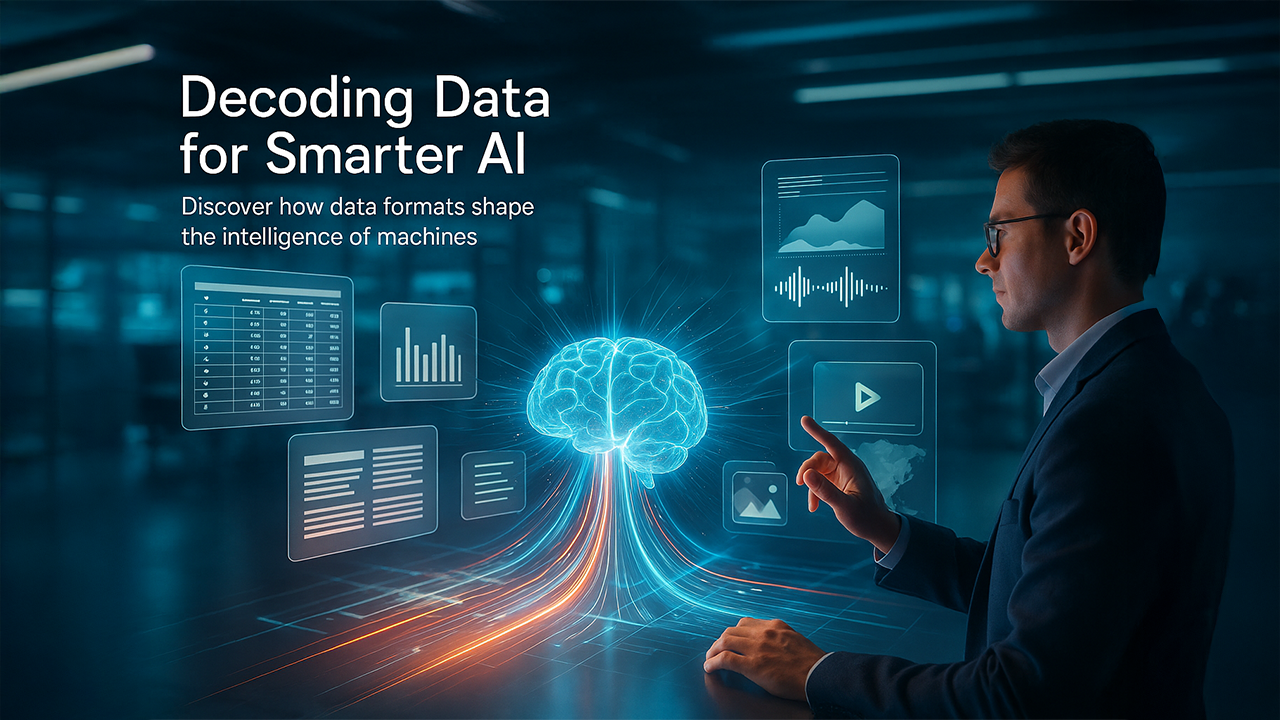






Have you ever wondered how Netflix always seems to know what show you'll like next? Or how does your bank instantly catch a suspicious transaction on your card? It can feel like magic. But it isn't. It's math, specifically statistics, that is working quietly in the background.
Most people hear the word "AI" and think it's too complicated to understand. So, they never try to learn how it actually works, even though the core features of AI affect their daily life in small, invisible ways”. You don't need to be a scientist or be good at math to understand statistical AI. You just need someone to explain it in plain, simple words. That's exactly what this guide will do.
What Is Statistics AI?
Statistics AI refers to artificial intelligence systems that use statistical methods such as inference, probability, and data-driven modeling to derive accurate predictions, recognize patterns, and support decisions. These AI models don’t follow rigid or hand-coded rules. Rather, they learn from data, estimate probabilities, and tweak their outputs as they receive new information.
Think of it as the difference between a system that's told exactly what to do versus one that figures out what's probably true based on evidence. A spam filter doesn't "know" an email is spam the way a human would recognize a face to tell apart their friends from strangers. Based on patterns in millions of past emails, it calculates the probability when something fits the profile. When this calculation is repeated and refined constantly, that is when you know statistics AI is working.
How Statistics AI Works: Core Principles and Mechanisms
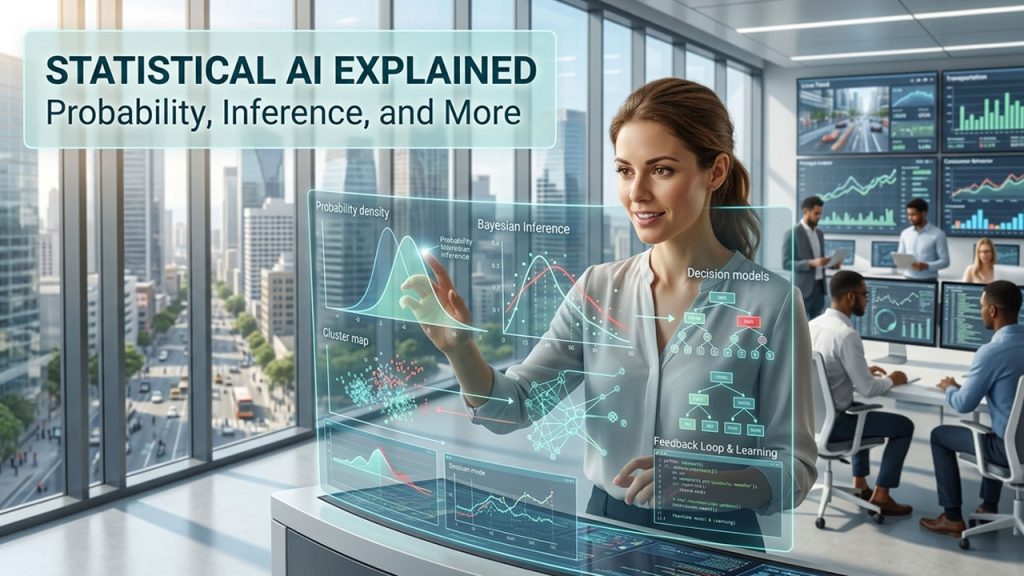
There are a few core mechanisms that are doing the actual work underneath every statistical AI system. Here's what they are:
- Probability Theory: This is the very foundation that everything else sits on. Statistical AI doesn’t give out absolute output; rather, it deals in likelihoods. It estimates how probable an outcome is rather than declaring it absolutely true.
- Statistical Inference: This is how a model concludes a larger population from a smaller sample of data. It does not need to examine every single case to do that
- Pattern Recognition: AI models are fed with data to identify recurring structures or patterns in data, whether that's a shape in an image, a trend in sales numbers, or a sequence in language.
- Statistical Models: These are mathematical frameworks, like regression or classification models. They translate raw data into predictions that can be used meaningfully.
- Continuous Learning Through Feedback: The model keeps updating its estimates upon receiving new data. Over time, it gets sharper and more accurate instead of staying static.
Put together, these mechanisms allow a system to move from “here’s some data” to “here’s what’s likely to happen next,” which is really the whole point of statistics in AI.
Key Features of Statistics AI You Should Know
Statistical AI has several features, but not every feature can be applied in every situation. Below are the five features that actually matter and where you can use them:
Probabilistic Reasoning
The system does not give a flat yes-or-no answer. Rather, it expresses outcomes as probabilities. You can use this feature when you need to attach a confidence level to a decision, like a medical diagnosis tool that says “70% likely” instead of just “yes.”
Predictive Modeling
This feature uses historical data to forecast future outcomes, forming the backbone of what's known as predictive analytics. It is most useful in situations like anticipating something before it happens. For instance, when you are trying to figure out when a customer will abandon you or predict stock movement.
Anomaly Detection
Statistical AI is especially good at recognizing data points that don't fit the expected pattern. You can use this feature if your business deals with sensitive information. This helps you catch fraud, defects, or unusual system behavior early.
Data-Driven Adaptability
When new data arrives, these AI systems adjust their internal models rather than staying rigid or static. This is particularly important in fast-changing environments, like stock or financial markets, where situations keep changing, and yesterday’s patterns might not be useful today.
Uncertainty Quantification
Beyond just making a prediction, statistical AI can estimate how confident it actually is in that prediction. This is critical when decisions carry real risk, and you need to know not just the answer, but how much to trust it.
Top Benefits of Statistics AI

Statistics AI offers several advantages that improve prediction accuracy, decision-making, and business efficiency.
More Accurate Predictions
Because statistical AI is built on probability rather than fixed rules, it tends to handle messy, real-world data better than simpler systems. It is especially useful in areas like demand forecasting, where conditions rarely stay constant.
Better Decision-Making Under Uncertainty
When outcomes aren't guaranteed, you can use statistical AI to assist you with weighing options based on likelihood instead of guesswork. It's especially valuable in high-stakes fields like healthcare or insurance, where every decision carries risk.
Scalability Across Large Datasets
These systems can process and learn from massive amounts of data far faster than manual analysis ever could. This becomes essential once you're working with big data, where traditional statistical methods simply can't keep pace.
Continuous Improvement Over Time
These models keep improving over time as the new data flows in. The longer the system runs, the more it improves its performance. This benefit matters most in long-term applications, like recommendation engines that get sharper the more you use them.
Early Detection of Risks and Opportunities
Statistics AI constantly analyzes patterns to flag any problems, anomalies, or possibilities before they become obvious to a human observer. This is particularly useful in detecting fraud and controlling quality, where catching something early saves real money and time.
5 Best Statistics AI Tools for Data Analysis
If you're looking to actually put statistical AI to work, here are five statistical analysis tools that are worth knowing and perform well:
| Tool | Best For | Works With | Standout Feature |
|---|---|---|---|
| ChatGPT (with data analysis) | Quick statistical summaries and exploratory analysis via natural language prompts | CSV, Excel, PDF, Google Sheets | Turns plain-English questions into working statistical breakdowns |
| Julius AI | Running statistical tests and generating visualizations without writing code | Excel, CSV, Google Sheets, live database connectors on paid tiers | Builds an understanding of your dataset so repeat analysis stays consistent |
| DataRobot | Automated machine learning and predictive modeling for business use cases | Cloud platforms (AWS, Azure, GCP), Tableau, Looker, Qlik Sense | Automated feature engineering that removes manual model-building steps |
| IBM SPSS Statistics | Advanced statistical analysis in academic and research settings | Excel, SAS, Tableau, Power BI, RStudio | AI Output Assistant translates complex statistical results into plain-language insights |
| Tableau (with AI features) | Turning statistical patterns into clear, interactive visual dashboards | Excel, SQL databases, cloud data warehouses, SPSS | Tableau Agent enables natural-language querying of your data |
Each of them is used for different purposes. So, the right choice depends on what you want to do, whether you want to do quick analysis, carry out deep research, or build something that needs to scale.
Real-World Applications of Statistics AI

Statistical AI isn't theoretical. You might not realize it, but it’s already used in things that you use regularly.
Healthcare Diagnostics: Statistical AI models are used in hospitals or clinics to analyze patient data, scans, and history so that healthcare professionals can estimate the probability of certain conditions to catch issues earlier and with more confidence.
Financial Fraud Detection: Banks rely on statistical AI to identify transactions that deviate from a customer's normal pattern. It helps catch fraud in real time instead of long after the damage is done.
Recommendation Systems: Whether it's a streaming service or an online store, these platforms use statistical models to predict what you're likely to want next, based on patterns from your past behavior and people like you.
Weather Forecasting: Modern forecasts rely heavily on statistical inference. They process enormous amounts of atmospheric data to estimate the probability of rain, storms, or temperature shifts days in advance.
Conclusion
Statistics AI isn't a far-off, specialized field anymore. It's the quiet logic running behind recommendation engines, fraud alerts, medical tools, and forecasts you check every morning. You don't need to build these systems yourself to understand them. Once you know that AI is really just statistics and probability working in the background, it doesn’t feel confusing anymore. You start to see it for what it actually is, a tool that looks at patterns in data and makes educated guesses. It is not mysterious.
That shift in perspective, more than any single tool or technique, is what makes statistical AI worth learning in the first place.
FAQs About Statistics AI
Not exactly; machine learning often uses statistical AI methods, but statistical AI is broader and includes classical statistical reasoning too.
No, a basic grasp of probability and how predictions work is enough to understand the concept.
Healthcare, finance, retail, and weather forecasting are among the heaviest users of statistical AI today.
Yes, tools like ChatGPT and Julius AI let you run statistical analysis through simple, natural language prompts.
It allows AI systems to draw reliable conclusions from limited data instead of needing to analyze an entire population.