





Developing a new feature or a product without testing can be an expensive gamble. Teams that skip initial validation generally find usability issues, design flaws, or misaligned expectations only after substantial money and time have been spent already. This is precisely the gap that rapid prototyping closes. By generating a working model of a product early in the design cycle, teams can collect actual feedback, test assumptions, and fine-tune their approach before committing to full-scale development. For CRM platforms, digital products, and SaaS tools, rapid prototyping has become a core standard part of the design workflow since it minimizes guesswork and ensures that the development process remains aligned with precise user requirements.
What is Rapid Prototyping?
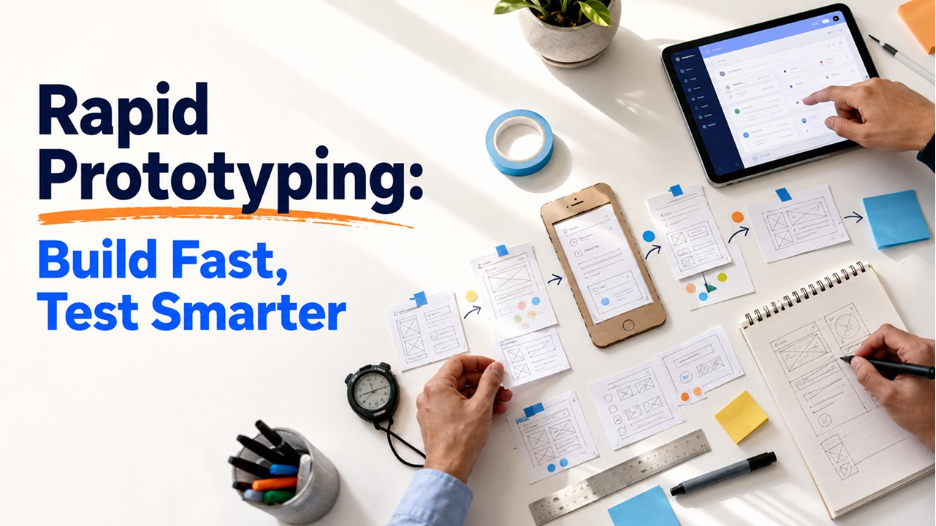
Rapid prototyping refers to the overall process of generating a testable and simplified version of a product, system, or feature quickly before developing the final version. Instead of investing months into a fully programmed app, teams first generate a scaled-down model such as a wireframe, a sketch, clickable mockup, or functional demo to check out how a design works in practice.
The core function of rapid prototyping is not to create a refined product. It is to quickly answer specific questions:
- Does this flow make sense to the users?
- Is the layout innovative for first-time users?
- Does the characteristic solve an issue it was designed for?
Since prototypes are quick and inexpensive to create when compared to completed products, teams can discard what does not work, test different ideas, and optimize what does, all before a single line of production code is written. This is an iterative approach which is closely associated with the wider UX and UI design principles. This is because a prototype is basically a tool for verifying the user experience early on.
How Does Rapid Prototyping Work?
Rapid prototyping often follows a repeatable and short cycle instead of a single linear step. Most teams segment the process into three main stages:
- Build – Create an initial version of the concept or design. It can be a digital wireframe, a paper sketch, or an interactive mockup based on how much detail is required at this stage.
- Review – Share your prototype with actual stakeholders or users to check out its performance. This step emphasizes collecting specific and honest feedback instead of general impressions.
- Refine – Utilize the feedback to resolve pain points, adopt the design, and enhance usability before going to the next iteration.
This loop of build-review-improve goes on until the prototype dependably meets business objectives and user expectations. Since the process prevents heavy investment upfront, teams that follow methods of rapid prototyping can quickly pivot if initial feedback reveals that an idea requires rethinking. It helps teams who rigorously follow user experience fundamentals, where initial structural decision fine-tunes how useful a product becomes ultimately.
What Are the Different Types of Rapid Prototyping?
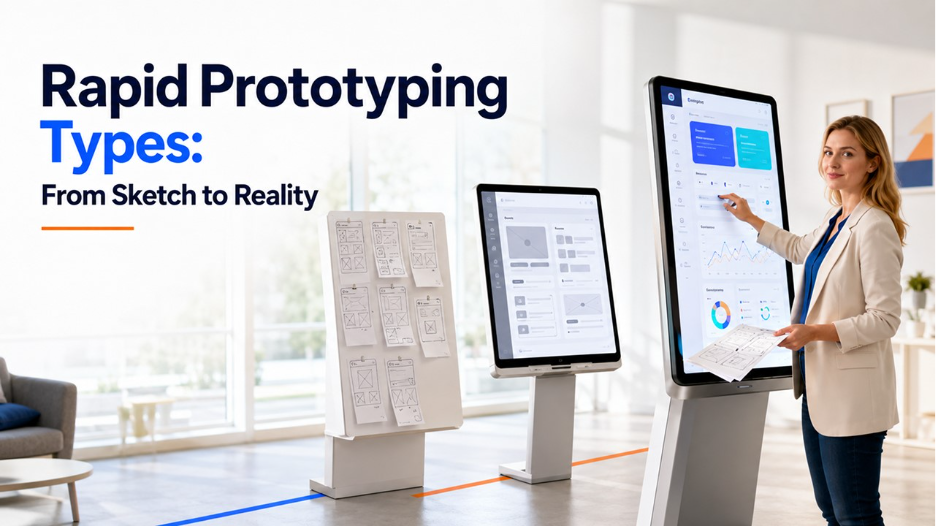
Not each prototype requires a similar level of detail. According to the questions being answered and the stage, rapid prototyping often falls into three core categories:
Low-Fidelity Prototypes
- Basic digital wireframes or paper sketches.
- Utilized early to test flow as well as the structure, not the overall visual design.
- Quick to create and simple to modify.
Medium-Fidelity Prototypes
- Wireframes with layouts and interactions that are more defined.
- Generally, create the available components of the design system.
- Valuable for verifying content hierarchy and navigation.
High-Fidelity Prototypes
- Near final and interactive mockups or coded demonstrations.
- Closely emulate the completed product in behavior as well as appearance.
- Ideal option for stakeholder presentations, user testing, or developer handoff.
While UI and software teams often work with online prototypes, rapid prototyping also plays a key role in the development of physical product, where techniques such as 3D printing and CAD modeling are utilized to test function and form before manufacturing. For teams developing digital tools like Customer Relationship Management tools, though, the process stays very close to clickable demonstration and wireframes. This is the same foundational thinking which is behind strategizing how to build a SaaS product from ground zero.
Main Advantages of Quick Prototyping
Adjusting rapid prototyping early in the project ensures numerous possible benefits:
- Quicker Verification – You can test the ideas in days instead of in month, minimizing the time which is spent on developing features that nobody really needs.
- Less Development Risk – Catching flaws in design in a prototype is significantly less costly than resolving them after launch.
- Better Alignment with Stakeholders – A visual prototype can explain an idea much more clearly than a written specification. This makes it simpler for clients and teams to agree in a single direction.
- Enhanced Satisfaction with Users – Involving actual users early on makes sure that the final product represents precise requirements than assumptions.
- Efficiency in Cost – Since prototypes are fast to develop and revise, teams must avoid the expense of re-creating a completely developed product.
Such advantages multiply over the course of a project. Each iteration of testing and refinement through rapid prototyping reduces the gap between what a team assumes users require and what they really require, resulting in a streamlined path for a usable and finished product.
Conclusion
Rapid prototyping provides teams with a way to test, verify, and fine-tune ideas before dedicating substantial time and resources to the entire development process. By developing fast and testable versions of a design and collecting feedback early on, teams can catch usability issues, align with stakeholder expectations, and minimize the risk of expensive rework later. Today, AI prototyping tools can make this process even more efficient by helping teams quickly turn concepts into testable designs and explore different ideas. Whether the objective is redesigning an interface, adding a new feature, or developing an entirely new product, beginning with rapid prototyping helps ensure that what gets developed is exactly what users require — create quickly, test early, and deliver with greater confidence.