





Choosing enterprise risk management software comes down to one decision more than any other. Do you want a platform that keeps your risk register current on its own, or one you can configure around a methodology you've already defined? Nearly every other difference between the leading tools follows from how you answer that.
That distinction matters more than it used to. Risk teams are being asked to govern AI tools nobody sanctioned, satisfy regulations that demand continuous testing, and produce a board report that holds up to scrutiny. Here's how we weighed each platform, what each one does well, and how to run an evaluation that surfaces the gaps before you sign anything.
What does enterprise risk management software do?
Enterprise risk management software gives you a single place to identify, score, treat, and report on risk across your organization. At minimum that means a risk register, a scoring method, and a way to tie each risk to the controls meant to reduce it. The platforms worth paying for do more than store that information. They keep it current.
That difference is what separates the five platforms below. Some were built around continuous monitoring, so a failed control changes a risk score without anyone intervening. Others were built as configurable databases, which means they hold whatever you put into them and reflect reality only as often as someone updates them. Both have legitimate buyers, and knowing which one you need will save you months of evaluation.
Which fits depends on how much of your program you're willing to run by hand. A configurable platform can model any risk methodology you can describe, but someone has to keep feeding it. A continuous platform makes fewer assumptions about your taxonomy and more about your tooling, since it needs deep connections to the environment it watches. The criteria below are built to surface that difference early, before it hardens into a procurement decision you can't reverse.
How we evaluated enterprise risk management software
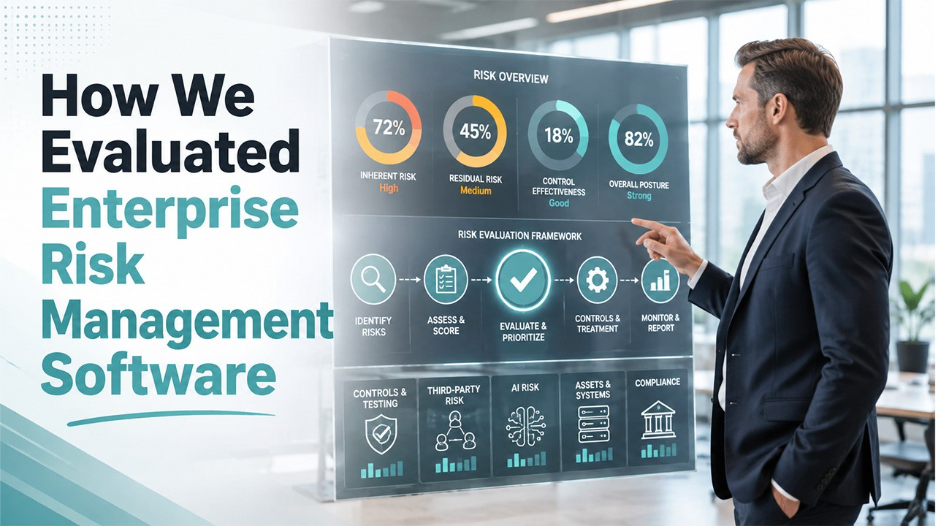
We assessed each platform against criteria that reflect real enterprise buying decisions rather than feature checklists. Five areas separate the platforms that hold up under audit from the ones that look fine in a demo.
Whether risks surface continuously or wait for a quarterly review
Enterprise risk that gets rediscovered manually each quarter is always out of date. Risks should surface from live signals like control failures, test results, incidents, vendors, and assets. Mature programs also need a structured starting point, which is why a pre-built risk library and an adaptable taxonomy matter more than they sound like they should.
Two coverage gaps show up repeatedly. The first is internal AI risk, since most enterprises run dozens of unsanctioned AI tools with no scoring method attached to any of them. The second is third-party exposure, which drives a large share of enterprise risk and belongs in the same register as everything else rather than in a disconnected module.
Ask vendors whether risk identification is continuous and signal-driven or a periodic manual exercise, what data sources feed new and changing risks, whether they provide a risk library with suggested control mappings, how they help you identify and score internal AI tools, and whether vendor risk feeds directly into the enterprise register.
How current your risk scores stay between audits
Boards and auditors need to see gross exposure and exposure after controls and treatment, which means inherent and residual scoring are both table stakes. The harder question is whether those scores stay current. Manual, gut-feel scoring is inconsistent the day it's entered and stale a month later.
Ask whether the platform can recommend scores with a stated rationale, and whether residual scores update automatically as controls and evidence change.
What happens after a risk gets identified
ry risk, whether that's accept, mitigate, transfer, or avoid, with evidence and an approver attached. Risk that isn't linked to controls, assets, and vendors can't be monitored or proven, and mapping is what turns a register into a posture.
The tie-in to continuous control monitoring is where most platforms separate. Point-in-time assessment is being replaced by continuous testing, and risk should reflect control performance in real time. Ask what treatment options are supported, how each decision is documented and approved, whether a failed control automatically elevates the related risk, and how frequently controls are tested.
Which reports your board and regulators will accept
Large organizations run separate registers per team, entity, or region, and they need scoped views rather than one shared list with filters bolted on. They also need a hierarchy, because a board doesn't want operational scenarios. It wants the top organizational risks, which means tactical scenarios have to roll up into strategic ones.
Ask whether the platform supports multiple registers with scoped views by business unit, entity, or region, whether tactical risks roll into enterprise risks for executive reporting, and whether you can produce board-ready and audit-ready reports without manual reconciliation.
Where consolidation ends and admin overhead begins
Running risk, compliance, vendor risk, and trust in separate tools creates fragmented data and reconciliation overhead that lands on your team every reporting cycle. Integration depth matters just as much, since risk grounded in your real environment requires connectors purpose-built for GRC rather than generic API plumbing.
Total cost of ownership is the last filter. Legacy GRC suites often require dedicated administrators, long deployments, and heavy service fees that don't appear on the initial quote. Ask about typical time to value, whether the platform needs dedicated administrators, and what implementation services cost in practice.
The 5 best enterprise risk management platforms compared
Each of these platforms serves a different buyer. Read the tradeoffs before the feature lists.
1. Vanta
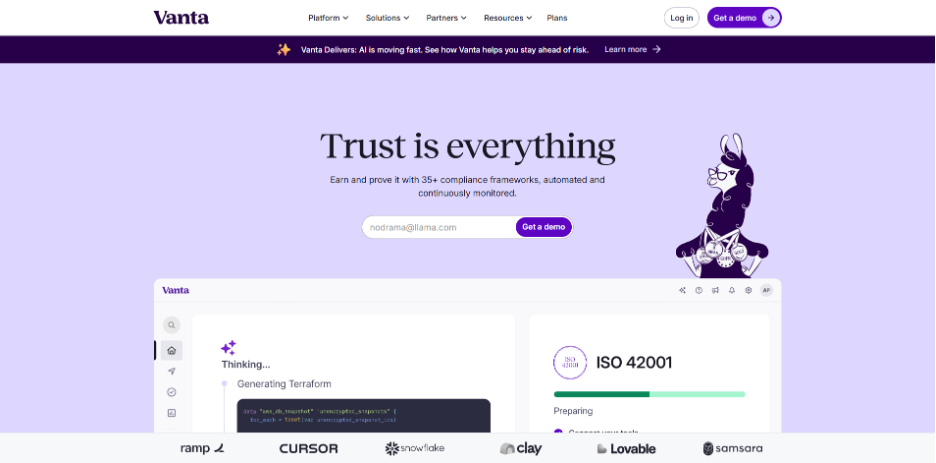
Vanta is an Agentic Trust Platform that unifies compliance, risk, and proof in one place. As you scale, your attack surface grows and security work fragments across disconnected tools, which is how unidentified risk accumulates. Vanta integrates directly into the tools you already run so every control, policy, vendor review, and risk stays current.
The platform replaces spreadsheets and point-in-time reviews with a continuous view of internal and third-party risk. You get AI-powered vendor security reviews that flag key risks, multiple risk registers for organization-wide visibility, and flexible risk scoring. Vanta AI surfaces the issues that matter most so you know what to fix first, and continuous control monitoring keeps that ranking honest between audits.
Risk data connects directly to compliance and control data, which means a failed SOC 2 control automatically surfaces as an elevated risk. That removes the manual reconciliation most enterprises perform before every board meeting. Vanta supports SOC 2, ISO 27001, HIPAA, HITRUST, GDPR, NIST AI RMF, ISO 42001, and custom frameworks, with enterprise features like adaptive scoping and multi-entity workspaces. Vanta is recognized as a Leader in The Forrester Wave for governance, risk, and compliance platforms.
Key features
- Continuous control monitoring across risk, compliance, and vendor workflows with real-time alerts
- Multiple risk registers with enterprise roll-ups, flexible risk scoring, and risk-to-asset mapping
- AI-powered vendor risk management with automated reviews and continuous third-party monitoring
- Agentic AI workflows for policy management, evidence collection, and vendor assessments
Best for
Growing companies and enterprise security teams that need to manage risk, compliance, and proof continuously in one platform.
Where it stands out
Risk, compliance, vendor risk, and customer trust live together, which eliminates the data silos that force manual reconciliation. Automated tests keep risk scores and evidence current without anyone touching them, and Vanta AI prioritizes the highest-impact risks with data-driven recommendations.
What to watch
If your needs are genuinely simple and single-framework, you may not use the full depth of the platform. Connecting the full integration network across a complex environment takes upfront configuration planning. Quantitative scoring with dollar-value exposure per risk is on the roadmap, so teams that need financial-impact modeling today should test that specifically during a POC.
2. Drata
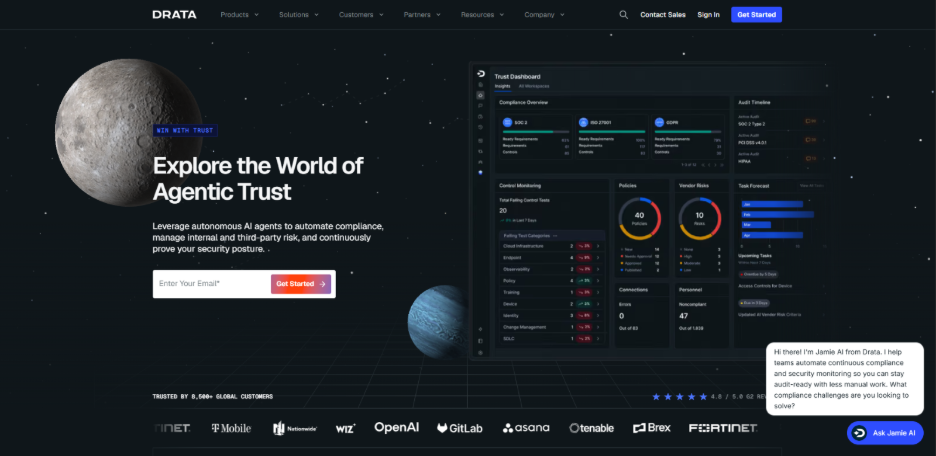
Drata is a compliance-first platform that has expanded into risk management and vendor risk. It acquired SafeBase to add trust center and security questionnaire capabilities. The product focuses heavily on automated evidence collection and continuous compliance monitoring across multiple frameworks, and you can use it to streamline audit preparation and keep visibility into your compliance status.
The risk module includes risk assessments, a centralized register, and vendor risk tooling. It grew out of the compliance product rather than the other way around, and that origin shows. Evidence surfacing at scale is thinner than on platforms built around integration result libraries, cross-framework control mapping runs shallow, and the trust center arrived through acquisition rather than as a native module. If you're evaluating Drata for enterprise risk management, ask whether risk, compliance, and vendor data share a unified data model or whether you're buying three products marketed as one.
Key features
- Automated evidence collection and continuous compliance monitoring
- Risk assessments and a risk register with framework mapping
- Vendor risk management with security review workflows
- Trust center capabilities for sharing security posture
Best for
Teams focused primarily on compliance automation that want basic risk management in the same tool.
Where it stands out
Automated evidence collection is strong and speeds up audit prep. Pre-built framework mappings help satisfy several frameworks at once, and the included trust center tooling makes it easier to share security documentation with prospects.
What to watch
Risk coverage handles the basics but lacks depth for mature programs. Customization of inherent risks and scoring rubrics is limited, and reporting may fall short of what complex, multi-entity organizations need.
3. OneTrust
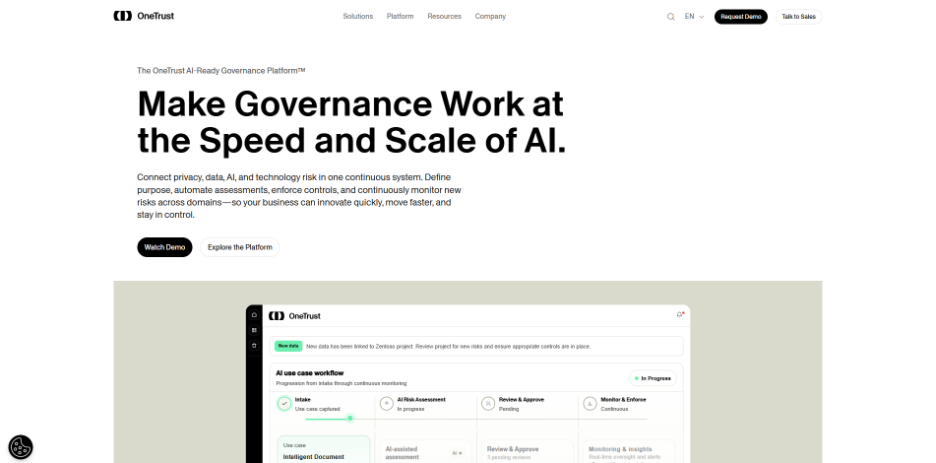
OneTrust is a broad trust intelligence platform with deep roots in privacy management and data governance. It was assembled through acquisitions spanning privacy, risk, compliance, third-party risk, and ESG modules, and it's a reasonable fit if you manage complex regulatory requirements across global jurisdictions.
The platform provides risk assessments, registers, third-party risk management, and regulatory intelligence. It performs particularly well in privacy-specific workflows like Data Protection Impact Assessments and automated data mapping. Its AI capabilities concentrate on data and privacy use cases, helping you track how personal data moves through your environment and identify the privacy risks that follow.
That breadth introduces real complexity. Implementation timelines and total cost of ownership for enterprise deployments run high, and the platform typically requires dedicated administrators. If your program centers on security and compliance risk rather than privacy and ESG, you'll likely find it wider than you need.
Key features
- Integrated risk management with assessments, registers, and treatment workflows
- Third-party risk management with vendor assessments and continuous monitoring
- Privacy management including DPIAs, data mapping, and consent management
- Regulatory intelligence tracking global compliance changes
Best for
Organizations with complex privacy, risk, and compliance requirements spanning multiple regulatory domains, including GDPR, CCPA, and ESG reporting.
Where it stands out
Data-mapping and DPIA tooling are mature, built on genuine privacy heritage. Module coverage spans privacy, risk, and ESG in one suite, and built-in regulatory intelligence helps you monitor global changes.
What to watch
The scope makes the platform hard to navigate and configure. Total cost of ownership is high and implementation timelines are long. Most organizations need full-time staff dedicated to administering it.
4. LogicGate Risk Cloud
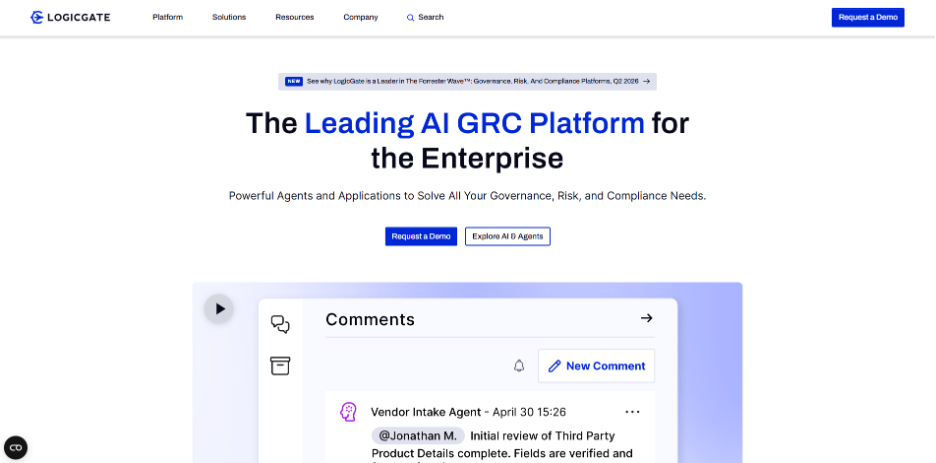
LogicGate Risk Cloud is a flexible, no-code risk management platform aimed at enterprise risk and compliance teams. Its workflow builder lets GRC teams design custom risk processes without pulling in engineering, so you can shape the tool around your organizational structure and risk methodology rather than the reverse.
You get configurable registers, inherent and residual scoring, risk-to-control mapping, and third-party risk management. The platform supports custom taxonomies and unusual scoring models well, and you can build assessment workflows that match how your business units already operate.
That flexibility has a cost. Significant configuration work comes before you see value, and integration depth with security tooling is narrower than on platforms built with a bottom-up integration architecture.
Key features
- No-code workflow builder for custom risk processes and assessments
- Configurable risk registers with inherent and residual risk scoring
- Third-party risk management and compliance management modules
- Custom risk taxonomies and flexible scoring methodologies
Best for
Teams that need highly configurable workflows and custom taxonomies, and have the resources to build tailored processes.
Where it stands out
Teams build custom workflows without software engineers, adapt the tool to unique scoring models, and align processes with existing business unit operations.
What to watch
Upfront build and design time is substantial. Advanced reporting takes additional configuration and sometimes external tools. Integration depth with technical security and cloud tooling is narrower than competitors built integration-first.
5. Archer
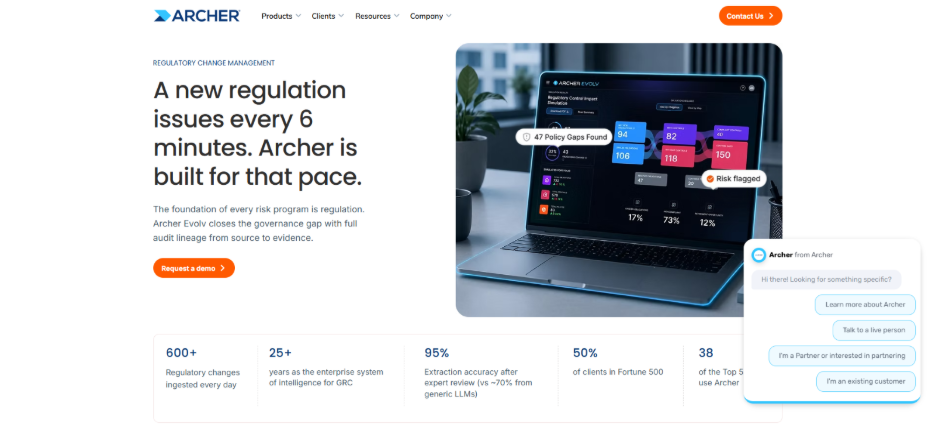
Archer is a legacy enterprise GRC platform offering deep configurability and broad module coverage across operational risk, IT risk, regulatory compliance, and business resiliency. It has historically served large, highly regulated enterprises in financial services and healthcare.
The platform provides enterprise registers, quantitative and qualitative scoring, and tactical-to-strategic hierarchies for board-level reporting, along with extensive regulatory content libraries and incident management. It performs well in complex, multi-entity environments that require mature, formalized risk governance.
Its architecture shows its age. Implementation takes significant time, dedicated administrators, and heavy professional services investment. The user experience feels dated next to cloud-native platforms, and automation depth for evidence collection and continuous control monitoring is typically lighter than on integration-first tools.
Key features
- Configurable enterprise risk registers with quantitative and qualitative scoring
- Tactical-to-strategic risk hierarchies for board-level reporting
- Broad module coverage including operational risk, IT risk, and business resiliency
- Extensive regulatory content libraries and incident management
Best for
Companies with mature GRC programs, dedicated GRC administrators, and complex risk governance requirements.
Where it stands out
It can be customized to fit the most complex enterprise risk models, supports tactical-to-strategic roll-ups for board reporting, and covers operational risk, IT risk, and business resiliency in one suite.
What to watch
The dated interface and slow, expensive implementation cycles are real friction. Dedicated administrators and ongoing professional services are effectively required. Automated evidence collection and continuous compliance are available only with Archer Evolv, not the core platform.
How to choose the right enterprise risk management software
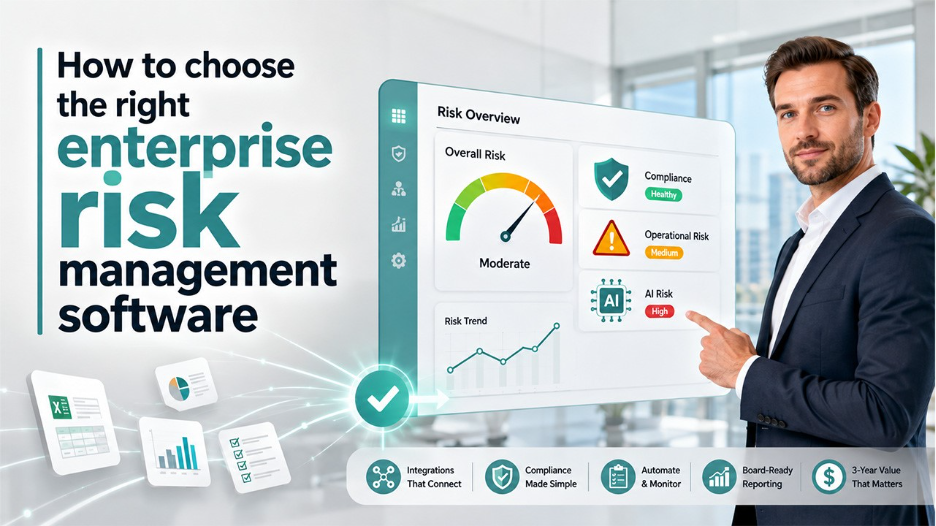
Picking a platform comes down to how well it solves your specific operational bottlenecks. Work through these seven steps to land on a tool that eliminates disconnected data and governs emerging threats like AI risk.
Price the reconciliation work you do before each board meeting
Find out where risk data lives today, including every spreadsheet and standalone tool nobody lists on the architecture diagram. Then document the manual reconciliation effort your team performs before each board meeting. That number is the clearest baseline you'll get for what a unified platform is worth.
List the frameworks you'll add in the next two years
Map every compliance framework you must satisfy today, whether that's SOC 2, ISO 27001, HIPAA, GDPR, or a sector standard, then extend the list to where the business is heading. Confirm the platform supports cross-mapped controls so one piece of evidence satisfies several frameworks. Scoping to only what you need right now is what makes the second framework expensive.
Match the integration list to the environment you run
Confirm the platform connects to your cloud infrastructure, identity providers, and HR tooling with purpose-built, GRC-specific integrations. Generic connectors that pull raw API data still leave your team interpreting it. Ask how many integrations exist, how deep each one runs, and whether on-premises and private environments are supported.
Break a control during the trial and watch what happens
Run a live trial against actual production connections rather than a sandbox. Verify that a failed control surfaces as an elevated risk automatically, without anyone filing a ticket. This single test separates continuous platforms from tools that simply store the results of periodic assessments.
Ask to see the AI risk register and the scoring rationale
Confirm the platform can identify, score, and track internal AI tools as a distinct risk category with a structured methodology. A checklist isn't a methodology. Push for a live walkthrough rather than a roadmap slide, since this is the area where the gap between marketing and shipped product is widest right now.
See what reporting looks like out of the box
Request sample board-ready risk reports and confirm the platform produces defensible posture views without manual data assembly. Ask what ships ready to use versus what requires configuration or a separate BI tool. If reporting depends on exporting to a spreadsheet, you've reintroduced the problem you set out to solve.
Compare three-year cost against year-one pricing
Factor in implementation services, dedicated administrator headcount, and integration maintenance alongside license cost. Legacy suites often carry service fees that exceed the subscription. Ask each vendor for a realistic time-to-value estimate you can hold them to, and treat the first year's quote as the floor rather than the number.
Where to start
The choice comes down to two questions. Do you need the platform to match your risk methodology exactly, or do you need it to stay current without manual upkeep? Archer and LogicGate answer the first well, provided you have dedicated administrators to configure and maintain them. OneTrust answers a narrower version of it, worth considering when privacy and ESG obligations drive the program rather than security risk. Drata answers the second at a basic level, with a risk module that arrived after the compliance product. Vanta answers it with risk, compliance, vendor data, and customer trust running on one data model, which is what lets a failed control raise a risk score without anyone intervening.
Whichever way you go, test the platform against real connections before you commit. A trial that runs on sample data won't show you how the tool behaves when a control fails overnight or when a vendor's posture changes mid-quarter. Ask each vendor for a sample board report and confirm it comes out of the platform without a spreadsheet step. Those checks tell you more about production behavior than a feature comparison can.