





If you work in a marketing agency, running campaigns without a sales funnel is no longer sustainable. Paid advertising costs are rising, digital marketing efforts are more fragmented, and sales cycles are getting longer. You must guide potential customers through the buying process, rather than hoping they will convert on their own.
Below are seven reasons why your agency needs a sales funnel as you launch your marketing campaigns.
1. Sales funnels bring the sales and marketing teams together.
A major challenge for agency owners is the divide between marketing and sales teams. A clear sales funnel helps everyone understand the process, stages, and shared goals.
Once you know how to set up funnels for an agency, you can align both teams. Marketing professionals can focus on lead generation, creating awareness, and content marketing. The sales team will focus on sales calls, the sales pipeline, and final purchases. Both of them work together to turn their leads into actual customers.
2. Funnels reduce customer acquisition costs.
Using a random marketing approach can waste your financial resources. A structured funnel lets your agency track key metrics and spend less to acquire customers.
This is how funnels improve efficiency:
- Filter qualified leads from a large pool of potential customers.
- Optimize landing pages for each funnel stage.
- Retarget prospective customers with relevant content.
Funnels help make digital marketing campaigns more predictable and profitable.
3. Funnels improve lead nurturing and relationships.

A funnel begins the long-term growth for your business. Agencies should nurture leads through building relationships before pushing immediate sales.
Effective lead nurturing includes:
- Email drip campaigns that deliver educational content at the right time in the customer journey.
- Lead magnets offer, like free trials.
- Content that combines automation and personalized content.
This method guides potential clients smoothly through every stage of the buying process.
4. Funnels support smarter content marketing strategies.
Agencies often create content that doesn’t convert or reach the right audience when they don’t use a content marketing funnel. Funnels let you research audience behaviour and intent.
Here’s a simple content map that you can use for your sales funnel:
- Awareness stage: Writing blog posts and creating social media posts.
- Consideration stage: Webinars and case studies.
- Decision stage: Customer testimonials, success stories, and social proof.
A focused marketing strategy ensures that every asset transforms users into customers.
5. Funnels enhance conversion rates across campaigns.
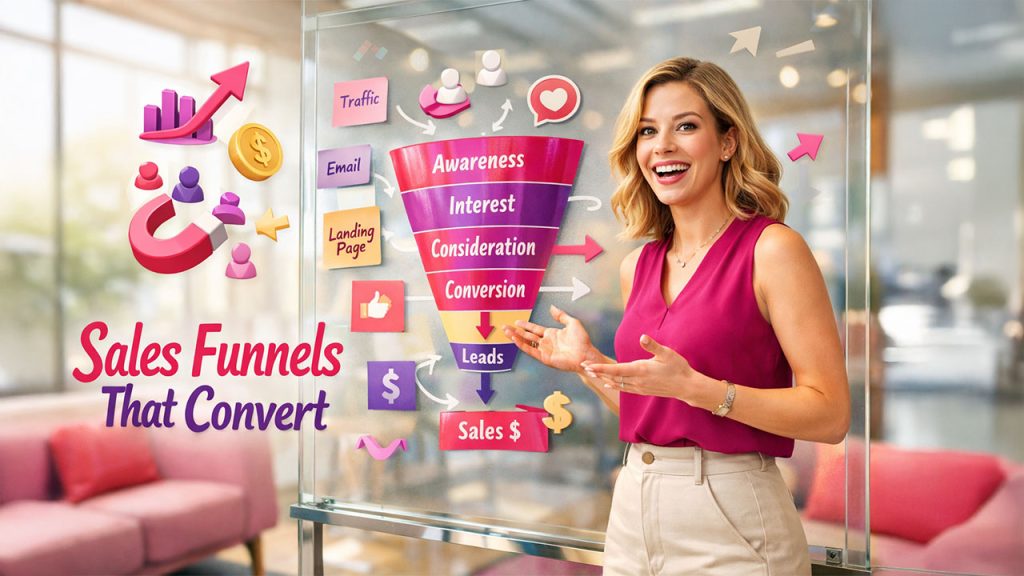
A functional digital marketing sales funnel optimizes conversions at every part of the campaign. Agencies can use the data from the funnel to refine customer experience.
These features make high conversion rates possible:
- Funnel optimization tactics
- A/B testing landing pages
- Web traffic and search engine performance tracking
- Customer relationship management tools for segmenting audiences and helping make sales easier with CRM automation.
Sales funnels are a continuous improvement process. You need to improve them over time as trends and audience behavior change.
6. Funnels turn existing clients into loyal customers.
Sales funnels still work even after the final purchase. If your agency only focuses on acquisition, you miss out big time on retention and referrals.
Use these post-purchase funnel strategies to nurture your customers:
- Upsells for the current ones.
- Follow-up campaigns for present clients.
- Collecting customer testimonials from your satisfied clients.
7. Funnels make your campaign performance measurable.
It’s difficult to show and prove a return on investment without sales funnels. With them, you can track sales cycle programs and improve your campaigns.
Here are the essential metrics you should track:
- Cost per lead from paid advertising: This shows the amount you spend to generate every lead through paid channels. Tracking this metric allows you to refine targeting and optimize your budget.
- Lead-to-sale conversion rates: This is the percentage of leads that turn into paying customers and shows if your sales and marketing funnels are effective.
- Funnel drop-off points: These points show where your potential customers get stuck in the funnel.
These valuable insights help you come up with more effective strategies and show measurable success to your clients.
Final Thoughts
If your agency is tasked to deliver results, sales funnels become a non-negotiable part of your marketing strategy. Using a well-structured one streamlines your marketing efforts and sales cycle, seizing every opportunity to turn leads into customers.
Funnels transform marketing efforts into scalable growth, from lead generation to the final purchase.