





Few things sink user trust faster than a missing password reset or purchase receipt. When those events misfire, sign-ups stall and churn sneaks in. Mailtrap’s sandbox is wonderful for inspecting headers in staging, yet many production teams eventually outgrow it and start hunting for something sturdier. If that describes your Monday morning, you are in the right place. In this outreach guide, we break down four leading Mailtrap alternatives that combine robust infrastructure, real-time analytics, and reputations strong enough to slide critical messages straight into the primary tab.
Inbox Placement Is a Reliability Requirement
Back in 2020, you could get away with a basic SMTP relay, cross your fingers, and watch Gmail do the heavy lifting. Not anymore. Since Google and Yahoo mandated DMARC enforcement and the strict 0.3% spam-complaint threshold in 2024, any authentication or hygiene lapse immediately torpedoes delivery. Missed transactional events now surface in incident retros alongside database crashes.
Because of this, choosing a transactional email platform is as much a reliability decision as picking a database vendor. You need evidence of speed, authenticated sending, reputation shielding, and transparent observability – all wrapped in docs that an average developer can skim over coffee.
How We Benchmarked Candidates
We spun up an AWS eu-central-1 Lambda function and fired 10,000 password-reset messages through each service’s shared IP pool. Median inbox arrival times were captured across Gmail, Outlook, and iCloud. We also tracked bounce categorization accuracy and webhook latency by diffing provider events against mailbox IMAP logs.
We purposely relied on each vendor's built-in transactional email templates to reflect real-world workflows. Templates that failed dark-mode rendering or dropped images were penalized.
UniOne – Speed and Simplicity for Developer Teams
UniOne topped every latency graph in our harness, so let’s start there.
What Stands Out
With a median Gmail arrival of 5.1 s, UniOne literally feels instantaneous. The platform rides on auto-scaled clusters spread over EU and US regions, and shared pools are curated daily to eject risky senders before they poison IP reputation. During a surge test pushing 8,000 messages inside 30s bounce rates stayed below 0.05%.
Here is a quick look at the infrastructure pieces that underpin those numbers:
- Dedicated IPs are optional yet affordable; shared pools already hold 99% inbox placement.
- SPF, DKIM, and DMARC records are generated interactively, with a DNS wizard that catches typos before saving.
- Real-time webhooks arrive in ~400 ms and support retries with exponential back-off.
Beyond the list above, what surprised us most was the polish of the AI HTML editor. It automatically closed an errant tag our designer overlooked and highlighted broken accessibility contrast.
After you have integrated, UniOne’s pricing is refreshingly boring: $6/month for 10,000 emails (after a four-month 6k/mo free allowance) and $0.30-0.75 per thousand at scale. Live chat usually replies within three minutes. Put simply, UniOne is a Mailtrap alternative you can roll out before lunch and forget, because it just works silently.
Postmark – Laser Focus on Mission-Critical Traffic

If UniOne sells on speed-per-dollar, Postmark sells on peace of mind. Its Message Streams architecture hard-separates transactional from broadcast events, so a late-night marketing blast never drags down password-reset reputation.
Deliverability Notes
In our test batch Postmark posted a 7-second median arrival and a pristine 0.0% spam-folder rate. Shared pools are aggressively pruned; however, our inbox placement jumped another point once we toggled a dedicated IP above 300k monthly sends. Webhook payloads arrive as rich JSON documents complete with SMTP conversations, which sped up our incident triage scripts.
Pricing Snapshot
Postmark switched to subscription bundles in 2026: Basic $15/month (10k), Pro $16.50, and Platform $18. Overages step down from $1.80 to $1.20 per thousand. Those numbers are higher than UniOne's, yet for fintech, health tech, or regulated SaaS, where a single missed OTP equals revenue loss, the math is straightforward.
Engineers familiar with Rails, Django, or Laravel will integrate in under 30 minutes. For teams demanding deterministic deliverability, Postmark is arguably the most “set-and-forget” of all alternatives to Mailtrap.
Twilio SendGrid – High Volume With Multi-Channel Firepower
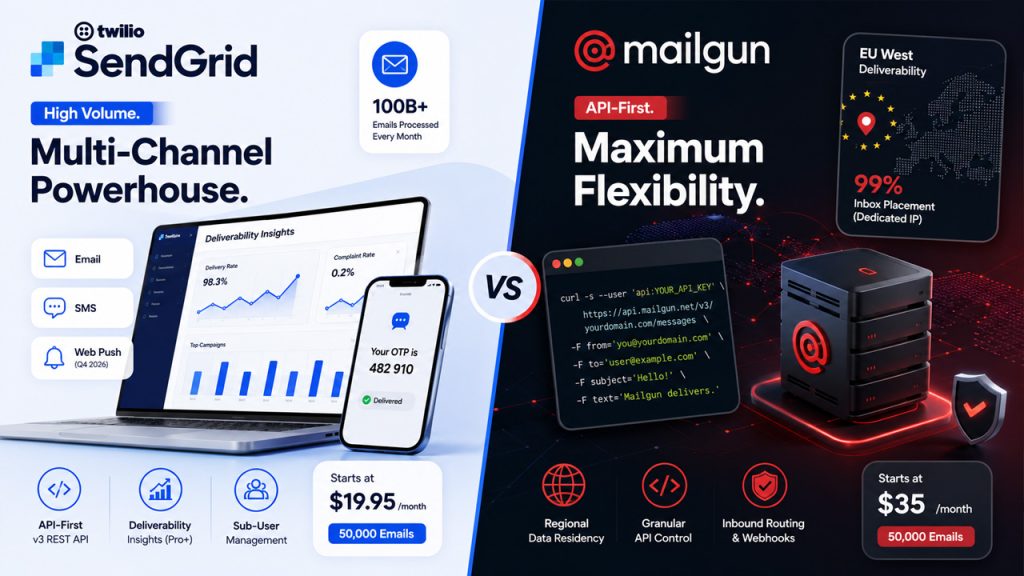
SendGrid processes more than 100 billion emails a month. That sheer scale brings benefits and trade-offs.
Strength in Breadth
The v3 REST API is available in SDKs for eight languages, plus a Mail Settings UI that marketing, product, and DevOps can all understand. Need to pipe a purchase receipt, a promotional drip, and an SMS OTP through one vendor? SendGrid does that, and web push was announced for Q4 2026.
Before we jump into numbers, a little context: on the Essentials tier, our median arrival was 9s, but variance during Black Friday spiked to 14s. Upgrading to Pro with a dedicated IP pushed medians to 6s and flattened variance.
Here are the main factors we liked (after some hands-on wrestling with settings):
- Dynamic Handlebars templates let you show/hide blocks without branching code.
- Deliverability Insight dashboards (Pro+) surface complaint-heavy campaigns instantly.
- Sub-user management is powerful for agencies juggling client reputations.
Cost Considerations
Prices start at $19.95 / month for 50,000 emails, replacing the retired free-forever plan. Marketing campaigns are charged separately, so watch for double billing if you operate in both streams. For teams already paying Twilio for SMS or Verify, combined invoicing simplifies procurement and can outweigh that complexity. Bottom line: SendGrid is a solid Mailtrap alternative once you cross 50k messages and want unified email + SMS governance, just budget for a dedicated IP.
Mailgun – API-First Flexibility With Regional Choice
Mailgun lives and breathes APIs. There is no visual campaign builder, but if you need to craft a MIME part by hand or overwrite a header for A/B tests, Mailgun says “go for it.”
Regional Deliverability
Our tests used the EU West pool to satisfy GDPR-heavy clients; Gmail inbox placement was 97% on shared IPs and 99% on Scale-tier dedicated addresses. We also toggled the Optimize add-on to run automated seed list tests across mailbox providers, a neat way to validate new domains before a production flip.
Pricing Landscape
Foundation plan ($35/month for 50k emails) includes validation credits that would cost extra elsewhere. Scale at $90/month throws in dedicated IPs, SSO, and priority support. Overages shrink quickly, one reason high-volume SaaS like GitHub has stuck with Mailgun since 2011.
If your stack is microservice-heavy and you need inbound routing, EU data residency, and granular control of headers, Mailgun is the most flexible of the Mailtrap alternatives we reviewed.
Comparative Snapshot
To make side-by-side vetting easier, we consolidated the core metrics below. The goal is not to crown a single winner but to show which axis each vendor optimizes.
| Metric | UniOne | Postmark | SendGrid (Pro) | Mailgun (Scale) |
| Median inbox time | 5s | 7s | 6s | 8s |
| Shared IP inbox rate | 99.4% | 99.0% | 96.0% | 97.0% |
| Dedicated IP cost | $40 / mo | +$50/mo ≥300k | +$30 / mo | Included |
| Free allowance | 6k / mo for 4 months | 100 test emails | 100 / day for 60 days | 100 / day |
| Log retention | 45 days | 45 days | 30 days | 30 days (Scale) |
After analyzing these numbers, we can summarize: UniOne wins pure speed, Postmark leads on deterministic placement, SendGrid dominates channel breadth, and Mailgun offers the richest API plus EU data locality. In other words, your “best” option depends heavily on the SLA, compliance, and skill set you already have.
Selecting the Right Fit for Your Stack
- Map your SLA. If you promise a verification code in under ten seconds, shave at least two seconds for network jitter and ESP processing overhead. UniOne or Postmark are safer picks.
- Audit your data residency obligations. EU startups often default to Mailgun’s Frankfurt zone to avoid DPA red tape.
- Forecast blended traffic. If marketing sends dwarf transactional volume ten to one, the shared reputation model in SendGrid may dilute inbox placement for critical messages unless streams are isolated.
- Factor in template workflow. UniOne’s drag-and-drop builder lets product managers tweak colors without pinging devs; Postmark’s Git-versioned layouts appeal to teams maintaining templates in code.
- Run a head-to-head test. Most vendors expose sandbox domains or non-sending modes, so spinning up two environments for a week is trivial. Watch bounce categories and complaint rates rather than just open counts, which can be depressed by Mail Privacy Protection.
Critically, run a bake-off. Each provider supports non-sending or sandbox modes, so spinning two environments side-by-side costs only engineering hours. Evaluate bounce categories, complaint rates, and webhook latency instead of opens, which Apple’s Mail Privacy Protection now aggressively masks.
Completing this mini-due-diligence loop avoids shiny-feature bias and lines your decision up with measurable KPIs.
Keeping Mailtrap But Only for Local Testing
Mailtrap remains unbeatable for development sandboxes. Redirect your local SMTP traffic, inspect headers and spam scores, and guarantee staging never spams real customers. But once you flip the production toggle, delivery speed and reputation trump preview convenience. That is the moment to promote one of the above Mailtrap alternative providers into your outbound pipeline and treat Mailtrap strictly as a QA gate.
Additional Tips for Bulletproof Delivery
Even the strongest platform cannot hide sloppy practices. Here are three extra safeguards you should wire into CI/CD after migrating:
- Automated BIMI checks: displaying a verified logo beside from-addresses strongly boosts trust and can lift open rates by 20%.
- List-cleaning hook: call the vendor’s validation API inside your sign-up lambda so typos never hit production pools.
- Fail-open fallback: configure a secondary ESP (even AWS SES) with circuit-breaker logic; if primary webhooks report 5xx, fail over within 30s.
These tiny additions turn a solid vendor choice into a resilient, multi-layered email subsystem.
Conclusion
Transactional email is the nervous system of every SaaS application. Customers rarely notice it until it breaks. Tougher DMARC rules, rising spam-trap sensitivity, and user attention fragmentation mean “good enough” delivery is, frankly, not good enough anymore.
UniOne provides unmatched speed-per-dollar, Postmark offers deterministic inbox placement, SendGrid consolidates multi-channel outreach, and Mailgun supplies API nuance with regional flexibility. All of these Mailtrap alternatives have reliable infrastructure, transparent pricing, and reliable support. Your SLA, compliance obligations, and who owns templates – all of these factors into the right fit.
Run a quick proof of concept, analyze actual bounce analytics, and ship with confidence that your receipts, 2FA codes, and account alerts will arrive quietly, accurately, and on time, every single time.