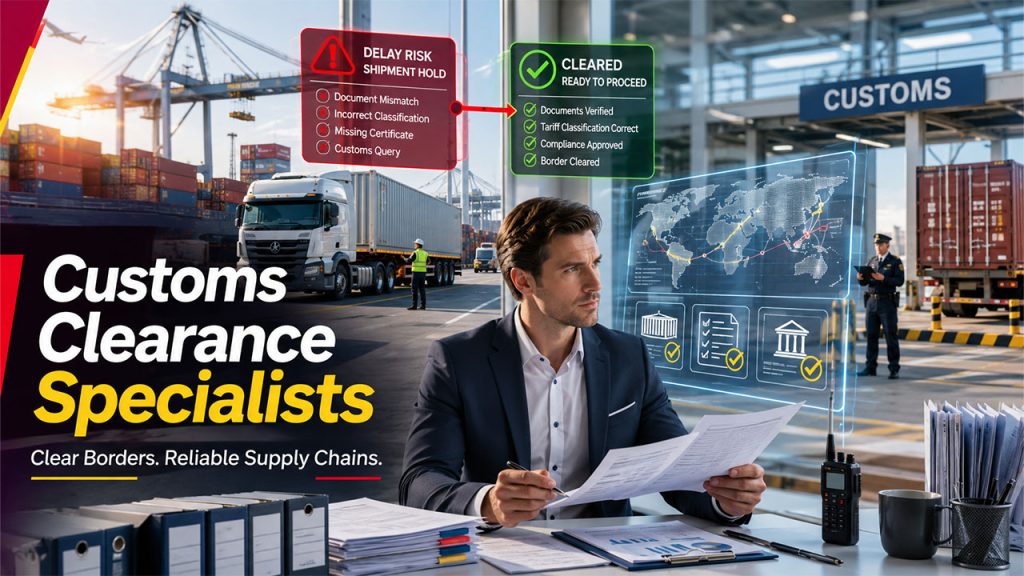






A delayed shipment appears like a logistical issue. For B2B supply chains, it is often much more than that. It can mean a lot of things such as production line waiting for components, a retail partner missing a seasonal window, or a service contract at risk because a crucial part did not arrive on time.
The point of vulnerability in most B2B supply chains is the border. What happens between the moment a shipment leaves an origin country and the moment it clears customs at the destination determines whether the supply chain functions the way it was designed to, or whether it becomes an expensive source of uncertainty.
Why Customs Is Where Supply Chains Break Down
Customs clearance appears to be simple until it is not. A shipment comes at the border with the incorrect harmonized system code, an inconsistency between the packing list or commercial invoice, or a missing origin certificate. The shipment is held. Your operations team starts making calls. Your customer starts asking questions.
In the majority of cases, these errors are completely avoidable. They happen since customs documentation was created without specialist knowledge since classification was quickly done instead of being careful, or since no one in the organization tracked a regulatory change that impacted the shipment in transit.
According to the WTO's trade monitoring data, the value of global goods imports affected by new tariffs and trade measures rose more than fourfold between mid-2024 and mid-2025, the highest level recorded in over 15 years. In this environment, relying on generic or internally managed customs processes creates meaningful and growing risk.
What Customs Clearance Specialists Actually Do
A customs clearance specialist is not simply a filing service. The most effective specialists provide end-to-end management of the clearance process, including:
- Pre-shipment classification review to confirm correct tariff codes before goods move
- Document preparation and accuracy checks across commercial invoices, packing lists, and declarations
- Communication with customs authorities on any queries or examination requests
- Duty optimization advice, including identifying free trade agreement eligibility where applicable
- Proactive monitoring of regulatory changes in relevant trade corridors
- Post-entry auditing to ensure that historical filings remain defensible
These functions minimize a specific point of failure in the supply chain. Together, they generate a customs process that is defensible, consistent, and considerably less likely to create the kind of unexpected hold that cascades into operational disruption.
The B2B-Specific Case for Specialist Support
Consumer supply chains have margin for imprecision, that the B2B supply chain generally does not. When one business depends on another for any type of resources, like components, materials, or finished goods, the tolerance for delay of the supply chain is measured in hours, rather than days.
A few practical realities that help in making specialist clearance are valuable in the B2B context:
Relationship risk: Missing any delivery commitment to a B2B customer has reputational and contractual consequences. These commitment failures do not apply in the same way to consumer deliveries. A specialist who prevents a border delay also protects the business relationship that the shipment supports.
Volume and frequency: The B2B importers majorly transport more shipments frequently, with each shipment of new opportunity of error surfaces. The efficiency gains from specialist handling compounds across volume.
Product complexity: Many B2B products involve technical classifications, dual-use restrictions, or component-level origin determinations that require genuine expertise to handle correctly. Getting these wrong does not just cause delays. It creates audit risk.
Choosing the Right Partner
Not all customs brokers operate at the same level of capability. When evaluating options for your supply chain, the questions that matter most are:
- Do they have proven experience in your specific product categories and trade corridors?
- What technology do they use to track shipments and flag exceptions in real time?
- How do they stay current with regulatory changes, and how do they communicate those changes to clients?
- What is their process for handling customs queries and examinations without requiring constant client involvement?
Working with established customs clearance specialists who combine regulatory expertise with strong technology infrastructure is what separates a proactive customs function from a reactive one.
Livingston International operates across North America and globally, providing customs brokerage and trade compliance services to B2B businesses that need consistent, expert-level clearance at scale.
Improving Supply Chain Visibility and Predictability
For B2B businesses, knowing where a shipment is and whether any customs issues are developing is often just as important as the clearance process itself. Unexpected delays create planning challenges for procurement teams, production schedules, and customer commitments.
These capabilities align with broader digital transformation initiatives across the logistics sector. Technologies such as real-time shipment tracking, AI-powered forecasting, and automated compliance tools are helping organizations build more resilient and transparent supply chains. Businesses exploring these innovations can benefit from understanding the latest tech-driven trends reshaping supply chains.
Conclusion
The measure of a good customs clearance partnership is not what happens when everything goes smoothly. It is what happens when a regulation changes, an authority raises a query, or a shipment arrives with a documentation discrepancy.
Specialists who have established processes for handling these situations resolve them faster, with less disruption to the supply chain, and with better outcomes than businesses managing the same situations without dedicated expertise.
In a trade environment that is growing more complex by the year, that consistency is worth a great deal to any B2B operation that depends on reliable cross-border supply.