





Selecting a reliable AI software development company is not an easy task. There are hundreds of companies offering their services as experts in artificial intelligence, but the difference between those who present good demos and those who deliver results in production can be significant. In this blog, we try to eliminate confusion.
We analyzed ten companies working on building AI-based products, automation of business processes, and delivery of software with tangible results for American clients in 2026. Our review included various AI software development companies of different sizes, specializations, and service delivery models. We provided a brief description of each company based on publicly available data and client feedback.
If you are a CTO analyzing potential partners for your AI based product development, a COO automating business processes, or a product owner delivering software faster, our review may be useful for you.
How we selected these companies
The selection criteria focused on:
- Verified track record of AI project delivery, not just AI positioning
- Presence in the US market as a primary or strong secondary focus
- Technical depth in relevant areas: machine learning, LLMs, process automation, cloud infrastructure
- Client feedback from third-party platforms (Clutch, G2)
- Ability to work on enterprise or mid-market projects with real complexity
Comparison table: top AI software development companies in the USA
| Company | Main expertise | Key strengths | Best for |
| Artkai | AI-native software development, business process automation, AI product build | Economics-first approach, senior engineering, transparent production delivery, enterprise governance | Mid-market and enterprise teams needing AI in operations or products |
| 10Pearls | Digital transformation, AI/ML, product engineering | Broad service portfolio, US-based leadership, healthcare and fintech focus | Companies looking for a US-headquartered digital partner |
| BairesDev | Staff augmentation, software development, AI/ML | Large talent pool across Latin America, fast scaling | Companies that need to extend their engineering team quickly |
| Ciklum | Digital engineering, AI, data & analytics | Strong delivery in Europe and UK, nearshore model, enterprise scale | Enterprises needing a nearshore partner with AI and data capabilities |
| DataArt | Custom software, data engineering, AI | Deep domain expertise in financial services and healthcare | Complex domain-specific software with data at the center |
| LeewayHertz | AI development, generative AI, blockchain | Strong focus on emerging tech, LLM integrations, AI agents | Startups and mid-size companies exploring GenAI and Web3 |
| N-iX | Software engineering, AI/ML, data | CEE engineering talent, Clutch-recognized, financial and telecom projects | Mid-market clients needing reliable nearshore development |
| Simform | Cloud, product engineering, AI | Agile delivery, startup to enterprise range, US presence | Product companies scaling their platform with cloud and AI |
| SoftServe | Enterprise AI, cloud, data platforms | Scale, regulated industries, strong consulting layer | Large enterprises navigating AI transformation at scale |
| Thoughtworks | Technology consulting, AI strategy, platform engineering | Deep strategy practice, global reach, continuous delivery expertise | Organizations that need both strategy and delivery capability |
1. Artkai
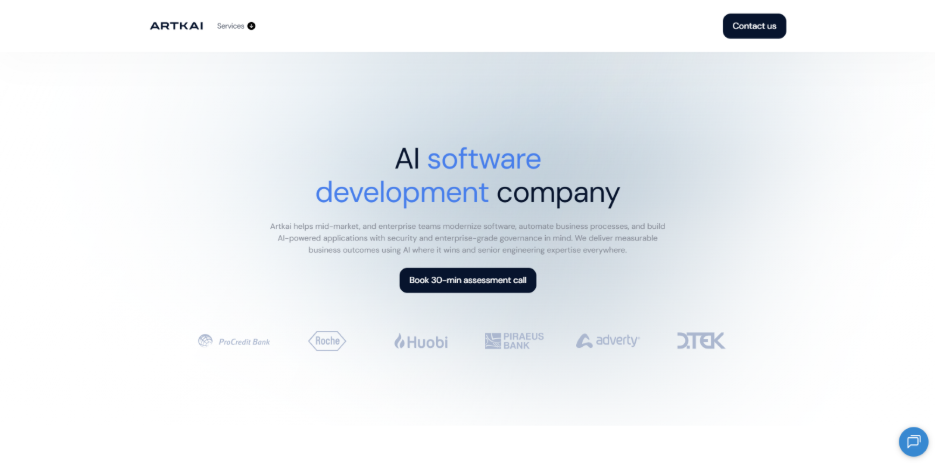
Artkai is an AI-native software development company that works with mid-market and enterprise clients primarily in the US and UK. The company focuses on two main delivery areas: automating business operations with AI and building AI features directly into software products. It operates as part of the Euvic Group, a European technology group with over 6,000 engineers.
The track record covers 150+ projects, with a Clutch rating of 4.9 from 53 reviews and a Clutch Top 1000 Global 2025 recognition. Clients include ProCredit, Roche, Huobi, and Piraeus. The company has been referenced in TechCrunch, Bloomberg, Forbes, and other business publications.
What Artkai focuses on
Three service pillars dictate how the company is structured:
- Business Process Automation helps operation teams by offering automation for manual and repetitive business processes. Services included in this pillar are workflow reengineering, intelligent documents processing, Robotic Process Automation with intelligent agents, and integrations. 40% savings in operating expenses have been observed on automated processes, payback period equals 3 to 6 months, and up to 60% reduction in manual labor.
- Development of AI Application helps product and technology teams to get AI functionality either implemented into their applications or build a completely new application using AI. A process begins with building a prototype within 2 weeks using the customer's data, then it goes into production. Benefits observed include 3x faster time to market and $3.70 ROI per $1 invested into AI development.
- UI/UX Design offers production-ready interfaces, such as design systems and frontend prototypes. It works on an inbound basis without paid promotions.
Why companies consider Artkai
The most important distinction is the emphasis on economic value first. Every project begins with assessing how much the client loses because of poor technology and operations economics, then scopes the project around ROI rather than cool technology. It’s an important distinction in light of many AI projects stalling when they reach the production stage due to lack of clarity about how they should be managed.
There is a strong emphasis on accountability of the project through experienced engineers. Experienced engineers are responsible for the success of the project; the use of AI will accelerate the project process but will not eliminate the need for oversight. This combination decreases the possibility of technical debt, as AI-assisted code written during the process may not be understood sufficiently to manage after it has been written.
Security and governance are included into the delivery process, which is important for financial services, healthcare industry, and other highly regulated environments. Access controls, privacy of data, auditability, and human-in-the-loop control are all available by default during the engagement.
The company does not push clients toward a single technology stack or platform. Decisions are made based on what performs best for the specific problem, which limits vendor lock-in.
Best for: Enterprises and mid-market teams that require AI in production, not in the demo.
2. 10Pearls
10Pearls is an American digital transformation company with engineering hubs located in South Asia and Latin America. The company has operated since 2004 and offers services in AI/ML, product engineering, clout, and cybersecurity.
Experience in healthcare, financial services, and government industries is one of the strengths of the company. The presence of US leadership and management can be considered a benefit for customers who value the same time zone and communication.
Strengths: Product-focused approach to delivery, US headquarters, references in healthcare and fintech.
Best for: US organizations that require domestic leadership with offshore delivery capabilities.
3. BairesDev
BairesDev maintains one of the biggest Latin American software engineering platforms, having thousands of engineers in the region. It mainly provides staff augmentation and team expansion services, along with having AI/ML capabilities as a part of their talent services.
Their clients have been big names like Google, Pinterest, and Rolls-Royce, but the extent of their service isn’t always clear publicly. This approach serves very well for firms which want to build up an engineering team quickly but do not want to commit to a full-outsourcing process.
Advantages: Bigger pool of talent, rapid scaling, flexible engagement options.
Best for: Firms that have internal product/engineering lead and want to scale up quickly.
4. Ciklum
Ciklum is an IT engineering firm based out of London but has delivery hubs in Eastern Europe. It has a few thousand engineers and caters to the enterprise segment in retail, finance, and media.
The AI offering from Ciklum includes data engineering, machine learning, and analytics. The nearshore approach works well in the case of UK and European clients even though the firm is trying to grow its footprint in North America.
Strengths: Scalability, strong experience with data analytics, well-defined delivery processes.
Best for: Enterprises, espically those in UK/Europe that want a structured nearshoring partner.
5. DataArt
DataArt is an international technology consultancy firm which has been in existence since 1997. The company’s main competencies are in the areas of financial services, healthcare and travel sectors, with considerable domain expertise which extends beyond mere software development.
The company’s artificial intelligence solutions are usually embedded in domain-oriented platforms: trading, clinical information management, and hospitality systems. DataArt has thousands of engineers spread across the US, UK, and Eastern Europe.
Strengths: Long history, considerable domain expertise in financial services and healthcare, and sound processes of delivery.
Best for: Companies developing or upgrading complex domain-oriented platforms.
6. LeewayHertz
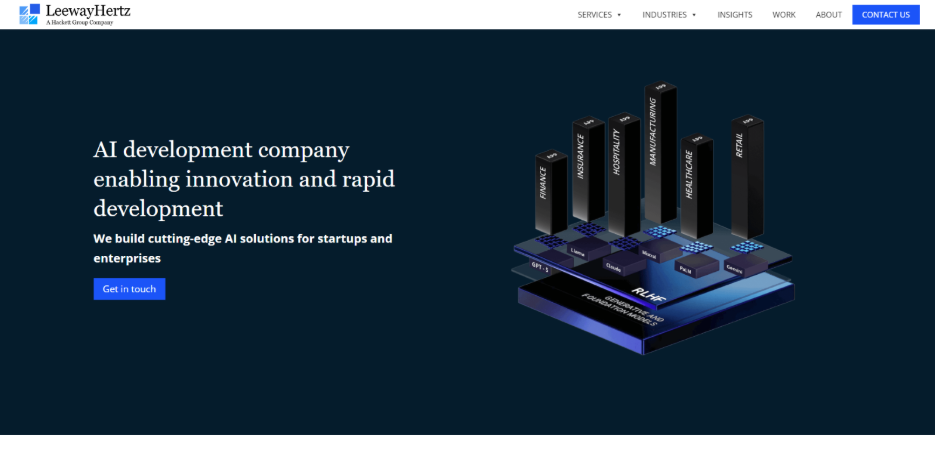
LeewayHertz has established itself in the field of AI development with a focus on Generative AI, Large Language Model integration, and AI agent systems. The San Francisco-headquartered company is also a provider of solutions in blockchain and Web3 development.
The firm provides comprehensive information about how AI can be implemented. This shows the real proficiency of LeewayHertz in the matter. If you have just started investigating Generative AI applications for your business, this is one of the options you will find more technically focused.
Strengths: Strong in Generative AI and LLM development, involved in Web3 practical experience with AI agents.
Best for: Startups and mid-size companies that want to implement generative AI or agentic workflows in their product.
7. N-iX
N-iX is a software engineering firm based in Ukraine that boasts more than 2,000 software engineers. This firm works for clients in the USA and Europe, having impressive projects in finance, telecommunications, and enterprise software.
N-iX is awarded by Clutch and has a strong clientele. It has strong expertise in providing reliable software engineering, and AI/ML solutions, most often embedded rather than greenfield AI developments.
Strengths: Experienced software engineering teams, stable development process, impressive references clients.
Best For: Organizations that need reliable software engineering solutions.
8. Simform
Simform is a US-based product engineering company with development teams in India. The firm works across cloud platforms, mobile, and AI/ML, serving clients from early-stage startups to mid-market product companies.
The delivery model leans toward agile product development, with a focus on helping product companies scale their platform over time. Cloud architecture and engineering optimization are consistent areas of work.
Strengths: Flexible delivery model, cloud expertise, approachable for product companies at various stages.
Best for: Product-focused companies building or scaling a SaaS platform who need a partner with both cloud and AI capabilities.
9. SoftServe
SoftServe is one of the larger Eastern European technology companies, with over 12,000 employees and a strong presence in the US, UK, and across Europe. The company covers enterprise AI, data platforms, cloud engineering, and digital consulting.
Its scale allows it to handle complex, multi-year engagements for large enterprises. The consulting layer adds strategic capability beyond pure delivery, which is useful for organizations navigating large-scale AI transformation programs.
Strengths: Scale, regulated industry experience, combined consulting and delivery capability.
Best for: Large enterprises running multi-year digital transformation programs with AI at the center.
10. Thoughtworks
Thoughtworks is a global technology consultancy known for its continuous delivery practices, agile methodology, and platform engineering work. The company employs over 10,000 consultants and developers across more than 40 offices worldwide.
The AI practice covers strategy, applied machine learning, responsible AI, and platform development. Thoughtworks publishes the Technology Radar, a widely referenced guide to emerging technology trends, which reflects the depth of its technical thinking.
Strengths: Strong methodology, global delivery capability, serious technical culture.
Best for: Organizations that need a strategy partner with delivery capability, particularly those running large-scale platform modernization or AI strategy programs.
How to choose the right AI software development company
No single company fits every situation. The right choice depends on what you are actually trying to solve. A few questions that narrow it down quickly:
What is the primary outcome you need? Automating back-office processes is a different problem from building a consumer-facing AI product. Not every company is equally strong in both. Check whether the firm has delivered projects similar to yours, not just adjacent ones.
Where does the technical ownership sit? Some vendors provide capacity and expect you to direct the work. Others take end-to-end accountability for outcomes. If your internal team is small or already stretched, you need a partner who can own delivery, not just contribute to it.
How close is the firm to production delivery? AI projects fail most often at the transition from prototype to production. Ask vendors how they have handled this transition in past projects. What happened after the demo? Who maintains the system?
Does the engagement model fit your stage? Early-stage companies need different structures than enterprises with existing systems. A firm that works well for staff augmentation at scale may not be the right choice for a mid-market company running its first AI product build.
What does governance look like? For financial services, healthcare, or any regulated environment, security and compliance requirements need to be part of the conversation from day one, not addressed at the end of a project.
What to expect from an AI development engagement
The way a firm structures the start of an engagement tells you a lot about how the rest will go.
Strong partners typically begin with an assessment phase: mapping your current processes, identifying where AI adds real value, and building a ROI model before writing a line of code. This phase is relatively short (days to a few weeks) but determines whether the project makes economic sense.
From there, a working prototype on your actual data and infrastructure is a meaningful checkpoint. It validates technical assumptions before a full build commitment. If a vendor skips this step and goes straight to a multi-month project proposal, that is worth questioning.
Production delivery involves integration with your existing systems, governance setup, and handover to whoever maintains the system afterward. Managed services or ongoing support arrangements are increasingly common for AI systems, which require monitoring and retraining over time.
Pricing considerations
AI project costs vary significantly based on scope, team size, and engagement model.
Project-based delivery for a mid-size AI product build typically runs from $150,000 to over $500,000 depending on complexity. Staff augmentation models are billed monthly per role. Assessment phases are often short-term engagements priced separately, sometimes offered at no charge as an entry point.
Rate differences between US-based, nearshore Latin American, and Eastern European teams are real and significant. Eastern European senior engineers typically run $50 to $80 per hour, compared to $120 to $200 or more for US-equivalent talent. The tradeoff is usually timezone overlap and communication bandwidth, which varies by firm.
Read also: IoT App Development: Complete Guide to Building Connected Apps (2026)