





If you run a small business, your CRM is only as useful as the data going into it. A pipeline full of unqualified contacts does not just look messy. It costs you time every single week as you chase people who were never serious to begin with. This is exactly the problem AI lead qualification solves before a contact ever lands in your system.
The problem is not the CRM. Most CRM for Small businesses tools, including lean options built for small teams, do exactly what they are supposed to do. The problem is what happens before a lead ever gets logged. There is no filter. Someone fills out a contact form, lands in your pipeline, and suddenly you are spending 20 minutes on a discovery call with someone who wanted something you do not offer.
There is a practical fix for this, and it does not require hiring anyone or rebuilding your process from scratch.
Why Lead Qualification Breaks Down for Small Businesses
Large sales teams have SDRs, people whose entire job is to screen inbound leads before passing them to someone senior. Small businesses do not have that luxury. The owner is often the one doing the screening, the selling, and the delivering.
When you are stretched thin, qualification gets skipped or rushed. You take every call, log every contact, and try to figure out fit during the conversation itself. By the time you realize a lead is not a good match, you have already spent an hour on them.
The Real Cost of Unfiltered Leads
This is not just a time problem. When your CRM fills up with cold or irrelevant contacts, a few things happen:
- Your pipeline reporting becomes unreliable
- Follow-up sequences get sent to people who will never convert
- You start ignoring contacts because you have been burned too many times
- Genuine leads get slower responses because they are buried
None of that is the fault of your CRM software. It is a front-end problem, happening before the lead ever reaches the tool.
Where AI Fits Into the Front End of Your Pipeline
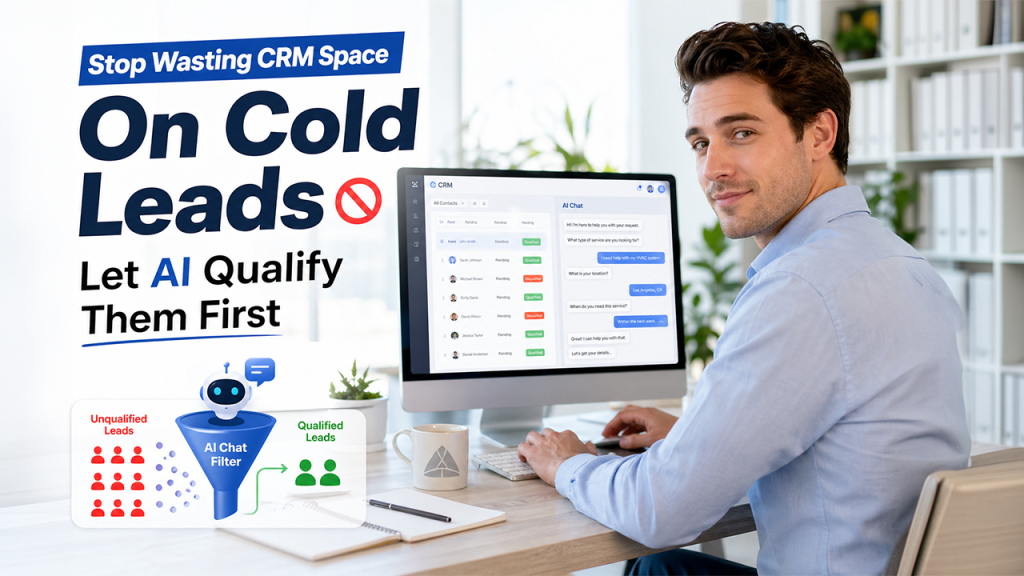
The idea is simple: put a layer between your website visitor and your CRM that can have an actual conversation with them before they become a logged contact. That layer is AI lead qualification, and it changes what your pipeline looks like at the end of the week.
This is what AI Chat does at the top of the funnel. Instead of a static contact form that collects a name and email and nothing else, a chat tool can ask real qualifying questions such as what the visitor is looking for, what their timeline is, what budget range they are working with, and whether they have tried other solutions. The responses tell you, before you pick up the phone, whether this person is worth pursuing.
For a solo operator or a team of two or three, this changes how the day runs. You are not returning every inquiry with equal urgency. You know which leads answered the qualifying questions in a way that signals genuine interest, and which ones dropped off after the first message.
What Good Qualification Looks Like in Practice

Say you run a home services business, something like HVAC or plumbing. Someone lands on your website at 7pm and wants a quote. Without any front-end qualification, they fill out a form, you call them the next morning, and find out they are three states away or looking for a service you do not provide.
With an AI chat layer in place, the conversation starts immediately. The tool asks about location, the type of job, rough timeframe, and whether they have had other quotes. By the time you see the lead the next morning, you already have context. If the answers look good, you call. If not, you have not wasted the follow-up.
This is not about replacing human judgment. It is about having better information before you apply it.
How This Works Alongside Your CRM, Not Instead of It
Some people hear "AI" and assume it means replacing something they already have. That is not what is happening here. The CRM stays exactly where it is. It is still your system of record for contacts, deals, follow-ups, and history.
What changes is the quality of what goes into it.
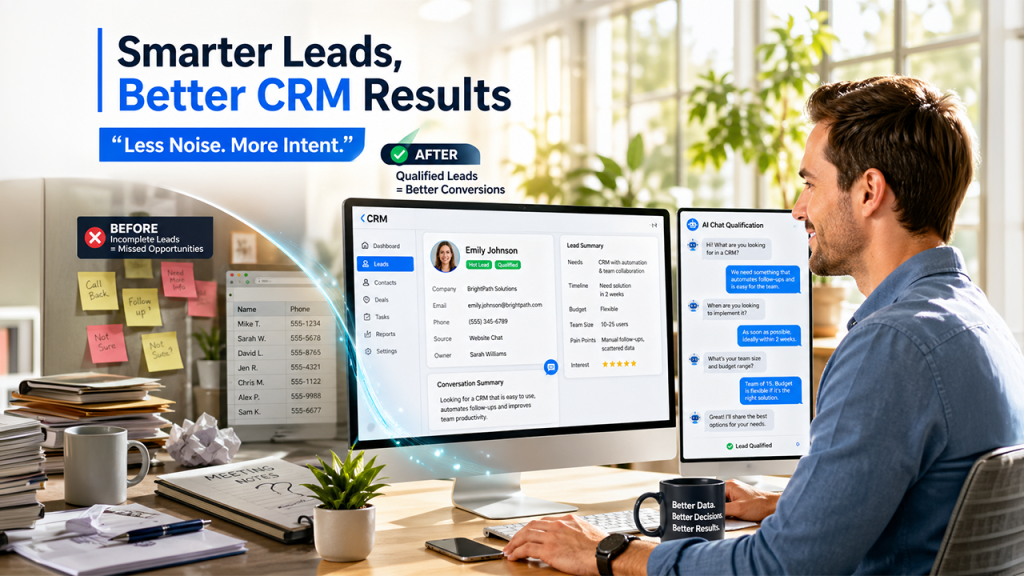
When a lead has already gone through a conversational qualification step, the data that lands in your CRM is richer. You are not just logging a name and phone number. You are logging what they said they needed, when they need it, and what context they gave you upfront. That makes every stage of the CRM process more useful. Your notes are better, your follow-ups are more targeted, and your pipeline reflects reality instead of wishful thinking.
For teams using a CRM like Outright, where the goal is simplicity and speed, this kind of front-end filter is a natural complement. You are not adding complexity. You are removing the noise that makes simple tools feel cluttered.
Setting Realistic Expectations
AI chat qualification is not magic. It works well when your qualifying questions are clear and your ideal customer profile is defined. If you have not thought through what makes a good lead for your business, the tool can only do so much.
The setup investment is real but manageable. You need to think about what questions to ask, what answers indicate a good fit, and what the handoff looks like when a lead qualifies through. Once that is in place, the system runs without you having to be present for every initial inquiry.
It also will not convert browsers into buyers. Some visitors will ignore the chat entirely, and that is fine. The ones who engage are typically more motivated, which in itself is a soft qualification signal.
A Simple Starting Point
If you want to test this without overhauling anything, start with your highest-traffic page, usually your homepage or a main service page. Add an AI chat tool there with three to five focused qualifying questions. Run it for 30 days and compare the leads that came through chat versus standard form submissions.
Most businesses that run this comparison find that chat leads convert at a meaningfully higher rate, simply because the conversation created a two-way exchange rather than a one-sided form submission.
You can also use Ask AI to help draft those qualifying questions before you build anything. Describe your business, your ideal customer, and your most common time-wasters, and you will get a starting set of questions you can refine from there.
Conclusion
Your CRM works best when the data inside it is accurate and relevant. The fastest way to improve that is not to change the CRM. It is to use AI lead qualification to control what reaches it in the first place. Adding a conversational qualification layer to your website front end is one of the most practical steps a small business can take to make every hour of selling count.
The leads are already coming in. The question is whether you are filtering them or just catching them.
Frequently Asked Questions
Q1. How many qualifying questions should an AI chat tool ask before handing off a lead?
Three to five questions is usually the right range. Enough to establish fit and intent, but not so many that the visitor drops off before finishing. Focus on the questions that would immediately disqualify someone if answered the wrong way, such as location, budget range, or type of need, and leave everything else for the human follow-up.
Q2. Will adding a chat tool slow down my website?
Modern chat tools are lightweight and load asynchronously, meaning they do not block your page from rendering. The impact on page speed is minimal when you are using a well-built tool. That said, it is worth testing your page speed score before and after adding anything new, just to confirm nothing unexpected is happening.
Q3. What should I do with leads that do not qualify through the chat?
Do not log them as active pipeline contacts. Instead, keep a separate list for leads that did not meet your criteria. This gives you the option to revisit them later if your offer changes, without filling your active CRM with contacts that are not ready to buy. Some CRMs let you create a status category specifically for this, which keeps things organized without losing the data entirely.