





Picture a school during peak admission months. Someone is flipping through a spreadsheet trying to find admission forms, another staff member is calling a parent back for the third time because the message got lost in someone's inbox, and a third person is manually sorting fee details, hoping they don't make a mistake. The people are not the problem here. It's just that the student's information is scattered across five different tools, which don't talk to each other at all.
This is where a student management CRM comes in. It's not just another software that every school buys out of peer pressure. It ties every piece of a student's journey, like an inquiry, admission, attendance, fees, and communication, into one place. Everybody works with the same accurate records.
What Is a Student Management CRM?
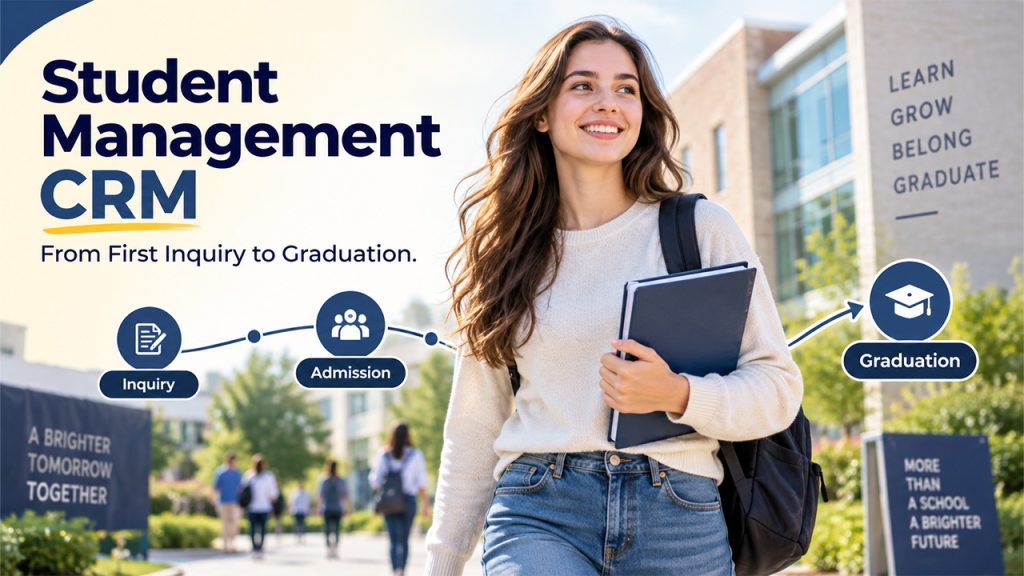
It is a system that helps schools, colleges, and training institutes manage everything about a student's relationship with them. It covers everything from the very first inquiry call to the day they graduate, and sometimes even after, as an alumnus.
It's like a digital cabinet that never forgets a follow-up, never loses a page, and gives every staff member visibility into the same, accurate picture of a student. From admissions to finance to academics, every department remains on the same page without data silos.
Student Information System vs Student Management CRM
People often use these terms interchangeably, but they're not quite the same thing. Here's a quick breakdown of where they overlap and where they split:
| Aspect | Student Information System (SIS) | Student Management CRM |
| Main focus | Academic records, like grades, attendance, course history | Relationships and communication, inquiries, admissions, follow-ups |
| Who uses it most | Teachers, registrars, academic staff | Admissions teams, marketing, front-desk, leadership |
| Covers pre-admission stage? | Rarely. It usually starts once a student is enrolled | Yes. Tracks a person from their very first inquiry |
| Typical data stored | Grades, transcripts, attendance, course records | Inquiries, communication logs, fee status, applicant stage |
| Primary goal | Keep an accurate academic record | Build and manage the full student relationship, start to finish |
| Best suited for | Managing students who are already enrolled | Managing the entire journey, including recruitment and retention |
To put simply, an SIS is where a student's academic story gets recorded once they're in. At the same time, a student management CRM is what gets them there in the first place and keeps that relationship organized long after enrollment too.
Key Features of a Student Management CRM
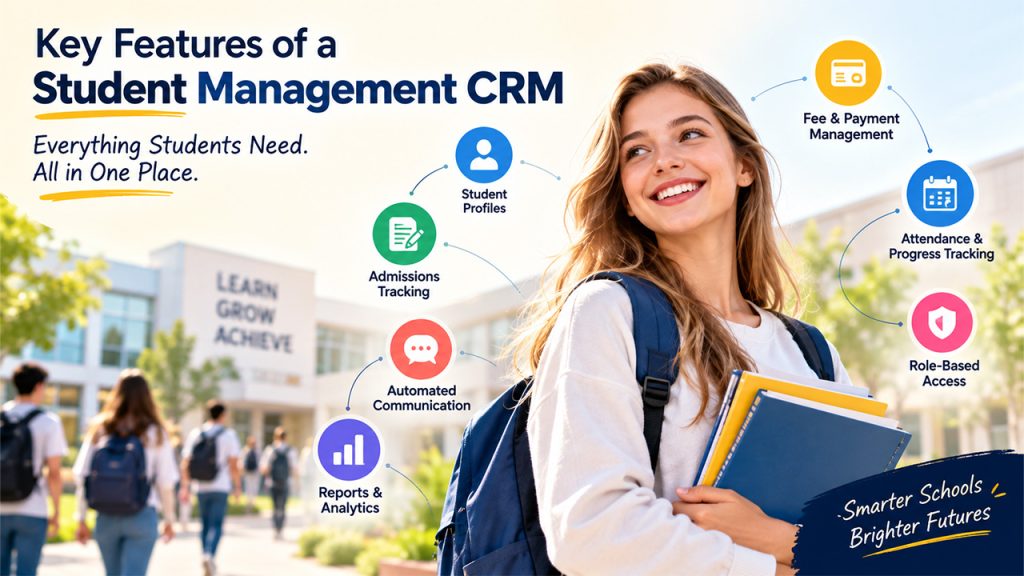
Let's see what you'll find in a good student management CRM:
- Centralized Student Information and Profiles
Every student has a dedicated profile that holds their personal details, admission history, attendance, fee status, and communication log. They no longer have to dig through five spreadsheets to answer one question.
- Student Admissions and Inquiry Tracking
The CRM system tracks every step at every stage, from the first time someone fills out an admission or registration form to the moment they get enrolled and graduate. It allows staff to see exactly where each applicant stands, so nobody is neglected or overlooked. Many schools also connect their student CRM to their website and email tools, so a new inquiry doesn't sit unnoticed in an inbox.
- Automated Student Communication
No one needs to remember to send reminders or follow-up emails for pending documents, fee due dates, holiday and event notifications. All of this is automated by the system and runs on autopilot. It saves staff from having to remember and manually chase every single student.
- Student Fee and Payment Management
Invoices, receipts, and payment tracking live in the same system as the student's academic record. This means finance teams no longer have to juggle completely separate tools that never quite match up.
A properly configured CRM integration is usually what keeps the fee data and academic record talking to each other in real time.
- Student Attendance and Progress Tracking
Teachers don't have to take attendance manually and maintain records. The CRM system logs attendance automatically and allows teachers and administrators to monitor academic progress without switching between three different apps. Everything is connected to the same student profile.
- Reports and Analytics Dashboards
A good CRM makes it easy to track numbers and reports. Whether you want to know the number of applicants converted to enrollments last month or the class with the lowest attendance, you can view all of that on the CRM dashboards instead of spending weeks on manual number crunching.
- Role-Based Access for Student Data
Not everyone needs to see everything. Teachers see academic data, finance sees payment records, and admins see the full picture. A good CRM system controls everything through permissions, so sensitive information stays where it should.
Benefits of Using a Student Management CRM
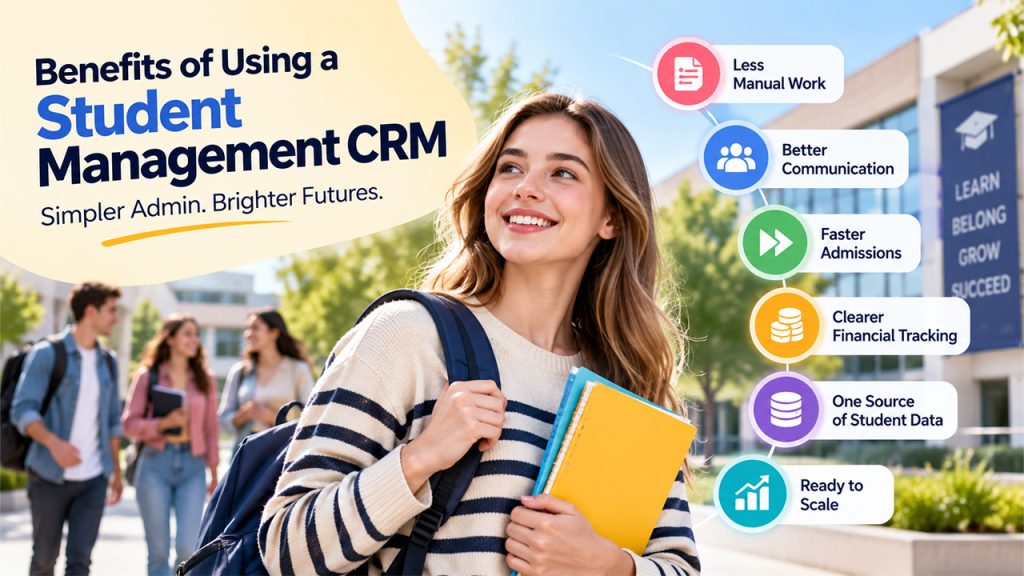
A student management CRM can make everyday administration more efficient while creating a smoother experience for students, parents, and staff.
- Less Manual Work, Fewer Mistakes
When you don't have to type information into three different places, you won't make typos, miss updates, or create duplicate records. This way, staff spend less time double-checking data and focus more on actually helping students.
- Improved Communication With Students and Parents
When the reminders are automated and communication history is recorded, nobody sends the same email twice or forgets to send it at all. This ensures that parents receive timely updates, and staff aren't wasting time asking each other.
- Faster Admissions Process
Applicants move through the pipeline without getting stuck in email threads or lost paperwork. When staff have all the details of every applicant on a single screen, the admission process becomes a lot faster. And this speed matters because a slow admissions process is what pushes a promising applicant to a different school.
- Clearer Financial Tracking
Because fee data lives alongside the student's full record, reconciling payments becomes far less of a headache. Nobody's chasing a receipt that was recorded somewhere else entirely.
- Create a Single Source of Student Data
When all data lives in one place, there's no room for data silos or discrepancies. Instead of five different spreadsheets that say five different things, everyone works with a single source of truth. This helps stakeholders make better, accurate decisions.
Good CRM document management practices also make it far easier to pull accurate reports, since nothing is missing or misfiled in the first place.
- Scale Student Management as Your Institution Grows
Whether a school has 200 students or 20,000, a CRM scales without falling apart. Manual systems, on the other hand, tend to break down exactly when growth is happening fastest, which is the worst possible time.
Conclusion
In short, a student management CRM is software that makes sure that people who run the school actually have all the information they need, when they need it, without wasting time chasing it down from five different places. Schools that adopt CRM for education aren't just saving time; they are eliminating daily friction that makes staff exhausted, and students feel like just another file number during a crucial moment of their lives.
If your school is still juggling spreadsheets, sticky notes, and half a dozen disconnected tools, it might be time to ask a simple question: how much easier would this be if everything lived in one place? That's really what a student management CRM offers. It doesn't offer magic, just order.
FAQs About Student Management CRM
Not at all. Smaller institutes benefit just as much, sometimes more, since they often don't have big admin teams to manage scattered records manually. A CRM helps a lean staff do more without burning out.
A database just stores information. A CRM actively manages relationships by tracking communication, automating follow-ups, and connecting every interaction to one student's profile instead of leaving data sitting idle.
Yes. It covers the entire lifecycle, from the first inquiry, through admission and enrollment, all the way to graduation and even alumni relations, all within the same connected system.
Not usually. Most modern platforms are built to be simple enough for non-technical staff to use daily, with straightforward dashboards and workflows that don't require a background in software.
Reputable systems use role-based access, encryption, and audit trails to protect sensitive information. Staff only see what's relevant to their role, keeping personal and financial data appropriately restricted.