





CRM platforms are no longer what organizations used to think of them a few years ago. Brands and businesses using a CRM platform treated it like a digital filing cabinet. Contract records went into it, notes used to get accumulated, and sales activities were logged when needed. In most cases, that was the end of the story.
But, if you look closely, most brands now use CRMs differently. They use their CRM to do more than store information. Their requirements include building workflows that move deals faster and forward, and triggering actions automatically. Most importantly, brands now want their teams to spend less time doing repetitive work.
In short, businesses no longer judge the real value of a CRM by the amount of data it stores. What’s become more important is the effectiveness of the actions those data drive.
Teams that automate communication, reporting, scheduling, and record management sometimes gain a noticeable advantage over organizations still relying on manual processes.
Also Read: Understand what CRM Workflow is and How to Use it for Business
Examining The Cost of Manual CRM Processes
Your manual work always finds a way to creep into everyday operations. At first, it does not look as problematic.
All you have to do is solve a few things with some clicks here and there and update a spreadsheet by the end of the day.
It rarely appears problematic initially. Next, workloads grow, and teams expand. That’s when the inefficiencies become impossible to ignore. Consider the following comparison:
| CRM Activity | Manual Approach | Automated Approach |
| Lead Assignment | Individual review required | Rules-based instant assignment |
| Calendar Updates | Manual scheduling | Real-time synchronization |
| Customer Follow-Ups | Employee reminders | Automated workflow triggers |
| Reporting | Data compiled manually | Scheduled report generation |
| Record Management | Multiple user actions | Automated record updates |
The difference is not merely about saving time. Automation reduces inconsistencies, improves visibility, and allows employees to focus on customer-facing activities rather than routine administration.
Even famous publishing platforms like Cybernews.com highlight how manual effort across all touchpoints of CRM reduces efficiency.
Identifying The Workflows That Deliver Immediate Value
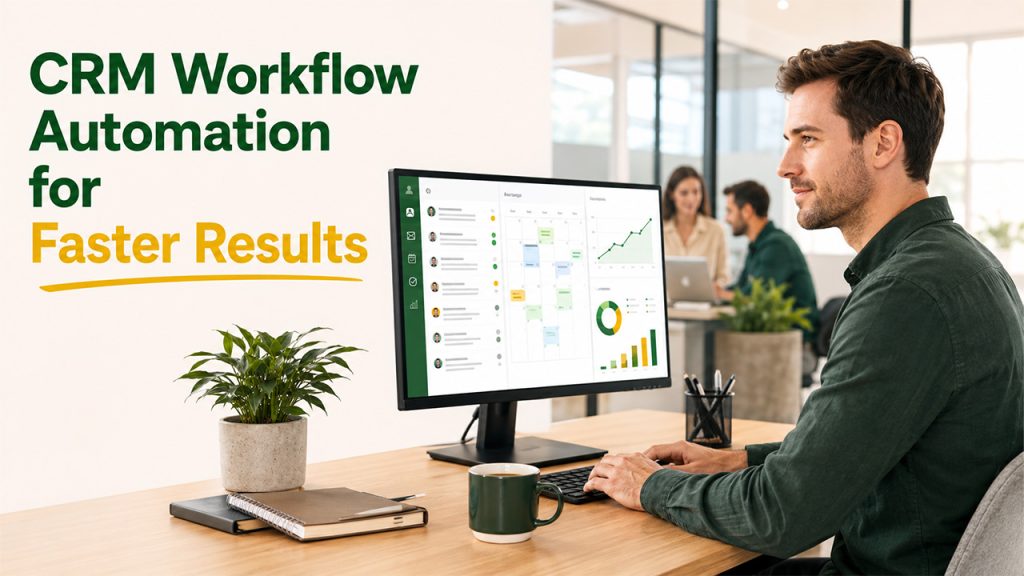
Not every process needs automation from day one. The most successful CRM workflow automation projects usually begin with high-frequency activities that consume significant employee attention.
Automating Communication Management
Communication management consumes a significant amount of time for people handling customer queries and grievances on CRM platforms. Almost all businesses now generate a sizable amount of data at the customer support level. CRM platforms have to record emails, follow-up requests, reminders, and notifications all the time.
With manual communication and customer support, your customer support team is spending too much time with too little output. But when the process is automated, they can send the right message to the right recipient at the right time. It could be a little app notification, emails, or important follow-ups.
Automation helps create consistency. Messages reach the right people at the right time. Important follow-ups are less likely to be forgotten. Customer experiences become more predictable, which often translates into stronger relationships over time.
Synchronizing Calendars And Activities
Scheduling issues remain one of the most common operational frustrations across sales and service teams.
When CRM platforms integrate directly with calendar systems, meetings, calls, and events remain aligned across departments. Fewer scheduling conflicts occur. Information stays accurate. Teams gain confidence that everyone is working from the same source of truth.
Streamlining Reporting Processes
Reporting is essential. Yet many organizations still spend hours collecting information that already exists inside their systems.
Automated reporting transforms raw CRM data into actionable insights without requiring repeated manual effort. Managers gain visibility into performance trends while teams avoid the burden of creating reports from scratch every week.
Comparing Traditional CRM Usage with Modern CRM Operations
The evolution of the CRM strategy can be summarized through a simple comparison.
| Traditional CRM Usage | Modern CRM Operations |
| Data storage focus | Workflow execution focus |
| Manual updates | Automated actions |
| Periodic reporting | Real-time insights |
| Department silos | Connected processes |
| Reactive management | Proactive decision-making |
This shift reflects a broader business reality. Organizations increasingly compete on responsiveness, efficiency, and customer experience.
A CRM system that actively supports these goals becomes more than software. It becomes an operational infrastructure.
Conclusion: CRM Workflow Automation Turns Data Into Business Momentum
For years, businesses have invested in CRM systems. The organizations that are stronger in today’s context definitely aren’t the ones that collect more data. It’s the ones that use their existing data sets more intelligently.
Advanced CRM platforms ensure CRM workflow automation, reduce manual efforts, and help bridge the gap between information and action. As manual effort through advanced CRMs decreases, it improves consistency and creates operations agility. Something modern businesses are constantly looking for.
With evolving CRM platforms, companies prioritizing connected and automated workflows will find themselves better positioned to scale, adapt, and compete.
If you are using open-source CRM such as SuiteCRM and you want to automate your workflows, you must partner with experts who can give you precise CRM customization solutions. Explore OutRight Store to find ready-to-use plugins to automate workflows and reach out to us for custom solutions.