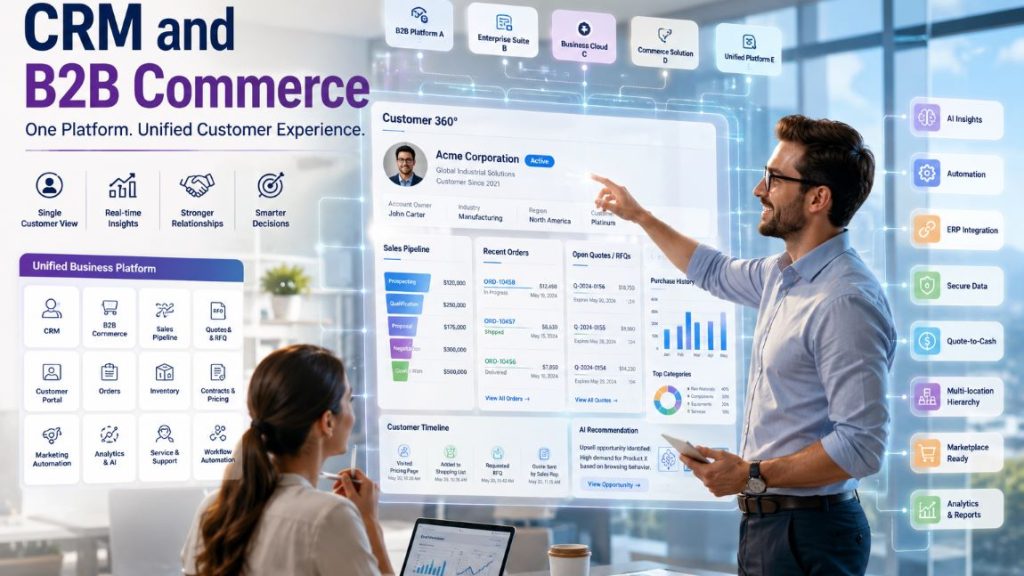






For most of the last decade, B2B companies have run their commerce platform and CRM as separate systems stitched together with integration middleware. A sales rep would log into Salesforce or HubSpot to track an account, then switch to Magento or Shopify to check what that account actually bought. Marketing would pull lists from one system, attach behavior data from another, and hope the customer IDs matched.
The connectors exist, and for basic data flows they work. Order history syncs. Contact records update. For straightforward B2C use cases, that's often enough.
B2B is less forgiving. A connector that pushes completed orders into a CRM tells a rep what a buyer purchased — it doesn't tell them what's sitting in an open shopping list, which pages they browsed before abandoning a quote request, or what products they've been checking repeatedly without buying.
That behavioral layer rarely makes it through a standard integration. Neither does account hierarchy data, custom pricing fields, or the kind of granular session activity that would actually help a sales or service rep have a more informed conversation.
When the service team needs access to commerce data, that's another connector. When the catalog has custom attributes that don't map to standard fields, the off-the-shelf connector breaks down and a custom build fills the gap — at cost, with a maintenance burden that compounds every time either system updates.
The result is a data picture that looks complete at a glance but has real gaps at the moments that matter most: a rep on a call who can't see what a buyer is looking at right now, a service agent who can see an account record but not the open order attached to it, a marketing team that can segment by purchase history but not by on-site behavior tied to company accounts.
Why combining CRM and commerce changes how B2B operates
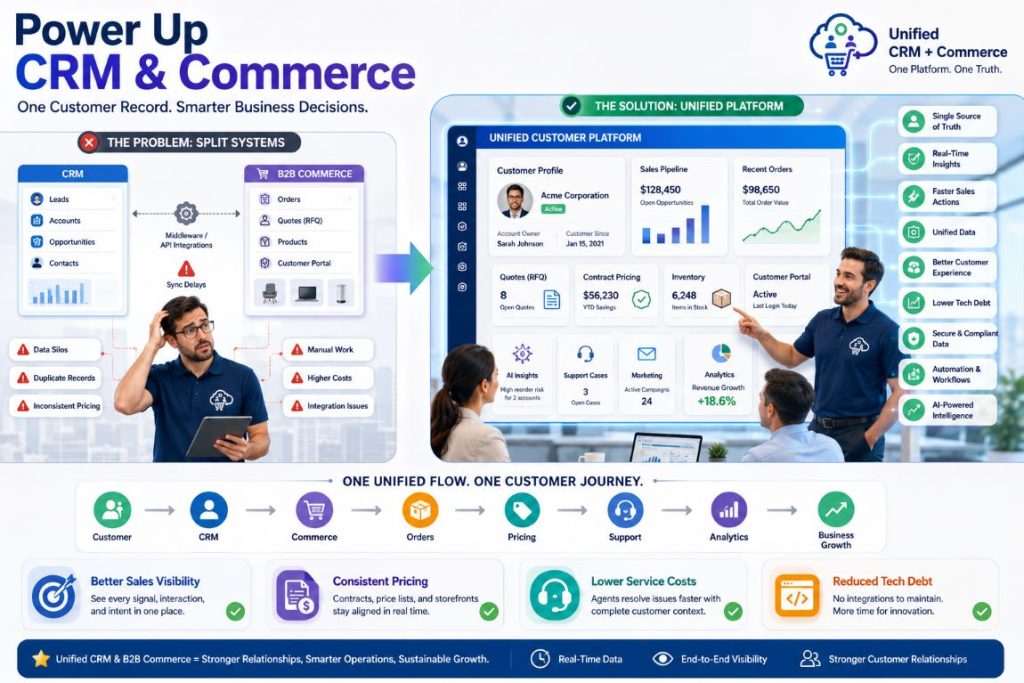
The case for a unified system is operational, not just technical. When commerce and CRM share the same customer record, three things shift.
- Sales reps stop working blind. In a split-system setup, a rep sees the deal pipeline but not the e-commerce activity on existing accounts. They miss signals — a buyer who suddenly stops reordering, a new contact who started browsing high-margin products, an account that abandoned a quote three times. With a unified system, those signals show up in the same view as the opportunity pipeline, and reps can act on them inside their normal workflow.
- Pricing and contracts stay consistent. In a split system, a contract negotiated in CRM has to be replicated as pricing rules in commerce. The two drift apart over time, and buyers end up seeing different numbers on the storefront than what their rep quoted. A shared data model means the contract, the price list, and the storefront display are all reading from the same source.
- Service costs drop. A support agent handling a billing question or a delivery issue normally toggles between systems to find the order, the customer, and the case history. Unified platforms put all three on one screen, which cuts handle time and reduces the number of escalations that happen because the agent could not find the right data fast enough.
- Tech debt shrinks. Every integration between separate systems is code someone has to maintain — sync jobs, field mappings, middleware that breaks when either side pushes an update. In a split setup, that connective tissue grows over time and quietly becomes a liability: an engineer leaves, the integration logic goes undocumented, and a routine CRM update silently breaks the order sync. A unified platform removes the seam entirely. There's no pipeline to babysit between commerce and CRM because they're the same system, so the team spends its time on features instead of keeping two systems talking to each other.
- The trade-off is rigidity. A unified platform is harder to swap out one piece of. If commerce is bundled with CRM, replacing the storefront means rethinking the customer data layer too. Companies that want best-of-breed in every category usually accept the integration burden in exchange for flexibility. Companies that want operational simplicity and a single source of truth go the other way.
The seven platforms below take the unified approach seriously. They are not "CRM that integrates with commerce" or "commerce with a CRM connector." They share a data model — the customer record, the account hierarchy, and the order history are the same object across both functions.
1. OroCommerce
OroCommerce is one of the few platforms built from day one with both B2B commerce and a native CRM as part of the same product, under a single license. The CRM tracks leads, opportunities, accounts, contracts, tasks, and emails alongside the commerce data — orders, quotes, RFQs, and customer portal activity — without sync layers. This architectural choice stems from a deep understanding of B2B companies’ needs, where a unified experience for back-office teams is just as important—if not more important—than the storefront customer experience.
The practical effect shows up in how account hierarchies work. A multi-location buyer can be modeled once, with parent-child relationships, delegated purchasing rules, and contact roles, and that same structure drives both the sales pipeline and the buyer self-service portal. A rep working an opportunity sees the same account view their support colleague sees when a service case opens. Native CPQ, PIM, DAM, marketplace, and AI tooling sit on the same foundation, so there are no per-module licenses or add-on fees stacking up as the business grows. Because of the platform’s modular architecture, the ecommerce module can also be integrated with a third-party CRM if that is the preferred approach.
OroCommerce fits manufacturers, distributors, and marketplace operators looking to consolidate their tech stack and unify customer and back office teams experiences.. It is less suited to small DTC brands or companies looking for a lightweight setup.
2. NetSuite SuiteCommerce
NetSuite is unusual in this category because the CRM is part of the base ERP, not a separate module. SuiteCommerce, the e-commerce layer, runs on the same record. A B2B buyer's order on the storefront updates the same customer object that the sales rep sees in CRM, the warehouse team sees in inventory, and the finance team sees in accounting.
For B2B, that means quote-to-cash runs end-to-end inside one system. A buyer requests a quote on the storefront, a rep negotiates and converts it to an order, fulfillment is triggered, revenue is recognized, and the customer history is updated — all on the same record without any integration code. SuiteCommerce supports both B2B and B2C from the same admin, which suits companies running both channels.
The fit is strongest for mid-market and enterprise B2B companies that want commerce, CRM, and ERP under one roof. The cost structure and implementation timeline make it less practical for smaller operations.
3. Salesforce B2B Commerce
Salesforce B2B Commerce was rebuilt natively on the Salesforce platform after the CloudCraze acquisition, and it now shares the same data model as Sales Cloud, Service Cloud, and CPQ. The customer record, the account hierarchy, and the order history are Salesforce objects — not external data being synced in.
For companies already running their sales and service operations in Salesforce, this removes the integration layer entirely. A sales rep sees commerce activity in the same account view they use for pipeline management. A service agent handling a case sees the buyer's open orders without leaving the console. Marketing Cloud can build campaigns off commerce behavior data without a connector.
The native commerce capabilities are narrower than purpose-built B2B platforms — complex CPQ, RFQ, and high-SKU catalog scenarios sometimes need additional Salesforce modules or partner solutions. The value is the unified data model, not commerce depth. Costs are an important factor here as well: even if the integration between systems is smooth, you still need to pay for CRM, Commerce, and Marketing Clouds separately.
4. Microsoft Dynamics 365 Commerce
Dynamics 365 Commerce sits inside the broader Dynamics 365 suite, which includes Sales (CRM), Customer Service, and Finance. The modules share the Dataverse data layer, so commerce transactions, sales activities, and service cases all reference the same customer entity.
B2B-specific capabilities include account hierarchies, customer-specific catalogs, contract pricing, and approval workflows, with deep integration into Microsoft 365 — Teams, Outlook, Excel, and Power BI. Sales reps can pull commerce data into a Power BI dashboard or trigger workflows in Teams off customer behavior without custom development.
The platform makes the most sense for organizations already running on the Microsoft stack. For companies in other ecosystems, the licensing complexity (Sales is a separate license from Commerce) reduces the appeal.
5. SAP Commerce Cloud
SAP Commerce Cloud is the commerce layer that sits on top of SAP's enterprise stack, including SAP Sales Cloud (CRM) and SAP S/4HANA. While these are technically separate modules, they share customer master data and integrate at the data-model level, which is closer to a unified system than most middleware-connected setups.
B2B buyers see real-time inventory, contract pricing, and order status pulled directly from the ERP. Sales reps in SAP Sales Cloud see the same customer record and order history. Account hierarchies, approval workflows, and quote management are native, and configurable products are handled well — which matters for engineered or made-to-order industries.
The fit is enterprises already deeply invested in SAP. For companies on other ERPs, the integration math rarely justifies the migration.
6. Odoo
Odoo takes a different angle: it is an open-source business suite where CRM, e-commerce, inventory, accounting, and marketing are separate modules that share one underlying database. Turning on the e-commerce module gives access to B2B features — customer-specific pricing, tiered discounts, customer portals — and that data lives in the same database as the CRM pipeline and the accounting ledger.
For small to lower mid-market distributors and manufacturers, the appeal is breadth at a lower price point than the enterprise platforms above. A sales rep working leads in Odoo CRM sees the same customer record that drives the storefront. Orders flow into invoicing automatically, and account-level margin analysis becomes possible because commerce, finance, and CRM all reference the same data.
Odoo's B2B feature depth is lighter than purpose-built platforms like OroCommerce or SAP, especially around complex contract pricing and approval workflows. For companies that need a working unified system without enterprise budgets, it remains one of the more practical options.
Slug7-platforms-that-combine-crm-and-b2b-commerce-in-one-system
7. HubSpot Commerce Hub
HubSpot moved into commerce with Commerce Hub, which sits on the same Smart CRM as the rest of the HubSpot suite (Sales, Marketing, Service, Content). For B2B companies already using HubSpot CRM, this extends commerce capabilities into the same system where customer data already lives, primarily enabling back-office teams to manage quote-to-cash workflows in a unified environment.
The B2B capabilities focus on quote-to-payment workflows, invoice management, subscription billing, and payment links — rather than catalog-heavy or storefront-driven commerce. A sales rep can send a quote, the buyer accepts and pays, and the entire interaction stays inside HubSpot, with marketing and service teams seeing the result on the same timeline view.
This makes HubSpot a strong fit for service-led B2B businesses, SaaS, and professional services where the commerce model is closer to invoicing and checkout workflows than a complex product catalog experience. For traditional wholesale or distribution use cases, the commerce depth is more limited, particularly around advanced catalog management and buyer-facing commerce functionality.
Choosing between unified platforms
The decision rarely comes down to feature lists. Three questions narrow it faster:
What is your existing system of record? If Salesforce or Microsoft already holds the customer data, the matching commerce platform removes the largest integration burden. If there is no existing system of record, purpose-built B2B platforms like OroCommerce give the strongest commerce depth alongside native CRM.
How complex is the B2B model? Multi-tier account hierarchies, contract pricing, RFQs, and approval workflows need platforms built for them — OroCommerce, SAP, NetSuite. Lighter B2B models (digital products, services, simple wholesale) can run well on HubSpot or Odoo. Organizations with industry-specific requirements may also benefit from specialized CRM platforms. For example, financial advisory firms often use solutions designed for compliance, client relationship management, and advisor workflows. If you're evaluating CRM options for the financial services sector, our Redtail CRM guide explains its features, benefits, limitations, and ideal use cases.
How much operational unification matters? Some companies want commerce and CRM to share a record but keep ERP separate. Others want everything on one stack. NetSuite and Dynamics push hardest on full unification; Salesforce and HubSpot are unified across customer-facing functions but leave ERP to integrate. OroCommerce sits between, with native commerce, CRM, CPQ, and PIM, but flexible ERP integration.
Unifying commerce and CRM is not a silver bullet — it trades flexibility for operational consistency. For B2B companies where sales, service, and commerce teams need to work off the same customer record without spending engineering hours keeping systems in sync, the trade-off is increasingly the right one.