





The article explores how AI is reshaping B2B marketing in 2026 and how technologies are leading the transformation, including practical use cases, benefits, challenges, and best practices for successful AI adoption.
Artificial Intelligence is not just a futuristic concept in B2B marketing, but it now acts as a strategic necessity in the sector. As businesses try to navigate the growing competitive market in 2026, AI has become one of the major driving factors in offering personalized customer experiences, data-driven decision-making, and highly efficient marketing operations.
In the current landscape, B2B buyers don't just expect tailored interaction, but also want immediate responses and valuable content throughout their purchasing journey. The traditional marketing methods generally struggle to meet these expectations at a large scale, making the AI-powered solution indispensable for modern organizations.
What is Meant by AI in B2B Marketing?
In B2B marketing, artificial intelligence (AI) generally refers to the use of advanced technologies, which include machine learning, natural language processing, predictive analytics, and generative AI, to optimize, automate, and enhance marketing activities, which is aimed at other businesses. AI in B2B marketing analyzes a large volume of customer and market data to uncover patterns, predict buyer behavior, and deliver personalized marketing experiences, rather than just relying solely on manual processes.
AI in the B2B marketing environment helps marketers better understand customer needs and engage with prospects at the right time with relevant content and messaging. It can also automate various tasks, such as email marketing, lead scoring, customer segmentation, and campaign management, allowing marketing teams to focus on relationship building and strategy.
In B2B marketing, AI also helps in improving decision-making by offering real-time insights into customer behavior, campaign performance, and market trends. For instance, the AI-powered tools can also identify high-intent leads and can recommend the best marketing action, generate personalized content, and optimize advertising campaigns based on performance data.
Benefits of AI in B2B Marketing

AI in B2B marketing acts as a transformative force that enables businesses to make smarter decisions, improve customer engagement, and streamline marketing operations. Users can leverage AI-powered tools and data-driven insights, and organizations can also enhance every stage of the marketing funnel.
Some of the key benefits of AI in B2B marketing are as follows:
- Improves Lead Generation and Qualification: The most crucial advantages of AI in B2B marketing are its ability to identify and qualify high-potential leads. The platform can analyze customer behavior, website interactions, purchase history, and engagement patterns to identify which prospects are most likely to convert. AI-driven systems such as AI Voice Agents for Outbound Calling further enhance this process by enabling automated, real-time lead qualification and engagement.
- Personalized Customer Experience: Modern B2B buyers look for relevant and personalized interaction throughout their purchase journey. Artificial intelligence enables businesses to deliver customized content, product recommendations, email campaigns, and website experiences, which are based on individual customer preferences, industry, and company size.
- Enhanced Marketing Automation: In B2B marketing, AI significantly helps in improving automation, simply by handling repetitive tasks, like email scheduling, customer segmentation, campaign management, and follow-up communications. This allows marketing teams to focus on strategy, creativity, and customer engagement, rather than routine administrative tasks.
- Data-Driven Decision Making: B2B organizations usually generate a large amount of customer and market data every day. The AI-powered tools process this information instantly and identify valuable insights that would be hard to discover manually.
Why AI Matters More Than Ever in 2026
In B2B marketing, AI has become a crucial part. In the increasingly competitive landscape, AI in B2B marketing empowers businesses to meet the evolving expectations while also improving efficiency and delivering measurable results.
- Rising Customer Expectations: In the B2B marketing landscape, AI enables marketers to analyze customer behavior in real time, along with delivering tailored experiences based on various factors such as industry, company size, previous interactions, and purchase intent.
- Managing Growing Volumes of Data: Modern businesses generate a large amount of data from multiple sources, such as websites, CRM systems, social media platforms, email campaigns, and third-party sources. In this, AI processes vast datasets instantly, along with identifying meaningful patterns and providing actionable insights, which can help marketers in making informed decisions.
- Enhance Marketing Efficiency: AI in B2B marketing helps in improving productivity by automating repetitive tasks, like lead scoring, customer segmentation, email marketing, campaign optimization, reporting, and content recommendations. This also allows the marketers to focus on strategic planning, creative initiatives, and relationship building.
- Enabling Smarter Decision-Making: Rather than relying solely on intuition or historical data, businesses can utilize AI-powered tools to make data-driven decisions. The predictive analytics capability of the platform also helps in forecasting customer behavior, identifying high-value prospects, and estimating future sales.
This becomes even more powerful when combined with AI contextual organizational knowledge systems that unify business intelligence across departments and customer touchpoints.
Key Applications of AI in B2B Marketing
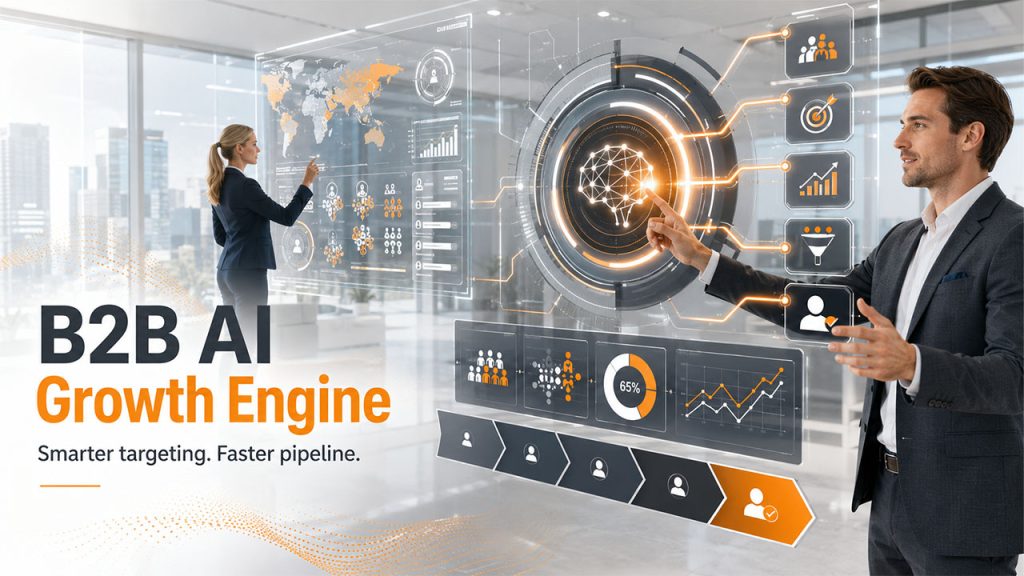
AI in B2B marketing helps teams in enabling smarter targeting, deeper insights, and more efficient execution. Some of the key applications of AI in B2B marketing are as follows:
- Lead Scoring and Qualification: Intelligent lead scoring is among the most crucial applications of AI in B2B marketing. The AI systems help in evaluating prospects based on various data points, such as website activities, email engagement, company size, and past interactions. This helps sales teams to focus on high-quality leads, which are more likely to convert, improving efficiency and revenue outcomes.
- Predictive Analytics and Forecasting: The AI-powered predictive analytics also help businesses in anticipating future outcomes. AI can efficiently analyze various insights, such as sales trends, identify high-intent buyers, predict customer churn, and estimate customer lifetime value.
- Personalized Marketing Campaigns: AI in B2B marketing can analyze customer behavior, preferences, and engagement history to deliver personalized messaging across multiple channels, such as email, websites, and advertising platforms.
- Content Creation and Optimization: The generative AI tools in B2B marketing platforms can be used to create and optimize marketing content. The tool can also optimize content for SEO, improve readability, and suggest structural improvements.
Popular AI Tools for B2B Marketing
HubSpot
HubSpot is among the most popular AI-powered B2B marketing platforms, which offers various tools for CRM, email marketing, lead nurturing, and sales automation. HubSpot also enables teams to work from a unified system, making it easier to track customer journeys and optimize conversion rates.
Salesforce
Salesforce is one of the leading enterprise CRM platforms, which integrates advanced AI capabilities through its Einstein AI layer. The platform helps businesses efficiently predict customer behavior, automate sales processes, and generate actionable insights from large datasets.
Jasper
Jasper is a generative AI writing assistant that is especially designed for marketing teams. The platform can efficiently create blog posts, email campaigns, landing pages, and ad copy, among other key content. The tool uses AI to maintain tone consistency and optimize each piece of content for marketing performance.
Marketo
Marketo, which is a part of Adobe, is widely used as a B2B marketing automation and lead management tool. The platform leverages AI to generate personalized email campaigns, track customer engagement, and optimize marketing funnels.
Google Analytics
The platform incorporates AI-driven insights to help marketers understand website traffic, user behavior, and conversion patterns. It can also identify trends, predict user actions, and highlight opportunities. In B2B marketing, this acts as an essential feature for measuring campaign effectiveness and improving digital performance.
While artificial intelligence has significantly transformed B2B marketing with automation, personalization, and predictive insights, it also includes various key limitations, which are as follows:
- Dependence on Data Quality: The AI tools are only as good as the data they are trained on. In B2B marketing, inaccurate, incomplete, or outdated data can lead to flawed insights and poor decision-making.
- Higher Implementation and Integration Costs: Although AI can generate content and analyze patterns, it still lacks genuine creativity, emotional depth, and contextual understanding. The content generated by AI tools can feel generic or fail to capture the tone needed.
- Privacy and Ethical Concerns: The AI in B2B marketing heavily relies on customer data, which raises concerns related to privacy, consent, and ethical usage. Various regulations, such as data protection laws, necessitate businesses to handle data responsibly.
Conclusion
AI in B2B marketing is set to transform the sector in 2026, as it helps businesses in attracting, engaging, and retaining customers across increasingly complex digital ecosystems. From enhancing lead generation to automating workflows and improving data-driven decision-making, the AI tools in B2B offer their efficiency and effectiveness at every stage of the customer journey.
In recent years, AI capabilities have also evolved significantly, offering B2B marketers the ability to strategically integrate intelligent technologies into their workflows. It also helps marketers change customer expectations, accelerate growth, and create lasting value.
FAQs About AI in B2B Marketing
Yes, AI can help in improving lead generation. It can analyze customer behavior, engagement, and firmographic data to identify high-quality leads most likely to convert.
Yes, AI tools analyze user data to deliver a customized and more personalized campaign, which includes content for emails, product recommendations, and targeted content based on customer behavior and preferences.
Predictive analytics uses AI to forecast future outcomes, which include customer behavior, sales trends, churn rates, and lead conversion probability.
Yes, AI can significantly improve the ROI of the company by optimizing ad spend, improving targeting accuracy, reducing manual work, and increasing conversion rates.