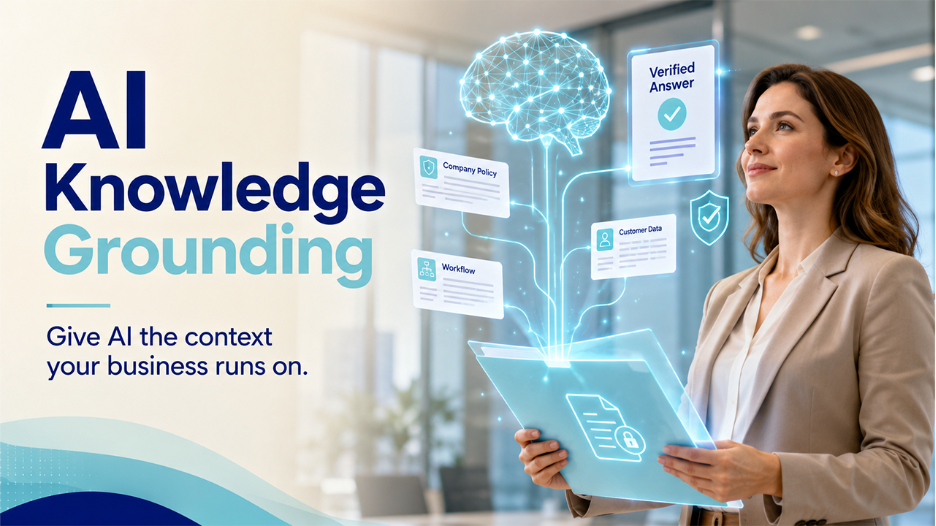






AI Contextual Organizational Knowledge aids Enterprise Content Management (ECM) systems deliver contextually-aware and accurate AI insights by grounding AI models in the unique data of the organization, terminology, and workflows. Using techniques such as fine-tuning, RAG, context passing, and knowledge graphs, businesses can minimize AI hallucinations, enhance semantic search, and allow smarter enterprise decision-making.
Introduction
After 2023, the popularity of Artificial Intelligence has exploded. It has transformed each and every industry at a rapid pace. One of the areas where it has been a game changer is content management. Businesses are not only handling huge volumes of content but also finding new ways to utilize this content to drive innovation. Enterprise Content Management Systems, which were previously focused on data organization and security, are now playing a huge role in ensuring AI adoption.
By laying out the foundations of AI in ECM systems, businesses can automate complex tasks, reveal new insights, and expedite data-driven decision-making. At the center of it all is the AI contextual organizational knowledge, which allows systems to go beyond generic responses and truly deliver meaningful outcomes.
Knowledge grounding is extremely important in boosting the capability of AI to deliver valuable insights that go beyond generic responses. It is a mistake to assume that AI will naturally understand the specific context of an organization, its compliance standards, terminology, and industry nuances. Knowledge grounding gives you the framework to enable AI to understand a unique environment. This makes sure that the generated insights are not only relevant but also actionable within the specific operational ecosystem of the organization.
Generative AI in Enterprise Content Management Solutions
You can use generative AI to provide support to semantic questions and answers in a vast ECM platform such as FileNet, Box, Share Point, IBM Content Manager On Demand (CMOD), or any in-house systems. The RAG (“Retrieval-Augmented Generation”) pattern to create/store/retrieve word embeddings from reliable documents, their semantic similarities, and later allow focused-content Q&A interactions with LLMs is a great approach to solve this problem. RAG has grown in popularity tremendously with frameworks such as LangGraph and LangChain and commercial solutions such as watsonx.ai making it simpler to execute standard RAG platforms.
However, the experts who have worked on numerous RAG-based solutions have found that RAG alone is not sufficient. Moreover, numerous RAG technologies claim to enhance results. However, it is quite difficult to validate effectiveness on real-world data. This is exactly why an in-depth focus on AI contextual organizational knowledge is vital. It makes sure that the AI outputs are based on the specific data landscape of the enterprise, instead of solely depending on retrieval mechanisms.
What Is Knowledge Grounding?
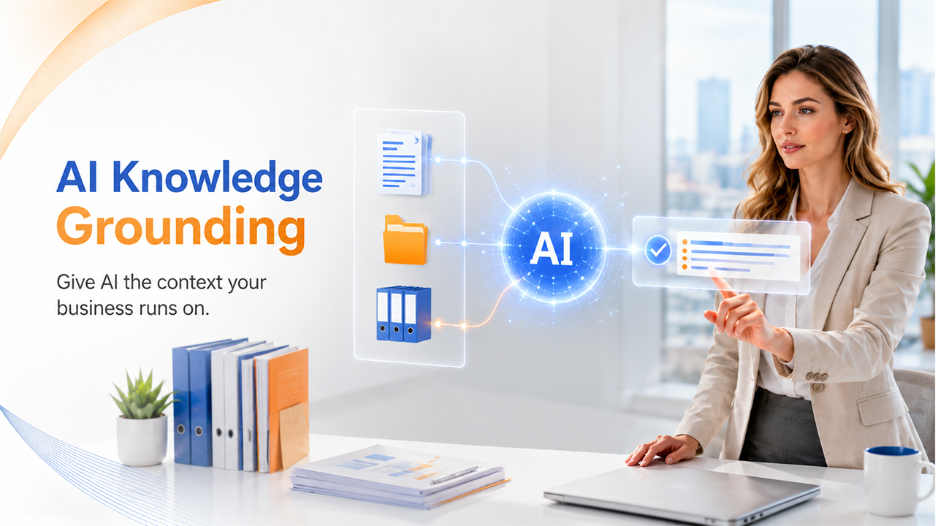
When you consider a new generation of AI-based ECM solutions, knowledge grounding incorporates anchoring AI models in a particular and relevant context by tethering the unique knowledge base of the organization. This process is vital for ECM platforms, where AI must ensure contextually relevant and accurate insights as per the large repository of records, documents, and policies. Essentially, this is what AI Contextual Organizational Knowledge is built to achieve. It reduces the gap between raw enterprise data and actionable AI-based intelligence.
Knowledge grounding enables the AI to reference up-to-date and specific resources dynamically when responding to queries, reducing hallucinations and inaccuracies. It is greatly valuable when the data that the model needs frequent changes or when you are aligning with particular knowledge bases.
In AI-based ECM solutions, knowledge grounding generally includes the below-mentioned techniques:
- Context Passing: When the needed knowledge base is small enough to align within the context window of the model, you can achieve grounding by directly including this knowledge in the prompt. This is extremely effective for shorter datasets or when utilizing LLMs with large context windows, enabling them to answer questions as per the given context alone.
- Retrieval-Augmented Generation: RAG integrates retrieval with generative models, allowing AI to extract specific and relevant data from a real-time knowledge base. This approach is quite vital for ECM, as it enables the AI to respond based on unique regulations, terminology, and content flow.
- Fine-tuning: Fine-tuning enables AI models training on chosen dataset of company-specific information, improving the ability to understand tasks aligned with internal terminology and policies. Tailored models are more proficient at providing insights that are consistent with the requirements of the organization.
- Knowledge Graphs: Knowledge graphs sort the relationships and entities of the organization in an organized format. They provide a semantic map of the organization’s data, as per the ontology that works as a schema. The graph provides a machine-readable and dynamic structure that aids the AI to navigate real-world contexts and relationships, enhancing contextual alignment and retrieval accuracy.
Also Read: Machine Learning Integration: Harnessing the Power of AI in Database Services
Techniques for Executing Knowledge Grounding
1. Context Window:
We have mentioned the context window in the previous section. So, you might ask what the context window is? A context window is a concept in deep learning and natural language processing that refers to the amount of input data or text that a model can process or consider when you are generating text or making forecasts. Essentially, a context window is the number of tokens (characters, words, or sub-words) that a model can take into account or “see” when you are processing a piece of text. This window can be variable or fixed, as per the model architecture and specific task at hand.
While the execution is quite simple, this method creates a foundational layer of AI Contextual Organizational Knowledge by inputting the most relevant context of the organization directly into the model.
Advantages:
- The approach is quite simple and is quite easily readable without much preparation needed.
Disadvantages:
- If the knowledge volume is larger than the present size of the context window, this approach will not be possible.
- Sending the complete knowledge in each LLM session utilizes tokens quite fast.
2. RAG:
Retrieval Augmented Generation (RAG) refers to a framework that combines the strengths of retrieval-driven systems with generative language models to generate responses that are both factually fluent and accurate. Built to address the generative AI model limitations, which can create plausible and incorrect data sometimes, RAG has introduced an organized retrieval step to make sure responses are grounded in reliable data.
Common RAG executions generally are not good enough for enterprises as they ignore the requirements to control information access and might not have the logic to control the logic scope. To enhance the above, you would at least require a check of authorization layer before passing the results from Vector database to the LLM model to create the answer. There are also numerous distinct ways to fine-tune the solutions, e.g., different chuck sizes, embedding models, chuck overlaps, indexing cost, the LLM model to use, and the cost of re-indexing.
When it is correctly implemented, RAG becomes a strong pillar of AI contextual organizational knowledge. This allows enterprises to query their own content repositories with reliability and precision.
Advantages:
- This is relatively a well-known pattern these days, and a straightforward RAG implementation can be developed quite easily with the present AI frameworks (langchain, watsonx flow, langgraph, etc.)
Disadvantages:
- Tendency is gravitate to utilize RAG for everything associated with knowledge but does take time to verify the quality of the generated answer. An enterprise solution must have a complete set of test cases to verify the accuracy of the answers.
3. Fine-tuning:
Fine-tuning pertains to retaining the model on specialized data to fine-tune its responses on specific domain or task. During this process, the model learns about the process from a static dataset, enabling it to be more accurate in that particular area. Fine-tune models do not retrieve data externally; they depend on patterns that are learned at the time of training. This process results in a more domain-specific and consistent model that performs effectively specific tasks but might not adjust easily to fresh or evolving data.
While fine-tuning was pretty much talked about in the initial days of Gen AI to incorporate the “knowledge,” its need has been greatly reduced with the introduction of large context workflows and sophisticated RAG solutions.
Advantages:
- Creates highly specialized and consistent models.
Disadvantages:
- Needs retraining when the knowledge base evolves.
- Costly and might not be feasible without the support of LLM provider or hosting capabilities.
- DevOps skills and complex dataset are needed for optimum outcomes.
- The possibility of hallucination remains higher or even the same as both old and new knowledge are mixed.
4. Knowledge Graph:
Knowledge Graphs (KGs) sorts the data into structured relationships and entities, adding a semantic layer on top of unstructured text. This semantic layer enables AI to interpret the meaning behind each word and phrase by linking them to the associated concepts and entities, instead of treating them as isolated information pieces. By ensuring this organized framework, KGs allow AI models to verify, retrieve, and contextualize data accurately within the particular domain of business. For instance, if an AI model must answer the query “Who is the CEO of IBM?” It can query a knowledge graph that contains updated data on corporate hierarchies, making the responses factually correct.
Knowledge graphs ai also improve disambiguation by enabling the AI to understand the context behind each term that can have different meanings. For example, in financial environments, “rate” can mean different things such as currency exchange rate, interest rate, or premium rate. The semantic layer of knowledge graph aids in clarifying the intended meaning.
By integrating knowledge graphs with generative AI, businesses can get contextually aware, highly accurate, and factually correct responses. Generative AI models can utilize semantic relationships of knowledge graphs to create more data-driven responses. At the same time, it also utilizes knowledge graphs to retrieve and disambiguate crucial facts, ensuring more contextually aligned and deeper meaning of the user's queries.
This makes knowledge graphs one of the most scalable and structured approaches to developing powerful AI Contextual Organizational Knowledge across distinct enterprise domains.
Advantages:
- Knowledge Graph is organized and can be extremely extensive to cover different domains.
- Great to establish concepts between distinct concepts.
Disadvantages:
- High upfront expenses to determine knowledge schema and create the KG.
- Needs consistent updates.
Conclusion
AI Contextual Organizational Knowledge is the cornerstone of successful AI integration within Enterprise Content Management platforms. Irrespective of whether through RAG, Context Passing, or Knowledge Graphs, every technique introduces different advantages personalized to distinct organizational requirements. Choosing the right combination depends on update frequency, data volume, and budget constraints. As AI continues to reshape content management, organizations that invest in powerful knowledge grounding strategies will be able to create more contextually relevant and accurate insights, essentially converting their content repositories into robust engines for data-driven decision-making.