






The market for trusted EOR providers managing remote teams is expanding fast as global hiring becomes a standard growth strategy. According to Deloitte, 74.0% of companies plan international expansion by 2027, which directly increases demand for compliant hiring solutions.
Employer of Record providers solve a structural problem. Companies want access to global talent but avoid opening a legal entity in every country. EOR vendors bridge that gap. They manage employment, payroll, and compliance, while businesses focus on product and growth.
How EOR Providers Manage Global Teams
An Employer of Record becomes the legal employer of your workforce in another country. This model allows companies to hire international talent without setting up a local entity.
In practice, EOR providers for global teams operate as an infrastructure layer between your company and local regulations.
They handle multiple functions at once. Not isolated tasks. A full employment lifecycle.
Key responsibilities of EOR providers
- Draft compliant employment contracts aligned with local labor law
- Process payroll across currencies, tax systems, and jurisdictions
- Administer statutory and optional benefits
- Ensure compliance with termination rules and employee protection laws
- Maintain documentation required for audits and inspections
Each of these functions involves risk. Payroll errors lead to fines. Misclassification triggers penalties. Poor contract structure exposes IP.
That is why trusted EOR providers for remote teams rely on local legal teams and in-country expertise rather than generic global templates.
How the model works in reality
For example, a company in the US hires a developer in Poland through an EOR.
- The EOR becomes the legal employer
- The developer signs a local contract
- Payroll and taxes are processed locally
- The US company manages tasks and performance
This separation is critical. Legal responsibility sits with the EOR. Operational control stays with you. To manage day-to-day performance of international hires, many companies pair EOR services with employee monitoring tools that track productivity, working hours, and task completion across time zones.
Legal responsibility sits with the EOR. Operational control stays with you.
The Compliance Architecture Behind EOR Operations

At the technical level, EOR providers maintain what is known as a multi-jurisdictional compliance stack. It is a layered system that maps local labor law requirements, tax codes, and statutory benefit obligations across every country they operate in. When a new employee is onboarded, this system automatically applies the correct contract template, payroll calculation logic, and reporting schedule for that specific jurisdiction. Most enterprise-grade EOR platforms also integrate directly with local tax authorities through API connections, reducing manual filing errors. This infrastructure is what separates a reliable EOR provider from a generic HR platform; one carries legal accountability, and the other simply manages paperwork.
Top Locations to Hire Employer of Record
Choosing the right geography defines hiring success. Talent availability, salary levels, and compliance complexity vary significantly.
Eastern Europe
Eastern Europe remains a priority region for Employer of Record providers for remote teams due to its strong engineering base.
- Large pool of developers across Poland, Ukraine, Romania
- High English proficiency
- Strong STEM education systems
- Salary levels 2.0–2.5x lower than the US
Companies use EOR providers here to build long-term product teams, not short-term outsourcing capacity.
Latin America
Latin America attracts US companies due to time zone alignment.
- Real-time collaboration across working hours
- Growing developer population
- Competitive salary levels, up to 40.0% lower than the US
EOR providers for global teams simplify hiring in countries like Mexico, Colombia, and Argentina where labor laws differ significantly.
South-East Asia
- This region offers scale.
- Large workforce availability
- Strong presence in QA, support, and development roles
Lower compensation expectations
Still, compliance complexity increases. Regulations differ across countries, making having a pipeline of trusted EOR providers for remote teams essential.
Top 6 Trusted EOR Providers for Employing and Managing Remote Teams
Selecting the right partner requires more than brand recognition.
You need alignment with your hiring geography, workforce structure, and operational model.
Below is a detailed breakdown of the best EOR providers options available on the market.
1. Alcor

Alcor positions itself as trusted Employer of Record provider for hiring exclusively remote tech tech. The company provides full-cycle support, including hiring, payroll, legal compliance, and operational infrastructure. This approach appeals to companies planning long-term expansion rather than short-term hiring.
Key EOR Services
Alcor delivers a bundled solution. Not only EOR.
- Employer of Record services for global teams
- Payroll and tax compliance
- Benefits administration
- Legal employment framework
- Recruitment support and R&D center setup
This combination reduces fragmentation. You avoid working with multiple vendors.
Key Strength
Alcor’s advantage lies in local expertise.
- Strong presence in Eastern Europe and Latin America
- Dedicated recruiters and legal teams
- Ability to build teams from 10 to 100+ engineers
According to internal data, companies reduce hiring timelines from months to weeks when combining EOR with recruitment .
Key Limitations
- Focused on tech workforce
- Less relevant for general administrative hiring
Best For
- Product companies scaling engineering teams
- Businesses planning long-term international expansion
2. Deel
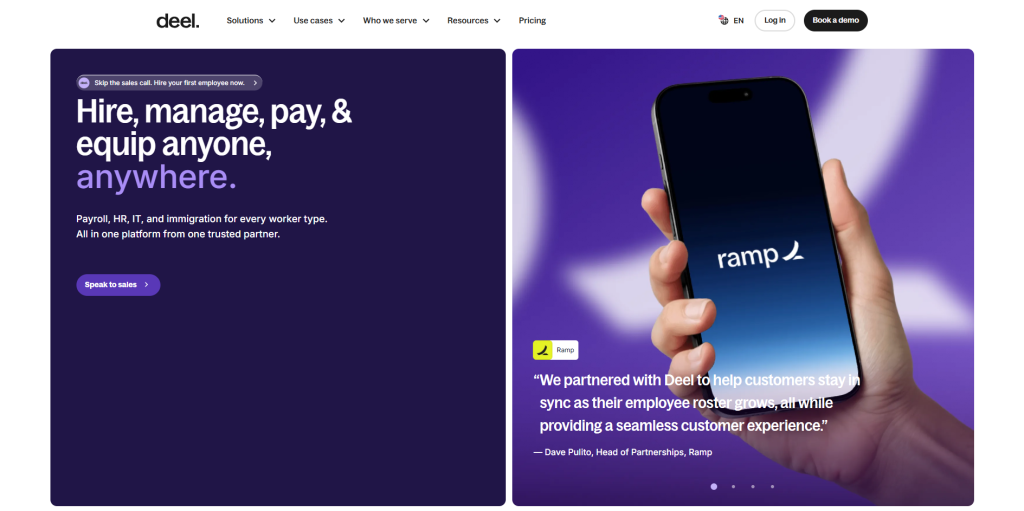
Deel is one of the most recognized top EOR vendors globally.
Key EOR Services
- Global payroll platform
- Contractor and employee onboarding
- Compliance in 150+ countries
- Automated documentation
Key Strength
The platform is the main differentiator.
- Fast onboarding process
- Transparent pricing structure
- Centralized dashboard for workforce management
Companies gain speed. Especially startups entering multiple markets quickly.
Key Limitations
- Costs increase as team size grows
- Limited customization in complex setups
Best For
- Startups and scale-ups
- Companies prioritizing speed over deep localization
3. Remote
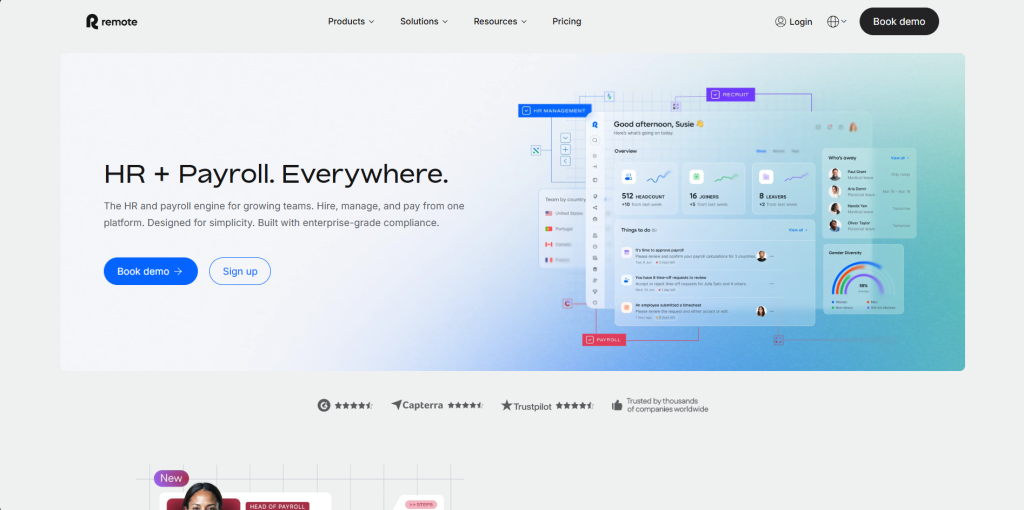
Remote focuses on compliance-first operations.
Key EOR Services
- Global employment infrastructure
- Payroll and tax compliance
- IP protection
- Benefits management
Key Strength
Ownership of local entities.
Remote builds its own legal infrastructure instead of relying on partners. This improves compliance control.
Key Limitations
- Less flexible pricing
- Slower onboarding in niche markets
Best For
- Companies with strict compliance requirements
- Organizations handling sensitive IP
4. Papaya Global
Papaya Global targets enterprise clients.
Key EOR Services
- Workforce analytics
- Payroll automation
- Multi-country employment management
Key Strength
Data visibility.
- Real-time reporting
- Centralized financial analytics
- Scalable platform for large teams
Key Limitations
- Complex onboarding
- Requires internal HR maturity
Best For
- Enterprises managing large distributed teams
5. WorkMotion
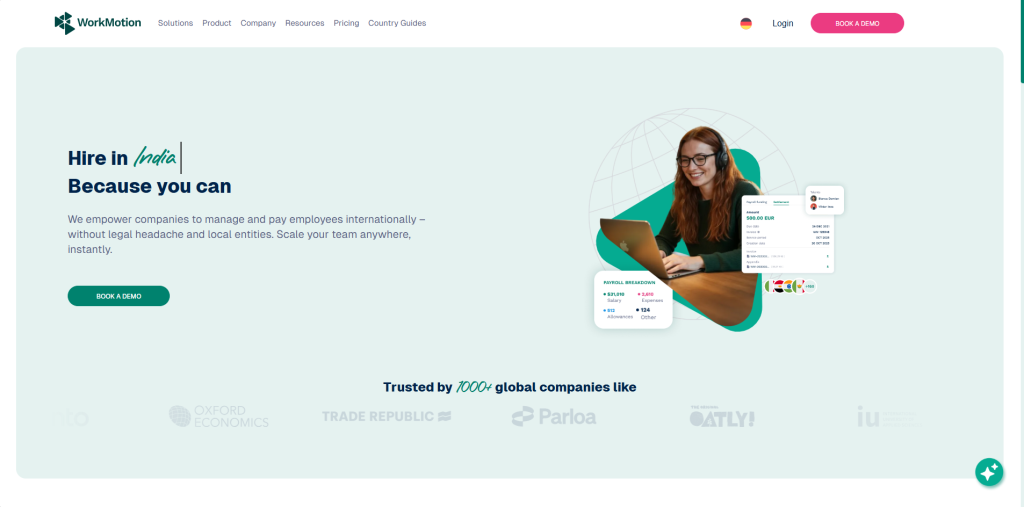
WorkMotion specializes in hiring in European countries.
Key EOR Services
- Employment across European countries
- Payroll and compliance
- Local benefits
Key Strength
Deep European coverage.
Companies expanding into Eastern Europe benefit from localized expertise.
Key Limitations
- Limited global reach outside Europe
Best For
- Businesses targeting European expansion
6. Oyster HR
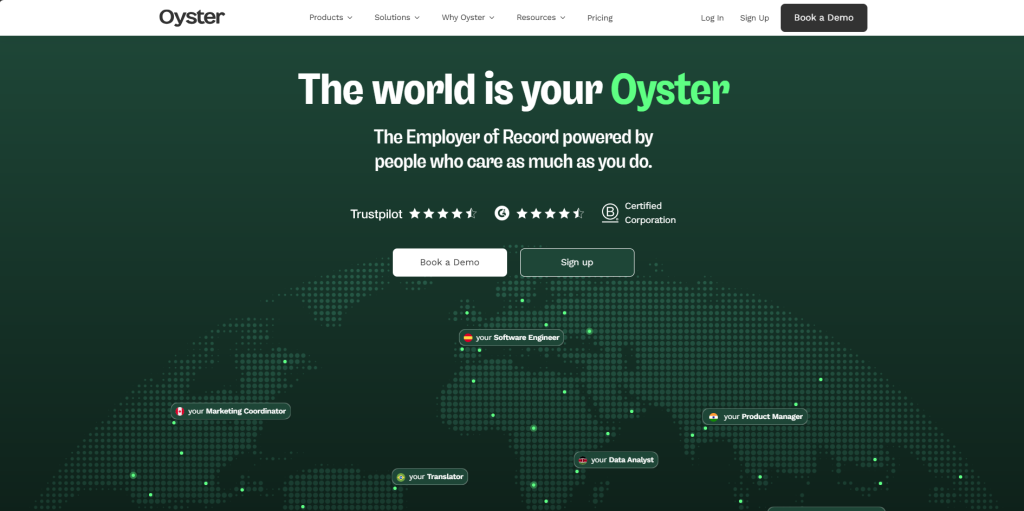
Oyster HR supports distributed hiring models.
Key EOR Services
- Global hiring platform
- Payroll and compliance
- Benefits management
Key Strength
Ease of use.
- Simple interface
- Quick onboarding
Key Limitations
- Customer support inconsistency
- Limited enterprise capabilities
Best For
- Remote-first companies
Best EOR Providers to Hire Global Teams by Region
Latin America
Latin America attracts global companies due to time zone alignment, growing talent pools, and lower employment costs. Businesses reduce salary expenses by up to 40.0% compared to the US , but hiring here requires strict compliance with local labor laws.
Why Latin America requires EOR support:
Each country operates under different employment regulations. Companies face:
- Complex payroll systems with mandatory bonuses
- Strict employee protection laws
- Risk of contractor misclassification
- Country-specific tax and reporting requirements
Without Employer of Record providers for remote teams, these factors slow expansion and increase legal risk.
1. Alcor
Alcor stands out among trusted EOR providers for remote teams due to its regional expertise.
- Strong presence across Latin America
- Combines EOR with recruitment support
- Handles payroll, compliance, and benefits
Best for companies building long-term engineering teams.
2. Deel
Deel is one of the most scalable EOR vendors.
- Wide country coverage
- Fast onboarding
- Centralized payroll platform
Best for companies scaling distributed teams quickly.
3. Remote
Remote focuses on compliance and legal clarity.
- Owned local entities
- Strong employment frameworks
- Reliable payroll execution
Best for companies prioritizing risk reduction.
South-East Asia
South-East Asia offers scale. Countries like the Philippines, Vietnam, and Indonesia provide access to large talent pools across engineering, support, and operational roles.
However, this region presents a different type of complexity compared to Eastern Europe.
Why South-East Asia requires scalable EOR infrastructure:
The main challenge is fragmentation.
Each country operates under its own:
- Labor laws
- Tax regulations
- Payroll systems
- Benefits requirements
There is no unified regulatory framework. As a result, companies expanding into multiple countries face multiplied compliance risks.
This is where EOR providers for global teams play a central role.
They standardize processes across jurisdictions and reduce operational overhead.
1. Deel
Deel is one of the most widely used top EOR vendors for South-East Asia.
Why Deel performs well in this region:
- Coverage across a large number of countries
- Fast onboarding process
- Automated payroll and compliance workflows
Deel’s platform simplifies complexity. Instead of managing multiple local systems, companies operate through a single interface.
This is particularly valuable when scaling distributed teams quickly.
However, companies should consider cost implications. Pricing increases as workforce size grows.
2. Papaya Global
Papaya Global focuses on enterprise-level workforce management.
Key strengths in South-East Asia:
- Centralized payroll processing across multiple countries
- Advanced analytics for workforce costs
- Integration with existing HR systems
Papaya is suitable for companies managing large distributed workforce operations.
It provides visibility into spending, headcount distribution, and compliance status.
The trade-off is complexity. Implementation requires internal resources and structured HR processes.
3. Oyster HR
Oyster HR offers a simpler approach.
Key advantages:
- User-friendly platform
- Quick onboarding
- Transparent pricing structure
Oyster works well for companies entering South-East Asia for the first time.
It reduces the learning curve and enables faster market entry.
However, compared to other trusted EOR providers for remote teams, it may offer fewer advanced features for large-scale operations.
Conclusion
Choosing the right EOR provider depends on your target region, team size, and compliance priorities. Latin America suits companies seeking cost efficiency with engineering depth, while South-East Asia offers scales across diverse operational roles. Providers like Deel serve both regions effectively, whereas Alcor and Oyster HR offer more focused advantages. Evaluate your expansion timeline and risk tolerance before committing to any single provider.