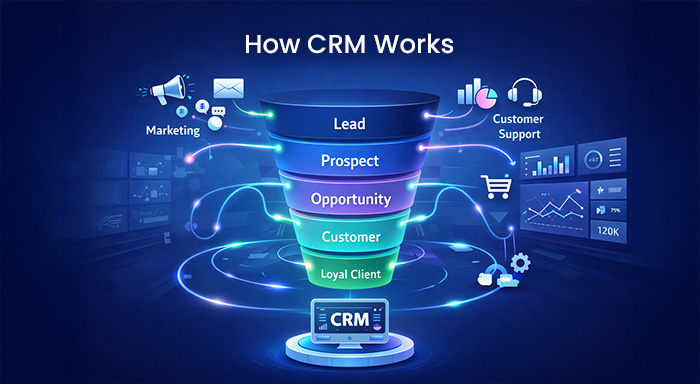






Customer Relationship Management (CRM) is a significant tool for businesses that aim to improve their customer relationships and thus ensure sustainable growth. In a bid to understand CRM, as well as how it works, it is essential for businesses to be conversant with the CRM process, the different components of the CRM system, as well as the strategies involved in each of them with the aim of achieving improved sales performance and thus value.
Comprehensive Summary of How CRM Works
Foundation of CRM System: Customer Relationship Management (CRM) systems are built to handle customer data in a centralized way to enable personalized customer engagement and informed decision-making.
Data Gathering Process: CRM systems are built to automatically gather customer data from emails, calls, social media, website interactions, and transactions to compile a complete customer profile.
Analytics and Reporting: Analytics capabilities are built into the system to convert raw data into meaningful insights through dashboards, reports, and predictive analytics.
Workflow Automation: Automated workflows help in automating repetitive tasks such as sending follow-up emails, assigning leads, and entering data, so that teams can concentrate on high-priority tasks.
Integration Capabilities: Contemporary CRM systems can easily integrate with email services, marketing software, accounting systems, and communication services to provide end-to-end business operations.
Customer Journey Tracking: CRM software keeps track of and documents every interaction with a customer from the initial point of contact to the transaction, and even beyond.
The Story Behind CRM Evolution
A sales manager at a growing software company in the early 1980s was aware of this issue. His sales force used Rolodex cards, index cards, and file cabinets to store customer information. But when an important salesperson left the company, weeks of customer relationship-building and knowledge departed with them. This was the state of affairs in every business until visionary entrepreneurs asked, "What if we could centralize customer information in a way that would benefit the whole organization?"
This marked the beginning of a revolution. From basic contact management databases to today's AI-driven solutions, CRM technology has evolved from a digital Rolodex to a critical business intelligence solution. Organizations that employ CRM solutions experience a substantial boost in sales and customer retention.
In today's world, understanding how CRM works is no longer a differentiator; it is a necessity.
What is CRM and How Does It Work?
How CRM works begins with the basic idea that all customer information should be stored in one place. A CRM system is essentially an integrated tool that analyzes customer information to improve business relationships.
The basic idea of CRM is that it works through three elements:
• Data Repository: It holds all the customer data such as contact information, communication history, purchase history, and behavior patterns
• Process Management: It manages sales processes, marketing, and customer service processes
• Analytics Engine: It converts raw data into meaningful information through reporting, forecasting, and predictive analytics
The system runs in the background and records all interactions with customers, whether it is an exchange of emails, phone calls, visits to the website, or social media interactions. Contemporary CRM systems are based on cloud technology, which enables access to data from anywhere in the world where there is internet connectivity. The marketing, customer support, and management teams can access the data instantly when a salesperson updates a customer file.
The CRM Process: Step-by-Step Workflow
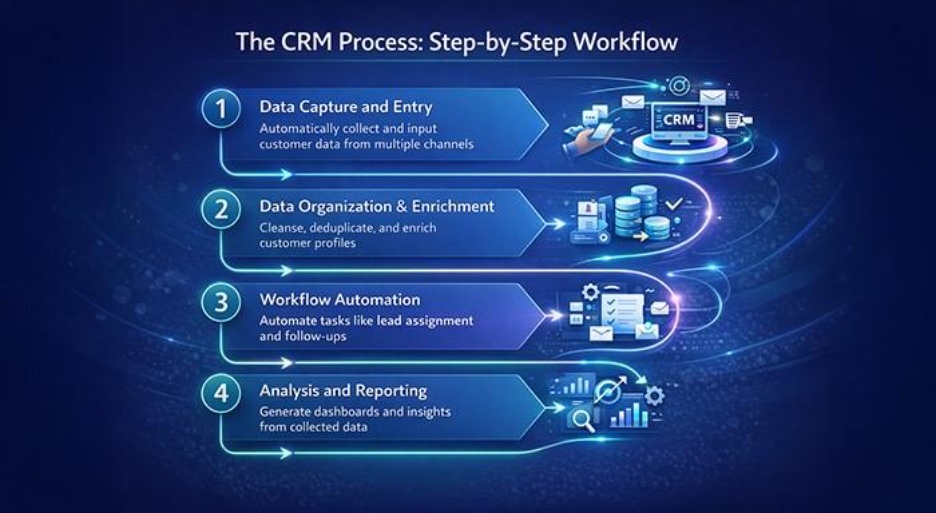
Understanding how CRM works requires examining its systematic process flow:
1. Data Capture and Entry
Customer Data Entry Methods into System:
- Sales team members send contact information and meeting details to system by Hand
- Marketing automation system also uses website visitor, form submission & email interaction activity to add customer data
- Customer service will document all customer inquiries including support tickets, chat or phone calls
- E-commerce integrates with system and automatically captures customer purchase history and web surfing history
2. Data Organization and Enrichment
The automated CRM will automatically structure that previously harvested data by removing duplicate entries, assigning types of contacts, enhancing profiles using third-party data, and linking related records to easily view a complete relationship of history.
3. Workflow Automation
Automated tasks will occur via the CRM system according to the rules you have established. These rules can include (but are not limited to) assigning leads to the appropriate salesperson, sending reminders when a follow-up is due, sending automated email messages to prospects and customers, and creating support tickets assigned to specific members of your team.
4. Analysis and Reporting
The system continuously analyzes data to generate real-time dashboards, examine customer behavior trends, forecast future sales, measure campaign effectiveness, and identify customers that are at risk, requiring prompt attention.
5. Continuous Optimization
On the basis of the insights that are generated, teams are able to refine their strategies by modifying their sales processes, marketing strategies, customer service protocols, and integrations.
Key Components of How CRM Systems Work
Contact Management
The contact management system stores basic contact information, company information, social media handles, communication preferences, and custom fields as per business requirements.
Sales Pipeline Management
The sales pipeline management feature in CRM displays the sales process with customizable pipeline stages, drag-and-drop functionality, tracking of deal value, win/loss analysis, and sales activities.
Marketing Automation Integration
The latest CRMs monitor the performance of email campaigns, score leads based on behavioral data, automate sequences for prospect nurturing, segment audiences for personalized communication, and measure marketing return on investment.
Customer Service Too
Customer service teams use the contact management system with access to ticketing systems, knowledge bases, customer satisfaction surveys, SLA tracking, and case escalation processes.
Analytics and Reporting Dashboard
The reporting feature of CRM provides integrated reporting features such as pre-built reports, customizable dashboards, scheduled reporting, drill-down analysis, and export functionality.
CRM Strategy: Maximizing System Effectiveness
Knowing how CRM technology works is only half the battle—implementation is the other half:
Define Clear Objectives
Establish goals such as enhancing sales conversion rates, reducing customer acquisition costs, increasing customer retention, enhancing collaboration between departments, and reducing sales cycle times.
Secure User Adoption
Technology works if people use it. Engage end-users in configuration, offer extensive training, highlight the value of CRM, appoint CRM champions, and track CRM usage statistics.
Ensure Data Quality
The success of CRM relies on the quality of data, which is ensured by the presence of data entry standards, validation rules, data cleansing, stewardship responsibilities, and quarterly audits.
Integrate Across Systems
The most effective way to unlock the power of CRM is through CRM integration with other tools like email clients, calendar software, accounting packages, marketing automation platforms, and e-commerce platforms.
Types of CRM Systems and How They Work
Different types of CRM systems work in distinct ways based on their focus:
Operational CRM:
The aim of operational CRM is to enhance and automate your operational activities. Operational CRM can help with sales automation (for example, lead tracking, opportunity management, and quote development), marketing automation (for example, campaign management, audience segmentation, and lead nurturing), and service automation (for example, automated ticketing, intelligent case assignment, and knowledge bases). Operational CRM is very process-driven, and as such, it is built to increase efficiency.
Analytical Customer:
Relationship management is very analytical. Analytical Customer Relationship Management is an in-depth process of gathering and analyzing data about customers to identify their buying behavior, market share, and purchasing patterns. Organizations apply analytical CRMs for segmenting customers according to demographics, pricing, and engagement levels with business organizations. Apart from analyzing the potential of a client for future purchases through statistical approaches of modeling or machine learning algorithms; the management of business organizations will apply analytical CRMs to assess their customer value, loss potential , and pricing strategies through competitive performance analysis.
Collaborative CRM:
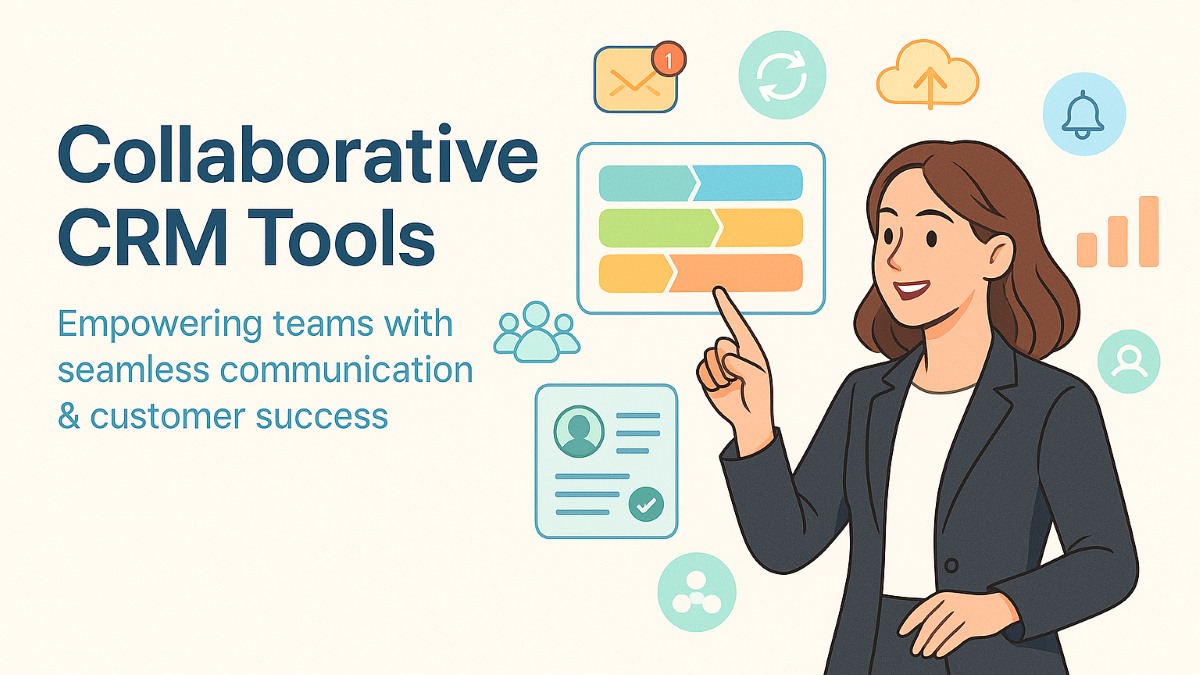
It is more about enhancing communication and sharing information among different departments and external parties. It eliminates the barriers between sales, marketing, and customer service organizations and also allows collaboration with external partners, suppliers, and vendors. This type of CRM supports customer self-service portals, communities, and a single view of the customer across all touch points, thus ensuring consistent communication and enhanced relationship building in complex scenarios.
Strategic CRM:
This CRM is all about developing and maintaining long-term business relationships with customers. Instead of focusing on the transactional aspect of business, strategic CRM focuses on customer retention and loyalty. Strategic CRM is all about developing and maintaining long-term business relationships with customers. Instead of focusing on the transactional aspect of business, strategic CRM focuses on customer retention and loyalty.
Common Challenges and Solutions
Low User Adoption
Increase adoption by engaging users early, demonstrating individual value, streamlining processes, offering role-based training, acknowledging usage, and resolving individual issues through ongoing feedback and support.
Data Quality Problems
Ensure data quality by requiring fields, applying validation rules, establishing strict entry guidelines, performing periodic data cleanups, and implementing duplicate detection to provide accurate and trustworthy data.
Over-Customization
Prevent over-customization by beginning with default settings, aligning processes with best practices, avoiding unnecessary customizations, tracking customizations, and periodically reviewing settings to ensure scalability and performance.
Measuring CRM Success
The following key performance indicators should be tracked:
• Sales Metrics: Conversion rates, average deal size, sales cycle length, win/loss ratios, customer acquisition cost
• Customer Metrics: Retention rates, customer lifetime value, Net Promoter Score, satisfaction scores
• Operational Metrics: Data quality scores, user adoption rates, response times, automation rates
• Financial Metrics: Revenue attribution, cost savings, marketing ROI, total cost of ownership
Conclusion:
Knowledge of how CRM works is the key to unlocking its full potential. CRM solutions are successful when they integrate strong technical prowess with sound strategic execution. Companies that make the necessary investments in planning, people, data, and optimization reap significant rewards in terms of improved sales outcomes and optimized customer relationships.
The best CRM solutions integrate technology with business processes, achieve widespread user acceptance, ensure high data quality, and keep improving based on insights and feedback. With the rapid evolution of CRM technology in areas such as AI, advanced analytics, and personalization, companies that get the basics right today are poised to benefit from the innovations of tomorrow.
Whether you are looking at CRM for the first time or trying to improve an existing process, remember that technology is simply a tool and that it is not the value that is created, but rather how that technology is used. The answer is not whether your business needs CRM, but rather how quickly you can tap into its power to build stronger customer relationships, drive revenue growth, and build lasting success.
Read also: CRM Project Management: How to Align Sales and Delivery Teams in 2026
Frequently Asked Questions for How CRM Works
A CRM captures customer interactions across channels and stores them in unified profiles. It automates workflows and gives teams real-time access to customer data for daily decisions.
CRM relies on a centralized database that collects and organizes customer data. It triggers automation and generates insights through analytics and system integrations.
CRM reduces manual work, eliminates data silos, and improves team collaboration. It enhances visibility, personalization, and data-driven decision-making.
You must define business goals, processes, and adoption strategies in advance. CRM success requires planning, training, and ongoing optimization.
Basic benefits appear within 1–3 months of implementation. Stronger performance and ROI typically develop over 6–12 months.
Contact management stores data, while CRM actively manages relationships. CRM adds automation, analytics, integrations, and strategic insights.