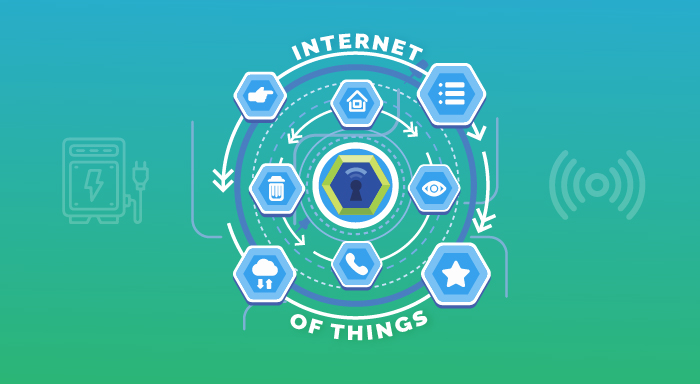






The Internet of Things environment is a broad network of interdependent and connected devices that specialists use to achieve a particular goal like home automation or construction of a smart city. Essentially, the applications of IoT are limitless, and thus, we can talk about a broad range of IoT environments existing and exchanging data. The logic that drives every IoT environment is the same: a device that collects the data and sends it to the platform or network that collects the data to perform a task or for future analysis. As you know, the main components of an IoT environment are as follows: networks, devices, platforms, and agents.
Now that we clearly understand what is IoT, how an IoT environment actually look like, and the components that tie everything together, the next question that arises is this: how do such components actually work together? You can consider it a well-oiled machine where each part plays a significant role, but what defines that role actually? This is exactly where the concept of Functional Blocks of IoT becomes important. Just how a professor divides a complex subject into digestible topics, IoT architects divide the complete IoT ecosystem into fundamental building blocks where each building block is responsible for a particular function that makes the system run seamlessly.
Essentially, these functional blocks are pillars of each IoT ecosystem whether it is a complex industrial automation network or a simple home setup. Having a clear understanding of IoT functional blocks is vital since every IoT environment depends on the same core processes to collect, process, and act on the data.
Core Functional Blocks of IoT
Every IoT environment operates through numerous functional blocks. Here, the purpose of every IoT functional block is clearly defined and complements the journey of data from device to application.
| IoT Sensors and Actuators | Detect as well as control physical conditions | Controlling Machine Temperature |
| Connectivity Layer | Transmitting data across diverse devices | 4G, 4G, NB-IoT |
| Processing Layer | Filters and assesses data | Cloud or Edge platforms |
| Application Layer | Represents insights to the users | Dashboards for predictive maintenance |
| Security | Secures networks, devices, and data from cyber threats | MFA, Intrusion Detection, TLS/SSL Encryption |
| Scalability | Makes sure that infrastructure efficiently scales as data volumes and devices grow | Load Balancing, Auto Scaling, Microservices |
Such IoT functional blocks help create consistent data flow. Data is gathered, processed, transferred, and displayed to facilitate various business decisions.
IoT Sensors and Actuators:
When we talk about the pillars of any connected system, IoT sensors and actuators are the most important. Sensors collect data related to metrics such as motion, heat, pressure, or humidity. Actuators implement actions as per the data collected by sensors. IoT sensors and actuators help in controlling lights, adjusting machinery, or automatically regulating systems.
What are the main qualities?
- Speed: Instantly responds to inputs
- Accuracy: Provides accurate data for tracking
- Durability: Can work in challenging conditions
- Scalability: Provide support to a wide network of devices
Processors:
Processors can be described as the brain of any IoT environment. They are real-time devices, which can be easily controlled by software. They also manage data security, which includes encryption and decryption of data.
- Its key function is to manage the data captured by IoT sensors.
- Extract the crucial information from the copious volume of data collected.
- Processors mostly operate on a real-time basis and can be controlled easily by the applications.
- It is also responsible for ensuring data security and can be controlled by the applications easily.
- Executes data encryption and decryption
Gateways:
In an IoT environment, gateways connect sensors, actuators, and the wide network. They get data from the connected devices and direct it to the relevant destinations for further action or processing.
- It is a device that is utilized for simple analysis of data coming from tethered sensors.
- Gateways are responsible for directing the processed data and sending it to the exact locations for proper utilization of data.
- Essentially, they work as decision points, sending specific control commands to actuators which perform relevant actions in turn.
- Gateway aids in establishing to-and-from communication with the data. Essentially, it ensures network connectivity with the data. Network connectivity is vital for any IoT platform to communicate. WAN, LAN, and PAN are a few examples of network gateways. Both microprocessors and microcontrollers can be utilized as gateways for IoT applications.
Connectivity:
Connectivity allows data to move between gateways, devices, and applications. Choosing a network depends on data rate, coverage, and power needs.
| Technology | Power Use | Coverage | Application |
| Wi-Fi | Medium | Local | Smart Buildings |
| Satellite IoT | Moderate | Global | Maritime Operations |
| LoRaWAN | Low | Long-range | Remote Monitoring |
| NB-IoT | Low | Deep Coverage | Smart Metering |
| 5G | Moderate | Wide | Real-time Control |
Here, each option caters to a particular use case. Enterprises often integrate numerous options for cost control and reliability. Learn more about communication protocols in IoT from our dedicated blog.
Data Processing and Analytics:
Raw data from IoT devices becomes crucial only once processing is done. In the processing layer, incoming data is transformed into valuable insights.
What Are the Various Types of Processing?
- Fog Processing: Happens at local nodes for analysis at mid-level.
- Edge Processing: Happen near to the devices for quick responses.
- Cloud Processing: Happens centrally for in-depth analytics.
For instance, logistics sensors monitor logistics temperatures. Edge devices send notifications if limits are crossed. Later, cloud platforms assess patterns for more effective planning. Data processing is one of the key components of IoT.
Application Layer and Integration:
The application provides IoT insights related to business operations. It converts processed data into alerts, dashboards, and automated alerts that support data-based and quick decisions.
Industry Applications:
- Utilities: Provides support for real-time monitoring of energy and automated consumption control.
- Manufacturing: It allows equipment tracking and predictive maintenance to minimize consumption.
- Healthcare: Remotely tracks patient data for medical interventions in a timely manner.
- Transportation: Manages fleet performance and optimizes routes through real-time data.
- Retail: Utilizes inventory monitoring and smart shelves to improve efficiency. It can also easily integrate with the warehouse management system.
This layer converts raw information into actionable insights, enhancing innovation, efficiency, and operational excellence across diverse industries.
Data Storage:
Once the data reaches its final destination, the value captured by the sensor is usually stored in a computer database that can serve other platforms easily. Data stored on the server can either be cloud, local, or both.
Security:
In any connected environment such as IoT, the role of security is of paramount importance. In IoT, all devices connect to one another, and every device has its own inherent risks that must be carefully managed.
What Are the Key Security Practices?
- Consistently authenticate devices
- Encrypt information at the time of transmission
- Track networks and detect evolving threats.
- Update the firmware to eliminate any vulnerabilities.
- Adopt powerful cybersecurity strategies to consistently mitigate risks.
Scalability:
Scalability is one of the most significant functional blocks of IoT. As the number of devices evolve, management turns out to be more complex. A carefully designed IoT infrastructure must be capable of managing hundreds, if not thousands or even millions of devices without sacrificing reliability or performance. This is achieved via auto-scaling cloud systems, modular architecture, and load balancing techniques that efficiently distribute traffic. Edge computing also plays a key role in scalability by minimizing overload on central servers. Businesses that aim for scalability in the beginning avoid expensive infrastructure modifications as the IoT environments expand.
Future Outlook
- IoT technology is evolving at an unprecedented rate. New trends and integration of AI and machine learning are expected to bring more paradigm shifts to how these IoT ecosystems operate.
- Edge AI can introduce quick decision-making at the device level.
- Blockchain boosts the authenticity of data.
- 5G adoption provides support to adoption in real-time.
- Sustainability initiatives leverage IoT to minimize energy waste.
- New IoT trends and developments can introduce new functional blocks of IoT
Endnote
Related Posts
IoT Levels Explained: A Deep Dive into the Internet of Things Hierarchy
Learn the Ideas Behind the Logical and Physical Designs of IOT
Internet of Things | IoT Design Methodology And Its Importance
Faqs For Functional Blocks of IoT
A- IoT is a network of devices, commonly referred to as “things” that are related with each other and can exchange data. Usually, these devices are embedded with sensors, software, and other technologies with the purpose of sharing information For example, devices such as busy lights communicate a person's work status with an LED light from a connection with the software on their computer.
A-In the functional model, we deal with functional groups (FGs) like devices, applications, security, etc. that comprise IoT. The functional model describes these FGs and their communication with one another.
A- IoT architecture requires functional layers to ensure smooth collection, analysis, and utilization of data. Namely, the functional layers are: the data processing layer, device layer, application layer, and network layer.
A- IoT connects various devices over a network that can be Bluetooth, Wi-Fi, or cellular network. These devices can then be connected with one another to collect, send, exchange, or analyze data.
A- The functional blocks that make up the IoT ecosystem are sensors, processors, applications, gateways, and databases. These blocks then make an IoT network capable of sensing, identification, automation, actuation, communication, and management.
A- Namely, there are five functional blocks in an IoT ecosystem