





Every morning, people open their browsers not just to catch up with the latest updates, but to enjoy a quick mental workout with Wordle. What started as a simple five-letter game has quietly become a part of the daily routine; something you do with your coffee, during break or before bed.
You’ve solved today’s wordle, maybe it took you two tries and you feel like a genius. Maybe it took five tries, and you’d rather not talk about it. Either way, you closed the tab, shared your little grid of colored squares, and moved on with your day. But here’s the thing; the most interesting part of Wordle doesn’t happen during the game. It happens right after it and most people completely skip it. That's where the Wordle bot comes in. To understand why this matters, it first helps to understand what bots are and how they work because the Wordle Bot, despite its playful context, is a sophisticated piece of software.
Wordle Bot Explained: Meaning, Purpose, and Origin
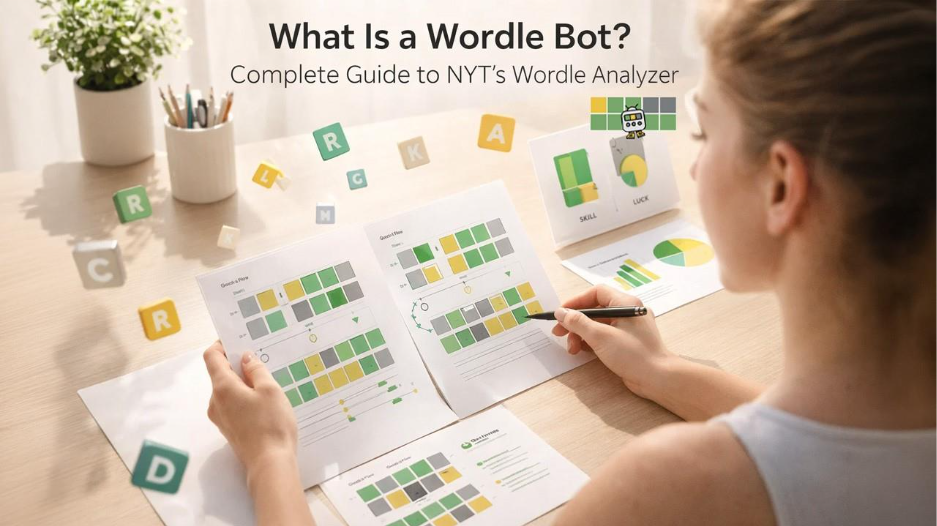
Wordle bot is an analytical tool developed by The New York Times that reviews your completed game and breaks down every single guess you made; not just whether you got the answer, but how you get there. Think of it like a coach who watched you play and has some very specific notes.
It was first launched in April 2022, created by NYT data journalists Josh Katz and Matthew Conlen, who originally built to settle one deceptively simple question: what’s the best starting word? The project quickly picked up pace and grew into something bigger. By 2023, the NYT released Wordle bot 2.0, which is a refined version with a sharper algorithm, trained on data from over 515 million Wordle games.
The result is a tool that doesn’t just look at your final score. It reconstructs your entire decision-making process, word by word, and tells you exactly where logic served you well, and where you were essentially guessing into the dark.
How Does a Wordle Bot Work? Step-by-Step Explanation
Before the bot makes sense, the game needs to make sense. Wordle gives you six attempts to guess a secret five-letter word. After each guess, the title changes color to guide you:
Green: means the letter is correct and in the right position.
Yellow: means the letter is in the word but in the wrong spot.
Gray: means the letter isn’t in the word at all.
That’s the whole game, no timer, no extra lives. You get one new puzzle per day. The simplicity is what made it go viral in late 2021. Millions of people were sharing their results on social media within weeks of its public release. This is also part of a much larger story; the rise of bots across digital platforms, where automated tools began appearing alongside almost every popular app or game to extend, analyze, or enhance the user experience. But simplicity on the surface doesn’t mean there’s no depth underneath. Every guess is a decision, and every color is a clue. Over six attempts, the gap between the methodical player and a lucky one becomes clear, especially once the wordle bot gets involved.
Wordle Bot Skill vs Luck: How Scoring Works Explained
This is the part that catches most people off guard. When you open the wordle bot after completing your puzzle, it grades your game across two dimensions: skill and luck, each scored on a scale of 0 to 99. Both scores are then benchmarked against NYT daily average across all people.
Here's what each means:
Skill: It measures whether your guesses minimize the number of possible remaining words. Did you use the information from each guess as efficiently as possible?
Luck: It measures whether the letters you happened to try eliminated more possible solutions than expected. Essentially, did the game cooperate with you?
These two scores tell a story together:
- A high skill score with a low luck score means you played intelligently against difficult odds.
- A high luck score with a low skill score means you were able to solve the puzzle despite questionable choices.
The bot also walks through each of your guesses individually, flagging alternatives you could have tried and showing how many possible answers remained after every step. It even reveals how it would have solved the same puzzle. Some days its approach is almost identical to yours. Other days, it's humbling. Unlike Blooket bots that auto-answer questions to game the score, the Wordle Bot works only after you've finished; analyzing your real choices, not replacing them.
How to Use Wordle Bot: Step-by-Step Guide for Better Results
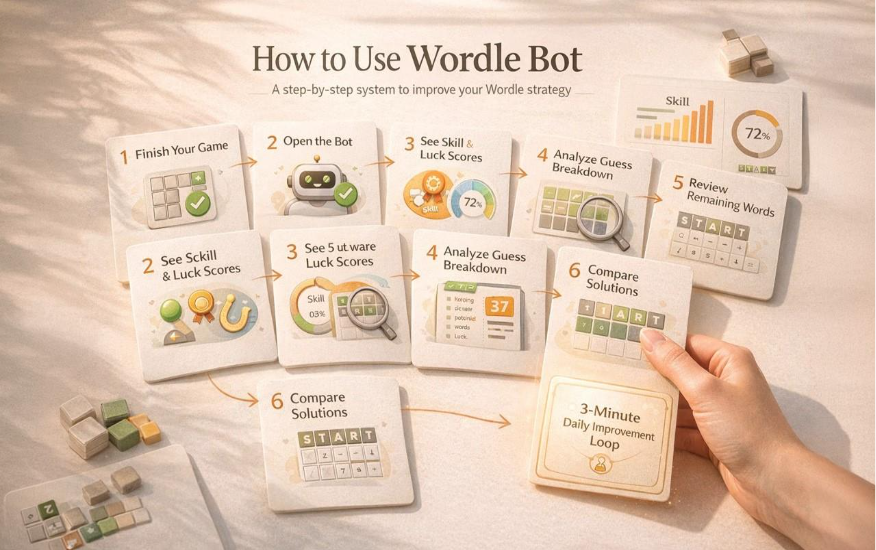
Using it is straightforward, but there’s a right way to approach it if you actually want to move:
- Finish Your Wordle Game First: The bot only analyzes finished games. It won’t spoil the answer beforehand.
- Open Wordle Bot in the Same Browser: It reads your game data automatically. There is no need for manual input.
- Check Your Skill and Luck Scores: Note whether you are above or below the daily average on both.
- Analyze the Guess Breakdown: Pay attention to moments where the bot suggests a different word; don’t just dismiss them. Ask yourself why it preferred that option.
- Review Remaining Word Options: The bot shows what other words were still possible at each stage. This is where real learning happens.
- Compare with Wordle Bot’s Solution: Compare it to yours. The goal isn’t to copy it; it’s to understand the logic behind narrowing down the possibilities faster.
- Evaluate Your Starting Word Performance: If your starting word is consistently scoring low, it might be time to change your opening word.
One round of this takes about three minutes. If done consistently, it genuinely rewires how you approach the puzzle.
Best Tips to Improve Your Wordle Score Using Wordle Bot
The bot is only as useful as the attention you bring to it. Here's to go beyond just reading your score:
Track Your Skill Score Trends: A single game tells you almost nothing. A week of data tells you whether you have a pattern.
Choose a Strong Starting Word: The starting guess is the single highest-leverage decision in Wordle. The bot’s current top-rated opener (updated after analyzing 515 million games) is no longer SLATE. Make sure yours is in the same tier of efficiency.
Learn from Weak Guesses: They are your blind spots, moments where you had information and didn’t use it well. This kind of pattern recognition is exactly what separates instinct from strategy and it's the same principle behind tools like Auztron Bot, which help users identify inefficiencies in their daily routines through consistent automated feedback.
Focus on Consistent Improvement: A 99-skill rating is great, but the goal is steady improvement, not optimization anxiety.
Build Vocabulary with Bot Suggestions: It works from a dictionary of approximately 4,500 words. Some of its preferred guesses will introduce you to words you hadn't considered, which sharpens your awareness for future games.
The players who improve fastest aren't the ones who obsess over their daily score. They're the ones who spend three quiet minutes reviewing why they played the way they did.
Is Wordle Bot Free? Pricing, Subscription, and Alternatives
This is the most common question, and the answer comes with a small catch. Wordle itself remains completely free to play. The Wordle bot, however, is currently available only to New York Times subscribers. The most accessible entry point is the NYT Games subscription, which costs $1.50 per week (billed as $6 every four weeks) or $50 annually.
If a subscription feels too much for a daily word game habit, there are free third-party alternatives worth knowing about. Sites like wordle-bot.org offer a free Wordle analysis tool that works similarly: you enter your guesses, the tool calculates the best next move, and it scores your efficiency. It's not the same depth as the official NYT bot, but it covers the fundamentals without a paywall. For serious players, the NYT subscription is worth it. However, for casual ones, the free alternatives can work too.
If you're curious about how these kinds of tools are built from the ground up, creating bots using ChatGPT has become a surprisingly accessible starting point even for those without a traditional coding background.
Why Wordle Bot Is More Than a Game: Improve Thinking and Strategy
The Wordle bot, at its core, is a lesson in a specific kind of thinking: using available information as efficiently as possible before making the next move. You start with nothing, but each guess gives you data. The question is whether you can act on that data intelligently or continue operating on instinct and habit. It is not just a word skill; it’s a thinking skill.
The frustrating games, where you burned three guesses on words that shared letters you'd already eliminated aren't really about Wordle. They're about the very human tendency to keep doing what feels familiar even when the evidence points elsewhere. The bot doesn't let you forget those moments. It shows them to you, quietly, every single day.
Over time, players who use it consistently report something worth paying attention to they don’t just get better at Wordle. They become more aware of how they make decisions where they're being methodical and where they're being lazy. That kind of self-awareness, sharpened by something as low stakes as a word puzzle, has a way of benefitting you in other areas. The Wordle bot started as a question about the best starting word. It ended up as something much more useful; a daily, five-minute exercise in thinking clearly.
Final Thoughts
The Wordle bot won’t solve the puzzle for you, and it won’t make the next one easier on its own. What it will do is show you, honestly and specifically, how you think and give you the information to think better. Whether you're chasing a perfect score or just trying to stop burning four guesses on a Tuesday, the bot is the most underused tool in the game. Open it tomorrow and stay with it for a week. The score you care about isn't your Wordle result; it’s what you learn from reviewing it.