





The guide explains what CRM companies do, why businesses invest in CRM development, what to look for in a development partner, and how to choose the right CRM development partner.
Customer relationships are considered at the heart of every successful business. As the company grows, managing customer information, sales activities, marketing campaigns, support requests, and communications through disconnected tools or spreadsheets can become increasingly difficult. This is where Customer Relationship Management, or CRM software, can help businesses centralize customer information, streamline workflows, and improve customer relationship management.
Building a CRM solution is not simply selecting software with the longest features, but it should help reduce the manual workflow of the business. Businesses often need customized workflows, industry-specific functionality, integrations, automation, analytics, and long-term technical support. This makes choosing the right CRM development partner or CRM companies a crucial strategic decision.
What are CRM Companies?
CRM companies are a type of business that develops, provides, customizes, and maintains Customer Relationship Management (CRM) software. The solution helps organizations manage customer information, sales activities, marketing campaigns, communication, and customer support from a centralized system. This type of company offers a wide range of CRM solutions and services, such as ready-made CRM platforms, custom-built CRM solutions, or customization and integration services.
The CRM companies serve businesses of different sizes and industries. These types of companies provide enterprise-level solutions with advanced automation, analytics, integrations, and security features.
Why Do Businesses Need CRM Solutions?
For businesses, a CRM solution acts as an essential element, as it helps in managing customer information, making interaction easy and accessible to all responsible team members. The solution also manages and organizes all the key customer data, which used to be spread across spreadsheets, emails, messaging platforms, sales tools, and support systems, in a centralized dashboard.
Some of the key factors why businesses need a CRM solution are as follows:
- Centralize Customer Information
The CRM solution stores all the key customer details, such as contact information, communication history, purchase records, preferences, and sales activities, in a centralized dashboard. Through the solution, employees can easily access the information they need without searching through multiple systems.
- Improves Sales Management
The CRM solution helps sales teams organize leads, track opportunities, manage sales pipelines, and schedule follow-ups. It also helps sales representatives understand where each prospect is in the buying journey.
- Automate Repetitive Tasks
With a CRM solution, teams can automate various routine activities, such as follow-up reminders, email notifications, lead assignments, and data entry. CRM automation can help sales teams reduce repetitive work and focus more on customer-facing activities.
- Strengthen Customer Relationships
It offers easy access to customers' previous interactions and history, enabling employees to offer more personalized services.
Custom vs Ready-Made CRM Solution
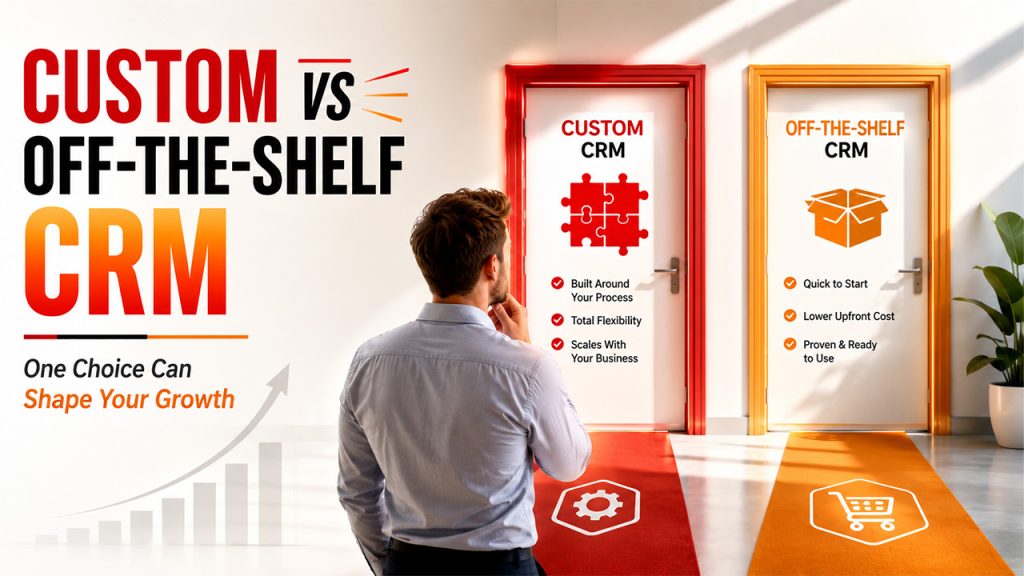
While choosing a CRM platform, businesses generally have two options: custom CRM development or a ready-made CRM solution. Both options offer efficient customer relationship management, but their approach differs in flexibility, cost, implementation, and scalability.
What is a Custom CRM Solution?
A custom CRM solution is a type of software that is specifically developed or customized for a particular business. The custom CRM solution offers greater control and flexibility to businesses, as it is designed around the company's unique workflows, requirements, and objectives.
What is a Ready-Made CRM Solution?
A ready-made CRM solution is a pre-built platform that is developed for a broad range of businesses. The ready-made or off-the-shelf CRM solution generally comes with standard features, like contact management, lead tracking, sales pipelines, reporting, task management, automation, and customer support tools.
Quick Comparison
A quick comparison between a custom CRM and a ready-made CRM solution are as follows:
| Factors | Custom CRM | Ready-Made CRM |
| Development | Built specifically for the needs of a business. | Pre-built for general business needs. |
| Customization | Very high | Limited to available customization options. |
| Initial Cost | Usually high | Usually low |
| Implementation Time | Longer | Faster |
| Scalability | Can be designed around future requirements. | Depends on the provider and plan. |
| Features | Selected and developed according to requirements. | Only standard features are included. |
| Integration | Can be built for specific systems. | Usually supports existing integrations. |
| User Experience | Designed around the business's workflows. | Designed for a broad user base. |
What does a CRM Company Do?
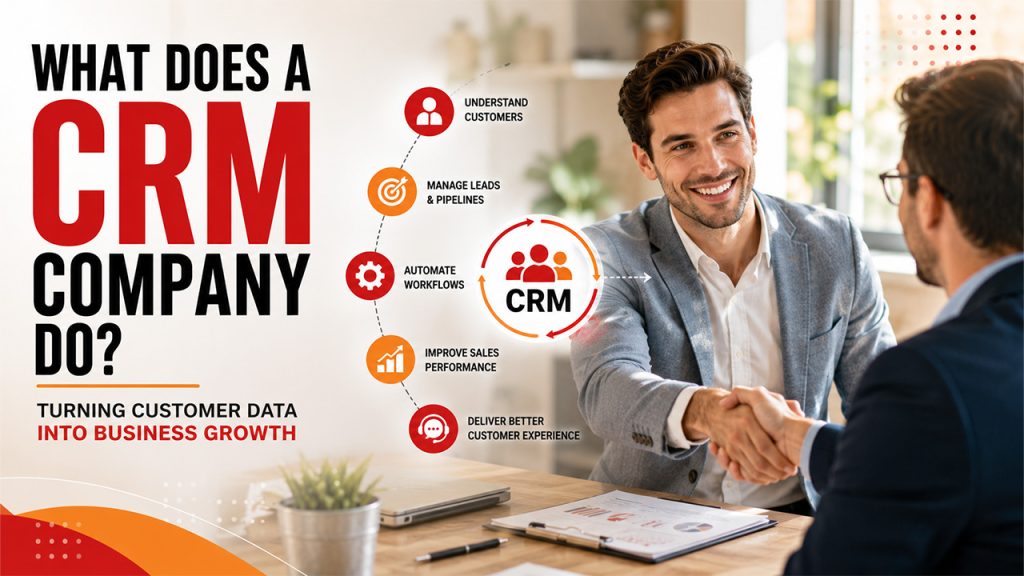
A CRM company helps businesses manage customer relationships by offering them software, development, customization, integration, and support services. The main objectives of a CRM company are to help organizations improve sales processes, organize customer data, automate repetitive tasks, and provide better customer experiences.
Some of the key applications of a CRM company are as follows:
- CRM Strategy and Consulting
The CRM companies begin by understanding how a business manages customers, leads, sales, marketing, and support. It also identifies inefficiencies and recommends a CRM strategy that can align with the organization's goals. It can involve determining which processes should be automated, what information should be collected, and which departments need access to customer data.
- Custom CRM Development
The CRM company can develop a customized solution if the off-the-shelf CRM cannot meet the requirements specification. The company can integrate new features, such as custom sales pipelines, customer portals, lead and contact management, custom dashboards, industry-specific modules, and mobile CRM applications.
- CRM Customization
If the business already uses a CRM platform, the CRM development company can customize the existing platform by adding features, modifying workflows, creating custom fields, developing dashboards, or changing the user interface.
- Third-Party Integration
The CRM systems need to communicate with other business applications. The CRM companies can integrate various business tools, such as accounting software, email platforms, marketing systems, e-commerce platforms, communication applications, and internal databases, with the CRM solution.
- Data Migration
The CRM companies can plan and execute data migration, which includes data cleaning, mapping, validation, deduplication, and testing. It also reduces the risk of losing or corrupting important customer information.
Key Factors to Consider When Choosing a CRM Development Partner
Choosing the right CRM development partner is among the most crucial decisions for any business. A CRM solution often becomes the central system for managing customer information, sales processes, marketing activities, and support operations.
Some of the key factors that a business needs to consider while selecting a CRM development partner are as follows:
- Industry Experience
Businesses should evaluate the industry-specific experience of CRM companies. Different industries have different customer-management processes, compliance requirements, and workflows. A development partner with relevant industry experience is more likely to understand the challenges and suggest practical solutions.
- Technical Expertise
A CRM development company generally requires software development, database, APIs, cloud infrastructure, security, integrations, and automation. Businesses need to evaluate whether the development company has experience with the technologies required for the projects.
- Customization Capabilities
An ideal CRM development partner should be able to customize the system around those processes. Businesses should look for a partner that can develop custom modules, workflows, dashboards, user roles, automation, and integration when required.
Conclusion
Choosing the right CRM solution is among the most important steps toward improving customer management, streamlining business processes, and supporting long-term growth. The right CRM development partners or CRM companies can make a significant difference, whether a business chooses a ready-made platform or invests in a custom CRM solution. Businesses also need to evaluate various factors, such as industry experience, technical expertise, customization capabilities, integration skills, scalability, and ongoing support.
FAQs About CRM companies
A CRM solution helps businesses centralize customer information, improve sales management, automate repetitive tasks, enhance customer service, improve team collaboration, and gain better insights through reporting and analytics.
Yes, a CRM company can customize an existing CRM platform by modifying workflows, adding custom fields and modules, developing dashboards, integrating external applications, and adapting the system to specific business requirements.
Businesses should consider various factors, such as industry experience, technical expertise, customization capabilities, integration experience, scalability, security, portfolio, communication, and project management, among others.
Yes, a CRM solution can be scaled as a business grows. A properly designed CRM can be configured to support increasing users, customer records, integrations, workflows, and business requirements.