






The best VoIP solution with IVR for SMBs bundles automated call routing into the base phone platform rather than selling it as a separate add-on, lets non-technical teams edit routing in minutes, and ties routing logic to the CRM so callers reach the right person with context. SMBs moving to cloud VoIP hit three problems that a basic phone plan doesn't solve. First, VoIP without IVR means callers still land in wrong queues or hit a single receptionist choke point, which is the exact bottleneck SMBs expected cloud to fix. Second, VoIP platforms sell IVR as a higher-tier feature or paid add-on, which pushes total cost well above the advertised entry price. Third, non-technical teams can't edit IVR without IT or vendor support tickets, which means routing stays frozen even as the business shifts. Native IVR on the VoIP plan solves these three problems with visual drag-and-drop builders editable by ops in minutes, included routing on mid-tier plans, and CRM integration for context-aware routing. The 5 platforms below cover realistic SMB fit in 2026, evaluated on five criteria: IVR included vs. add-on, visual builder usability, routing depth, pricing shape at 10 users, and integration ecosystem.
TL;DR
1. CloudTalk: Best for SMBs needing visual IVR plus CRM-based routing bundled on mid-tier VoIP.
2. RingCentral MVP: Best for established SMBs wanting mainstream VoIP with multi-level IVR.
3. GoTo Connect: Best for unified comms SMBs wanting visual dial plan editor.
4. Grasshopper: Best for solopreneurs and micro-SMBs wanting lightweight VoIP with simple auto-attendant.
5. net2phone: Best for North American SMBs wanting transparent per-user VoIP with IVR on all tiers.
How We Tested
Five criteria: whether IVR is included natively or sold as add-on, visual builder usability (drag-and-drop editable without IT), routing depth (multi-level, skills-based, CRM-based, time-based), pricing shape at 10 users with transparent seat minimums, and integration ecosystem with HubSpot, Salesforce, Pipedrive, Zendesk. Verified against documentation, G2 reviews, and SMB deployment feedback.
The 5 Best VoIP Solutions with IVR Compared
1. CloudTalk
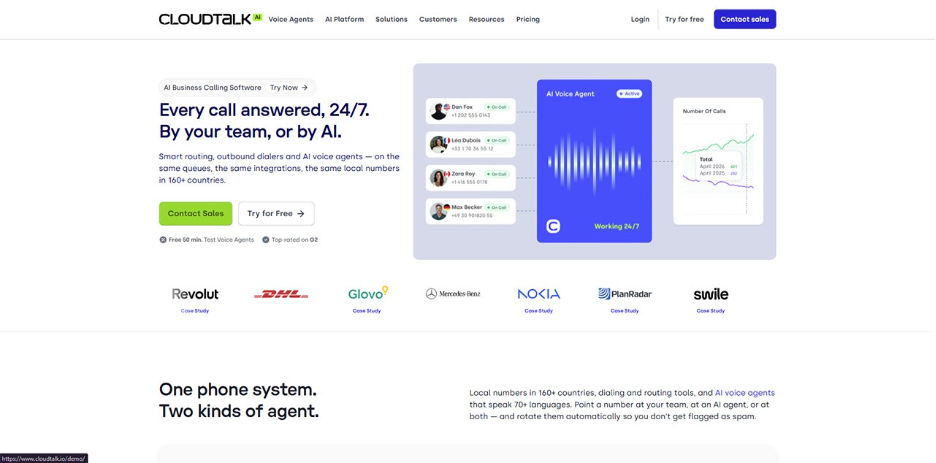
CloudTalk is cloud VoIP with a Visual Call Flow Designer (drag-and-drop canvas, 10+ nested IVR levels, 19 pre-built actions) and 5 routing modes (skill, CRM, time, geographic, sticky) all included on Essential at $29/user/month. Native CRM push to HubSpot, Salesforce, Pipedrive, Zendesk, Intercom. 160+ countries with local-presence calling.
Who is it best for?
SMB sales and support teams of 1 to 100 users wanting visual IVR plus CRM-based routing bundled on a mid-tier VoIP plan without upgrade requirements.
Key features
- Visual Call Flow Designer with 10+ nested levels, 19 actions
- 5 routing modes (skill, CRM, time, geographic, sticky) on Essential
- Native CRM push via Conversation Intelligence Data Export
- Dual-channel recording (Opus and G.722) with unlimited storage on Essential
- 160+ countries with local numbers
- Native AI Voice Agent for after-hours inbound
- SOC 2, HIPAA with BAA, SAML SSO on every plan
Pros and cons
Pros:
- 5 routing modes on Essential, not gated to higher tiers
- Visual IVR owned by ops without engineering
- Native CRM push writes caller context to agent desktop
- Dual-channel wideband recording from mid-tier
- 160+ countries with local presence (widest here)
- One-licence minimum on Starter and Essential
- AI transcription in 60+ languages at $9/user/month
- Native AI Voice Agent in same workspace
Cons:
- AI as separate $9/user/month add-on
- Expert tier (Salesforce CTI, Power Dialer) requires 3-licence minimum
- No live in-call AI coaching prompts
Pricing
- Starter: $25/user/month
- Essential: $29/user/month (full Visual Call Flow Designer)
- Expert: $49/user/month (3-licence min)
- AI add-on: $9/user/month
G2 rating
4.4/5 from 1,702+ reviews.
2. RingCentral MVP
RingCentral MVP is mainstream cloud VoIP with multi-level IVR on Core tier, unified voice-video-chat-SMS, and 300+ integrations. Automatic recording on Advanced; on-demand on Core.
Who is it best for?
Established SMBs of 10 to 100 users wanting broad integration ecosystem and mainstream enterprise-grade VoIP.
Key features
- Multi-level IVR on Core
- Unified voice, video, SMS, team messaging
- 300+ native integrations
- Automatic recording on Advanced tier
- 99.999% uptime SLA
Pros and cons
Pros:
- Largest integration ecosystem on this list (300+)
- Mature platform with 99.999% uptime SLA
- Unified comms on one platform
- Established enterprise credibility
Cons:
- Automatic recording gated to Advanced at $35/user/month
- UX feels dated compared to modern SMB-first platforms
- Platform heavier than needed for smaller SMBs
- G2 reviews flag inconsistent support
Pricing
- Core: $30/user/month
- Advanced: $35/user/month
- Ultra: $45/user/month
G2 rating
4.0/5 from 1,000+ reviews.
3. GoTo Connect
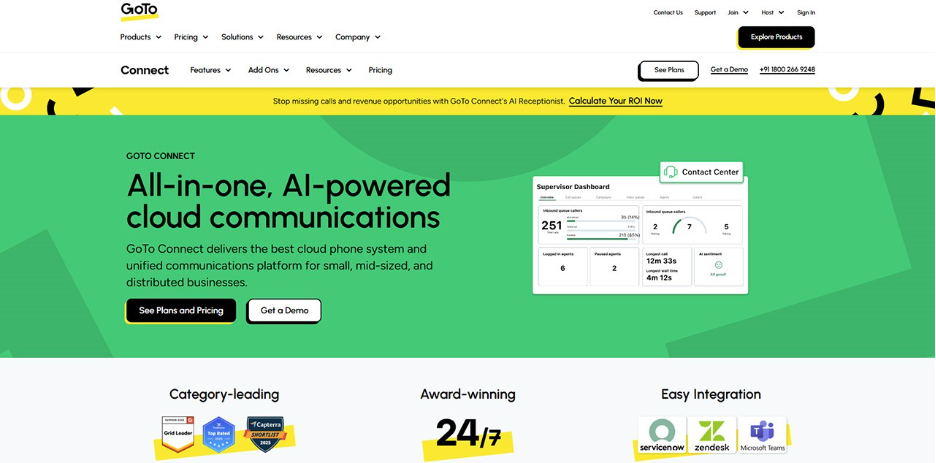
GoTo Connect is unified comms VoIP with a visual drag-and-drop dial plan editor consistently praised in reviews. Call recording on Standard tier with unlimited storage. 100+ native integrations.
Who is it best for?
Unified comms SMBs of 5 to 50 employees wanting voice, video, and chat in one platform with visual IVR editor.
Key features
- Visual drag-and-drop dial plan editor
- Unified voice, video, team chat
- Call recording on Standard with unlimited storage
- 100+ integrations (Salesforce, HubSpot, MS Teams)
- International calling to 50+ countries
Pros and cons
Pros:
- Visual dial plan editor consistently praised
- Unified voice-video-chat on one platform
- Recording with unlimited storage on Standard
- Transparent pricing on website
Cons:
- No native AI transcription (requires third-party)
- CRM push lighter than CloudTalk
- Smaller international footprint (50 vs 160 countries)
- No multilingual AI
Pricing
- Basic: $27/user/month
- Standard: $32/user/month (IVR, recording)
- Premium: Quote
G2 rating
4.4/5 from 700+ reviews.
4. Grasshopper
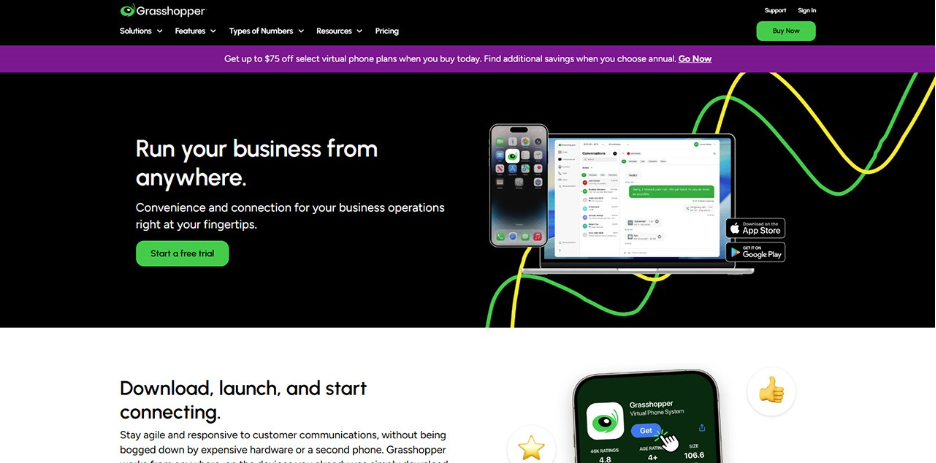
Grasshopper is lightweight business phone positioned for solopreneurs, freelancers, and micro-SMBs. Simple auto-attendant (not full multi-level IVR), virtual numbers, call forwarding. No real IVR depth for growing teams.
Who is it best for?
Solopreneurs and micro-SMBs of 1 to 5 users wanting a professional business number with simple auto-attendant.
Key features
- Simple auto-attendant (not multi-level IVR)
- Virtual business numbers
- Call forwarding to personal mobile
- Voicemail transcription
- Mobile and desktop apps
Pros and cons
Pros:
- Lowest-friction setup on this list
- Flat pricing (not per user)
- Strong fit for solopreneurs and freelancers
- Clean mobile-first UX
Cons:
- Auto-attendant, not full multi-level IVR
- No skill-based, CRM-based, or sticky routing
- No call recording on base plan
- Outgrown fast by teams past 5 users
- Limited CRM integrations
Pricing
- True Solo: $14/month (1 number, 1 extension)
- Solo Plus: $25/month (1 number, unlimited extensions)
- Small Business: $55/month (4 numbers, unlimited extensions)
G2 rating
4.0/5 from 400+ reviews.
5. net2phone
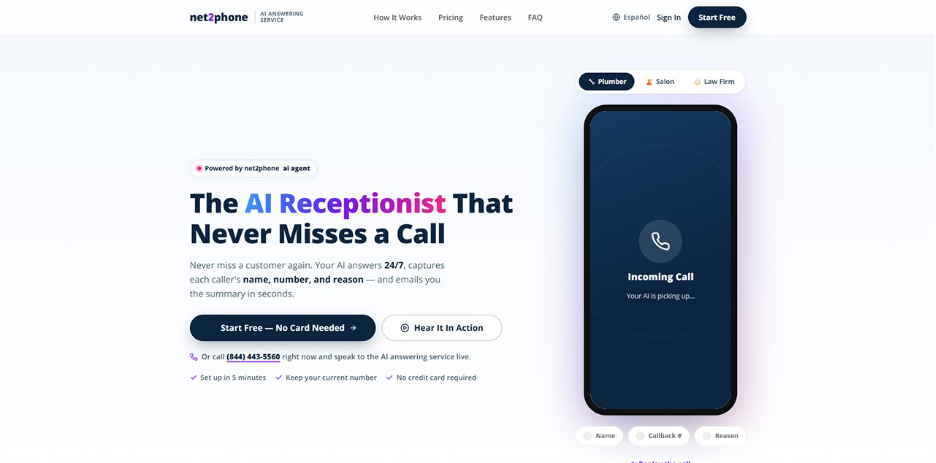
net2phone is North American cloud VoIP with IVR on all tiers, unlimited calling to 40+ countries bundled on Pro, and native CRM integrations. Strong presence in Canada and Latin America.
Who is it best for?
North American SMBs of 5 to 50 users wanting transparent per-user VoIP with IVR on all tiers.
Key features
- IVR included on all tiers
- Unlimited calling to 40+ countries on Pro
- Call recording on Pro tier
- Mobile and desktop apps
- Native integrations with HubSpot, Salesforce, Zendesk
Pros and cons
Pros:
- IVR included on all tiers (not gated)
- Unlimited calling to 40+ countries on Pro
- Strong presence in Canada and Latin America
- Transparent per-user pricing
Cons:
- Smaller integration ecosystem than CloudTalk or RingCentral
- No native AI transcription
- Less brand recognition than RingCentral or Nextiva
- UX feels functional rather than modern
Pricing
- Office: $17.99/user/month
- Professional: $21.99/user/month (unlimited international, recording)
- Enterprise: $27.99/user/month
G2 rating
4.5/5 from 200+ reviews.
How to Choose the Right VoIP with IVR Solution
Three variables narrow the shortlist. IVR depth needed: Multi-level with CRM-based routing fits CloudTalk best; simple auto-attendant for solo fits Grasshopper; mid-depth IVR on mainstream VoIP fits RingCentral or GoTo Connect. Team size: 1 to 5 users fits Grasshopper; 5 to 50 fits CloudTalk, GoTo Connect, or net2phone; 10 to 100 fits RingCentral. Integration ecosystem: Deep CRM push fits CloudTalk; broad general integrations fits RingCentral; unified comms fits GoTo Connect.
Short decision tree:
- SMB wanting visual IVR plus CRM routing bundled on mid-tier: CloudTalk Essential
- Established SMB wanting mainstream VoIP with broad integrations: RingCentral MVP Core
- Unified comms SMB: GoTo Connect Standard
- Solopreneur or micro-SMB: Grasshopper Solo Plus
- North American SMB wanting IVR on all tiers: net2phone Professional
Choosing the Right VoIP with IVR Solution for Your Business
Pick based on how deep your IVR routing needs to go, your team size, and integration ecosystem, not the loudest brand in the search results.
FAQs About VoIP with IVR
CloudTalk Essential at $29/user/month bundles visual IVR plus 5 routing modes plus CRM push with no upgrade required. RingCentral Core at $30/user/month fits established SMBs. GoTo Connect Standard at $32/user/month fits unified comms teams.
CloudTalk Essential, RingCentral Core, GoTo Connect Standard, and net2phone Office all include IVR natively on mid-tier plans. Grasshopper includes only simple auto-attendant, not full IVR.
Yes. CloudTalk Visual Call Flow Designer and GoTo Connect visual dial plan editor are both drag-and-drop canvases editable by non-technical ops in minutes.
CloudTalk routes inbound callers based on HubSpot, Salesforce, Pipedrive, Zendesk, or Intercom data (customer tier, deal stage, account owner). Other platforms here offer basic skills-based routing but not full CRM-based routing.
Entry tiers with IVR run $14 to $35 per user per month. CloudTalk Essential at $29 and Nextiva Core at $30 sit in the realistic mid-range. RingCentral Advanced with automatic recording sits at $35.