






Suppose two people on a marketing team are looking at the same landing page, arguing about the headline. Their opinions differ in a way that one thinks the current version works fine while the other suggests a shorter and punchier line as it would attract more people to sign up. Neither of them has proof to back their claim. They just have opinions, and opinions don’t run the business. Every office faces this disagreement almost over everything, from button colors and email subject lines to app layouts and headlines. A/B testing exists to end that argument the right way, not with the loudest voice in the room, but with actual data from actual users.
This guide walks you through everything you need to know about A/B testing: what it is, how it works, and why it matters.
What Is A/B Testing?
What you have to do is take one page, email, or app screen and make two versions of it, called Version A and Version B. There is only one thing that differentiates them from each other. The change might be a different headline, a button color, or an image. Everything else remains exactly the same. Then, you show each version to a different group of real users and observe which one performs better. So, no matter what difference you see in results, you can always trace it back to that one change. This is as simple as it sounds. There is no guesswork or gut feeling; just a clean, honest comparison.
Why Is A/B Testing Important?
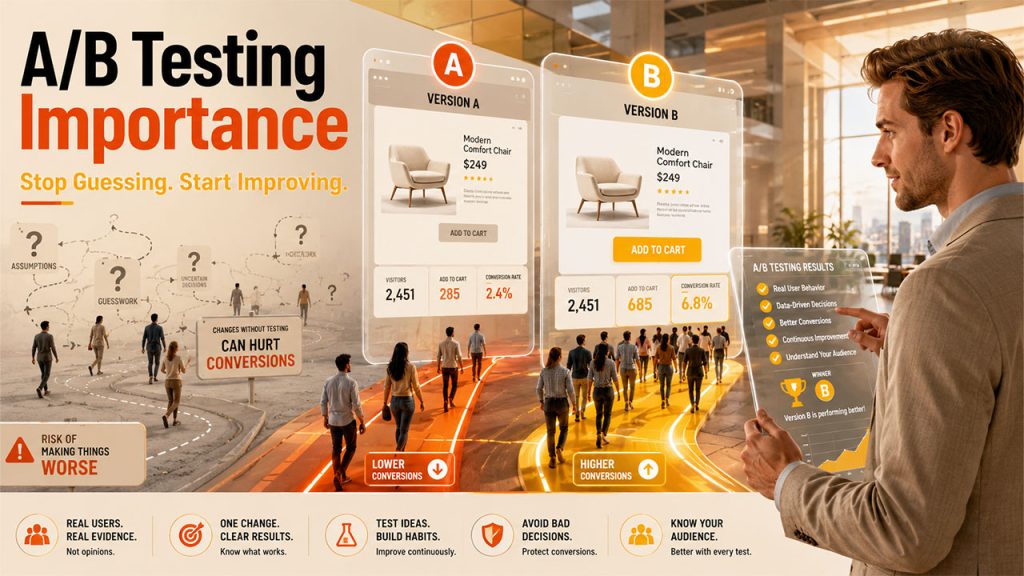
When you run a website or an app without testing it, you’re shooting arrows in the dark. Someone on the team told you to proceed without testing; you agree with them, and the changes go live. For about six months, it has been quietly hurting your conversions, and nobody notices. A/B testing identifies that blind spot and fixes it in a few ways:
- It replaces guesswork with real evidence from real users, not office opinions
- It shows you exactly which change caused a result, since only one thing was different
- It builds a habit of testing ideas instead of just assuming they'll work
- It protects you from rolling out an "improvement" that actually makes things worse
- It helps you understand your audience better over time, test after test
None of this is about chasing a single win. Teams that test regularly build up something more valuable than any one result; they build a real, evidence-based understanding of what their customers actually respond to. This same measurable, data-first approach sits at the heart of performance marketing. Every test, whether it succeeds or flops, teaches you something you didn't know before.
Types of A/B Testing Explained
Not every A/B test looks the same, and it helps to know which kind fits which situation. Here's a simple breakdown:
| Types of A/B Testing | What It Does | Best Used When |
|---|---|---|
| Classic A/B (Split) Test | Compares two versions of one page, changing just one element | You want a clean, simple test of a single change |
| Split URL Test | Sends traffic to two entirely different URLs instead of two versions of the same page | You're testing a completely redesigned page or a major structural change |
| Multivariate Test (MVT) | Tests several elements at once, in every possible combination | You have high traffic and want to see how multiple changes interact |
| Multi-Page Test | Tests changes across several pages in a user's journey, not just one | You want to see how a change affects the entire path a user takes |
| A/B/n Test | Compares more than two versions at once: A vs. B vs. C vs. D | You have several strong ideas for one element and want to compare them all |
The Classic A/B test is the easiest to understand and simplest to set up. That's why beginners mostly start with it. It gives you a solid feel for how testing works before you move on to deal with more complex stuff.
How A/B Testing Works: Step-by-Step Process
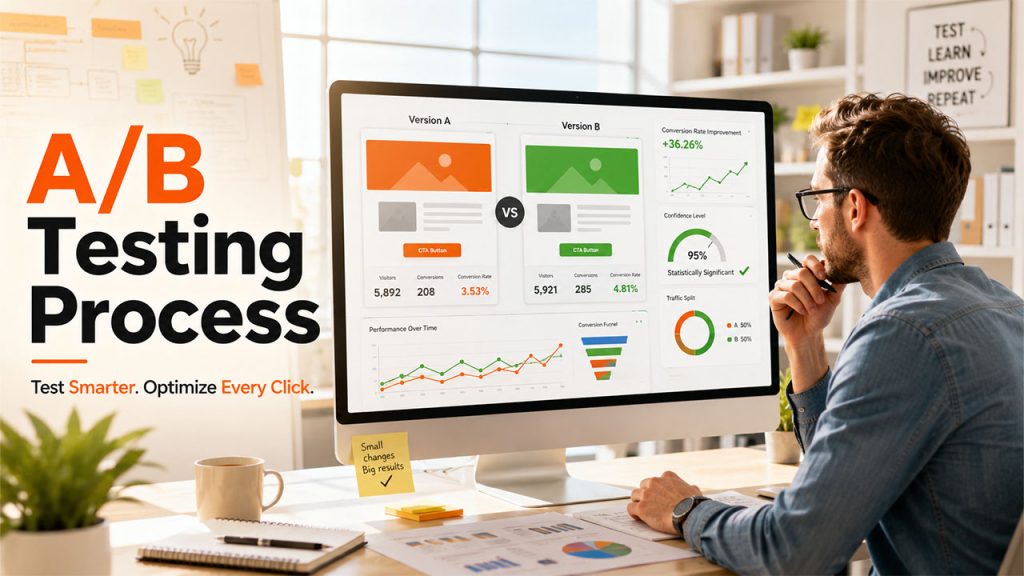
A/B testing follows a logical sequence, and it is easy to understand. You don’t need a technical background to get started:
Step 1: Create a Clear Testing Hypothesis
First, you just have to make an educated guess about which might improve results like “If I make the button green instead of orange, more people will click it.” This forms the base for your test, and a good hypothesis gives a clear purpose to the whole test.
Step 2: Test One Variable at a Time
Now choose the single element that you want to change and build its second version to conduct a test. Change just that one thing and keep everything else on the page exactly the same. This way, you can trust that any difference in result comes from that one change.
Step 3: Split Your Audience into Two Groups
Divide your visitors into two groups and use A/B test software to show half the visitors version A (the original one) and half version B (the new one). Neither group knows that they’re part of a test, so their behavior stays completely natural and unbiased.
Step 4: Run the Test for a Fixed Duration
While it's live, the software quietly tracks how each group behaves in terms of clicks, sign-ups, purchases, or whatever matches your goal. This part just takes time; rushing it gives you unreliable numbers.
Step 5: Analyze the Test Results
Once you have enough data to make a decision, review your results and compare which version performed better against your original goal.
Step 6: Validate Statistical Significance
Your software is doing more than just collecting numbers; it’s checking whether the difference between the two versions is big enough to trust, or whether it might just be a random chance. This is what people mean when they talk about "statistical significance," and it's what separates a real result from a lucky coincidence.
Step 7: Repeat and Continuously Optimize
A/B testing isn't a one-time event. The teams that benefit most from it treat testing as an ongoing habit, not a single project.
A successful A/B test follows a structured process that ensures every result is accurate, measurable, and actionable.
Common A/B Testing Examples
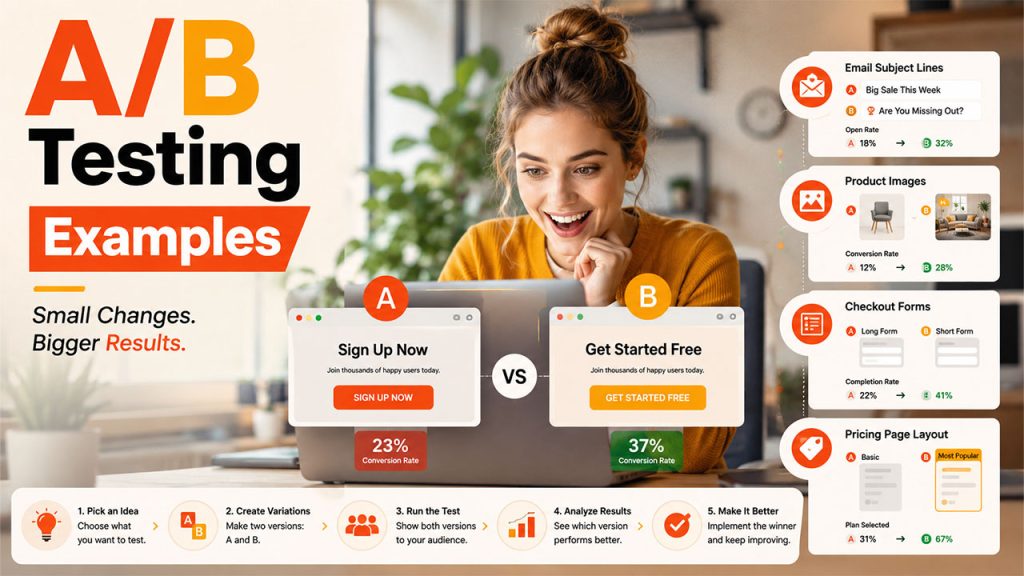
Sometimes the concept clicks faster with a few real-world examples. Here are some common ones, explained a bit more:
Call-to-Action (CTA) Buttons: When you test “Sign Up Now” against “Get Started Free”, it shows how a small word change can make a big impact. “Get Started Free” makes people feel that it costs nothing to try the product. It makes them feel safe to continue. Even tiny wording shifts like this can lead to more people clicking and signing up.
Email Subject Lines: If you want to know what actually gets someone to open an email, compare a plain subject line to one with emojis, a question, or an exclamatory mark. A question mark usually instills enough curiosity in people to click. At the same time, a plain line might feel more trustworthy to others. Testing tells you what your audience actually prefers.
If you're testing content ideas at scale, this Clearscope review is worth a look too.
Product Images: Testing a plain product photo against a lifestyle photo shows how people picture themselves using something. A plain photo shows exactly what they're buying. A lifestyle photo helps them imagine using it in real life, and one of these usually works better depending on the product.
Checkout Forms: Comparing a long form against a short one tests something simple: how much time and effort people are willing to give. Some people might feel that a short form feels quick and easy to finish. Others prefer a longer form that seems more serious for expensive purchases. Testing helps you find the right fit.
Pricing Page Layout: Testing whether labeling one plan "Most Popular" changes what people pick shows how people follow the crowd. When unsure, people often choose what looks popular to others. This one small label can quietly shift which plan most visitors end up choosing.
These examples prove the exact purpose of A/B testing. It usually deals with small, specific changes. However, when these small changes are tested properly, they can make a real difference in how people experience your product.
Conclusion
Once you stop thinking about jargon, A/B testing seems simple and easy. The test is just the structured way of asking, “Does this actually work better?” instead of assuming it does. By changing one thing at a time, showing it to real users, and letting the data speak, you replace guesswork with genuine evidence. Remember that it won’t make every decision as easy as you think, and not every test will go your way. But over time, testing builds something far more valuable than a single win: a real understanding of what your audience actually wants. For any team serious about growth, that's not optional anymore. It's just how good decisions are made.
FAQs About A/B testing
It compares two versions of something to see which one performs better with real users.
Usually, a couple of weeks is long enough to gather meaningful, reliable data.
Yes, that's called an A/B/n test, comparing multiple variations against the original.
A/B testing changes one element; multivariate testing changes several elements at once.
Yes, dedicated A/B testing software is needed to split traffic and track results accurately.