





Publishers traditionally think deeply about audiences. CRM teams think deeply about customers. For subscription publishers, those two disciplines are increasingly becoming one.
A reader doesn’t suddenly become commercially relevant at the moment they enter payment details. Their relationship with a publication may have started months earlier through search, social media, newsletters or direct visits.
Likewise, the relationship doesn’t finish once payment succeeds. This makes subscriber growth fundamentally a subscriber lifecycle management problem.
Stop seeing “subscriber” as the first meaningful state
A simplified subscription funnel might look like this:
Visitor → Paywall → Subscriber
Real reader behaviour is considerably messier. Someone might discover an article through search, return directly a week later, join a newsletter, register for additional access, begin visiting several times a week and only then encounter the right subscription proposition.
Each interaction changes the relationship. CRM thinking encourages businesses to recognise those changes rather than treating everybody who hasn’t purchased as the same generic “non-customer”.
For publishers, a more useful model might be:
Anonymous reader → Registered reader → Engaged known reader → Subscriber → Engaged subscriber → Retained subscriber
Each stage has a different objective and potentially requires a different experience.
Registration changes the relationship
Registration is particularly important because it creates a bridge between anonymous consumption and a commercial customer relationship.
The publisher now has a persistent identity. That makes it possible to understand behaviour over time, connect newsletter activity, collect preferences and provide more relevant experiences. Registration should still represent an exchange, however. A reader needs a reason to identify themselves.
Additional access, newsletters, saved content, personalisation or useful account functionality can provide that value. This is closely aligned with a core CRM principle: collecting customer data works best when customers understand what they receive in return.
Segmentation should drive action

CRM systems make it easy to create segments. The more important question is what the organisation does with them. A segment called “highly engaged registered readers” is valuable only if that knowledge changes something.
- Should those readers see a subscription proposition?
- Should the messaging differ?
- Would a lower-engagement group benefit from more content or newsletter engagement first?
- Should former subscribers enter a reactivation journey rather than the standard acquisition journey?
Behavioural segmentation becomes commercially useful when it produces different actions, rather than simply creating more detailed reports. For publishers, this is a central part of subscriber lifecycle management, because reader behaviour should influence what happens at each stage of the relationship.
Conversion is a lifecycle transition
This is one of the most useful principles subscription publishers can borrow from CRM. Subscription should not be viewed as the end of acquisition. It is a transition into another lifecycle stage. Immediately after conversion, the publisher has an opportunity to reinforce the value of the decision.
- Can the new subscriber immediately access what they purchased?
- Do they understand the benefits available to them?
- Can they configure their preferences?
- Are there newsletters, features or content that can encourage repeat use?
Retention starts much earlier than the renewal date.
Connect the lifecycle to the technology
Turning this model into reality requires commercial strategy and technology to agree.
- Identity needs to recognise the reader.
- Audience data needs to support useful segmentation.
- The subscription platform needs to deliver the appropriate experiences.
- Analytics needs to measure progression between stages.
For publishers using Piano, specialist subscription optimisation for publishers can connect these elements across registration, paywalls, offers, experimentation, engagement and retention.
The objective isn’t simply to configure more platform features. It is to make the technology support a coherent reader lifecycle and provide the foundation for subscriber lifecycle management.
Measure transitions, not only totals
CRM thinking can also improve subscription reporting. Suppose registrations increased by 20%. Is that good? Probably. But the more important question is what happened afterwards.
- Did those registered readers return?
- Did they become more engaged?
- Did more eventually encounter a subscription proposition?
- Did they subscribe at a different rate?
- Did registration improve the relationship or merely increase the number of records in a database?
Lifecycle measurement focuses attention on transitions:
Anonymous → Registered
Registered → Engaged
Engaged → Subscriber
New subscriber → Active subscriber
Active subscriber → Renewal
These transitions expose where value is being created and where it is leaking away.
Auditing the journey can reveal hidden lifecycle gaps
Before redesigning a lifecycle programme, it is often useful to understand where the current setup is already losing momentum.
For example, registration may perform well while the transition from registered reader to paid subscriber remains weak. A paywall may convert reasonably, but only a small proportion of relevant readers may reach it. Subscriber acquisition may look healthy while onboarding and early engagement are underdeveloped.
A structured subscription journey audit can help map these stages and identify where reader progression, measurement or journey logic deserves closer attention.
This makes prioritisation more evidence-based and helps avoid optimising the most visible part of the funnel simply because it is easiest to see.
Retention begins with behaviour
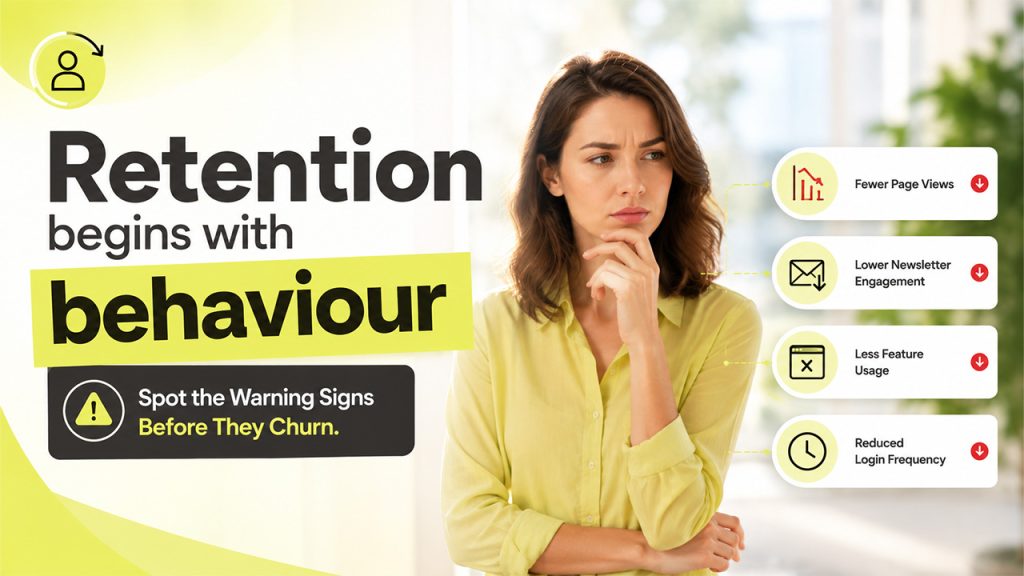
Cancellation is a very late signal. Changes in behaviour can appear considerably earlier. A previously frequent subscriber stops visiting. Newsletter engagement declines. A feature that once generated repeat usage is no longer being used.
CRM teams have long understood that customer behaviour can provide early indications of a changing relationship. Publishers can apply the same principle.
The objective isn’t merely to create a “churn risk” segment. It is to identify meaningful behavioural changes early enough for the business to respond appropriately. This behavioural approach makes subscriber lifecycle management more proactive, allowing publishers to respond before disengagement becomes cancellation.
The lifecycle also creates better experiments
Once the reader relationship is viewed as a series of stages, experimentation becomes more precise. Instead of asking, “How do we increase subscriptions?”, a team can ask smaller questions.
- How can more anonymous readers become registered?
- Which registered users are ready for a subscription proposition?
- Which onboarding behaviours correlate with stronger engagement?
- Which experiences help a new subscriber become a habitual reader?
Those questions are easier to test because they correspond to specific transitions in the lifecycle.
Conclusion: From audience management to relationship management
Publishers will always care about reach. But subscription economics makes the quality and progression of individual reader relationships increasingly important. CRM provides a useful mental model because it forces organisations to look beyond the transaction.
- Who is this reader?
- What is the current state of the relationship?
- What would be the most appropriate next action?
- What value should be provided now?
- How can the business tell whether the relationship is strengthening?
When publishers begin asking those questions across the entire lifecycle, subscriber lifecycle management becomes less about one paywall conversion and more about steadily turning attention into durable customer relationships.