






Have you ever noticed when you post something on social media, the views tick up, but there are no likes, comments, or reshares. This is because the silent scrollers are anonymously connected and closely noticing your every post in their own way. These individuals scroll through social media platforms, consume content, shape opinions, and even make purchase decisions without interacting publicly.
However, understanding social media silent scroller traits in 2026 is crucial for businesses and content creators to redefine their user engagement. Before diving into these traits, it's worth understanding the key points about social media that shape how users behave on these platforms today. A Hostinger Datalily Survey in 2024 stated that over 80% of individuals interact with social media channels for product discovery without liking, commenting, or posting publicly. Meanwhile, up to 86% of users have made online purchases through these platforms without visibly engaging with any posts related to them.
This comprehensive guide explains everything about who exactly these people are, what social media silent scroller traits are, and what makes them essential for businesses in 2026. Let’s break it down briefly.
What Do You Mean by Social Media Silent Scrollers?
Silent scrollers are individuals who proactively scroll through social media platforms, like Instagram, LinkedIn, and Twitter, to observe posts and watch videos without interacting publicly. They rarely like comments or reshare posts but significantly maintain a steady presence, boost content reach, and make their own decisions.
They're also abbreviated as "lurkers," but this word cannot fully encapsulate the essence of these silent scrollers. These aren't passive or disengaged users stumbling across content by accident. Instead, they're deliberate, thoughtful individuals who've engaged with content intentionally or based on their own terms. Knowing these social media silent scroller traits helps businesses refine their strategies to engage with users, improve content position, and reach target audiences.
How Silent Scrolling Works
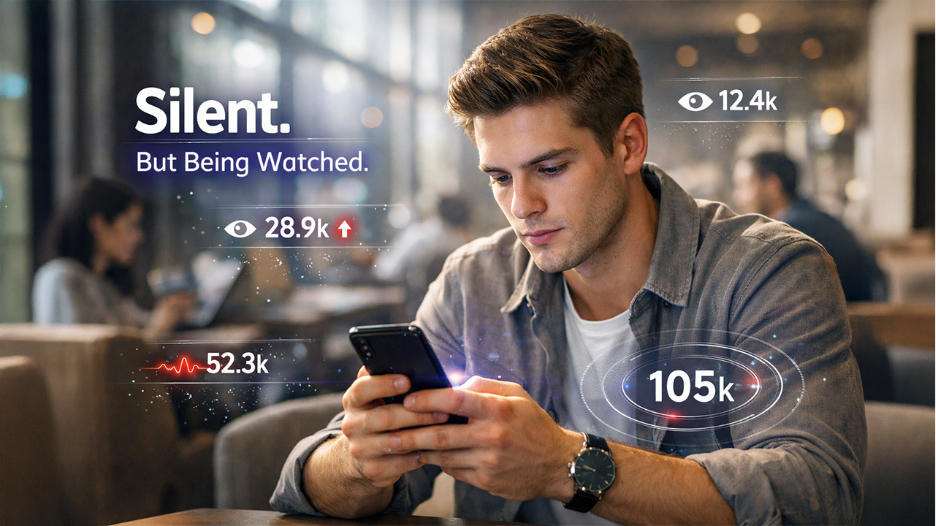
These characteristics represent the psychological and behavioral pattern of silent scrollers who influence the algorithm of digital platforms to consume content. They simply access the social media platform, browse through the feed, consume posts and visual content, leverage the meaningful data, and close the application. Throughout the scrolling cycle, these users don’t make digital appearances, engage in discussions, or observe content publicly. But their behavior is far from invisible to the right tools; this is where democratizing social media analytics becomes critical, as data collection methods can surface what silent scrollers are doing even without a single like or comment. Their anonymous behavior directly contributes to impressions, view count, and watch time, and even if they don't make public interaction through liking or commenting on a post, their pattern can be measurable through analytics.
What Are the Top Social Media Silent Scroller Traits?
Trait 1: Observers, Self-Monitors—Not Participants
Silent scrollers don’t see your posts accidentally. They leverage a well-defined psychological trait called "self-monitoring," which helps individuals outline their own decisions through social trends. They are actively observing content posted on social media and making informed decisions while carefully maintaining their professional or personal reputations. That doesn’t mean they are disengaged; they are deliberate users who notice everything silently on their own terms.
A 2024 study, proceedings of the CHI Conference on Human Factors in Computing Systems evaluates over 266,320 Facebook postings across 300+ participants over 80 months, stating that users with high analytical skills reduced posting instantly after knowing they are being observed. This highlights a pattern that researchers integrated directly with self-monitoring and public self-consciousness.
Trait 2: Emotionally Aware but Quietly Expressive
Instead of just externalizing the post on the platform, silent scrollers feel the content deeply, extract emotions, and find insights to make informed decisions. The ability to process content emotionally without appearing publicly is one of most defining social media silent scroller traits in 2026.
A well-documented term — digital emotion regulation (DER) shows the difference between active users (often post, like, and comment) and passive users (scroll feed, observe content). Additionally, suppression-based emotional regulation shows users are emotionally connected with the content rather than showing the contribution publicly. This encourages businesses to post emotion-rich content, as it can help boost engagement, authenticity, and content reach.
Trait 3: Prioritize Privacy, Authenticity, and Low Public Visibility
For silent scrollers, low public visibility isn't a casual preference — it's a deliberate, informed choice. Research consistently identifies privacy risk as a primary antecedent of lurking behavior. Every public interaction creates a traceable data trail: likes feed ad algorithms, comments can be decontextualized, and shares create a chain of credibility.
And because they aren't performing an identity themselves, they're especially sensitive to content that is. Overly polished posts, influencer copy, hollow brand messaging — their inauthenticity detectors are sharper than those of users who are actively in the performance game. What earns their attention is real experience, honest framing, and genuine expertise. For businesses, authenticity isn't a soft value here; it's a functional requirement.
Trait 4: Intentional Content Consumers
There's a meaningful distinction between mindless scrolling and intentional passive consumption. Silent scrollers predominantly do the latter. They operate with a clear internal purpose — staying informed, researching topics, monitoring a space, and evaluating a brand. The behavior looks identical from the outside. The cognitive state driving it is fundamentally different.
This outlines a behavior: goal-directed information seeking powered by internal purpose rather than technology-driven practice. Based on the 2024 UBC study on thoughtful social media application, deliberate consumers stated greater informational results and significantly reduced FOMO than consistent scrollers.
Practically speaking, they're observing your content against a personal goal of usefulness, and if they find that, get saved. However, the save rate is the factor that is generated by this segment and serves as the powerful indicator of the quality of the content on social platforms.
Trait 5: Independence from Social Engagement Metrics
Silent scrollers don't measure their self-worth in likes — and they don't use engagement counts as a proxy for content quality. This connects to internal locus of control: the degree to which individuals believe outcomes stem from their own judgment rather than external validation. High-internal-locus individuals are demonstrably less susceptible to social proof pressure. A viral post is not, by itself, evidence of value to this audience.
A minimal-like post with genuinely useful content will hold people's attention longer than a highly liked post without offering anything real. Silent scrollers don’t let the crowd shape their decisions; they make up on their own. They're not looking for what's popular. They're looking for what's true.
Trait 6: Reflective And Analytical Thinking
The cognitive approach of a typical silent scroller leans toward System 2 processing, which is slow, deliberate, analytical thinking, as compared to the fast, reactive System 1 reactions that drive most visible social media behavior. Silent scrollers with a high tendency toward social comparison often evaluate content analytically — weighing actual relevance and credibility.
Practically, they're rigorous content evaluators, noticing logical gaps, inconsistencies in brand messaging, and the difference between genuine content and that which misleads. If your content is research-backed and clearly reasoned, it earns their sustained attention.
Trait 7: Introverted but Inquisitive
This is the most commonly overlooked social media silent scroller traits: introversion isn't disinterest. Silent scrollers are often intensely curious — they just prefer to explore that curiosity quietly. Users with social anxiety—who skew introverted —reduce the psychological cost of public interaction. Observation becomes the rational engagement mode when participation feels risky.
But introversion amplifies curiosity rather than suppressing it. Introverted users process content more deeply precisely because they aren't managing a social performance at the same time. They read longer, click through to sources, and follow adjacent threads.
Conclusion
Summarizing, all key social media silent scroller traits point to deliberate, thoughtful, authentic engagement rather than audience reaction. Silent scrollers are observing your content, creating opinions, saving posts, and making decisions — they're just doing it without leaving a trace in your engagement dashboard. They are proactive observers that perform differently from the one most traits were built to improve the engagement tactics.
So, start building content exclusively designed to attract people, not just from likes and comments. It should be worth thinking about because the people thinking quietly about it are often the ones who matter most to your bottom line.
Have social media insight worth sharing? Visit our social media write for us page and submit your guest post today.