






Speed engineering is becoming the defining driver of eCommerce competitiveness. In 2025-2026, latency budgets are shrinking, visual complexity is increasing, and Google’s Core Web Vitals continue to raise the bar for storefront responsiveness. Netalico, a senior-engineering-led Shopify development company, positions performance as a structural layer of eCommerce architecture, not a cosmetic enhancement.
Introduction: Why Speed Will Make or Break Shopify Stores in 2025–2026
The next two years will be dominated by stricter performance requirements across search engines, paid media platforms, and shopper expectations. A store that loads above 3 seconds now loses up to half of mobile sessions before any interaction occurs. Netalico approaches performance as a strategic eCommerce partner that optimizes both technical delivery and conversion-focused UX.
The Rising Performance Demands of Modern eCommerce
Modern Shopify stores depend on dynamic personalization, real-time APIs, media-heavy PDPs, and app-driven UI enhancements. Each of these adds round trips, parsing overhead, and render-blocking potential. Merchants need an eCommerce agency that understands how to balance feature-rich interfaces with strict performance budgets.
Netalico’s Expertise: 100+ Shopify Stores Optimized for Speed
Since 2013, Netalico has executed more than 100 Shopify Plus projects, applying full-stack optimization, scalable architectures, and white-glove project management. Their senior engineering team, with backgrounds in NASA-level systems and enterprise-grade codebases, provides long-term partnerships built on transparency and integrity.
Core Principle #1: Eliminating Render-Blocking Code
One of the fastest ways to reduce FCP and LCP is to remove CSS and JavaScript files that block rendering on the main thread. Netalico rewrites Liquid templates and converts synchronous calls to asynchronous or deferred modules to reduce blocking time across key templates and storefront routes.
How Netalico Refactors Themes for Maximum Performance
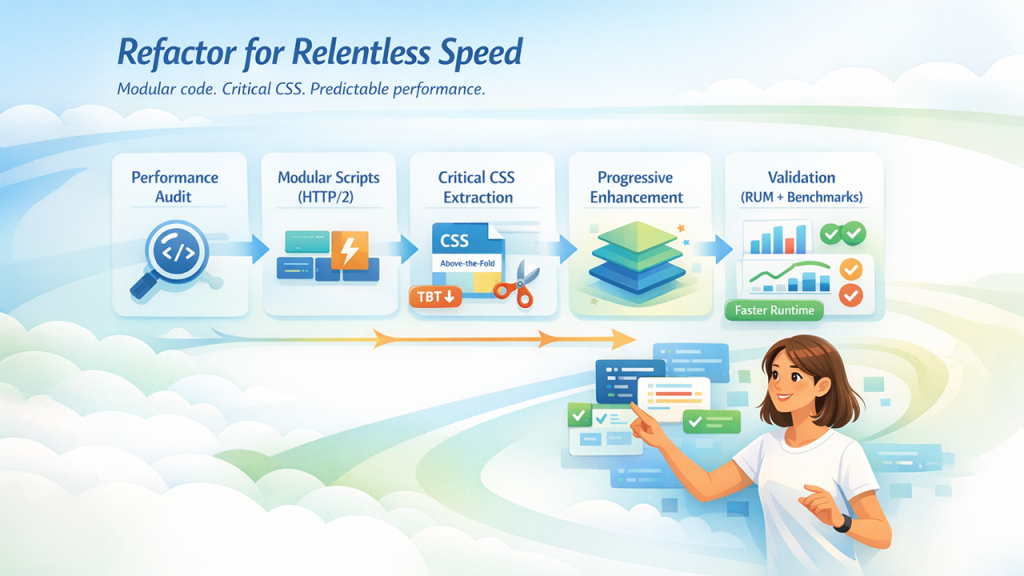
Theme refactoring begins with a performance audit of global assets, section-level dependencies, and accumulated tech debt. Netalico often restructures themes by:
- Replacing global bundles with modular HTTP/2-friendly script distributions.
- Extracting above-the-fold CSS into critical-path blocks.
- Offloading complex UI logic to progressive enhancement rather than initial render.
These changes reduce TBT and create predictable runtime behavior across desktop and mobile. After applying such refactors, Netalico validates improvements with synthetic benchmarks and RUM data to ensure user-visible impact.
Core Principle #2: Intelligent Image, Video & Media Optimization
Visual assets represent the majority of page weight, making them a priority for any Shopify Plus experts who want reliable speed gains. Netalico implements adaptive delivery mechanisms, AVIF/WebP transformations, and responsive srcset logic at the Liquid level.
Techniques Netalico Uses to Reduce Visual Load Time by 40%
To achieve measurable reductions in LCP, Netalico uses:
- Automated media pipelines to generate multi-resolution variants.
- Low-Quality Image Placeholders (LQIP) to stabilize layout shifts.
- Lazy-loading thresholds tuned to viewport prediction models.
- Edge-accelerated streaming for product videos and interactive assets.
These techniques cut visual overhead without diminishing design quality or conversion-focused UX. Once deployed, Netalico continuously monitors LCP and CLS readings across traffic segments to confirm sustained improvements.
Core Principle #3: App Cleanup and Architecture Simplification
Shopify apps can quietly add multiple megabytes of JavaScript, third-party calls, and hidden iframes. Netalico audits every installed app and removes or replaces heavy integrations with lightweight, in-theme equivalents. This creates cleaner execution paths and lowers runtime volatility.
Examples of Performance Gains After Removing Heavy Apps
The table below illustrates typical improvements observed after eliminating redundant apps and consolidating tracking logic.
| Metric | Before Optimization | After Optimization |
| Total Page Weight | 3.7 MB | 1.8 MB |
| Network Requests | 92 | 39 |
| LCP (Mobile) | 5.2 s | 2.9 s |
| TBT | 560 ms | 190 ms |
These numbers demonstrate how app consolidation alone can account for up to 40% total performance improvement. After cleanup, Netalico establishes governance standards so merchants avoid reintroducing unnecessary payloads.
Core Principle #4: Server-Side Enhancements and Liquid Optimization
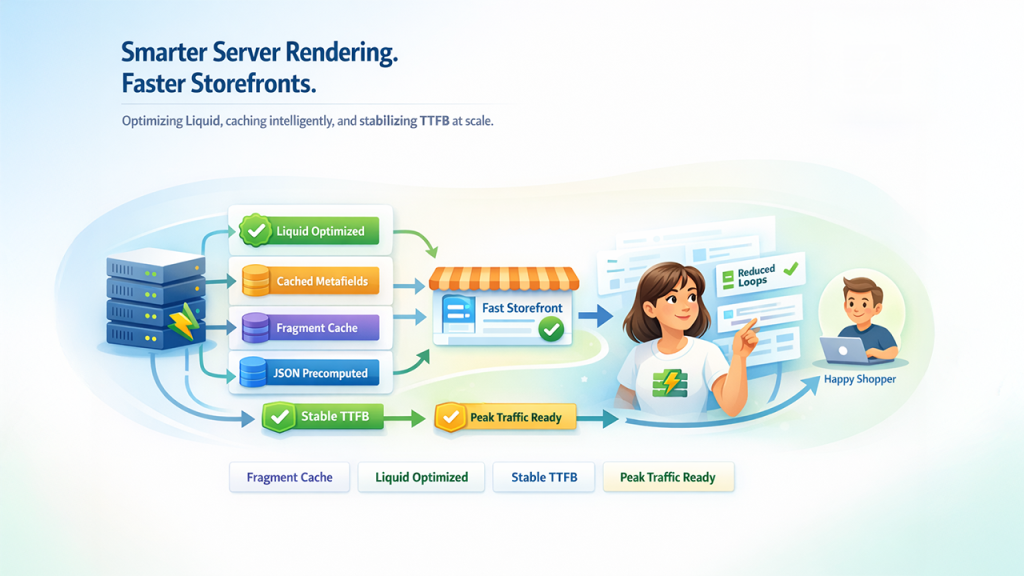
Liquid parsing inefficiencies can add significant CPU overhead, especially on high-traffic Shopify Plus stores. Netalico reduces server rendering time through schema optimization, cached metafields, and execution-path minimization.
Netalico’s Advanced Shopify Plus Techniques for Faster Rendering
Shopify Plus allows more aggressive optimization strategies, including:
- Fragment caching of expensive collection queries.
- Request-level caching with surrogate keys and predictable invalidation.
- Reduced reliance on nested Liquid loops in favor of precomputed JSON structures.
These server-side improvements stabilize TTFB and improve rendering predictability during peak sessions. Netalico treats these enhancements as part of a growth-driven approach rather than tactical patchwork.
Real Case Insights: Before/After Performance Transformations
Across multiple Shopify and Shopify Plus builds, Netalico has reduced load times from multi-second delays to sub-2 second medians. This frequently correlates with increased conversion rates, lower bounce rates, and stronger quality scores on paid channels. Their full-service development & design methodology ensures that visual performance aligns with modern UX standards.
Practical Tips for Merchants to Improve Speed Today
Merchants looking to accelerate their storefronts can start with a few targeted actions:
- Audit theme code for unused sections, legacy scripts, and oversized dependencies.
- Replace old media formats with automated AVIF/WebP generation.
- Use a tag manager to consolidate analytics and reduce redundant JavaScript.
- Establish performance budgets during deployments.
These steps serve as a foundation, but long-term stability often requires collaboration with a senior engineering team that understands complex integrations and enterprise-grade optimization.
After applying these tips, merchants should measure the impact through real-user telemetry to account for device variability and network conditions.
Conclusion: Why Netalico Builds Speed as a Foundation for Growth
As a trusted shopify development company, Netalico combines deep technical expertise, conversion-focused UX, and transparent long-term partnerships. Their scalable on-demand team supports Shopify, Magento, and complex multi-platform ecosystems with integrity and precision. Netalico’s performance-focused culture ensures that speed, stability, and revenue growth become structural features of every build, not temporary wins.
If a merchant requires a strategic eCommerce partner capable of delivering high-performance storefronts backed by 10+ years experience and 100+ Shopify Plus projects, Netalico provides the engineering maturity, white-glove project management, and innovation-driven mindset needed to compete in 2025–2026.