






Software spend rarely jumps in one dramatic moment. It creeps. A team adds a €12 seat, a manager upgrades a tier, a departed employee keeps a licence nobody cancelled, and the cloud storage bill climbs every quarter because deleting old files is nobody's job.
Then finance pulls a twelve-month report, and the number matches nobody's mental model.
Here is how to get it back under control.
SaaS Cost Optimization: Count everything before you cancel anything
SaaS Cost Optimization without an inventory means cutting the wrong thing. The tool you kill on Monday turns out to hold your invoice templates, and Tuesday goes to buying it back at a worse rate.
Build the list from three sources at once:
- Finance data — card statements and the AP ledger catch what IT never approved
- Identity logs — your SSO shows which applications people actually sign into
- The teams — ask each department head what they use daily; the answers rarely match the invoice list
That third source is where shadow IT surfaces. Marketing bought a design tool on a personal card. Sales trialled a prospecting service that renewed silently.
Capture the same fields across every entry: tool, owner, seats purchased, seats used, renewal date, notice period, annual cost, and what breaks if it disappears. A shared sheet is enough.
Reclaim the seats nobody sits in
Seat waste is the fastest money on the table, because reclaiming it changes nothing about how anyone works. Three patterns explain most of it.
- Departed staff: Offboarding usually covers email and building access. Licences to third-party applications outside IT's direct control get missed and keep billing.
- Dormant accounts: Most business software exposes a last-login report. Pull ninety days. Anyone at zero either doesn't need the tool or needs training — both worth knowing.
- Over-provisioned tiers: Someone holds an admin licence to run one report a quarter. Someone else sits on a premium plan because that was the default at signup.
Most mid-sized companies find a meaningful share of purchased seats sitting idle, and it's usually the largest single recovery available.
Watch the second meter: storage

Licence costs get attention because they arrive as a line item with a name attached. Storage behaves differently — it grows a little each month, spread across services, with no alert until a threshold is crossed.
Where it accumulates:
- Collaboration suites: Microsoft 365 tenants receive a pooled allowance plus an amount per licensed user. Cross the pool and you pay per gigabyte, monthly, indefinitely.
- Backups: Thirty daily copies means every wasteful file is stored thirty-one times. Bloat at the source multiplies downstream.
- Hot tiers: Files unread since 2021 cost four to five times what the same data costs archived.
- Old environments: Staging copies and sandboxes from a migration three years ago. Each was meant to be temporary.
Before buying capacity, find out what occupies the capacity you already pay to keep.
Clean out the document storage behind your CRM records
CRM systems generate files continuously. Quotes, signed contracts, proposals, email attachments, scanned purchase orders — each one attached to an account, a contact, or an opportunity. Many teams route that content into SharePoint or a connected document library rather than the CRM database itself.
Over a few years, that library fills with material nobody would keep on purpose:
- Eleven versions of the same proposal, saved as v1 through v11-final-FINAL
- Attachments hanging off opportunities lost in 2020
- Duplicate trees from a migration where somebody copied rather than moved
- Personal content that drifted in — holiday photos, CVs, downloaded media
- Whole site collections belonging to projects that shipped or died
This is ROT: redundant, obsolete, and trivial content. It costs twice. It occupies paid storage, and it degrades every system that reads from the same source.
In SaaS Cost Optimization, that second cost matters more now than it did two years ago. Copilot and similar assistants read whatever their permissions allow. Point one at a library stuffed with superseded pricing sheets and abandoned drafts, and it answers questions using exactly that material. A sales rep asks about standard terms and gets a discount structure withdrawn three years ago.
The obstacle is visibility. Native reporting tells you a site is large. It doesn't hand you a ranked list of what's stale, duplicated, or personal. Tools built to inspect content — SProbot is one — surface unwanted and inactive files across a tenant, so removal decisions rest on data rather than on guessing which site to open first.
A workable sequence:
- Report before touching anything — what exists, by age, size, type, and owner
- Sort by size and staleness together; large and untouched is where the recovery sits
- Route decisions to owners, since IT shouldn't judge whether a 2019 contract folder still matters
- Archive the ambiguous, delete the obvious
- Empty the recycle bins — deleted content counts against your quota until retention expires
Skip that last step and the numbers won't move.
Collapse overlapping tools
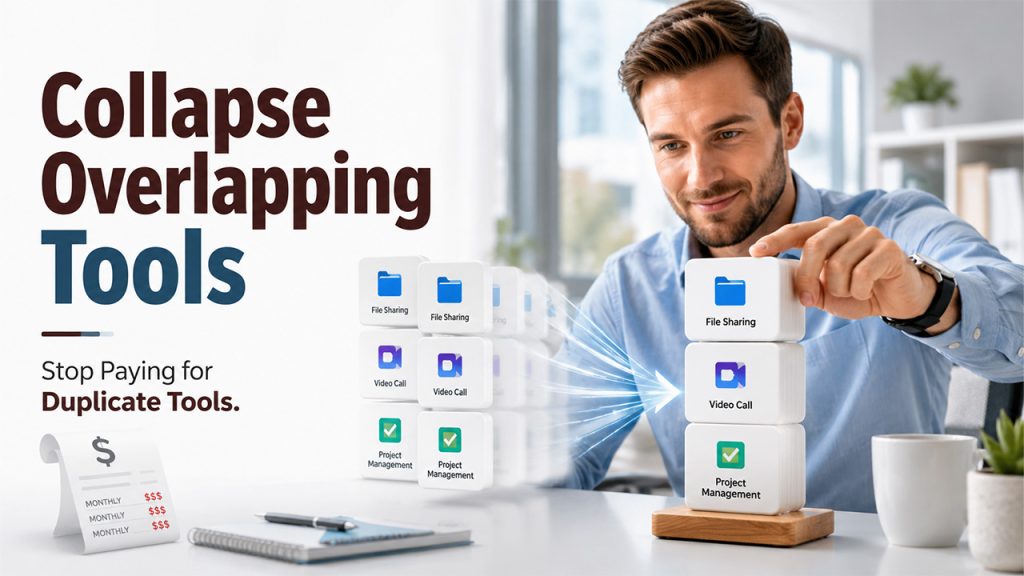
Overlap builds up when SaaS tools arrive department by department. Two file-sharing services. Three ways to run a video call. A project tracker per team.
Map the inventory by function rather than by vendor, and duplicates become visible. Then weigh the real cost of consolidating: migration effort, retraining, and the fight when a team loses the tool it likes. Paying €30 monthly to keep a group productive sometimes beats a six-week migration that saves €25.
Negotiate before the auto-renewal fires
Vendors expect negotiation. Most buyers never attempt it.
Start ninety days out, since notice periods commonly run thirty to sixty days and your position weakens once cancellation stops being credible. Bring usage data — a vendor looking at 40% adoption would rather cut the rate than lose the account.
Levers that work: annual prepayment, seat reductions matched to real usage, and asking what discount exists one tier down.
Keep it from creeping back
A one-off cleanup buys twelve to eighteen months. Four practices hold longer:
- A named owner per tool who answers annually whether it earns its place
- Renewal alerts sixty days out, not the week of
- A purchase path that isn't the company card
- A quarterly storage check — fifteen minutes against last quarter's growth rate
In SaaS Cost Optimization, the savings matter, but the bigger gain is knowing what you own. Most teams discover during the inventory that they were paying twice to get the same capability and storing the same files in four places. That isn't a dramatic failure. It's what happens when purchasing is distributed and nobody holds the whole picture.