






Node.js is a backend JavaScript runtime environment created on the V8 engine of Chrome. It leverages event-based, non-blocking I/O model that efficiently manages concurrent processes. Since its inception in 2009, its popularity has spread across industries and is currently one of the most adopted backend technologies globally. According to the Stack Overflow Developer Survey, over 42% of professional developers use Node.js for server-side work.
Its relevance extends beyond general web development. Node.js is extensively utilized to develop and extend CRM platforms that need data management in real-time, third-party integrations, and scalable multi-user accessibility. In this article, you get the technical reasons that drive the adoption, its core benefits for CRM platforms, practical applications, and how it fares against alternative backend solutions.
Technical Benefits of Node.js for Web Development
Non-Blocking I/O
Conventional frameworks sequentially process requests. Node.js utilizes an event-driven and asynchronous model. The server does not wait for API call or a database query before managing the next request. This enables a single Node.js instance to handle copious volume of concurrent connections with lower memory consumption than thread-driven architectures.
JavaScript Across the Full Stack
Node.js allows teams to utilize one language for both backend and frontend. This removes context switching between languages, streamlines code sharing through shared libraries, and minimizes the total number of dedicated roles required for a project. For teams operating on modern software development workflows, this leads to quicker iteration cycles and minimum coordination overhead.
npm Ecosystem
The npm registry contains around 2 million packages. These include database drivers, authentication, API frameworks, testing tools, message queues, and more. This minimizes the overall number of custom code teams required to create and expedite project delivery. Frameworks such as Express.js and NestJS deliver production-ready and structured foundations for developing and API and web applications. This maturity in ecosystem is one of the driving factors that separates top Node.js development companies from generalist agencies, as in-depth familiarity with the best packages impacts the quality of code and delivery speed directly.
Performance
The V8 engine directly converts JavaScript to machine code. Integrated with the non-blocking I/O model ,this provides Node.js high-level performance for I/O-heavy workloads like data streaming, API servers, and real-time applications. Benchmarks indicates that Node.js manages request better request throughput than Ruby and PHP for equivalent workloads. This performance profile is an important why professional Node.js development services are in great demand for latency-sensitive platforms like real-time collaboration platforms and CRM dashboards.
Why Node.js Is Well-Suited for CRM Development
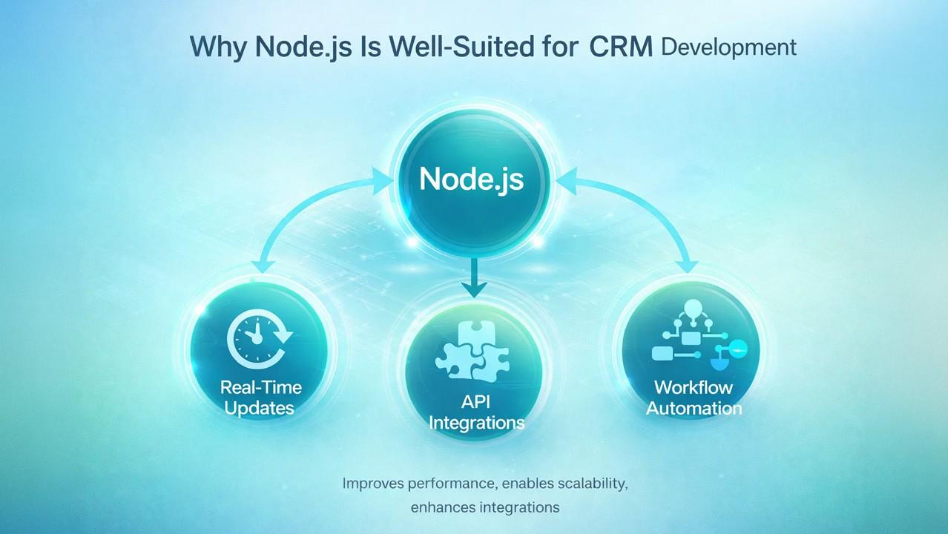
Modern CRM go beyond storing contacts. They automate marketing, handle sales pipelines, monitor support tickets, and integrate with external channels of communication. Such needs require a backend that provides support to high concurrency, real-time processes, and extensible architecture. Node.js addresses each of these requirements directly.
Synchronization in Real-time
CRM dashboards need real-time updates. When a sales rep completes a deal, the status change must be synchronized and visible across all connected sessions instantly. Node.js manages this via WebSocket connections through libraries such as Socket.io. Persistent bidirectional connections between the server and all clients eliminate polling delays and keep data consistent across the platform.
API-Driven Integrations
CRM platforms must connect with email services, telephony systems, marketing tools, payment processors, and ERP software. Node.js is built around an API-first approach. Creating RESTful or GraphQL APIs in Node.js is straightforward using Express.js, Fastify, or Apollo Server. For businesses working with SuiteCRM or SugarCRM systems, Node.js middleware allows seamless integrations with third-party tools enhancing the core codebase of CRM.
Note: Go for specialized SuiteCRM or SugarCRM integration services to ensure smooth third-party integrations.
Concurrent Management of User
Enterprise CRM deployments cater to hundreds or even thousands of users simultaneously. Node.js handles through its single-threaded loop integrated with cluster module, which shares incoming connections across diverse CPU cores. This architecture scales horizontally with minimum configuration modifications.
Extension and Plugin Development
CRM platforms that offer support extensibility are well-suited for Node.js backend services. Custom modules for advanced reporting, automated SMS campaigns, lead scoring, or workflows triggers can be developed as individual Node.js services with interact with CRM via APIs. This ensures that extensions are decoupled from the core platform and streamline maintenance.
Practical Applications
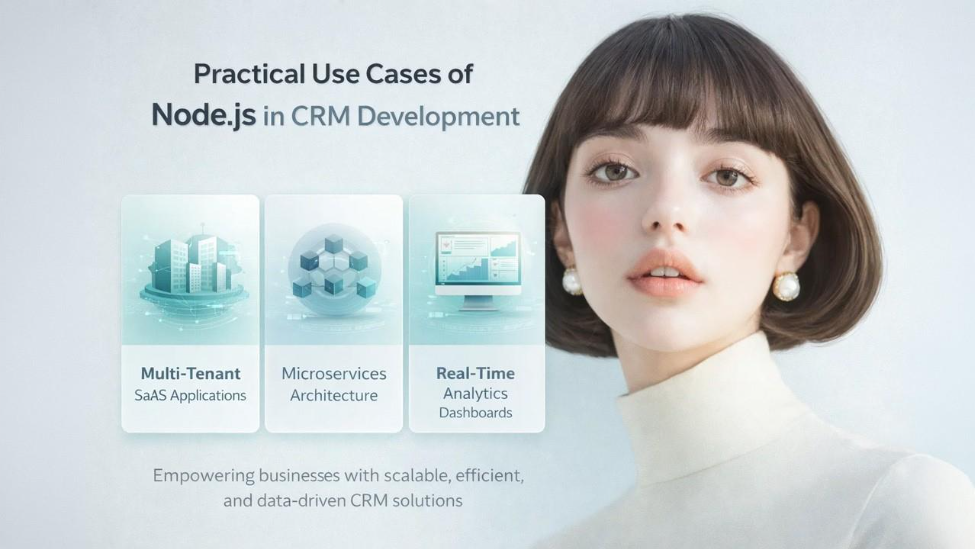
Multi-Tenant SaaS Applications
SaaS-powered CRM and business management tools need to cater to diverse clients from a shared infrastructure while separating their data. Node.js efficiently provides support to multi-tenant design patterns. Its low per-connection memory footprint keeps server costs manageable even as the tenant count grows. Database-per-tenant and schema-per-tenant strategies both work well with Node.js ORM libraries like Sequelize and Prisma.
Microservices Architecture
Node.js is a strong fit for microservices. Its compact runtime and quick startup times enable individual services to be independently scaled, deployed, and updated. A CRM platform might operate separate Node.js services for email automation, contact management, notification delivery, and reporting. Every service interacts through message brokers through event buses and RabbitMQ, allowing collaborative development across siloed teams without causing deployment dependencies.
Real-Time Analytics Dashboards
Executives and sales managers require live visibility into conversion rates, pipeline metrics, and performance of the team. Node.js-based dashboards that consolidate data from third-party APIs, CRM databases, and event streams, then push updates to connected browsers through WebSockets. Integrating Node.js with Redis for caching and PostgreSQL and MongoDB for storing data ensures responsive analytics stack.
Serverless CRM Automation
AWS Lambda, Azure Functions, and Google Cloud Functions all support Node.js as a primary runtime. CRM automation tasks like lead enrichment, data validation, scheduled report generation, and triggered email sequences can run as serverless functions. Node.js is preferred for serverless deployments because of its fast cold-start times and low resource consumption per invocation.
Selecting a Node.js Development Partner
The technology alone does not determine project success. Execution depends on the team building it. When assessing a Node.js development partner for web projects or CRM, the below-mentioned criteria is important:
• Framework expertise: Must be proficient with NestJS, Express.js, Fastify, and associated platforms.
• Real-time application experience: Must have experience in delivering event-based and WebSocket-based platforms.
• Track Record in API Development: GraphQL API and RESTful design with effective authentication, versioning, and documentation.
• Capability of Integration: Experience in tethering Node.js backends with ERPs, CRM solutions, and third-party services.
• Agile delivery practices: Sprint-driven development with consistent code reviews, consistent deployments, and transparent reporting.
For projects related to CRM, the development partner must also understand security standards such as HIPAA and GDPR, customer data workflows, and CRM-based patterns like audit logging and role-based access control.
Node.js vs. Alternative Backend Technologies
Selecting a backend technology includes trade-offs. Here is how Node.js is comparable to common CRM alternatives and web development:
Node.js vs. PHP: PHP powers numerous available CRM solutions, including SuiteCRM. It is widely supported and mature. However, Node.js is better than PHP in concurrent connection handling and real-time processing. For CRM features like live dashboards, instant notifications, and chat integrations, Node.js is the stronger option.
Node.js vs. Python: Python excels in data science, machine learning, and analytical workloads. For I/O-heavy CRM processes including WebSocket connections, API request management, and file processing, Node.js provides greater throughput with minimum latency.
Node.js vs. Java: Java ensures strict type safety and mature enterprise tooling. Node.js provides quicker speed of development, a smaller runtime footprint, and straightforward horizontal scaling. For CRM projects that require rapid iteration and frequent feature releases, Node.js reduces time-to-market.
Node.js vs. Go: Go ensures raw performance benefits for CPU-related tasks. Node.js has a significantly larger ecosystem, broader developer availability, and faster prototyping speed. For CRM use-cases where development velocity and integration breadth is more important than raw computational throughput, Node.js has turned out to be an optimal choice.
What the Future Lies for Node.js in Web and CRM Development?
Numerous developments are expanding the scope of Node.js in CRM and enterprise contexts:
• TypeScript adoption: TypeScript includes static typing to Node.js projects, minimizing runtime errors and enhancing maintainability in large codebases. It has emerged as default for enterprise-based Node.js projects.
• Edge computing: Implementing Node.js at edge locations (Vercel Edge Functions, Cloudflare Workers) minimizes latency for globally spread-out CRM users.
• AI integration: Node.js SDKs for Hungging Face, OpenAI, and LongChain allow CRM solutions to embed AI-driven characteristics such as sentiment analysis, lead scoring, and automated response creation.
• Deno and Bun: Alternative JavaScript runtimes are adopting Node.js to enhance startup performance, security defaults, and native TypeScript support. Such competitive pressures can yield advantages for the complete ecosystem.
Conclusion
Node.js ensures technical foundation that moder CRM and web applications need. Its non-blocking architecture efficiently manages concurrent users. Its API-driven design streamlines integrations with external services. Its environment minimizes development time through well-maintained and reusable packages.
For CRM tools specifically, Node.js resolves core technical issues: real-time synchronization of data, omni-channel communication, horizontal scalability, and plugin extensibility. Irrespective of whether the objective is developing a fresh CRM product, extending a broad SuiteCRM deployment, or creating a multi-tenant SaaS solution, Node.js ensures the flexibility, performance, and developer required to implement effectively.
With consistent enhancements via TypeScript integration, serverless deployment support, and capabilities of edge computing, Node.js remains an effective technology investment for businesses developing their next generation of CRM and web infrastructure.