





Every handwritten notes service sells the same promise. Real ink, real paper, mailed to a real person, and you never pick up a pen.
The promise is where the similarity ends.
Some of these companies build robots that grip an actual ballpoint and drag it across card stock. Others run a handwriting typeface through a laser printer and hope nobody turns the card over. One will mail a single note this afternoon. Another won't process your order below a hundred pieces. Prices that look nearly identical on the homepage can differ by 400% once you count postage at the volume you actually send.
This comparison covers ten services. It tells you which one fits your situation, what each one really costs, and where the marketing copy stops matching the product.
The quick version
- Handwrytten - the strongest choice when notes need to fire from your CRM, cross a border, or survive a security review. Robotic pen, native Salesforce and HubSpot, roughly 190 countries, SOC 2 Type II, running since 2014.
- IgnitePOST - built for e-commerce win-back. Fast dispatch, strong Klaviyo hooks, United States only.
- SimplyNoted - Shopify post-purchase automation at volume. Entry pack of 100 cards.
- Handwrite - flat $2.99 all in, no minimum, thin on CRM depth.
- PostPilot - Shopify and Klaviyo brands who want the whole programme run for them. Handwritten pricing is quote-gated.
- LettrLabs - geographic acquisition mail for local service businesses.
- Scribble - biggest doodle and design library, one-card minimum, but new to the category and expensive below four figures of volume.
- Thankster and Scribeless - printed handwriting font, not a pen. Cheap, and honest about it.
- Felt - draws from your own handwriting on a phone screen. Charming personal tool, no business use.
Real pen against printed font
This is the fork in the road, and most buyers walk past it.
A robotic pen service puts a genuine ballpoint or gel pen in a mechanical hand. The ink is wet when it goes down. Turn the card over and you can feel where the pen pressed through. Every card comes out slightly different, because the machine varies letter shapes deliberately.
A printed-font service runs your message through a laser or inkjet printer using one of many popular handwriting fonts. It photographs beautifully. It has no texture, no impression, no ink smell. Thankster and Scribeless work this way and say so plainly, which is more than some competitors manage.
Now the part that separates good robots from cheap ones: repetition. A basic plotter draws every letter "e" identically. One or two words, nobody notices. Across four lines, the eye picks up the pattern and the whole thing collapses into something that reads as printed. The better systems vary each character and let spacing drift, the way a real hand tires halfway down a card.
When you request samples, don't accept a single word on a card front. Ask for a full paragraph, then run your thumb across the back. Pen leaves ridges. Print leaves nothing.
The pricing trick almost everyone falls for
Two moves make a service look cheaper than it is.
Postage quoted separately. A card advertised at $1.19 becomes $2.01 once USPS First-Class gets added at the $0.82 stamped rate. Handwrytten does bill postage as its own line, and competitors make noise about it. The honest version: the number is disclosed rather than buried, and Handwrytten has since restarted its pricing page to lead with the all-in delivered rate at each tier, with postage broken out underneath. Once you add it, business-tier cards land around $2.00 to $2.80.
The floor rate advertised as the entry rate. This one costs people more money and gets called out less. A service leads with "from $2.45 per card, postage included" and the figure is real - at ten thousand cards a year.
Look at what happens below that. Scribble's own published tiers run from $6.99 per card at 1–99 pieces down to $2.45 at 10,000-plus, with $5.59 at 100, $4.19 at 500, and $3.50 at a thousand. So a company sending 300 notes a year pays somewhere near $4.89 a card at a service marketed on its low entry price - more than Handwrytten's ad-hoc rate with postage included, and roughly double Handwrytten's business-plan rate.
The lesson isn't that anyone is lying. It's that "postage included" and "from $X" are both compatible with you paying considerably more than you expected.
Write down the number of notes you'll realistically send in twelve months. Then make every vendor quote a delivered cost at that number. Any vendor that can't produce it cleanly is telling you something.
What to Check Before Choosing a Handwritten Notes Service
All-in delivered cost at your real volume. Postage included, at your number, not theirs.
Minimum order. A hundred-card entry pack rules a service out fast if you send fifteen notes a month.
Integration depth. "Integrates with Salesforce" covers an enormous range. It might mean a managed package with object-level triggers and status write-back, or it might mean somebody built a Zap. You discover which one you bought the first time you need a custom object or a merge field, and by then you've built a workflow on it.
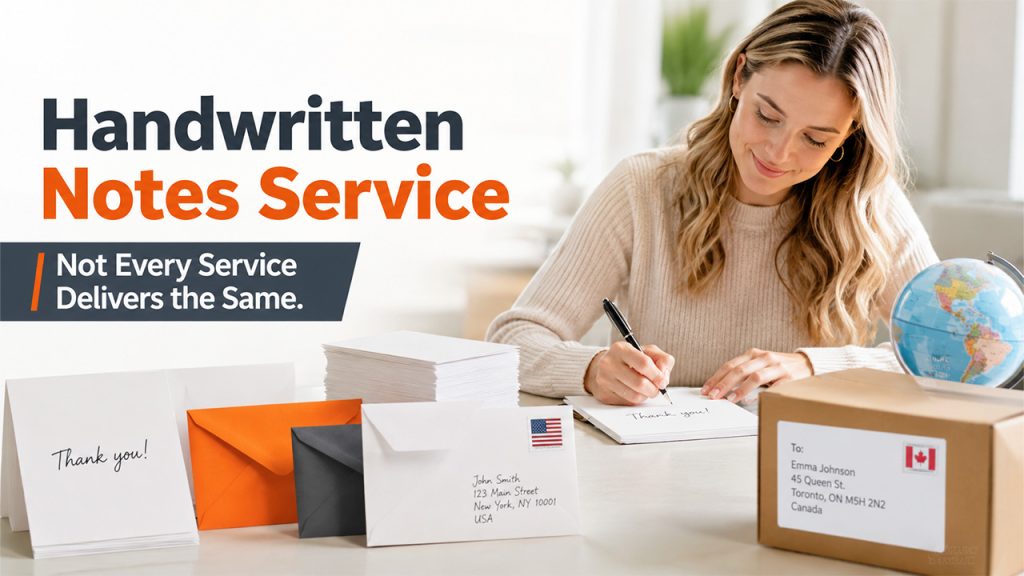
International delivery. Most of this category is the United States only. If you have customers in Toronto or Berlin, that single fact eliminates two-thirds of the list, and it's the most common reason teams switch providers after year one.
Security posture. You're handing over customer names, home addresses, and often deal context pulled straight from your CRM. Ask about SOC 2 Type II, where the data sits, and how long it's retained. Above roughly 200 employees, your InfoSec team will ask anyway, and a vendor without documentation stalls the purchase for weeks.
Card selection and custom design. Can you use your own stationery and brand cards, or are you stuck inside a template gallery? This decides whether the mailing looks like yours or like the vendor's.
Turnaround. Ask for the commitment from trigger to mailbox, not the marketing target. Direct mail response rates sit well above email, so every manual step and every delay costs more here than it would in a lower-response channel.
Operating history. Physical mail fails in physical ways. Machines break. Card stock runs out. Postal rates change mid-campaign. Ask how long the company has been running and what happens the week before Christmas. A vendor founded this year has no answer, however good the product looks.
The 10 Best Handwritten Notes Services, Ranked
1. Handwrytten - the strongest option for business
Suits: teams that trigger notes from a system of record, mail outside the US, or face vendor security reviews.
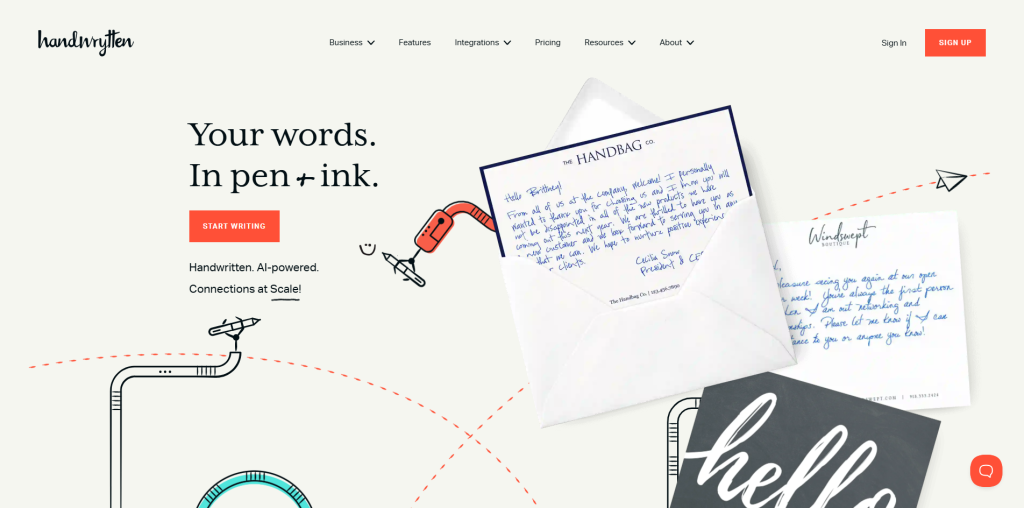
Handwrytten has been running since 2014, which in this category counts for a lot. The robotics are their own, under multiple US patents, and the letter-variation holds up across long messages rather than falling apart after two lines.
The integration list is the widest here: native Salesforce and HubSpot, plus Shopify, Zapier, Make, Blackbaud and a full REST API. Native matters more than the logo count. A managed Salesforce package means the send fires from a workflow rule and writes back to the record, so the touch shows up in the account history instead of living in a separate tool nobody opens.
International reach runs to roughly 190 countries, including domestic Canadian postage. Nothing else on this list comes close. SOC 2 Type II certification is in place, with the report available through their trust centre, which matters the moment procurement gets involved.
Custom card design, brand colours, multiple handwriting styles and your own stationery are standard rather than upsells. Volume runs from a single card up to enterprise campaigns.
Pricing: single cards around $3.25–$3.75 plus postage, so roughly $4.07–$4.57 delivered. Business plans carry a monthly fee and bring the per-card rate down to about $1.19–$1.49 at higher tiers, with CASS certification and delivery confirmation included. Check the current page before budgeting.
Where it isn't the answer: one personal card to your aunt. The monthly plans only make sense at real volume, and the setup rewards a team with a CRM rather than someone sending a birthday note.
2. IgnitePOST - e-commerce retention
Suits: online brands running win-back and reactivation.
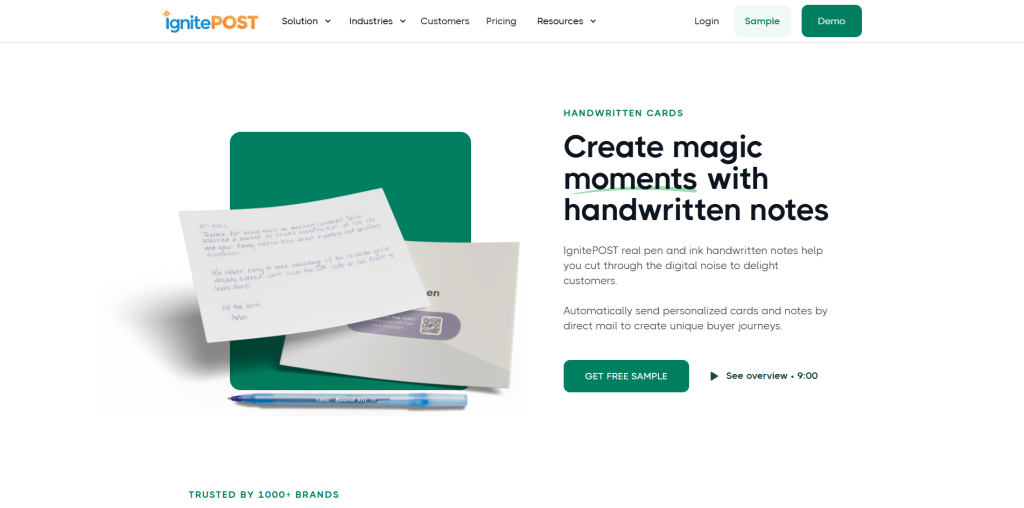
Real-pen output, dispatch usually inside 24 to 48 hours, and the marketing-stack integrations are strong - Klaviyo, HubSpot, Salesforce, Shopify, plus an API. Roughly $1.75 a card at high prepaid volume, up to about $4.39 at lower volume, postage included.
Bottom line: very good at one narrow job. United States only, and the attractive rates need money up front.
3. SimplyNoted - Shopify volume
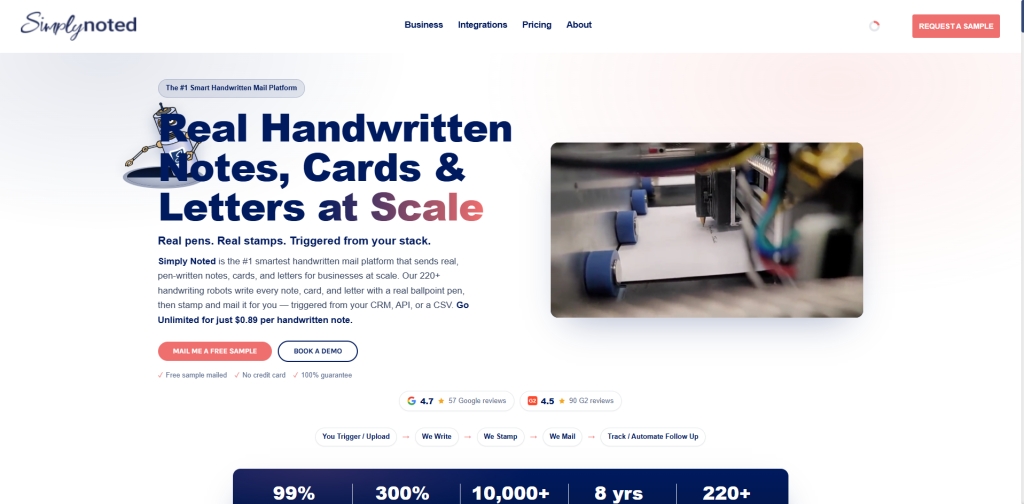
Suits: stores automating a thank-you when an order ships.
Genuine pen output with native Shopify, Zapier and API access. Entry is commonly a 100-card credit pack around $358 including postage, with an unlimited monthly plan that gets the effective rate well under a dollar at serious volume.
Bottom line: works when price leads the decision and you're sending steadily. The credit-pack floor rules out one-offs, and it's domestic only.
4. Handwrite - flat rate, low volume
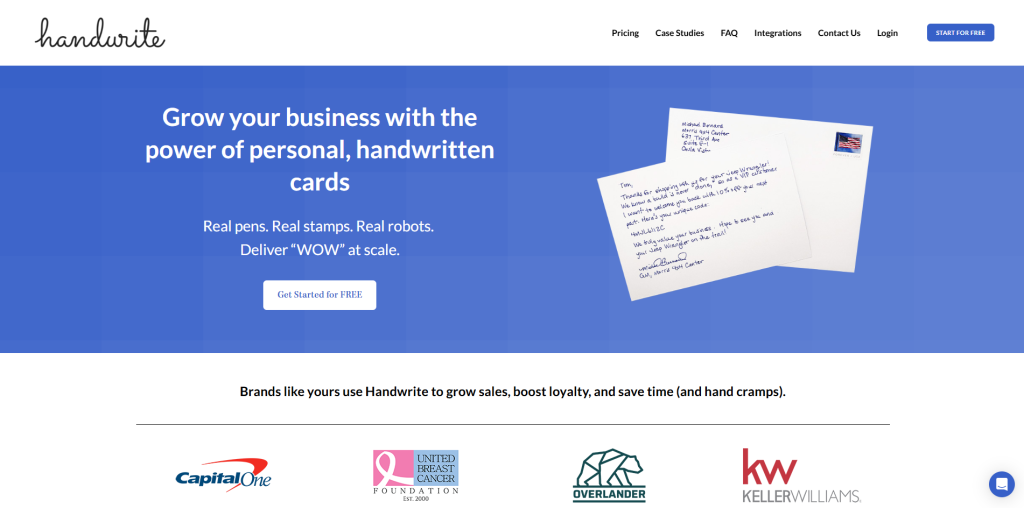
Suits: small senders who want one clear number.
Flat $2.99 per card covering card, envelope, writing and postage, with no minimum, dropping toward $2.45 at a few hundred. Connects through Zapier, Shopify and an API.
Bottom line: the clearest pricing in the category and a sensible starting point. Thinner on native CRM depth, and international coverage isn't documented.
5. PostPilot - DTC at scale
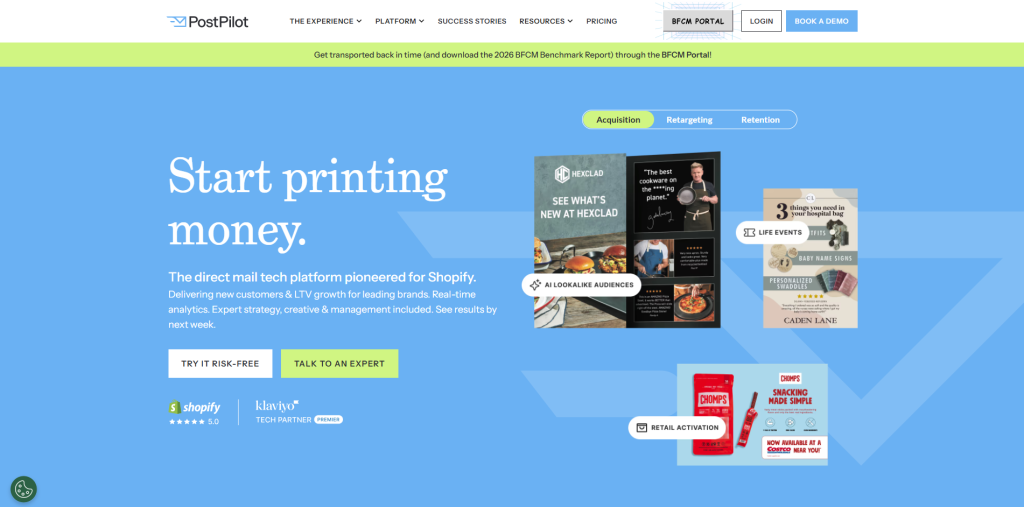
Suits: Shopify and Klaviyo brands who want direct mail handled end to end.
Strategy, creative and fulfilment are run for you, and the Shopify and Klaviyo integration is the deepest here. Worth knowing: the core product is printed postcards, with handwritten cards offered through a partner rather than built in house. Standard postcards start near $0.50 including postage. Handwritten pricing is quote-gated and not published.
Bottom line: strong when you want a programme operated rather than a tool licensed. Built around campaigns, not one-to-one sending, and the opaque pricing makes budgeting awkward.
6. LettrLabs - local acquisition
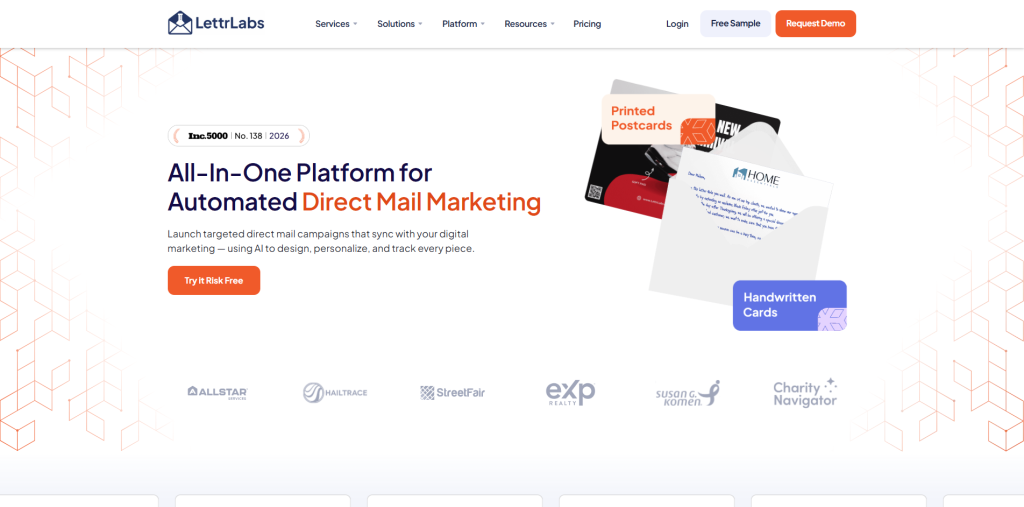
Suits: home services, insurance, and anyone mailing a postcode rather than a list.
Radius and ZIP targeting sit alongside CRM triggers, with ServiceTitan on the integration list next to the usual names. Rates from roughly $0.78 per piece, though that needs an annual enterprise commitment; a premium plan runs around $399 monthly and a free pay-as-you-go tier exists.
Bottom line: the acquisition specialist. The workflow favours campaigns over relationship sending, so it's a poor fit if your use case is thanking existing customers.
7. Scribble - best design library, shortest track record
Suits: design-forward domestic sending where the card itself does some of the work.
The doodle and illustration library is genuinely the best here, and the card design canvas is a pleasure to use. Real pen, one-card minimum, postage in the price.
Two things to weigh against that. It launched in 2026, so there's no public record of how it handles a December peak, and no published SOC 2 or equivalent compliance documentation at the time of writing. It's also US-only. And as covered above, the entry pricing at low volume is the highest on this list.
Bottom line: a legitimate option for domestic, design-led sending. Not yet built for international reach, deep native CRM work, or a procurement review.
8. Thankster - budget volume, printed font
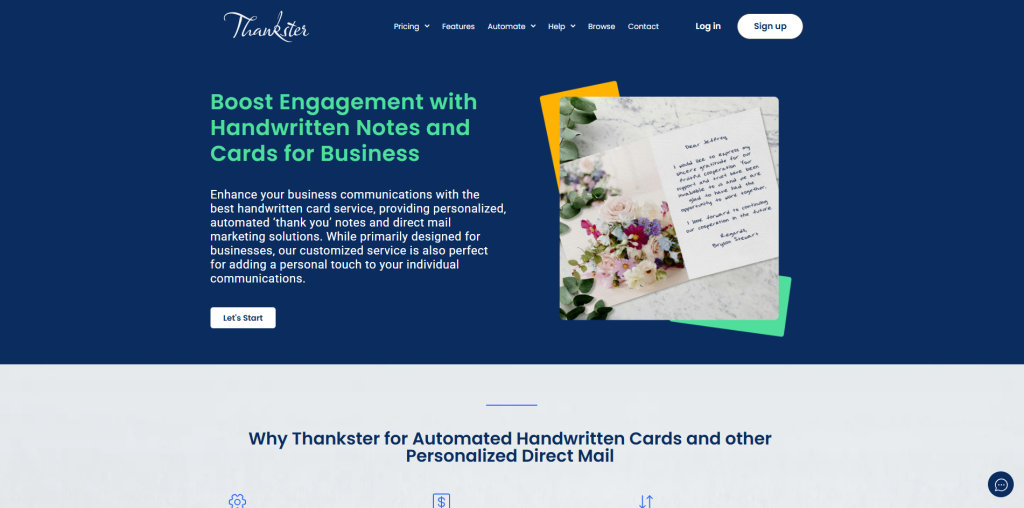
Printed handwriting typeface rather than a pen, and transparent about it. Roughly $1.18–$2.09 per card plus a small monthly subscription in some plans, with postage handled differently depending on the plan. Integrates through Zapier, Make and Keap.
Bottom line: cheap and flexible at volume. No ink texture, no pen impression. Fine when the handwritten look is enough.
9. Scribeless - international budget, printed font
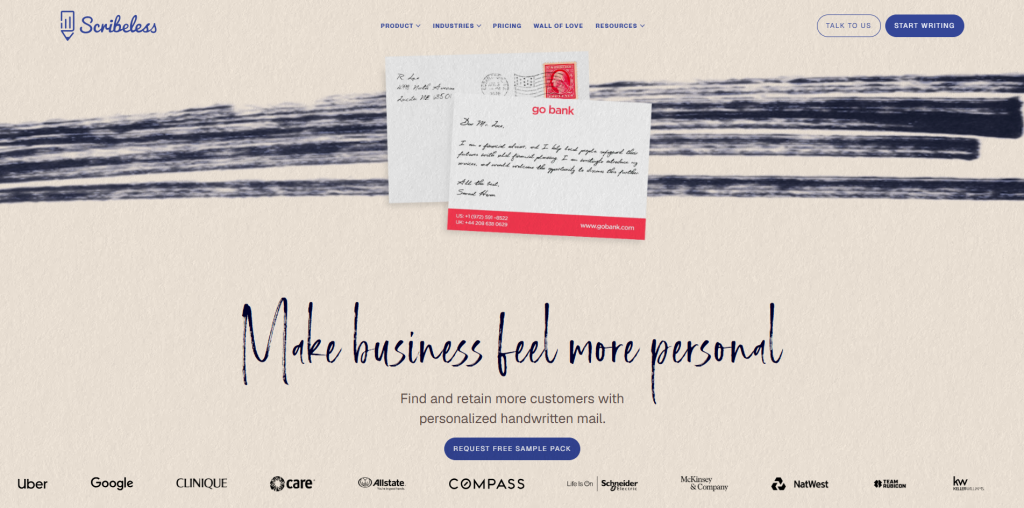
Also a printed font, but with facilities that give domestic postage in several markets plus worldwide shipping and a one-item minimum. Listed in GBP, roughly £1.19–£1.99 per item.
Bottom line: the pick when international reach beats authenticity. Real pen plus broad international coverage remains rare, which is why Handwrytten sits alone at the top of this list.
10. Felt - personal use only
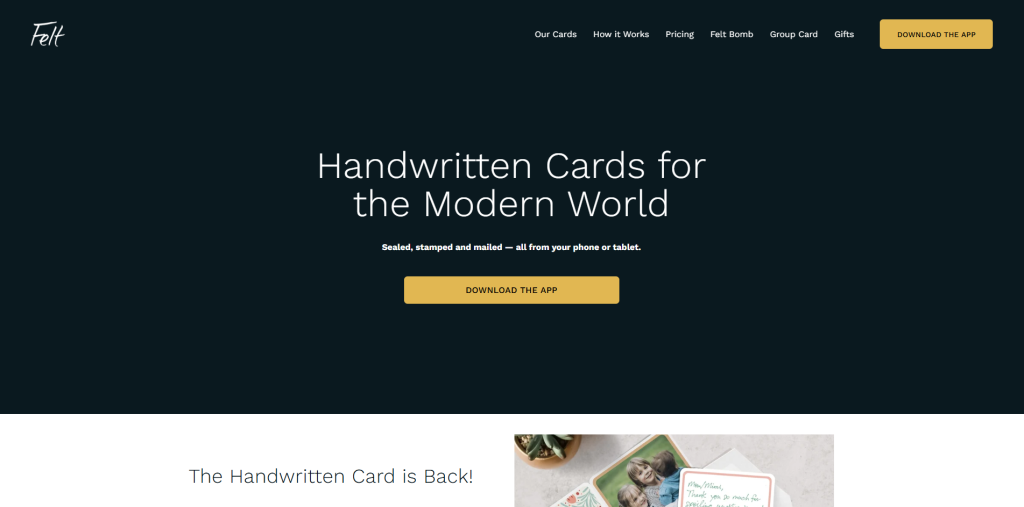
A phone app that captures handwriting you draw on the screen with a finger, then prints it. One-card minimum, single-panel cards starting near $4.50 with postage. No integrations, no API.
Bottom line: a lovely thing to send your mother. Not a business tool and not pretending to be one.
Side by side
| Service | Suits | Real pen | Postage in headline | Send just 1 | International | SOC 2 |
| Handwrytten | Business and enterprise | Yes | No | Yes | ~190 countries | Type II |
| IgnitePOST | E-commerce retention | Yes | Yes | Yes | US only | Not published |
| SimplyNoted | Shopify volume | Yes | Yes, in packs | 100 min | Limited | Not published |
| Handwrite | Low volume | Yes | Yes | Yes | Not documented | Not detailed |
| PostPilot | DTC at scale | Yes | Quote only | Limited | US only | Type II |
| LettrLabs | Local acquisition | Yes | Yes | Limited | US focus | Verify |
| Scribble | Design-led domestic | Yes | Yes | Yes | US only | Not published |
| Thankster | Budget volume | No, font | Varies | Varies | Limited | Not detailed |
| Scribeless | International budget | No, font | Often domestic | Yes | Yes | Not published |
| Felt | Personal only | Prints your own | Yes | Yes | Limited | Not published |
Track record and integrations
The first table answers what it costs. This one answers whether the vendor can carry the work.
| Service | Key native integrations | Support model | SOC 2 | Running since |
| Handwrytten | Salesforce, HubSpot, Shopify, Zapier, Make, Blackbaud, API | Self-serve and enterprise | Type II | 2014 |
| IgnitePOST | Klaviyo, HubSpot, Salesforce, Shopify, API | Self-serve and managed | Not published | 2017 |
| SimplyNoted | Shopify, Zapier, API | Self-serve and enterprise | Not published | 2018 |
| Handwrite | Zapier, Shopify, partial Salesforce, API | Self-serve | Not published | 2016 |
| PostPilot | Shopify, Klaviyo | Fully done-for-you | Type II | 2013 |
| LettrLabs | Klaviyo, Shopify, Salesforce, HubSpot, ServiceTitan, Zapier | Managed campaigns | Claimed, verify | 2020 |
| Scribble | API, Zapier, concierge setup | Self-serve and concierge | Not published | 2026 |
| Thankster | Zapier, Make, Keap, API | Self-serve | Not published | 2010 |
| Scribeless | Generic CRM and API | Self-serve | Not published | 2018 |
| Felt | None | Consumer app | Not published | 2013 |
Read that last column twice. Direct mail is a physical business, and the week before Christmas is when you find out whether a vendor has been through this before.
Why Handwritten Notes Services Still Work
Email open rates have been sliding for years. Everyone's inbox is a landfill and ads get ignored before they finish rendering.
A card doesn't compete in that arena. It arrives in a stack of four envelopes, and three of them are bills. It gets opened. More to the point, it gets kept - propped against a monitor, stuck on a fridge, mentioned to a colleague. No email in the history of email has been propped against a monitor.
For a business, that memory converts into callbacks, renewals and referrals. Which is also why the channel only works when it stays scarce. Send a card after every transaction and you've built a mailing list, not a relationship.
Choosing the Right Handwritten Notes Service
Settle international first. It cuts the field faster than any other question. If you mail outside the US and want a real pen, the list is short.
Check the minimum against your actual cadence. Fifteen notes a month needs a genuine one-card service, not a credit pack.
Match the integration to your system of record. If a rep has to leave the CRM to send a card, they won't send the card.
Ask for the SOC 2 report early if your company runs vendor reviews. Discovering the gap during procurement costs weeks.
Do the arithmetic at your volume, including postage. Not the floor rate on the homepage.
Then test with 25 cards. Send them to real customers. Check the ink impression, confirm the stamp is real rather than printed, read a full paragraph for repeated letterforms, and watch what comes back. Scale from there.
Key takeaways
- Compare delivered cost at your real annual volume, postage included. Entry pricing and floor pricing are different numbers, and the gap can exceed 100%.
- A real pen against a printed font decides how the card reads. Test the physical sample before you commit.
- Handwrytten covers the widest set of business requirements: real pen, native Salesforce and HubSpot, roughly 190 countries, SOC 2 Type II, and operating since 2014.
- IgnitePOST, SimplyNoted, PostPilot and LettrLabs each own a clear slice, all primarily US-focused.
- Newer entrants can be excellent on design and still lack the track record, compliance documentation and international coverage a business buyer needs.
- Test with 25 cards before scaling anything.
- Want a delivered cost for your own volume? Go to the vendor with your annual number and ask for the figure with postage included, in writing, before you commit to anything.
- Re-check live pricing before you buy. Rates and capabilities in this category move faster than the roundups covering them.