






Picture this: You've spent the last year building production-grade data pipelines with dbt. You know how to write models, build tests, manage dependencies, and structure a project that your teammates can actually navigate. Then you walk into the interview, and the questions feel oddly abstract. "What is a ref function?" "How does dbt handle incremental models?" You know the answers; you've done this for real but somehow, under pressure, the words don't come out the way you want.
Dbt model interview questions are designed to fill this gap between doing and explaining. This guide walks through the most important dbt interview questions by category — foundational, intermediate, advanced, and behavioral and explains what each question is really trying to surface.
Why DBT Interview Questions Are Different from SQL Interview Questions
Most SQL interviews test syntax and query logic. DBT interviews go further. They probe your understanding of the full analytics engineering workflow; from raw data ingestion to clean, tested, and documented models ready for downstream consumption.
Data Build Tool (dbt) sits at an intersection of software engineering and data analysis. When companies hire for dbt roles, they're usually looking for someone who can:
- Write maintainable, modular SQL using dbt's project structure
- Build and enforce data quality through automated testing
- Collaborate on data models the way developers collaborate on code
- Reason clearly about performance, cost, and data freshness tradeoffs
- Document data pipelines so others can understand and extend them
Understanding this broader picture changes how you approach every single question.
Top 20 DBT Model Interview Questions and Answers for 2026
Let's look at some important dbt model questions that are important for interviews in 2026.
Foundational DBT Model Interview Questions Every Candidate Should Know
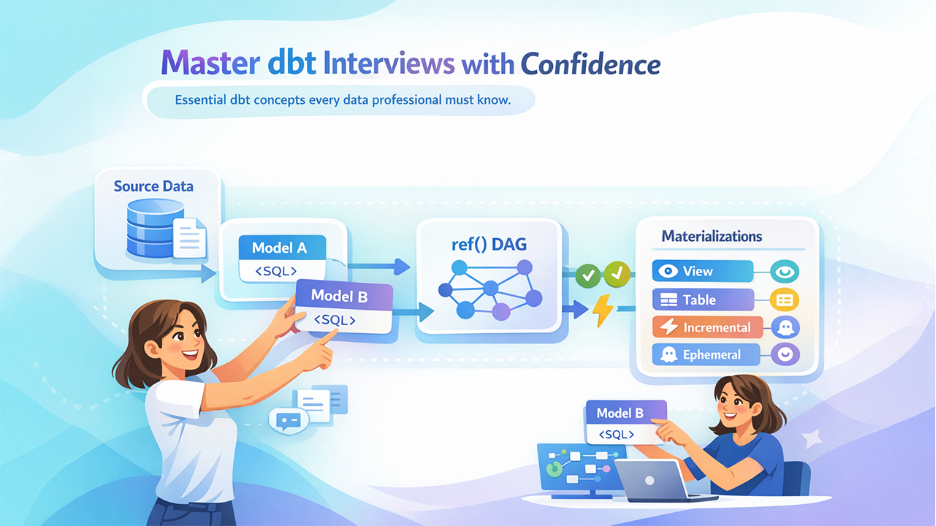
These are the questions that set the baseline. They appear in almost every interview and seem straightforward, but the way you answer them signals whether you have surface-level familiarity or genuine understanding.
Q1. What is dbt, and what problem does it solve?
DBT is a transformation tool that allows data analysts and engineers to write modular, version-controlled SQL transformations. Before dbt, SQL transformations were often written as ad hoc scripts with little documentation, no testing, and no dependency management. DBT solves this by applying software engineering principles like modularity, testing, version control, and documentation directly to SQL-based data transformation workflows. It runs inside your data warehouse, pushing computation to where the data already lives.
Q2. What is a dbt model?
A dbt model is simply a SELECT statement that is saved as a .SQL file within the dbt project. Each model represents a transformation layer. It can reference raw source data or build on top of other models. DBT runs materializes each model as a table, view, incremental, or ephemeral CTE depending on the configuration. The DBT model is not a script that you run manually, rather it defines what a data object should look like.
Q3. What does the ref() function do, and why is it important?
The ref() function tells how dbt models refer to other models. You write ref (‘model_name’) instead of hardcoding schema and table names, and dbt determines the right path based on the project and environment. This is important for two reasons: it enables the same codebase to function in development, staging, and production environments without needing manual changes, and it automatically creates a dependency graph (DAG).
Q4. What are the different materialization types in dbt?
DBT supports four primary materializations:
- View model runs as a SQL view. It is lightweight, always fresh, and without storage cost.
- Table creates a physical table on each run. It offers faster query performance and has higher storage costs.
- Incremental appends or updates only new or changed records. It works best for large datasets where full refreshes are expensive.
- Ephemeral compiles as a CTE and is never stored. It is useful for intermediate logic that doesn't need to exist independently.
Choosing the right materialization is one of the most consequential architectural decisions in a dbt project.
Q5. What is a source in dbt?
Sources are raw data tables that exist in the warehouse but were loaded by an external process such as ETL tools, data loaders, event streams, and so on. In dbt, you declare sources in a YAML file using the sources: key. This lets you use the source() function instead of hardcoding table names, and it enables source freshness checks where dbt can alert you if source data hasn't been updated within an expected window.
Intermediate dbt Model Interview Questions
Once you've established the basics, interviewers move into territory where judgment starts to matter. These questions probe your ability to reason about architecture, testing, and project organization.
Q6. What are dbt tests, and what types are available?
DBT tests are assertions about your data that run automatically as part of your pipeline. There are two categories: schema tests and custom data tests. Schema tests are applied in YAML files and include four built-in options:
- Unique: it means no duplicate values in a column
- not_null: it refers to no missing values
- accepted_values: it means values are constrained to a defined set
- Relationships: it refers to foreign key integrity between models
Custom data tests are SQL queries that return failing rows. They allow you to encode business logic directly, and that’s why they are powerful. For example, they ensure that revenue figures are never negative, or that the total number of orders always matches line-item sums.
Q7. How do incremental models work in dbt?
An incremental model instructs dbt to process only latest or updated records, eliminating the need to rebuild the entire table from scratch. You define the logic using the is_incremental() macro, which filters source data to only rows newer than the latest record in the existing table. On first run, dbt builds the full table. On subsequent runs, it processes only the delta.
However, in an incremental model, handling late-arriving data and ensuring idempotency if something goes wrong mid-run poses a real challenge. Can you re-run safely without duplicating records? This is the follow-up question that separates practitioners from people who've only read the docs.
Q8. How would you structure a dbt project for a large team?
A well-structured dbt project typically follows a layered architecture:
- Staging layer: one model per source table, lightly transformed, renamed columns, basic type casting.
- Intermediate layer: more complex joins and business logic, not directly exposed to end users.
- Mart layer: final consumer-ready models organized by business domain (finance, marketing, product).
This separation ensures that each model has a single responsibility, changes are easy to trace, and new team members can understand the pipeline without needing to reverse-engineer everything. Naming conventions, folder structure, and clear documentation in schema.yml files become critical at scale.
Q9. What is the dbt DAG, and how do you use it?
The DAG (Directed Acyclic Graph) is a visual and computational representation of all model dependencies in a dbt project. Every time you use ref() or source(), you're adding an edge to the DAG. DBT uses it to determine execution order, run models in parallel where possible, and identify upstream failures. In practice, the DAG is one of the most powerful debugging tools available. When a downstream model fails, you trace it back through the lineage to find exactly where bad data entered the pipeline.
Q10. What are seeds in dbt?
Seeds are CSV files that live inside the dbt project and are loaded directly into the data warehouse as tables. They're useful for static reference data such as country codes, product category mappings, configuration tables that changes rarely and is easier to manage as a flat file than a database table. Because seeds are version-controlled alongside the rest of the project, they're transparent and auditable in ways that manually maintained lookup tables never are.
Q11. How does dbt handle environments — dev vs. prod?
DBT uses profiles and targets to manage environments. A profile defines the connection settings for your warehouse, and each profile can have multiple targets typically dev, staging, and prod. In development, engineers write to their own schema using the {{ target.schema }} variable, so work-in-progress models don't touch production data. The same SQL runs in every environment; only the connection details and target schema change. This separation is what makes safe experimentation possible on a shared warehouse.
Advanced dbt Model Interview Questions
These questions separate solid practitioners from people who've truly internalized how dbt fits into a modern data stack. Expect them in senior or lead-level interviews.
Q12. What are macros in dbt, and when should you use them?
Macros are reusable Jinja functions written in the macros/ directory of a dbt project. They let you encapsulate logic that repeats across models, generating a date spine, applying standard column transformations, or abstracting warehouse-specific SQL syntax. Macros are powerful but carry a readability cost. A good rule of thumb: use a macro when the same logic appears in three or more models, and changes to that logic should propagate everywhere automatically. Don't reach for macros just to feel clever.
Q13. What is the difference between dbt compile and dbt run?
DBT compile translates all Jinja and ref() calls into raw SQL and saves the output to the target/ folder, but it doesn't execute anything in the warehouse. DBT runs compiles and then executes those statements. Using compile is valuable when you want to preview the SQL dbt will generate without incurring any compute cost, or when debugging complex Jinja logic that isn't behaving as expected.
Q14. How would you debug a model that keeps failing in production?
Start with the run artifacts, dbt generates manifest.json, run_results.json, and catalog.json files that tell you exactly what happened during a run. Check the compiled SQL in the target/ directory to see what dbt actually sent to the warehouse. Reproduce failure in a dev environment. If it's a data quality issue, run dbt test on upstream models to find where bad data has entered. If it's a performance issue, use EXPLAIN plans in the warehouse to understand query execution. Your choice of MySQL IDE can make a significant difference here, as a good environment lets you inspect and run the compiled SQL directly against your warehouse to isolate failures faster. Document what you find so the fix becomes part of the project's institutional knowledge.
Q15. What is dbt's exposure feature, and when is it useful?
Exposures let you define downstream consumers of your dbt models such as dashboards, ML models, reports, and external APIs directly in YAML files. When documented as an exposure, these consumers appear in the lineage graph, giving teams visibility into which models are business critical. The real value is impact analysis: before modifying a model, you can see what exposures reference it and proactively alert the owners of those downstream systems.
Q16. How do you handle slowly changing dimensions (SCDs) in dbt?
DBT doesn't have native SCD support out of the box, but it provides the building blocks. For Type 2 SCDs where historical records are preserved alongside current ones; dbt Snapshots are the primary feature. Snapshots use a timestamp or check strategy to track row-level changes over time, creating a table with valid_from and valid_to columns. The result is a full, query-able history of how records changed, which is invaluable for point-in-time reporting.
Behavioral and Scenario-Based DBT Interview Questions
Technical skill gets you in the room. Behavioral questions determine whether you get the offer. These probe how you collaborate, communicate tradeoffs, and handle real-world messiness.
Q17. Tell me about a time you refactored a complex dbt project.
Strong answers show you can identify technical debt, build consensus before making disruptive changes, and measure success after the fact. Talk about specific problems like maybe models were too deeply nested, tests were missing, or nobody understood the lineage anymore. Describe how you communicated the need for refactoring to stakeholders who didn't care about internals, how you sequenced the work to minimize disruption, and how you validated the output afterward.
Q18. How do you handle disagreements with teammates about data modeling decisions?
This is about collaboration and intellectual humility. Good answers acknowledge that data modeling often involves tradeoffs without obvious right answers — performance vs. simplicity, flexibility vs. consistency. Describe a real situation where you held a different opinion, how you made your case using evidence, and how the team arrived at a decision together. Interviewers want to see that you can advocate for your position without becoming territorial.
Q19. How do you decide when a dbt model is "done"?
This deceptively simple question reveals a lot about engineering maturity. A thorough answer includes: the model has tests covering uniqueness, not_null constraints, and key business rules; it has meaningful column-level documentation in schema.yml; it follows project naming conventions; it has been peer-reviewed; and downstream consumers have confirmed it meets their needs. Done isn't just about the SQL working; it's about the model being maintainable and trustworthy.
Q20. What are model contracts in dbt, and why do they matter?
Model contracts, introduced in dbt Core 1.5, let you enforce a defined schema: specific column names, data types, and constraints on a model output. DBT validates the structure before the model runs, catching breaking changes like renamed columns or shifted data types at compile time rather than in production. For teams with multiple downstream consumers depending on stable model interfaces, contracts are a critical guardrail.
How to Prepare for DBT Interview Questions
Reading through questions is a starting point. The candidates who perform best have done more than read; they've built things, broken things, and fixed them. Here are the most effective preparation strategies:
- Build a sample dbt project from scratch: Take a publicly available dataset and model it through staging, intermediate, and mart layers. Write tests and document your models. The act of building forces you to make real decisions.
- Practice explaining your DAG out loud: Open your project's lineage graph and narrate it as if onboarding a new teammate. If you stumble, that's a gap worth filling before the interview.
- Study incremental models, snapshots, and macros specifically: These are the areas where depth separates candidates at the mid-to-senior level.
- Review a real schema.yml file: Notice how tests are structured, how sources are documented, and how descriptions are written. This builds vocabulary and concrete examples.
- Prepare two or three stories about production problems you've solved: Interviewers at senior levels care more about your debugging process than your ability to recite definitions.
One more thing: DBT interviews often include a take-home or whiteboard modeling exercise. Practice writing clean, readable SQL models under time pressure. Speed matters less than clarity, and interviewers want to see how you think, not just what you produce.
Conclusion: How to Succeed in a dbt Interview
The key to answering dbt model interview questions is understanding that companies face real, complex data challenges. Interviewers want to see how you think, not just whether you can recall definitions. Strong candidates connect their answers to real experiences, tradeoffs, and architectural decisions.
If you’ve worked with dbt in practice, you likely know more than you realize. Preparation is about turning that experience into clear explanations and becoming comfortable with terminology. As the data engineering ecosystem evolves with features like model contracts, unit testing, and semantic layers; staying curious and continuously building will help you stay ahead.
Approach interviews as conversations about data rather than tests. That mindset often makes the biggest difference.