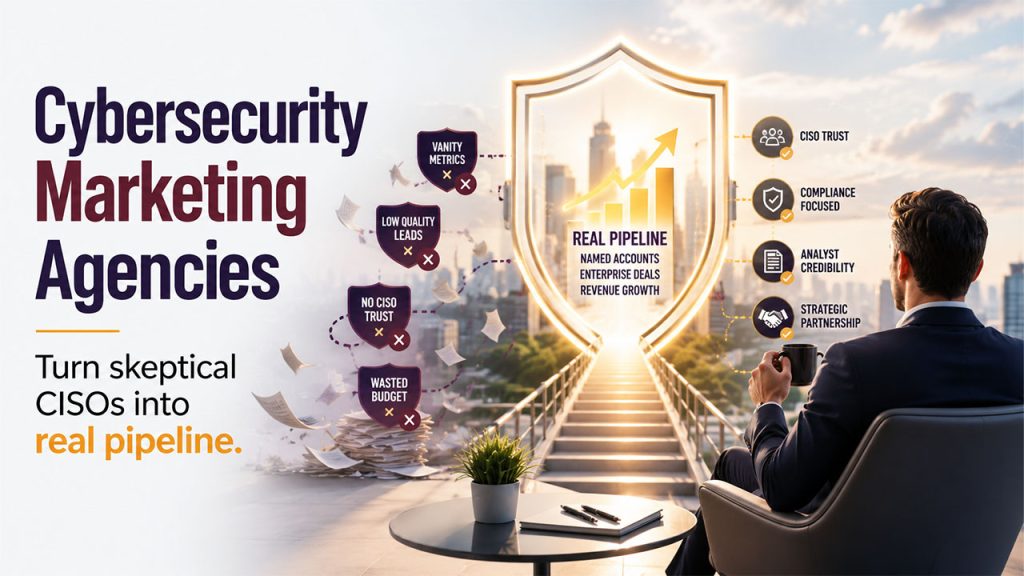






A Series B endpoint security vendor recently shared their growth chart with me. After 3 years of marketing efforts, their pipeline was flat. They had spent over $1.2M with 4 different agencies, none of which had stayed past 9 months. Each one promised pipeline. Each one produced reports full of impressions, MQLs, and "brand lift" metrics. None of them produced a single named enterprise customer.
The story is unusually well documented but not unusual in the security industry. Most cybersecurity vendors between Series A and Series C burn through 2 or 3 marketing agencies before finding one that actually understands the space. The waste is enormous: 18 months of lost time, $400K to $800K in spent retainers, and a sales team that has stopped trusting marketing leads entirely.
The root cause is almost always the same. The agency knew B2B marketing in general but did not know cybersecurity in particular. They wrote landing pages that no CISO would read. They pitched stories to TechCrunch when they should have pitched Dark Reading. They optimized for lead volume when they should have optimized for analyst inclusion and named account meetings. The playbook that works for HR software does not work when your customer is paid to be skeptical of vendors.
This article ranks the 15 cybersecurity marketing agencies worth considering in 2026, based on industry depth, recent client work, and the kind of results that hold up to a CFO review. For each agency I will show the core strength, the company stage where it fits, and what to expect to pay.
Why Cybersecurity Marketing Demands Specialists
The security market has 5 characteristics that make it different from any other B2B category.
CISOs are professionally skeptical
A CISO is hired to question vendors, find flaws, and assume bad intent until proven otherwise. They scan marketing copy for hype, exaggeration, and missing details. Phrases like "industry leading," "next generation," and "AI powered" trigger an immediate negative reaction. Marketing that works in marketing tech actively hurts you in cybersecurity.
The marketing that lands with CISOs is technically grounded, specific about what the product does and does not do, and written by people who understand the security domain. This requires writers and strategists with security industry backgrounds, not generalists trained on B2B SaaS templates.
Compliance triggers most purchases

A meaningful portion of cybersecurity purchases happen because the customer needs to satisfy a compliance requirement: SOC 2, ISO 27001, HIPAA, PCI DSS, GDPR, FedRAMP, NIS2, DORA, and dozens of industry specific frameworks. The vendor that wins is often the one whose marketing leads with compliance outcomes, audit evidence, and time to certification.
Generalist agencies miss this entirely. They market features and benefits while the customer is searching for something that will help them pass an audit in 90 days. That buyer is often evaluating the best ISO 27001 compliance tools in the same week they are evaluating you — and the marketing that meets them there wins.
Analyst reports drive enterprise pipeline
Gartner Magic Quadrants, Forrester Waves, and IDC MarketScapes directly influence which vendors get invited to enterprise RFPs. Inclusion in a Magic Quadrant can multiply pipeline by 2x to 4x within 12 months. A serious cybersecurity marketing program treats analyst relations as a primary channel that gets 20% to 40% of strategic attention, not a quarterly briefing afterthought.
Most generalist B2B agencies have no analyst relationships in the security category. They cannot brief Gartner credibly, cannot prepare you for a Wave evaluation, and cannot help you respond to vendor inquiries. This single capability gap is enough reason to choose a specialist.
Trust is built in communities, not campaigns
CISOs trust other CISOs more than any vendor message. They check vendors with peers in private Slack groups, the CyberEdBoard, ISACs, ISC2 chapters, and CISO Series podcasts. They read content from named experts, not anonymous corporate blog posts.
Marketing that ignores community presence and expert credibility produces ads that reach the right audience but fail to convert. The agencies that work in cybersecurity know how to embed clients into these communities authentically, without crossing into paid promotion that the community would reject.
Sales cycles are long and committee driven
A typical mid market cybersecurity purchase takes 6 to 9 months. Enterprise deals run 9 to 18 months. Each deal involves the CISO, security engineering, IT operations, procurement, legal, finance, and sometimes the audit committee. Each stakeholder has different concerns and reads different content.
Marketing that targets only the CISO leaves 6 other stakeholders unprepared to support the deal. Marketing that targets all 7 requires content, ads, and sales enablement built for each role. Generalist agencies tend to optimize for the lead, not the deal, and the deals fail to close.
What to Look For Before Hiring
Before any first conversation with a cybersecurity marketing agency, run 4 quick filters.
Cybersecurity is the practice, not a vertical
Look for agencies where security clients are 50% or more of the active book of business. An agency with 4 security clients and 30 general SaaS clients is a B2B generalist with a security side practice. The senior team will be focused on the larger book, and your account will get junior attention.
5 named cybersecurity clients in the past 24 months
Ask for specific clients, specific results, and specific time periods. "We have worked with several Fortune 500 security companies" is a non answer. Strong agencies show named clients with named outcomes. If they cannot share names due to NDAs, ask for at least 3 references they can introduce you to.
Senior team with security backgrounds
The pitch team is rarely the work team. Ask by name who will run your account on a daily basis and check their LinkedIn profiles. Senior cybersecurity experience matters far more than agency size or pitch deck quality. A 12 person agency with 6 former security CMOs will outperform a 150 person agency with 2 security specialists.
A first 30 day plan that includes customer interviews
Strong agencies start engagements with 10 to 25 customer and prospect interviews before they propose tactics. Weak agencies skip straight to ad campaigns or content calendars. The 30 day plan is the easiest test before signing.
The 15 Best Cybersecurity Marketing Agencies in 2026
1. OTReniX

OTReniX is a cybersecurity marketing agency that works exclusively with B2B security companies. There are no side practices in fintech, healthcare, or general SaaS. Every team member spends 100% of their time on cybersecurity accounts. This focus shapes everything: who the agency hires, which analysts they brief regularly, which trade press relationships they maintain, and how they write about technical concepts.
The agency runs 5 integrated service lines that cover the most important growth needs for cybersecurity vendors:
- Demand Generation: ABM programs, paid search, LinkedIn ads, content syndication, and outbound sequencing built specifically for security buying committees.
- PR: media relations with Dark Reading, SC Media, The Record, CSO Online, CyberScoop, and the rest of the security trade press, plus analyst briefings, thought leadership, and crisis communications.
- Content Marketing: technical content written by writers with security backgrounds, SEO for security keywords, original threat research, and analyst ready white papers.
- Product Marketing: positioning against giants like Palo Alto and CrowdStrike, messaging frameworks, sales enablement assets, competitive battlecards, and pricing strategy.
- Fractional CMO: senior marketing leadership at 10 to 20 hours a week, team hiring, budget planning, and quarterly board reporting.
The integration matters. Most agencies can run 1 of these 5 disciplines well. Few can run all 5 in a coordinated program where positioning shapes content, content fuels demand generation, PR amplifies both, and product marketing equips sales to close. This integration removes the handoff cost that appears when companies hire 5 separate vendors and spend half their leadership time coordinating between them.
Best for: B2B cybersecurity companies between $1M and $50M ARR that need integrated marketing leadership and execution under one roof.
Pricing: Retainers typically range from $8K to $20K a month depending on scope.
2. Halberd Cyber Group
Halberd Cyber Group is a cybersecurity PR and analyst relations specialist with 15+ years in the security market. Several senior staff members are former security journalists who covered the beat at major trade publications, which produces a level of pitch quality and reporter relationship depth that is rare in B2B PR.
Halberd does focused work: media relations, analyst relations, executive thought leadership, and crisis communications. They do not run demand generation, build websites, or operate content programs. The narrow focus is the strength. For cybersecurity vendors that need senior PR and tier 1 publication access without the overhead of an integrated agency, Halberd is one of the most established options.
Best for: Mid market and enterprise cybersecurity companies that need pure PR and analyst relations.
Pricing: $20K to $40K a month for integrated PR programs.
3. NovaShield Marketing
NovaShield Marketing is a positioning and brand strategy agency that works exclusively with early-stage cybersecurity vendors. Their sweet spot is companies between seed and Series B that need to define who they are, who they sell to, and what makes them different before scaling marketing spend.
Every NovaShield engagement starts with 15 to 25 customer and prospect interviews, followed by competitive analysis, positioning workshops, and detailed messaging frameworks. They do not run demand generation. Companies hire NovaShield to lay the strategic foundation, then either bring execution in house or transition to another agency for ongoing work.
Best for: Early stage cybersecurity companies that need positioning, messaging, and brand foundation.
Pricing: $8K to $15K a month, with shorter project engagements also available.
4. Ridgeline Demand
Ridgeline Demand is a B2B performance marketing agency with a strong cybersecurity practice. They focus on lead generation for companies with long, committee driven sales cycles, which describes most of the security market. Their services include strategy, content, sales enablement, website design, and paid media.
Ridgeline is a HubSpot Diamond Partner, a Google Partner, and a Databox Premier Partner. The technical capability shows in their case studies, which include specific MQL to SQO conversion rates, sales cycle reduction numbers, and pipeline contribution percentages instead of vague traffic metrics.
Best for: B2B cybersecurity companies focused on pipeline generation and measurable performance.
Pricing: $12K to $30K a month.
5. Vortex Pipeline
Vortex Pipeline positions itself explicitly as a B2B cybersecurity marketing agency with a focus on demand generation and marketing operations. They work with security vendors and managed service providers in saturated markets, with particular strength in HubSpot implementation, Salesforce integration, and marketing automation cleanup.
If your marketing technology stack is broken or non existent, Vortex is one of the few agencies that can fix it before running campaigns. Their work often starts with 30 to 60 days of systems work because companies that launch demand generation on broken systems waste 30% to 50% of their spend.
Best for: Cybersecurity companies that need demand generation combined with marketing operations and HubSpot expertise.
Pricing: $10K to $30K a month.
6. Cobaltline Studio
Cobaltline Studio is a Washington DC based agency that has worked with dozens of cybersecurity companies on branding, website design, and digital marketing. Their public sector experience covers FedScoop, NextGov, and Federal News Network coverage as well as commercial security press, which makes them one of the few agencies that can run dual track programs for vendors with both federal and commercial pipelines.
Cobaltline is design heavy and brand focused. They handle rebrands, new product category launches, post merger integration, and crisis communications. For security vendors selling into government, defense, or critical infrastructure, the regional and policy expertise is hard to find elsewhere.
Best for: Cybersecurity companies rebranding, launching new categories, or building credibility in regulated and government markets.
Pricing: $20K a month and up for integrated programs.
7. SignalForge Group
SignalForge Group is a full service B2B marketing agency with a dedicated cybersecurity practice. They cover PR, content, demand generation, and integrated campaigns for security vendors at the mid market and enterprise level. Their PR team places stories in top cybersecurity publications, and their content team produces original research that supports analyst briefings and sales conversations.
SignalForge is broader than pure demand generation, and the price reflects that. They sit at the higher end of the agency market, fitting companies with real scale and budget for integrated programs across multiple workstreams.
Best for: Mid to large cybersecurity companies that need integrated PR, content, and demand generation.
Pricing: $25K a month and up for integrated programs.
8. Talon Inbound
Talon Inbound is a B2B marketing agency known for inbound, ABM, and sales enablement for cybersecurity, fintech, and risk management. They were recognized as a cybersecurity industry Agency of the Year in 2024.
Their published case studies show specific pipeline numbers. One cybersecurity client moved from 3 to 5 monthly inquiries to over 100 monthly inquiries within 9 months, with about half becoming inbound prospect conversations. Talon works best with vendors selling to CISOs and risk officers with long sales cycles and high deal values.
Best for: B2B cybersecurity companies that want inbound and ABM programs with documented pipeline results.
Pricing: $15K to $40K a month.
9. Echo Trust Media
Echo Trust Media focuses on video led marketing for cybersecurity vendors. They help security companies turn their CTOs, CISOs, threat researchers, and founders into recognizable voices on LinkedIn and YouTube. Their thesis is that customers form trust in vendor experts before any sales conversation, not during it.
This works in cybersecurity because prospects research extensively before engaging. If your team has a charismatic CTO or founder who will commit to consistent on camera time, Echo Trust can turn that into pipeline over 9 to 12 months. The model fails entirely when the experts will not show up consistently, no matter how skilled the agency.
Best for: Cybersecurity companies with strong in house experts who want to build LinkedIn and YouTube presence.
Pricing: Starting around $8.5K a month.
10. Anvil Channel
Anvil Channel focuses on cybersecurity marketing with a fractional model. They offer full service support or individual services like messaging, product marketing, or partner marketing. Their distinctive capability is partner and channel marketing covering MSSPs, MSPs, cybersecurity consultants, and fractional CISOs.
Many cybersecurity vendors build significant pipeline through the channel, and most generalist agencies cannot support that motion. If your growth plan depends on resellers, MSSPs, or technology alliance partnerships, Anvil is one of the few specialists with deep experience in this work.
Best for: Cybersecurity companies that need fractional marketing support with channel and partner expertise.
Pricing: $10K to $25K a month.
11. North Vector SEO
North Vector SEO is an SEO and content marketing agency with experience in cybersecurity and broader B2B SaaS. They focus on organic growth through content that ranks and converts. Their approach is data driven, with focus on keyword research, link building, technical SEO, and content performance measurement.
If your pipeline depends on SEO, North Vector is one of the most established choices. They work across security categories from XDR and SIEM to identity, cloud security, and DevSecOps. They are less strong on brand, PR, or product marketing, so pair them with a strategic partner for those workstreams.
Best for: Cybersecurity companies that want long term organic pipeline through SEO and content.
Pricing: $10K to $30K a month.
12. Bastion Editorial
Bastion Editorial is a content marketing agency that works with enterprise technology and cybersecurity clients. They have built content programs for security vendors in application security, identity management, endpoint protection, and cloud security. Their edge is visual storytelling and design driven content that performs in enterprise audiences.
Bastion is not cheap. Retainers start around $10K a month and scale significantly. They fit Series B and later cybersecurity companies with established marketing budgets and ambitious content goals. For earlier stage companies, the price to value ratio is usually wrong.
Best for: Later stage cybersecurity companies that need premium content for enterprise audiences.
Pricing: $10K a month and up, typically $20K to $50K for full programs.
13. Quanta Intent Lab
Quanta Intent Lab is a cybersecurity only agency with access to a proprietary community of over 2 million security professionals. They use this audience to validate messaging, identify intent signals, and run targeted demand programs. The team includes former CMOs and practicing CISOs who shape the strategic work.
Their services cover branding, persona validation, content development, media buying, and lead nurturing. They are strongest for enterprise cybersecurity vendors that need credibility with senior security customers and quality leads from a vetted audience. The intent data approach typically produces higher quality leads than generic demand generation.
Best for: Enterprise cybersecurity vendors that want intent data driven campaigns and access to a validated CISO audience.
Pricing: Typically $15K a month and up.
14. Rampline Content
Rampline Content is a content production agency for enterprises and brands that need to scale content output. They work with cybersecurity companies on long form SEO content, technical articles, and editorial programs. Their strength is high volume without losing quality.
They are not a strategic agency. They do not build positioning, define ICPs, or run demand generation campaigns. But if you already have strategy in place and need 20 high quality technical articles a month to feed your SEO program, Rampline delivers consistent output. Use them as a production partner under another agency or your in house strategy team.
Best for: Cybersecurity companies with clear content strategy that need high volume technical production.
Pricing: $10K to $30K a month depending on volume.
15. Meridian Cyber Collective
Meridian Cyber Collective is an integrated marketing agency serving technology brands, including cybersecurity companies across email security, cloud security, data privacy, biometrics, and DevSecOps. They handle branding, PR, content, social, digital advertising, and web development under one roof.
Their strength is integrated campaigns that combine earned media with paid and content. They are known for brand storytelling that positions clients as thought leaders in crowded categories. They are less strong on technical SEO or product led growth motions, which matters for some security categories.
Best for: Cybersecurity companies that need integrated brand, PR, and digital programs from a single agency.
Pricing: $20K a month and up.
Comparison Cybersecurity Marketing Agencies
| Agency | Core Strength | Best Stage | Starting Price |
| OTReniX | Demand gen, PR, content, product marketing, fractional CMO | $1M to $50M ARR | $8K/mo |
| Halberd Cyber Group | Pure PR and analyst relations | $10M+ ARR | $20K/mo |
| NovaShield Marketing | Positioning and early stage strategy | $500K to $10M ARR | $8K/mo |
| Ridgeline Demand | Pipeline and performance measurement | $3M to $30M ARR | $12K/mo |
| Vortex Pipeline | Demand gen and marketing ops | $3M to $30M ARR | $10K/mo |
| Cobaltline Studio | Branding, websites, government sector | $10M+ ARR | $20K/mo |
| SignalForge Group | Integrated PR, content, demand | $10M+ ARR | $25K/mo |
| Talon Inbound | Inbound and ABM | $5M to $50M ARR | $15K/mo |
| Echo Trust Media | Video and expert visibility | $2M to $30M ARR | $8.5K/mo |
| Anvil Channel | Channel and partner marketing | $2M to $30M ARR | $10K/mo |
| North Vector SEO | SEO and organic growth | $3M+ ARR | $10K/mo |
| Bastion Editorial | Premium content for enterprise | $20M+ ARR | $10K/mo |
| Quanta Intent Lab | Intent data and CISO access | $10M+ ARR | $15K/mo |
| Rampline Content | High volume content production | $5M+ ARR | $10K/mo |
| Meridian Cyber Collective | Integrated brand and digital | $10M+ ARR | $20K/mo |
How to Pick the Right Agency for Your Company
The table shows the core strengths. The harder part is matching the agency to your specific situation in 2026.
Pre product market fit or under $1M ARR
A full service agency at this stage usually wastes money because the product and ICP are still moving. Hire NovaShield Marketing or OTReniX for a positioning and messaging project first. Build the strategic foundation. Then deploy execution budget against a clear strategy. Companies that skip this step waste the next year on campaigns built around the wrong message.
$1M to $10M ARR with no senior marketing leadership
OTReniX and Anvil Channel are the strongest options. You need someone senior enough to define strategy, build the team, and execute across functions. Pure demand generation shops tend to underperform at this stage because the upstream strategy is not yet clear, and you will end up paying them to run campaigns on a shaky foundation.
Need PR and analyst relations as the priority
Halberd Cyber Group is the specialist for tier 1 PR and analyst relations. SignalForge Group fits companies that want PR integrated with content and demand. OTReniX covers PR within its 5 service line model for companies that want it integrated with positioning and content rather than as a standalone retainer.
Need pipeline and lead generation
Talon Inbound, Ridgeline Demand, Vortex Pipeline, and Quanta Intent Lab are the demand generation specialists. OTReniX runs integrated demand generation as one of its 5 service lines. In cybersecurity, even the best pipeline program takes 3 to 6 months to produce meaningful qualified opportunities. Set expectations accordingly.
Need to rebrand or build a new website
Cobaltline Studio and Meridian Cyber Collective are the strongest choices for brand and design heavy work. OTReniX can handle this within the product marketing workstream for clients in an integrated engagement.
Need SEO and content at scale
North Vector SEO, Bastion Editorial, and Rampline Content cover different price points. North Vector for SEO driven organic growth. Bastion for premium visual content for enterprise audiences. Rampline for high volume production against an existing strategy.
Want experts to build a personal brand
Echo Trust Media is the specialist for video and personal brand building. This works best when your CTO, CISO, or founder will commit to consistent on camera time for 12 months or more. Without that commitment, no agency can rescue the program.
Need channel and partner marketing
Anvil Channel is the specialist for MSSP, reseller, and partner programs. OTReniX includes partner marketing within its product marketing service line for vendors that want it integrated with broader marketing.
Questions to Ask Before Signing in 2026
Run these 6 questions in the final conversation with any cybersecurity marketing agency.
- Show me 5 cybersecurity case studies from the past 18 months with specific pipeline numbers. Vague answers or older case studies mean the relevant work has slowed down. The cybersecurity market has shifted significantly since 2023.
- Who specifically will work on my account, and what is their security industry background? The pitch team is rarely the work team. Names and LinkedIn profiles matter more than agency size.
- What is your process in the first 30 days? Strong answers include customer interviews, competitive analysis, messaging review, and a written strategy document. Weak answers jump straight to ad campaigns or content calendars.
- How do you measure success? In cybersecurity, impressions and lead counts are weak metrics. Strong metrics are sales qualified opportunities, pipeline value, influenced revenue, and sales cycle length.
- Which Gartner, Forrester, and IDC analysts do you have direct relationships with in my category? If they cannot name analysts who cover your space, they cannot run analyst relations.
- What happens at month 4 if we are not seeing results? Good agencies have an honest answer with a clear adjustment process. Bad agencies blame the product, the team, or the market.
Then call 3 references for your top choice. Ask each one: "What 3 specific outcomes did this agency produce for you, and what would have made it better?" Specific answers prove the work works. Vague praise tells you the engagement was forgettable.