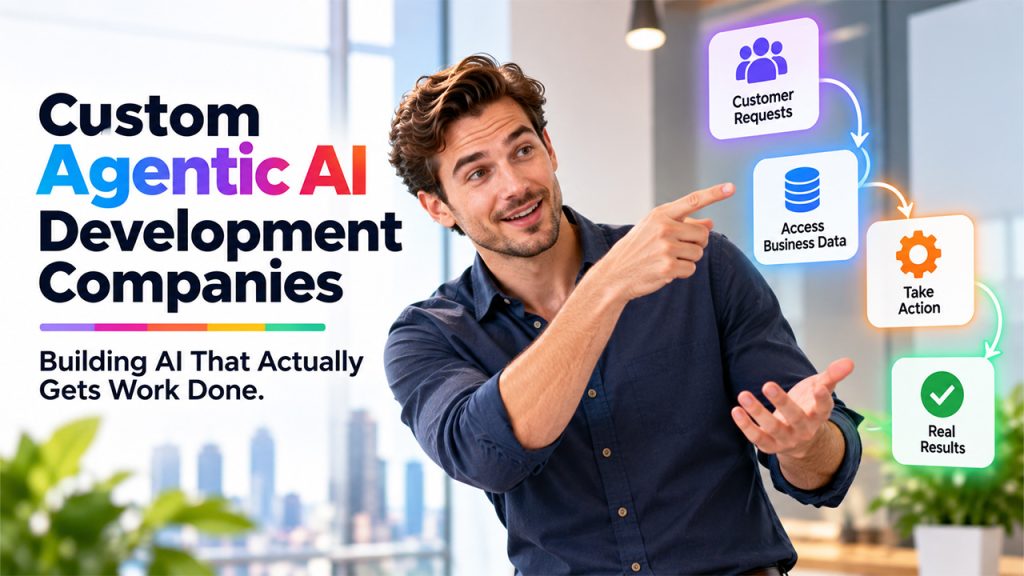






Every vendor in this market can produce an agent that works in a controlled demonstration. Far fewer can deliver one that runs for a quarter across a CRM, ticketing system, data platform, and approval process without a person repeatedly repairing failed tasks.
The difference is operational engineering. Production systems need identity controls, reliable integrations, observable tool calls, deterministic stopping conditions, and an owner for failures after launch. A convincing interface does not prove that any of those elements exist.
The first decision is whether the workflow needs autonomy at all. If the system should help a person with research, prepare work, and complete approved actions while the user retains control, AI copilot development services may be the more appropriate category. Agentic development is justified when the system must carry a bounded workflow forward without continuous human direction. We will explore the 5 best Custom Agentic AI Development Companies in this blog.
What Custom Agent Development Involves
An agentic system pursues a defined outcome across several steps. It interprets current context, selects the next action, calls tools or APIs, records what happened, and escalates when it reaches a condition it cannot handle safely.
The core architecture usually includes planning, persistent state, retrieval, tool access, orchestration, identity, and observability. This is a key part of AI Software Development, where systems are designed to integrate intelligent capabilities with reliable business workflows. The system also needs safeguards around the AI model that powers its decisions: schema validation, retries, timeouts, idempotency, approval gates, rollback procedures, and explicit stopping rules. These controls determine whether the workflow remains reliable when data is missing or an external system changes.
A copilot can use the same reasoning, memory, retrieval, and tools as an agent. The difference is authority. A copilot proposes or prepares consequential work for a person to approve. An agent executes within pre-agreed limits and brings exceptions back to a person.
Why Category Fit Matters?
The market contains several different supplier categories. Foundation model companies provide reasoning capability. Enterprise software platforms add agents to their own ecosystems. Low-code products help internal teams assemble standard workflows. Custom development partners design and operate systems around a specific process, data model, and risk profile.
A platform is often the sensible choice when most data and actions already sit inside that platform. A custom build becomes more defensible when the workflow crosses several systems, depends on proprietary logic, or requires controls that packaged configuration cannot express. The shortlist below focuses on custom delivery partners rather than model vendors or software products.
How the Companies Were Selected?
Each company has a US office or substantial US delivery presence, a defined custom AI development practice, and public evidence describing a real implementation. Production deployments received more weight than proofs of concept. Where a company reports its own business results, the wording below identifies them as vendor-reported rather than independently verified.
Five Custom Agentic AI Development Companies
1. DBB Software
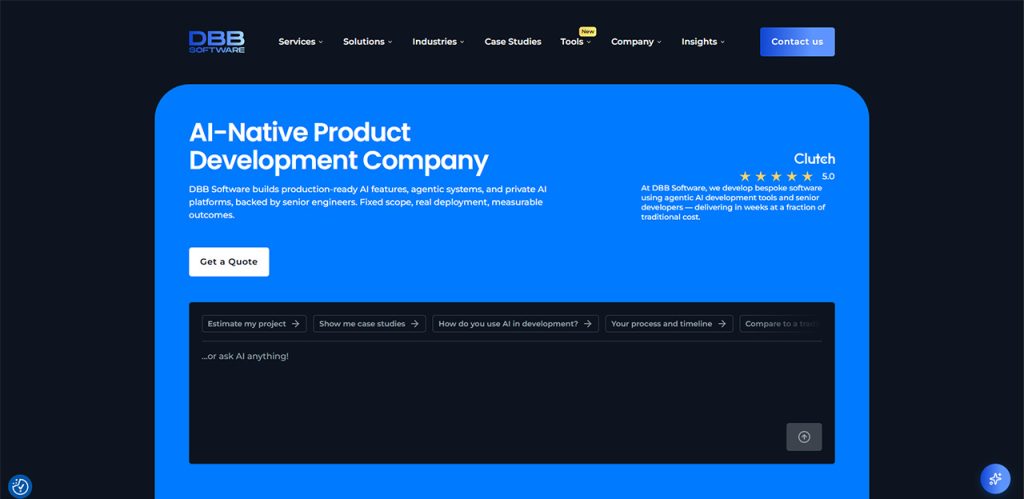
What they do: DBB Software builds custom copilots and bounded agents inside existing products and business systems. Its architecture covers grounding, context, tool access, permission-aware retrieval, interfaces, evaluation, and production monitoring. Senior engineers remain accountable for AI-assisted development output.
Production evidence: For a self-hosted AI platform, DBB built authentication, an encrypted credential vault, local data storage, persistent memory, audit logging, supervised agent processes, scheduled tasks, and portable tool integrations. The product moved from zero to a working platform in about four months with one senior engineer. DBB also added an AI-powered assistant and editable insight workflows to the Plaace real-estate platform.
Why companies choose them: The delivery model starts with architecture and action boundaries. The company describes proof-of-concept delivery in one week and a functional MVP in one month when scope and integrations support that schedule. The service page also specifies human confirmation before consequential writes, visible sources for answers, provider-neutral model access, and evaluation against representative user questions.
Best for: Software companies and operations teams that need an assistant or agent embedded in proprietary software, with ownership, auditability, and model portability addressed from the beginning.
2. Simform
What they do: Simform develops enterprise products and workflow systems that combine AI agents with mobile applications, data platforms, and existing operational software. Its offering is relevant when the agent is one part of a larger modernization program rather than a standalone interface.
Production evidence: For a US HVAC group with 23 subsidiaries, Simform built a mobile and web field-operations platform with five agentic workflows on Azure AI Foundry. Specialized agents process voice notes, images, receipts, measurements, timecards, and project data. The system integrates with Procore and uses Microsoft single sign-on, role-based access, guardrails, and workflow observability. Simform reports an 80 percent reduction in report-creation time and 60 percent less manual expense entry in the initial rollout.
Why companies choose them: The published case covers the system around the agents, including offline field capture, synchronization, project integration, review workflows, security, and operational monitoring. That is stronger production evidence than a chatbot demonstration or a framework list.
Best for: Enterprises that need agentic workflows delivered as part of a broader product, cloud, or field-operations platform.
3. ITRex Group
What they do: ITRex combines custom AI development with data architecture, model operations, and enterprise integration. This is useful when agent quality depends on cleaning, consolidating, and governing the underlying data before the system can act reliably.
Production evidence: ITRex built an AI customer-intelligence agent for a global haircare brand using Snowflake, Snowflake Cortex AI, Python, and Streamlit. The solution consolidates more than 30,000 reviews, performs sentiment and persona analysis, and generates summaries inside the client's Snowflake and AWS environments. The published implementation is explicitly a proof of concept, so its forecast savings should not be treated as realized production results.
Why companies choose them: The company covers the full path from AI readiness and data architecture through model validation, integration, and LLMOps. Its case material provides useful implementation detail, but buyers should insist on a production reference matching the required autonomy level.
Best for: Enterprises whose agent initiative is constrained by fragmented data, governance requirements, or the need to operate inside an existing cloud data platform.
4. Master of Code Global
What they do: Master of Code Global develops AI agents and conversational systems, with particular depth in customer experience, self-service, analytics, and integration. Its portfolio also includes AI readiness work, pilots, and custom product development.
Production evidence: For a North American B2B lender, the company integrated advertising, CRM, and core lending data into an analytics platform with an embedded agentic assistant. The assistant identifies anomalies, answers natural-language questions, recommends budget changes, and prepares stakeholder reports. Master of Code reports a 35 percent increase in marketing return, a 22 percent reduction in acquisition cost, and more than 15 staff hours saved each week within six months.
Why companies choose them: The case shows a practical sequence: assess readiness, repair the data foundation, build business-specific attribution logic, and then add an agent on top. That sequence is relevant when the first requirement is trustworthy analysis rather than autonomous transaction execution.
Best for: Companies building customer-facing assistants, revenue analytics agents, or conversational workflows that depend on several business systems.
5 SoluLab
What they do: SoluLab builds AI-enabled products and multi-agent platforms, supported by a wider software, cloud, and data engineering practice. The company is a plausible fit when the buyer needs web, mobile, and agent orchestration delivered together.
Production evidence: For UpdateIA, a French AI startup, SoluLab reports building a central orchestrator and more than 14 specialized agents for HR, CRM, finance, legal, marketing, and customer support. The platform includes human fallback triggers, a no-code workflow layer, monitoring through Prometheus and Grafana, and integrations with Microsoft 365, Google Workspace, Salesforce, and HubSpot. The case reports 60 percent automation coverage and an 80 percent reduction in manual workflows, but these remain vendor-published figures.
Why companies choose them: The reference architecture covers orchestration, connectors, web and mobile interfaces, fallback behavior, observability, and compliance controls. Buyers should verify which connectors and outcomes are live in production and which remain on the product roadmap.
Best for: Startups and enterprises building a multi-agent product that needs orchestration, application engineering, and a broad connector layer from one supplier.
Budget and Timeline Expectations
A narrow proof of value may cost in the low tens of thousands of dollars and take several weeks. A production single-agent system with identity, integrations, evaluation, and monitoring often moves into the mid five figures or higher. Multi-agent platforms that cross departments can reach six figures and require several months.
These are planning ranges, not quotations. Integration count, data quality, exception complexity, security review, uptime requirements, and the cost of operating the models usually matter more than the number of agents shown in the proposal. A fixed estimate is credible only after the vendor has inspected the systems and action boundaries.
Errors Worth Avoiding
- Judging the demonstration: A curated scenario hides missing permissions, stale data, rate limits, partial failures, and ambiguous records. Evaluation should focus on how the system handles those cases.
- Automating before defining authority: The team must decide which actions the system may take, which require approval, and which remain prohibited before implementation begins.
- Underestimating integration: Authentication, data transformation, write conflicts, API limits, and recovery logic can require more work than the reasoning layer.
- Deferring governance: Audit events, escalation rules, access controls, and ownership are cheaper to design into the architecture than to retrofit after a security or compliance review.
- Treating launch as completion: Agents need ongoing evaluation because models, prompts, APIs, source data, and business rules change after release.
Final Thoughts
Custom development is appropriate when the workflow is specific, the data environment is fragmented, and the organization needs a production system rather than a toolkit. When the process fits an existing platform and stays within that platform, configuration may be cheaper and easier to maintain.
Before comparing the best Custom Agentic AI Development Companies, define the business outcome, connected systems, action permissions, failure conditions, and evidence required for acceptance. That work removes more delivery risk than choosing one orchestration framework over another.