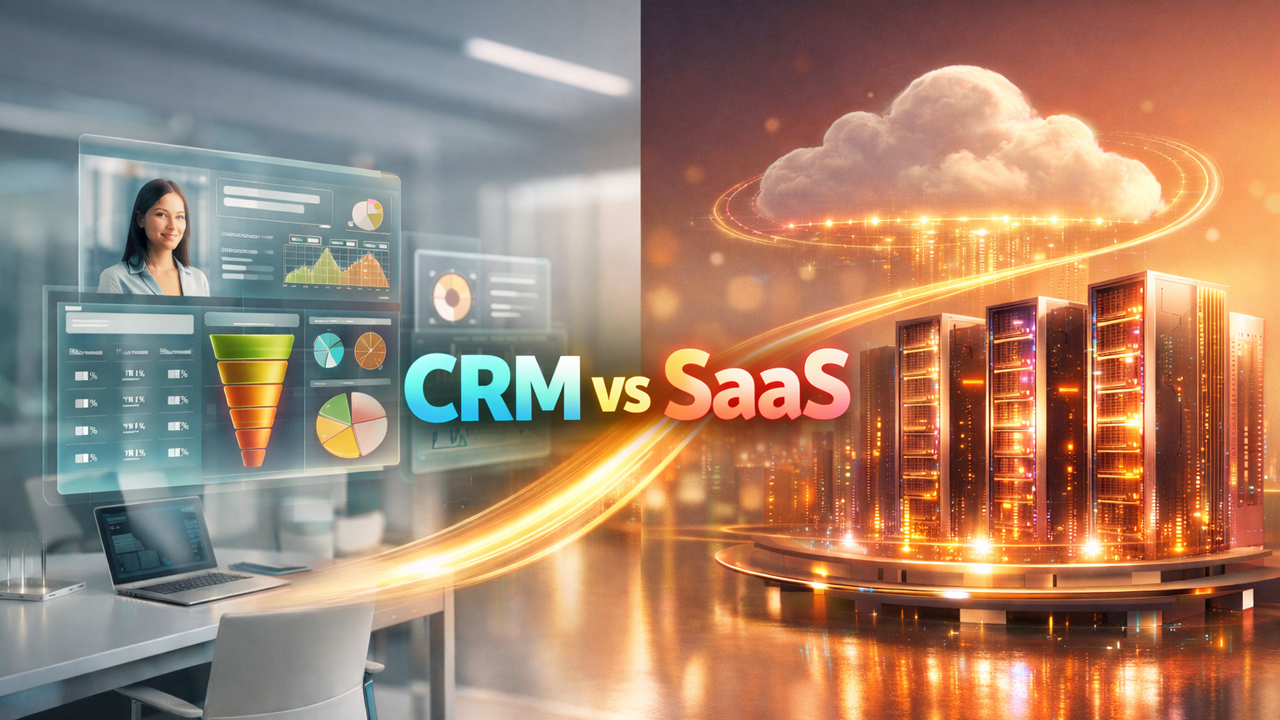






In the growing digital age, businesses rely heavily on digital tools to effectively manage customers, operations, and upscale their growth. There are two terms that are often discussed in this context— CRM and SaaS. They are frequently used together and sometimes interchangeably, but they are not the same thing.
Having a proper understanding of CRM vs SaaS is essential as misunderstanding their roles or incorrect choice can negatively impact businesses. It can lead to wasted budgets, poor adoption, and limited scalability. This blog explains what CRM and SaaS really mean, how they are different from each other, how they overlap, and how businesses should decide what they need. In simple terms, CRM is what the software does, while SaaS is how the software is delivered.
Quick Overview: CRM vs SaaS
- CRM (Customer Relationship Management) is a business system focused on managing customer data, interactions, sales, and relationships.
- SaaS (Software as a Service) is a software delivery model where applications are hosted online and accessed via the internet.
Understanding CRM
What is CRM? Organizing, monitoring, and managing relationships with customers and prospects throughout the whole lifecycle is made simple for businesses with CRM (Customer Relationship Management) solutions. CRM systems are made to consolidate all customer data in one location. It boosts productivity and efficiency by improving how teams engage with leads, clients, and current accounts.
Core functions of CRM
The main function of a CRM is to manage customer relationships in a systematic way. Understanding the Objectives of CRM helps businesses align their customer management strategy with specific goals such as improving retention, increasing sales efficiency, and enhancing customer satisfaction.
Customer Data Management
CRM systems keep records of customer profiles in a centralized CRM database which contains their contact details, communication history, preferences, and purchase records. This is done in order to create a unified view to ensure that sales, marketing, and support teams always work in sync with accurate information.
Reporting and Analytics
CRM platforms generate detailed reports which cover sales performance, behaviors and patterns of each customer, conversion rates, and team productivity. These insights are helpful to businesses to identify trends, measure success, and refine their strategies accordingly.
Sales Automation
CRM automates all daily routine sales tasks such as sending follow-up reminders, email scheduling, updating deals, and logging every activity without fail. This saves manual effort and reduces chances of error. This frees up sales team so that they can focus more on nurturing relationships and closing deals.
Lead and Opportunity Tracking
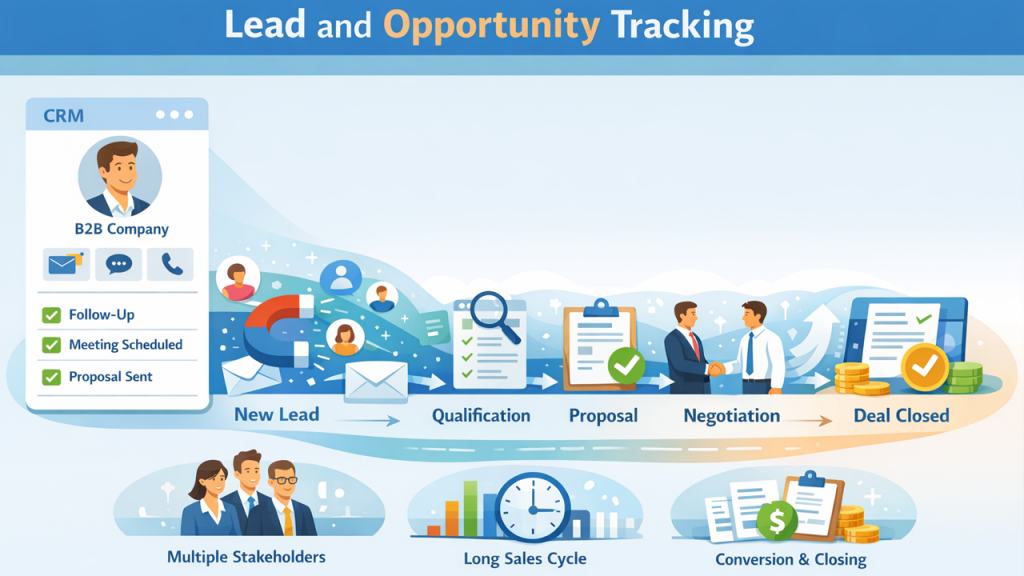
CRM platforms are helpful to businesses as they track leads from the first interaction to final conversion and deal closing. This is especially critical for B2B CRM systems where sales cycles are longer and deals involve multiple stakeholders. It ensures that no potential opportunity slips through cracks.
Customer Support and Service Management
CRM systems allow support teams to track tickets and complaints while offering informed solutions to customer queries. Accessing previous interactions within seconds, agents can offer faster and more personalized support to customers.
Marketing Campaign Management
Many CRM tools support campaign tracking by linking customer interactions with marketing efforts. B2C CRM platforms excel at segmenting large consumer audiences, tracking engagement across channels, and evaluating campaign performance.
Benefits of CRM Systems
CRM systems deliver value by helping businesses build stronger, more meaningful relationships with their customers.
Improved Customer Relationships
CRM systems provide a 360° view of each customer, which includes their history, preferences, and all previous interactions. This helps teams communicate more effectively and in a personalized way. It fosters trust and builds long-term loyalty.
Better Sales Performance
It also helps teams stay organized and focused by enabling them to track leads, deals, and pipeline stages. With automated reminders and clear visibility into opportunities, businesses can reduce missed follow-ups and boost conversion rates.
Enhanced Team Collaboration
CRM platforms offer a shared workspace for sales, marketing, and customer support teams. This allows everyone to work with the same up-to-data, which reduces gaps in communication while ensuring consistent customer experience across all departments.
Data-Driven Decision Making
CRMs generate detailed reports and dashboards to provide actionable insights. Through this, businesses can analyze sales trends, customer behaviors, and track the performance of campaigns. This enables smarter decisions that are backed by real data rather than guesswork.
What Is SaaS?
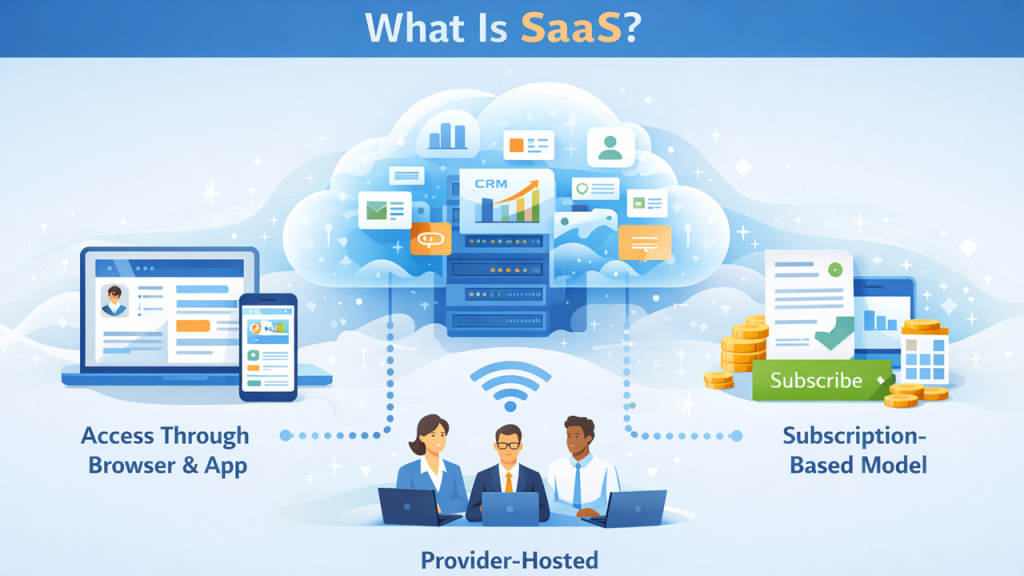
SaaS (Software as a Service) refers to a cloud-based software model where applications are hosted by a provider and accessed through a web browser or app. Rather than installing software on local machines or servers, users subscribe to SaaS platforms and access them online.
Key Functions of SaaS
The key functions of SaaS focus on how software is delivered, maintained, and scaled rather than on a specific business function.
Cloud-Based Software Delivery
SaaS applications are hosted on remote servers and accessed through the internet. This allows users to work from any location without having to install software on individual devices.
Subscription-Based Access
SaaS operates on a recurring pricing model, typically monthly or yearly. This allows you to predict costs and lower upfront investment compared to traditional licensed software.
Automatic Updates and Maintenance
Service provider handles all updates, fixes bugs, and enhances features. This way, users always get to work on the latest version without manual upgrades or system downtime.
Scalability and Flexibility
SaaS platforms allow businesses to scale usage up or down easily. It provides enough flexibility to companies as they can add users, storage, or features depending on their growing needs without changing infrastructure.
Integration with Other Tools
SaaS applications are designed in a way so that they can integrate seamlessly with other cloud-based tools. This allows businesses to create connected workflows across CRM, marketing, finance, and support systems.
Data Security and Backup
Most SaaS providers implement robust security measures which include encryption, access controls, and regular data backups. This helps in safeguarding business data against data breaches and other cyberattacks while ensuring continuity in case of system issues.
Benefits of SaaS Platforms
SaaS platforms remove traditional technical barriers and transform how businesses access and use software. Their benefits extend beyond convenience, which makes them ideal for organizations of all sizes.
Lower Upfront Costs
With SaaS, there is no need for expensive hardware, software licenses, or on-premises infrastructure. It offers a subscription-based pricing model which makes advanced software accessible to all, whether start-ups or small businesses.
Rapid Deployment
SaaS platforms can be set up and used almost immediately. There is no complex installation process. It allows businesses to adopt new tools quickly and respond faster to changing needs.
Easy Accessibility and Remote Work Support
SaaS applications are cloud-based, which makes it easier for users to access them from anywhere if they have an internet connection. This is significantly helpful to remote teams and support hybrid work environments, and global collaboration.
Automatic Updates and Innovation
It updates automatically to provide users with access to latest features and security updates without any human intervention. This ensures software remains modern, compliant, and competitive without additional effort.
CRM vs SaaS: Understanding the Core Difference
The confusion between CRM vs SaaS often comes from the fact that most modern CRM platforms are built using the SaaS model. However, they are fundamentally different concepts.
| Aspect | CRM | SaaS |
| Definition | A business system | A software delivery model |
| Purpose | Manage customer relationships | Deliver software via cloud |
| Scope | Specific to customer management | Applies to all types of software |
| Dependency | Can exist as SaaS or on-premises | Can deliver CRM, ERP. HR, etc. |
A CRM can be SaaS-based, but not all SaaS products are CRMs.
How CRM and SaaS Work Together
CRM and SaaS are not competing technologies; in fact, they complement each other extremely well. CRM defines how customer data is managed, and relationships are nurtured, while SaaS defines how software is delivered, accessed, and maintained. Together, they create a powerful, flexible, and scalable system for modern business operations.
CRM as a SaaS-Based Solution
Today, many leading CRM platforms operate as SaaS applications. This empowers businesses to access CRM tools through a web browser without having to install or maintain software on local servers. SaaS delivery makes it easier to deploy CRM systems, update, and scale them, which reduces technical complexity and costs.
Centralized Customer Data in the Cloud
When CRM runs on a SaaS platform, all customer data is stored securely in the cloud. This makes data accessible to sales, marketing, and support teams in real-time. This ensures consistency across all customer interactions and facilitates smooth collaboration between departments.
Automation and Workflow Optimization
CRM systems leverage SaaS infrastructure to automate routine tasks like assigning leads to agents, sending follow-up emails, customer onboarding, and tracking tickets. Through this automation, businesses can respond faster to customer inquiries while maintaining accuracy and consistency.
Scalability and Flexibility
Because CRM systems are delivered via SaaS, businesses can scale up their CRM usage as they grow. Companies can add new users, features, or storage with minimal effort. This makes it ideal for organizations with evolving customer bases and expanding operations.
Seamless Integration with Other SaaS Tools
SaaS CRM integrates seamlessly with other SaaS applications such as email marketing tools, accounting software, customer support platforms, and analytics dashboards. This creates a connected ecosystem where data flows smoothly between systems. It reduces manual work and improves efficiency.
CRM vs SaaS: Key Use Cases
When You Need a CRM
- You manage leads, customers, or accounts regularly
- Sales tracking and customer follow-ups are critical
- You want better customer retention and relationship insights
- Multiple teams need shared access to customer data
When You Need a SaaS Tool (Not Necessarily CRM)
- You need project management, accounting, or HR tools
- Your goal is operational efficiency rather than customer management
- You want cloud-based access without installing software
In many cases, businesses use multiple SaaS tools, including a CRM, working together.
Types of CRM in the SaaS Ecosystem
CRM platforms within the SaaS ecosystem are built to support different customer management needs while remaining flexible, scalable, and cloud accessible. The different types of CRM systems are:
Operational CRM: SaaS-based operational CRMs help manage leads, track interactions, and improve response times through real-time access.
Analytical CRM: Delivered via SaaS, it offers cloud-based analytics, dashboards, and AI-powered reporting without complex infrastructure.
Collaborative CRM: SaaS delivery ensures consistent communication and a unified customer experience across touchpoints.
Strategic CRM: It supports long-term relationships which are built through personalization, segmentation, and customer retention strategies, all powered by centralized SaaS data systems.
How to Choose Between CRM and SaaS Solutions
Rather than choosing CRM vs SaaS, the real question is what problem are you trying to solve? To rightly choose between CRM and SaaS solutions ask these questions:
- Do you need to manage customers or sales pipelines? → You need a CRM
- Do you want cloud-based access and low maintenance? → SaaS is ideal
- Do you need both customer management and flexibility? → Choose a SaaS CRM
Most growing businesses benefit from CRM software delivered via SaaS.
Final Verdict: CRM vs SaaS
The debate around CRM vs SaaS isn’t about choosing one over the other. CRM focuses on managing customer relationships, improving engagement, and supporting sales and service processes. While SaaS defines how these tools are delivered through cloud-based platforms that are flexible, scalable, and cost-effective.
For most modern businesses, the best solution is a SaaS-based CRM. It offers flexibility, scalability, and powerful customer insights. Understanding CRM vs SaaS helps you invest in the right tools, avoid confusion, and build systems that grow with your business.