






You can find countless articles on the internet that will explain to you how critical it is for your business to have a CRM. Considering the competitive business landscape, the significance of CRM implementation cannot be overstated. In 2024, the global CRM market size was estimated at USD 73.40 billion and is forecasted to reach around 163.16 billion by 2030. It is growing at a CAGR of 14.6% between 2025 to 2030. Current trends like hyper-personalization of customer service, use of automation and Artificial Intelligence (AI), and execution of social media customer service can aid in minimizing costs, enhancing response times, and boosting CRM adoption across diverse industries. These are the main factors that ensure market growth.
So, consider a business leveraging an advanced CRM platform. The business would benefit not just from monitoring customer communications but also for forecasting requirements and customizing their experiences. What is the end result? Strengthened relationships with your customers.
However, executing the CRM often comes with a vast number of budgetary and technical challenges. Having an effective strategy for CRM implementation leads to substantial cost savings and efficiency advantages. Introducing a no-code approach in this aspect has started to transform the CRM landscape. Businesses can now get feature-packed CRM platforms with detailed technical expertise and enjoy a lot of versatility.
60 Second Overview of Effective CRM Implementation
- What Is CRM Implementation?: Implementation of a CRM software involves setting up and incorporating CRM software by assessing configuration platforms, business requirements, and training teams for effective utilization of the platform.
- Significance of CRM Implementation: Effective implementation makes sure that there is smooth workflow integration, reduces employee downtime, minimizes errors, and prevents common pitfalls that cause approximately half of the CRM projects to crash.
- 10 Key Steps in CRM Implementation: A complete implementation plan covering platform selection, objectives, data migration, team formation, training, customization, feedback, testing, review, and consistent optimization.
- Determining the CRM Objectives, Requirements, and Budget: Lay out clear objectives, recognize vital features, assess business processes, and ascertain realistic budgets for both future and instant CRM requirements.
- Selecting the Most-effective CRM Platform: Select best CRM software through expert consultations, trials, final assessments, and consideration of no-code solutions for streamlined personalization.
- Forming a Qualified Implementation Team and Engaging Shareholders: Form a team of qualified and dedicated professionals including data analysts, system developers, QA engineers, department mentors, and project managers to guide effective adoption.
- Data Assessment and Clean Up: Assess accuracy of data, recognize crucial information, resolve errors, and prepare organized datasets before integration to ascertain expected CRM performance.
- CRM Customization and Configuration: Personalize security settings, user interface, field configurations, and test modifications in sandbox ecosystems before actual implementation to align the CRM with business processes.
- Employee Preparation and Training: Carry out complete training led by an in-house team to make sure teams understand the capabilities of CRM and can use the platform in the right way.
- System Testing and Data Integration: Test the security, core functionality, performance, and data processing while incorporating capabilities of automation to simplify workflows before going live.
- Instant Feedback and Adaptation Phase: Collect team feedback, track initial usage, quickly address concerns, and adopt training to make sure that there is seamless transition and adoption of the platform.
- Quality Assurance and Post Implementation Review: Monitor performance of the system, track KPIs such as customer satisfaction and conversion rates, and carry out periodic audits to make sure that there is continued effectiveness.
- Continuous Tracking and Optimization: Consistently track CRM performance, enable feedback channels, and make the required adjustments to improve the system with evolving business requirements.
What Is CRM Implementation?
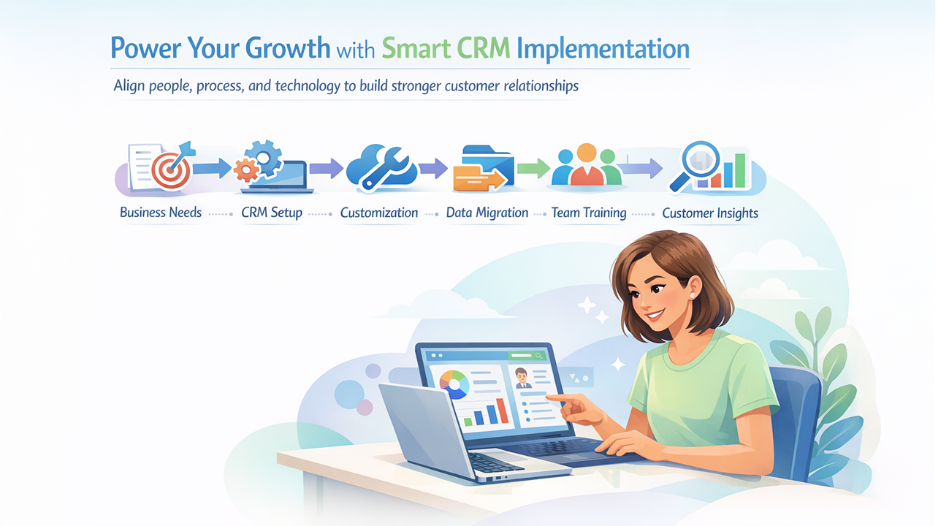
CRM implementation can be defined as the process of setting and integrating your CRM platform. This pertains to evaluating the requirements of your business, installing software, training, and configuring your team to effectively leverage the platform.
The overall objective is to simplify and enhance your relationship with every individual customer and improve business growth. CRM implementation generally involves assessment of your business requirements, carefully selecting the right type of CRM software, and personalizing it to adjust to your CRM objectives. It can look similar to data migration, including new workflows, and training the team on logistics.
Essentially, you need to have CRM implementation that aligns with your requirements. When you have the right CRM in place, it can lead to valuable customer insights, ensuring enhanced customer service and revenue. Customer relationship management is not an afterthought, but a core necessity for evolving businesses.
Significance of CRM Implementation
If there is one thing that differentiates between a smoothly integrated CRM platform and the one that becomes an issue in your business processes, it is the implementation. Now, let us understand why the process of right implementation is so crucial:
- Integration with Present Workflows: Consider that your business has been leveraging an ERP for years. Now, the introduction of a new CRM platform should not be seen as a disruptive force. Effective implementation of a CRM makes sure it complements and improves such present processes instead of overturning them.
- Reducing Employee Downtime: One of the greatest issues for any manager is the possible productivity loss during transition phase. Strategic execution minimizes downtime, allowing employees to modify the CRM platform without any level of disruptions to the routine tasks.
- Minimizing Risk of Errors: A team that has not become familiar with a new CRM platform can easily make a lot of mistakes, ranging from data mishandling to miscommunication. A well-thought-out implementation process aids in preventing such errors, protecting both your customer relationships and revenue.
- Complete Business Integration: Consider a CRM platform that complements every aspect of your business. In such scenarios, you must make sure that your CRM strategy is all-encompassing and robust. This makes sure that every department smoothly synchronizes with the new platform.
- Avoiding Pitfalls in Implementation: Given the fact that approximately half of CRM implementations do not meet the expectations, a detailed and well thought-out strategy is vital. This approach avoids issues such as staff frustration and data corruption, which comes from struggling to adjust to a completely new platform.
10 Key Steps in CRM Implementation
So, how can your organization create a CRM strategy that aligns with your objectives and ascertains success? It starts with an in-depth CRM implementation plan. In this blog, let us outline the main 10 steps in CRM implementation. The main steps are quite important to transform your processes and improve your customer relationships:
1. Determining the CRM Objectives, Requirements, and Budget:
Before going ahead with CRM implementation, it is vital to consider your goals, budget, and needs carefully. The main questions and factors you need to consider for a specific area are as follows:
Understanding Your Objectives:
- What particular customer experience and sales improvements are you focusing on?
- How do you strategize to gauge the improvement in lead capture rates or lead quality?
- What are the main benchmarks for enhancing productivity and team efficiency?
- How will CRM aid in prioritizing the top leads over the ones that are less promising?
CRM Necessity for Your Business:
- Which of your present business processes have the highest requirement for CRM capabilities?
- How do vital features such as live chat, email marketing platform, sales analytics, etc., integrate with your business model?
- Are sophisticated characteristics such as marketing campaign management and lead scoring required for your current processes?
- How do you predict the CRM adjusting to the future growth of your business and evolutions in market demand?
Understanding Your Budget:
- What is the realistic budget range that you can set for your CRM, considering both current and initial costs?
- Compare the investments in CRM integration to the anticipated enhancements in efficiency and revenue.
- What are the financial strategies that you have for future upgrades or integrations given the fact that CRM technologies evolve rapidly?
2. Selecting the Most-effective CRM Platform:
When choosing the most-effective CRM software, you can consider the main points:
- Start in a Simple Way: Go for a standard yet effective launch to prevent complications that come with higher-end implementations.
- Leverage Free Demonstrations and Trials: Benefit from free CRM demonstrations and trials to answers to your queries and hands-on experience.
- Get Expert Advice: Since CRM integration involves a substantial amount of investment, it is wise to consult with a CRM consultant which can guide you in your decision-making process.
- Final Assessment: Conduct a complete final review of the best CRM choices, including custom sales presentations for informed decision-making.
- Utilize No-code Solutions: Consider no-code solutions such as Creatio for simple customization and flexibility without requiring technical expertise.
3. Forming a Qualified Implementation Team and Engaging Shareholders:
Who will spearhead your CRM implementation to success? Imagine a dedicated team where each team member understands his or her role. A system developer will take care of installation, a data analyst will handle data migration, a QA engineer makes sure everything operates seamlessly, and a project manager will guide you throughout the journey. Furthermore, mentors in each department will also play a key role.
Such team representatives close the gap between daily users and management. They are instrumental in aligning all team members, especially those reluctant about new routines. You can consider them as valuable aspects to ensure disruption-free adoption across the organization.
4. Data Assessment and Clean-up:
Let us presume that you have a database of customer data, communication history, and financial records. Before you decide to integrate this database to your CRM, it is extremely important to first clean up your data.
- Assess Accuracy of Data: Make sure that all customer and contact data are up to date and written correctly.
- Recognize Vital Data: You can consider which data is important for migration, preventing the transfer of redundant data.
- Fix Incorrect or Missing Data: Take some time to address gaps or errors in data to improve CRM effectiveness.
- Strategize for a Complete Process: Keep in mind that data migration and cleaning will be time-taking but vital for an effective CRM implementation.
5. CRM Personalization and Configuration:
Personalizing your CRM software is key to preventing the shortcomings of generic setup that may or may not align with your particular business processes. Here is a short guide to what you can concentrate on:
- UI and UX: Personalize the field settings and user interface for streamlined data management.
- Security: Configure your security settings to safeguard data and control user access.
- Sandboxing: Test modifications in a sandbox environment before implementation.
- Patches and Updates: Execute various updates in stages to make sure there is seamless adoption, and issues are addressed proactively.
Lack of personalization can lead to user frustration, inefficiencies, and possible data mismanagement. This makes it a vital step in the implementation of a CRM platform. If you opt for an open-source CRM such as SuiteCRM and SugarCRM, you can check out our vast catalog of AI-powered plugins.
6. Employee Preparation and Training:
Consider your CRM system is prepared to go live. Now, comes a key step: team training. But who do you think is most suited to lead this training? Your in-house experts, i.e., professionals who are already familiar with the platform. They must be your front-line trainers, enabling the staff to learn about new features and platforms.
Why is this training so crucial? Well, imagine the impact of a team that is not completely versed with the capabilities of a CRM. It can potentially lead to your CRM not being utilized completely. In the worst case, it can even lead to mistakes while managing sensitive customer data.
Most CRM solutions provide training programs. However, it is the hands-on experience or internal guidance that makes all the difference. And, while you can expect a few bugs to be there, comprehensive training can minimize future disruptions substantially.
7. System Testing and Data Integration:
Irrespective of whether you are transferring from an old spreadsheet, CRM, or another platform, make sure data integration is efficient and effective. Also, factor in the automation capabilities of a CRM.
For instance, automating the call and email sequence of a sales team can greatly simplify their workflow. This integration and testing phase is important to make sure that the CRM is completely operational and personalized to your business requirements.
Once you have successfully loaded your data in the CRM, it is critical to test it completely. This step is critical to make sure that the system correctly processes the data and is working as expected. Check for any problems related to security, core functionality, and performance. Motivate your team to explore the CRM completely, ensuring there is transparent feedback on any encountered issues.
8. Instant Feedback and Adaptation Phase:
As your team starts with the new CRM platform, the adaptation phase is vital for streamlining the adaptation. Let us consider the important steps that you can follow:
- Track Initial Use: Notice how employees adjust to the CRM in the initial stages.
- Collect Instant Feedback: Collect challenges and first impressions from the team.
- Recognize Fixes Quickly: Resolve any initial concerns or issues quite quickly.
- Adjust Training As Required: Personalize training as per the staff feedback to enhance understanding.
- Encourage Open Discussions: Foster an environment of continuous discussions about the use and effectiveness of CRM.
9. Post Implementation Review and Quality Assurance:
After you have implemented the CRM, it is important to keep a close watch on the performance of the system. Check uptime, speed, and error rates consistently for optimum functioning. Assess the adoption rate and accuracy of customer data to measure the success of CRM.
Monitor key performance indicators like customer satisfaction scores, conversion rate, sales cycle lengths, and revenue growth to track progress. Regular audits of the CRM setup aid in ensuring its constant relevance in meeting business requirements and remaining a key tool for your business.
10. Consistent Tracking and Optimization:
The last step in your CRM journey is adaptability and vigilance. Ensure an anonymous system of feedback; it can even be through your new CRM. It captures insights of every team member after the roll-out. This ensures that the communication line remains open and makes sure everyone’s opinion is taken into account.
Consistently monitor the performance of a CRM, address any issues swiftly, and make the required adjustments. This proactive approach is to collect user feedback and work on it across all levels to make sure that the CRM evolves with the requirements of your team.
Conclusion
Effective CRM implementation needs strategic execution, careful planning, and constant commitment to your complete business. By implementing the 10 key important steps ranging from determining clear objectives to ensure constant optimization, you can revolutionize your customer relationship management and ensure crucial business growth. Keep in mind that CRM implementation is not a one-time project but a constant journey that requires periodic assessment and adaptation. With an effective approach, clear training, and stakeholder engagement, your CRM platform will become a crucial asset that boosts customer relationships, simplifies processes, and ensures measurable Return on Investment for years to come.
To have a complete peace of mind during CRM implementation, you can secure specialized services from OutRight Store. It provides a complete range of services with respect to SuiteCRM and SugarCRM integration and customization. From custom extension development, data migration, maintenance, integration, support, hosting, etc., to consultancy and marketing automation. If you want to get the best out of SuiteCRM and SugarCRM, then OutRight Store is the most reliable partner.