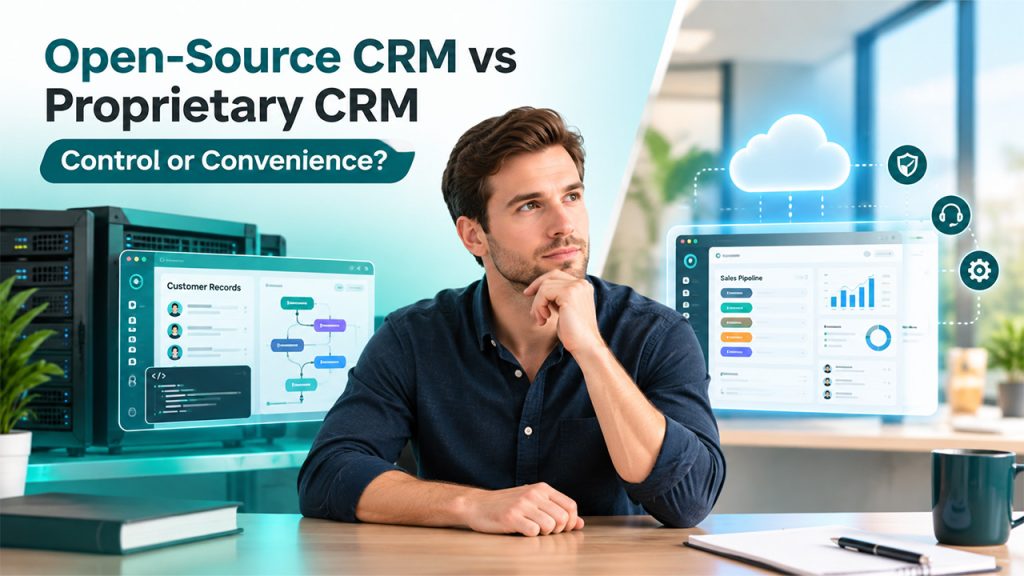






A CRM system is responsible for storing data about customers of the business, managing its sales processes, tracking communication, and supporting the teams. Nevertheless, picking suitable CRM models for the organization may be complicated.
Open-Source CRM vs Proprietary CRM is a real dilemma for many companies since both systems mean different levels of control and vendor management. The use of the open-source system makes it possible for companies to have higher control over the CRM software, while the proprietary system implies that all the responsibilities are taken on by the vendor.
Open-Source CRM vs Proprietary CRM: The Basics Explained
The main difference is who controls the software and how much freedom the business has to change it. Therefore, decisions require attention to both technical freedom and operational responsibility.
What Is Open-Source CRM?
Open-source CRM software makes its source code available under its license. Businesses can inspect the code and, depending on the license, modify it to meet specific requirements. They can also host the system on their own infrastructure or use a third-party hosting provider. This approach gives businesses greater control over customization, integrations, workflows, and deployment.
However, open-source does not mean that the complete CRM costs nothing. A business may still pay for hosting, development, security, maintenance, customization, and technical support. The company also needs suitable technical resources to manage changes and updates.
What Is Proprietary CRM?
Proprietary CRM software is developed and controlled by a vendor. Customers receive access according to the vendor's license or subscription terms, while the vendor controls the core source code and product development. Cloud-based proprietary CRMs also manage hosting, updates, infrastructure, and maintenance.
This model reduces work for customers. Businesses can usually configure fields, workflows, dashboards, permissions, and integrations within vendor-provided options. Bigger changes depend on platform support.
Open-Source CRM vs Proprietary CRM: Short Comparison
The difference becomes clearer when you compare the models across ownership and daily management. The table below focuses on practical differences rather than individual CRM features.
| Comparison | Open-Source CRM | Proprietary CRM |
| Price | License-free* | Subscription-based |
| Source code | Accessible | Restricted |
| Customization | Highly flexible | Vendor-defined |
| Hosting | Self-managed | Vendor-managed |
| Updates | User-controlled | Vendor-controlled |
| Support | Community/paid | Vendor support |
| Data control | Greater control | Vendor-dependent |
| Technical skills | Often required | Usually lower |
| Vendor lock-in | Lower | Higher |
*License-free does not mean cost-free. Hosting, development, maintenance, and support can still create expenses.
Open-Source CRM vs Proprietary CRM: Features Compared
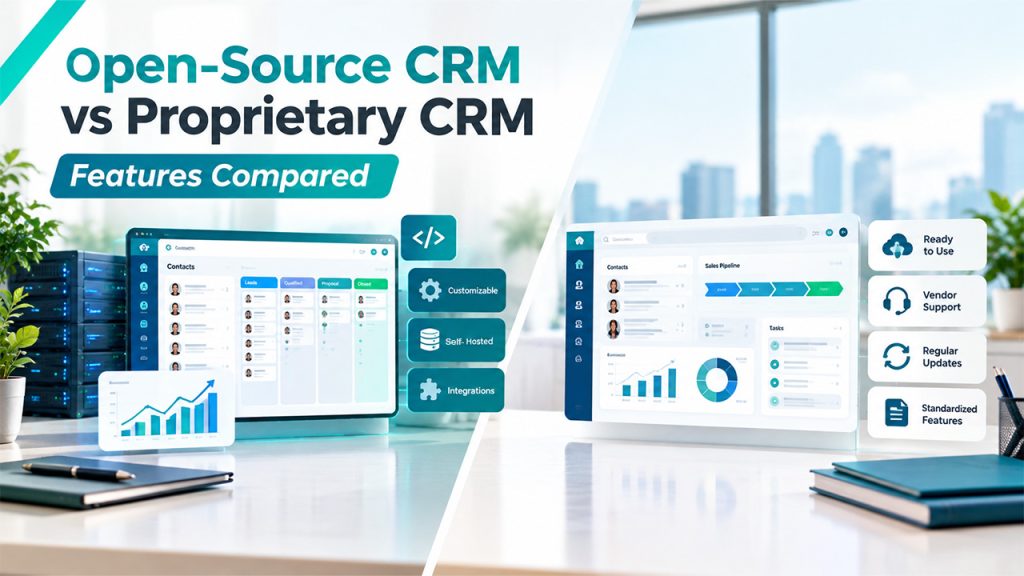
Both platforms offer similar sets of functionalities to manage day-to-day operations, contacts, and relationships, but the two approaches address specific use cases differently. Below are the features of open-source and proprietary CRM platforms.
Open-Source CRM Features
An open-source CRM can offer contact management, sales pipeline organization and tracking, reporting, automation of repetitive tasks, customer database storage, and other functions. It is particularly beneficial for companies that have in-house coding expertise to make significant improvements or build other tools around the CRM.
Such businesses can also benefit from hosting the platform themselves to ensure that the system’s data and tools are used to their fullest potential. At the same time, an open-source solution typically requires sufficient technical expertise to maintain and improve the system and make sure that no security vulnerabilities are present.
Proprietary CRM Features
Proprietary CRM software provides similar functionalities, but they are available in their standardized form. A company that opts for a proprietary solution purchases the software to use its features, typically with access to support, documentation, and updates provided by the vendor.
The products offer a wide range of functions and often give businesses a considerable amount of freedom to build an interface, set up procedures, and design automations within a provided framework. In other words, there is no need to modify the source code to improve performance or alter functions because the application offers enough flexibility to address a company’s specific needs.
Which CRM Should You Choose?
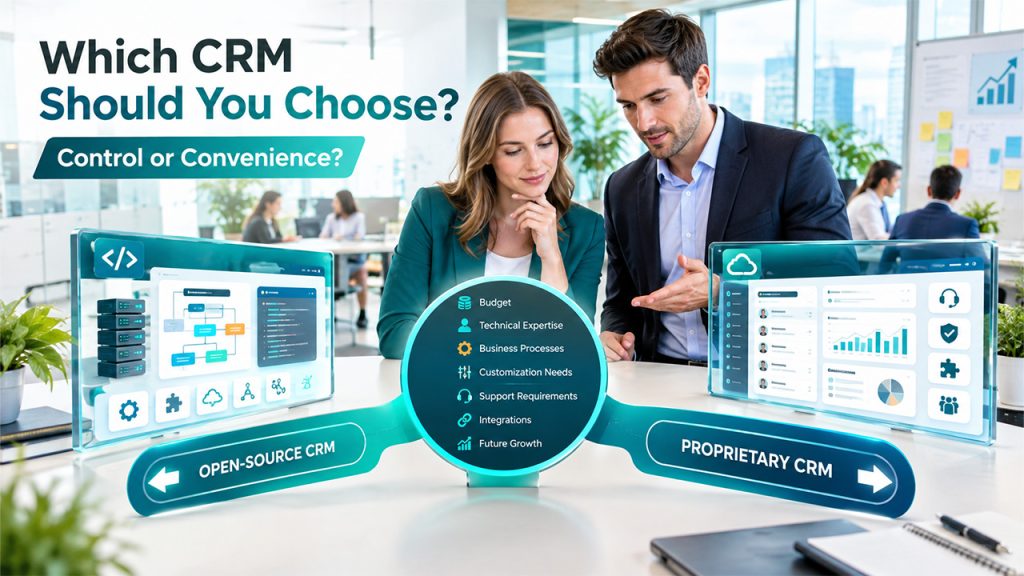
The best option will depend less on which has more features and more on what a company can handle. Open-Source CRM vs Proprietary CRM can be more easily narrowed down when comparing the model to what one's team is capable of. Budget, technical expertise, process, support, and growth can all play a role in the decision.
Choose Open-Source CRM If
Choose an open-source CRM if a company requires a highly customizable solution while having the technical expertise and capacity to operate it. It can be ideal for organizations whose processes don't align with conventional CRM software and require a different set of tools not offered elsewhere.
An open-source CRM can also be right for a company if they're looking for more control, both in terms of hosting and technical aspects. It can provide more flexibility for companies looking to make frequent or unique adjustments, rather than relying on a third party to do so.
However, it's important to remember that there could be additional costs associated with the software, both for development and upkeep. The time and money that would need to be allocated to the CRM should be taken into consideration before moving forward.
Choose Proprietary CRM If
Choose a proprietary CRM if a company is looking for something more out-of-the-box and doesn't require as much technical expertise. It can be a good fit for teams that want to dedicate less time and effort to development and rely on a third party for support.
It can also be a good option if a company's requirements align with what the software offers. Rather than trying to adjust their process, a company can adjust the software to fit more within their needs, or at least what they're looking for in a CRM.
Before choosing a platform, review your processes, budget, integrations, customization needs, and future requirements. Recent CRM selection guide on How to Choose a CRM for Your Business. Focus on how well a platform fits your processes, organizational structure, and budget rather than choosing a system simply because it has many functions.
Conclusion
The choice between Open-Source CRM and Proprietary CRM is all about authority and responsibility. There is no one-size-fits-all answer to the Open-Source CRM vs Proprietary CRM debate. The choice boils down to the specifics of your workflow, finances, technical requirements, and aspirations. Additionally, it is essential to note what is involved in the integration of the program into your business before making any decisions. Guide on Top 10 Steps for Effective CRM Implementation makes every step of your journey easier.
Frequently Asked Questions (FAQs)
It can have lower licensing costs, but hosting, development, maintenance, security, and support can increase the total cost.
Generally, yes. Vendors manage much of the technical infrastructure, updates, and support, which reduces the work required from internal teams.
Yes. Businesses can modify supported parts of the software when they have the required technical resources and the license permits those changes.
Neither is universally better. Small businesses with limited technical resources may prefer proprietary CRM, while technical teams may benefit from open-source flexibility.