






Think about the last thing you bought online. It was not something urgent, just something that you came across and liked enough to purchase before it went out of stock. You probably didn’t purchase it in one sitting. Maybe you saw it on an Instagram ad that you scrolled past twice before clicking. Then you verified its legitimacy by Googling the brand, reading a few reviews, and maybe texting a friend asking, "Have you heard of this?". You didn’t buy it the same day you first saw it. You bought it two weeks later, not even from the ad, but from an email offering ten percent off. That messy, back-and-forth path is the customer journey, and honestly, it's rarely as neat as the diagrams in marketing textbooks make it look. It loops, it stalls, it restarts. Understanding that loop is what this guide is all about.
What Is a Customer Journey?
A customer journey is the complete path a person takes with your brand, starting from the moment they first hear about you to the point they become a loyal, repeat buyer. It includes every touchpoint along the way, such as ads, website visits, product research, customer support chats, purchases, and even follow-up emails after the sale goes through. It is more than just the transaction. It's about how someone thinks, feels, and behaves at each step of getting to know your business, whether that takes ten minutes or ten months.
Why Customer Journey Mapping Matters for Businesses
Most businesses just assume that they know how customers reach them without conducting thorough research or analysis. However, a customer journey map insists that you look at real data and recognize patterns instead of just guessing your way through. The gap between assumption and reality is usually bigger than people expect. A customer journey map bridges that gap.
When you map it out, you start noticing patterns you'd otherwise miss. Maybe customers are dropping off right after they see your pricing page. Maybe your best leads come from a blog post nobody on the marketing team thought was important. Mapping the journey of a customer lets you see invisible behaviors or factors and turn them into something you can actually act on.
It also allows different teams to work with the same, accurate data and stay on the same page, reducing communication gaps. Often, sales, marketing, and support teams get to see only their slice of the customer’s experience. However, a journey map connects those slices to give one comprehensive picture, so everyone has a clear understanding of what happens before and after their part of the interaction.
7 Key Stages of the Customer Journey
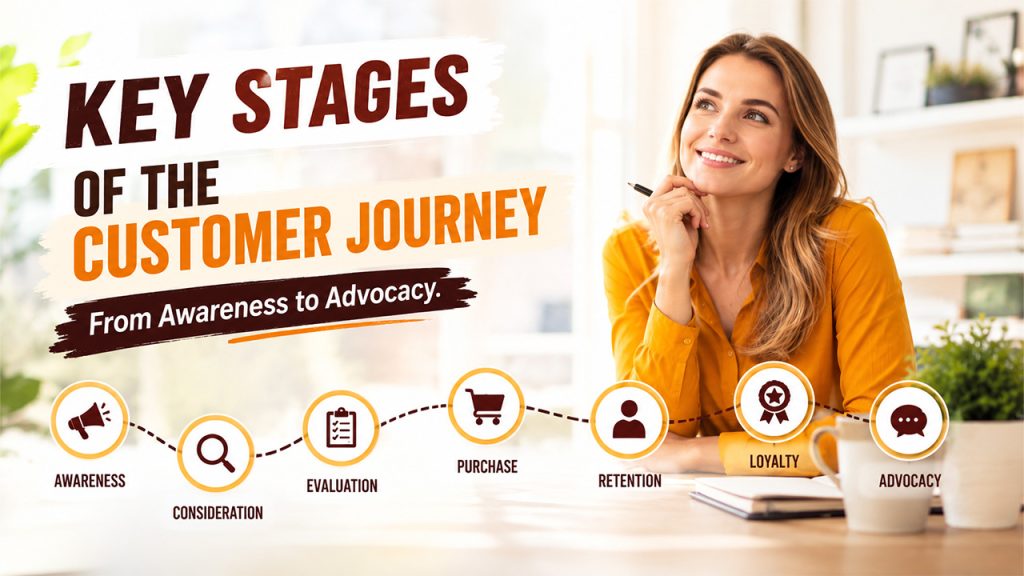
The journey rarely moves in a straight line. Customers jump back and forth between these stages more often than you'd think. Here's how each one typically plays out:
- Awareness: This is the moment when someone first hears about your existence, usually through an ad, a search result, or a friend mentioning your name in passing. Think of it like meeting someone at a party for the first time. You haven’t decided anything yet; you’re just acknowledging that they’re there.
- Consideration: Now the customer starts comparing you with other options, weighing price, features, and reputation side by side. This is the "shopping around" phase, similar to test-driving three cars before picking one.
- Evaluation: At this stage, people dig deeper to find out more about your business or how you operate. They read reviews, watch demo videos, and maybe reach out with a question before they commit. They do it to evaluate you and your brand.
- Purchase: Now, the buying decision finally happens, but it's really more of a checkpoint than a finish line. But if you offer a messy, difficult checkout or there is a hidden fee at this stage, it can undo weeks of good marketing in seconds.
- Retention: Right after the sale, the customer starts actually using what they bought. This is where good onboarding, like a helpful welcome email or a quick setup call, helps you turn a one-time buyer into someone who sticks around because they feel valued, even after the purchase.
- Loyalty: You cannot earn loyal customers immediately. This builds over repeated good experiences rather than one great interaction. It's the difference between someone who bought once and someone who reorders without thinking twice.
- Advocacy: This is the payoff stage, where a happy customer spreads the word about your brand by telling their friends or leaving a great review. It's worth more than most paid ads, simply because people trust people more than they trust brands.
Key Benefits of Understanding the Customer Journey

Once you actually understand how people move through these stages, a few good things start to happen:
Identify Customer Problems Before They Drive Churn: When your customer data shows that people are abandoning their cart at the shipping cost page, you can immediately act on it and fix that issue before it costs you sales month after month.
Create More Relevant and Personalized Marketing: It allows you to carry out more targeted and personalized marketing. Every customer is different, and therefore, instead of blasting the same generic emails to everyone, you can speak to a first-time visitor differently than someone who’s already compared you to three competitors.
Help Sales Teams Make Data-Driven Decisions: When you map the journey of a customer, patterns become obvious and sales teams are not left guessing. For instance, if most conversions happen after a live demo, that becomes the priority instead of cold calls that rarely land anywhere.
Make Customer Support More Proactive: When you know that a customer is struggling with a tricky onboarding step, your support team can instantly reach out and offer help, rather than waiting for the frustrated customer to come to you.
Improve Customer Retention and Engagement: When you know where your customers are abandoning you after the purchase, you can step in early and persuade them with helpful nudges instead of losing them quietly. This significantly improves customer retention rates since keeping existing customers is cheaper than scoring new customers every month.
Allocate Marketing Budgets More Effectively: Mapping the journey helps you allocate budgets where it’s needed. For instance, if a blog post is quietly driving more conversions than a paid campaign, that's where the next dollar should go, not toward the flashier option.
Customer Journey Communication Channels and Touchpoints
Customers don't stick to one channel anymore, and honestly, they never really did. A single journey might touch five or six different channels before it's done.
| Channel | Common Use in the Journey |
| Social media | Building early awareness through organic posts and paid ads |
| Email marketing | Nurturing leads and re-engaging past customers |
| Company website and blog | Educating prospects during consideration and evaluation |
| Search engines | Helping customers find you when they're actively looking |
| Live chat and chatbots | Answering quick questions during evaluation or purchase |
| Phone or in-person support | Handling complex questions or after-sale issues |
| SMS and push notifications | Sending timely reminders and personalized offers |
Using all these channels is not the tricky part if that’s what you think. Rather, it’s making sure they feel connected. For instance, if a customer reached out on a live chat and the next day, they ask for support via email, they shouldn’t have to repeat their whole problem from scratch. That's where a well-organized customer database really earns its keep. It keeps every interaction tied to one customer profile instead of scattered across disconnected systems.
How to Create a Customer Journey Map

Building a journey map isn't complicated, but it does take some real digging. Here's a straightforward way to approach it:
Define Your Buyer Personas: First, you should know who you’re mapping the journey for. You must have a full understanding of their goals, pain points, frustrations, and everyday habits. If you build a map for the wrong audience, it won’t reveal anything useful to you.
Identify Every Customer Touchpoint: Then, you must make a list of all channels or places a customer might use to interact with your brand, from the first ad they see to a support call months later. Most people make the mistake of skipping the small ones, don’t do that. They add up over time.
Gather Real Customer Data: Now, keep all relevant data stored in your CRM database. Additionally, pull analytics, surveys, and direct customer feedback to know how they feel or change, instead of relying on internal assumptions. Real numbers reveal what you might miss otherwise.
Map Customer Emotions and Pain Points: Observe and note where each customer feels confident, confused, or frustrated at each stage. This emotional layer often reveals more than the raw data alone and helps you provide a satisfactory customer experience.
Identify Gaps in the Customer Journey: Look for stages where customers seem to lose interest or quietly disappear. Identify and fix these gaps as they are usually where the biggest wins are hidden.
Remove Friction From Key Touchpoints: Make small, targeted changes to smooth out the roughest points, whether that's a confusing form or a slow response time. Small fixes often move the needle more than big overhauls.
Test and Update Your Journey Map Regularly: Market trends and customer behavior keep shifting over time. So, treat the map that you build as a living document to catch up with the changes, not a one-time project. What worked last year or even last month might not work today.
The goal isn't a perfect, polished map you frame and forget. It's a working tool your team actually revisits and adjusts as your customers change.
Conclusion
The customer journey never works in a straight line from stranger to loyal buyer. It's more of a loop; one that people enter and exit at different points, often more than once. Businesses that treat it like a rigid path often end up missing customers who don't follow the script. The ones that succeed are the ones who stay flexible, who build systems ready to catch someone wherever they show up next. Understanding this shift isn't optional anymore in 2026. It's simply how modern customer relationships and market trends actually work.
FAQs About Customer Journey
Customer journey is the actual path someone takes with your brand, every step from discovery to purchase. Customer experience is how they feel along that path.
It really depends on what is being bought. A cheap impulse buy might take minutes, driven by a single ad or a friend's recommendation. Bigger purchases, like software or furniture, can stretch across several months of research and comparison.
Yes, definitely. The stages aren't a strict checklist everyone follows in order. Many customers jump straight from awareness to purchase, especially for low-cost items.
Most businesses mix tools, such as analytics platforms to track behavior, CRM software to organize customer data, heatmaps to see where people click, and direct customer surveys. Combined, these give a far more accurate picture than any single tool alone.
Small teams don't have unlimited budgets or time to chase every idea. Mapping the journey shows exactly which touchpoints actually influence buying decisions, so limited resources go toward what genuinely moves customers forward instead of guesswork.