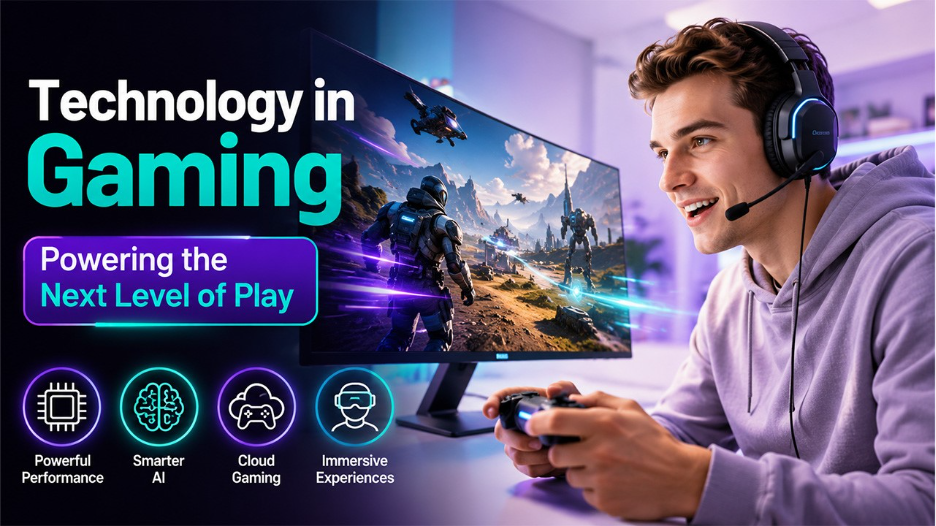






The article explores the technology behind video games and helps explain why modern games look, sound, and feel so realistic.
With the advancement in technological ecosystems, from powerful graphics processors and game engines to AI and virtual reality, video games have come a long way from simple pixelated adventures to immersive multiplayer experiences. Today, the games offer enormous open worlds, lifelike characters, realistic physics, and intelligent opponents. Behind this is the combination of complex technologies working together to create gaming experiences that the players enjoy.
What is Technology Play Gaming?
Technology pay gaming, or tech pay games, refers to the intersection of technology and gaming. It is the combination of technologies that are used to create, improve, and transform video games, making them more immersive and realistic. In simple terms, technology play gaming uses technologies to make gaming more interactive, accessible, and entertaining.
Technology play gaming includes various modern technologies, such as game engines, graphics technology, artificial intelligence, VR/AR, cloud gaming, online technology, mobile technology, and audio technology.
Various companies across the globe introduce new technology in their games, ensuring unique experiences for players. For instance, Netflix introduced a game called Unhinged, which demonstrates a shift towards gaming. The game turns a smartphone into a game controller, with phone movement controlling the character and real-world calls, vibrations, and sounds becoming a part of the gameplay.
Why is Technology Important in Gaming?
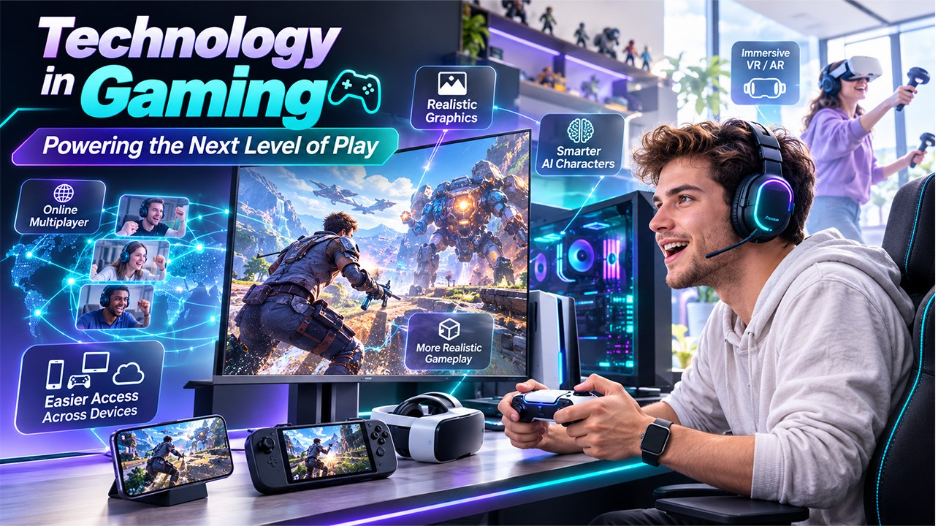
For the gaming industry, technology is not just a tool, but it helps make games more realistic, interactive, accessible, and enjoyable. In a modern game, almost every part, from its graphics and sound to an online multiplayer, depends on technology. Some of the key importance of technology in gaming are as follows:
- Better Graphics
Modern graphics technology allows developers to create more detailed characters, realistic environments, dynamic lighting, reflections, and visual effects. Key hardware technology like GPUs and ray tracing can also make the virtual world look more realistic.
- More Realistic Gameplay
Modern technology also allows games to simulate real-world physics, movements, vehicles, and other interactions. Game developers leverage physics engines that help objects behave naturally when players interact with them.
- Smarter Characters
In the gaming industry, artificial intelligence helps create intelligent non-player characters, or NPCs. AI technology also enables enemies to react to players, find paths through environments, take cover, and change their behavior based on what is happening in the game.
- Online Multiplayer
Faster internet and networking technologies allow players from all across the globe to connect and play together. Games utilize multiplayer servers to connect thousands of players, supporting competitive games, cooperative experiences, and online communities.
- Immersive Experience
Various games leverage advanced technologies, such as Virtual Reality Experience (VR), augmented reality (AR), spatial audio, motion tracking, and advanced controllers, to make players feel more involved in a game.
Platforms such as Sandbox VR demonstrate how VR can move beyond traditional screens by allowing players to physically interact with virtual environments and experience games in a shared setting.
- Technology and Interactive Online Gaming
Technology has also changed how players participate in online and educational gaming experiences. Platforms such as Blooket combine game mechanics with online interaction, allowing users to participate through connected devices. Players looking for information about Blooket Join can explore how these platforms use online connectivity to bring participants together in a shared gaming experience.
- Easier Access
With the expansion of technology, games have also moved beyond traditional consoles and PCs. Today, players can play games across multiple devices, such as smartphones, tablets, handheld devices, and cloud gaming services.
Key Technologies in Gaming
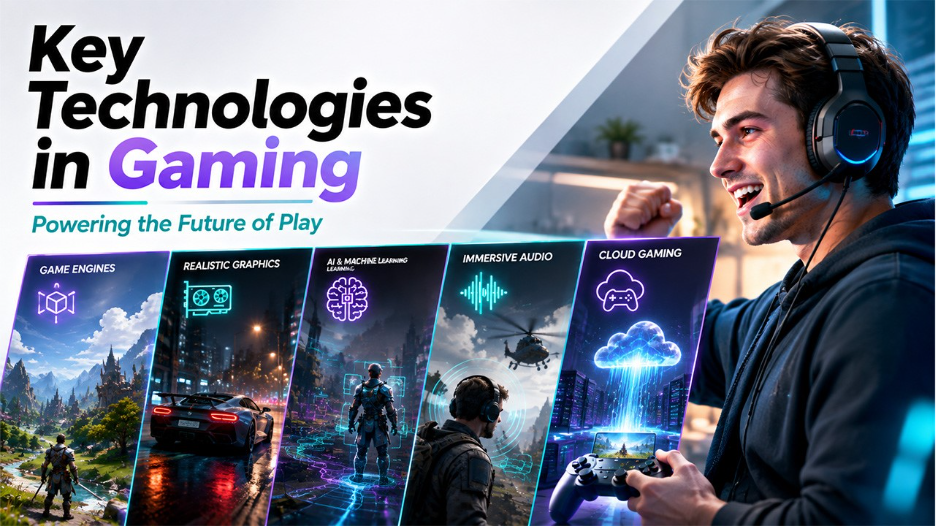
Modern gaming depends on several technologies working together to create a more engaging and interactive experience. Some of the most important technologies utilized in the gaming industry are as follows:
Game Engines
Game engines are also considered the foundation of modern gaming technology. It is among the most important technologies behind video games. A game engine is a software framework that offers developers the tools for building games. The engine can handle many complicated tasks such as graphics rendering, physics, animation, audio, lighting, networking, and user input.
Game engine technology has also made game development more accessible. With this, developers and small studios can utilize powerful development tools, contributing to the growth of the independent gaming landscape.
Modern game development often requires expertise across programming, 3D modeling, animation, sound design, testing, and other specialized areas. This has increased the importance of Game Outsourcing Studios, which helps game developers and publishers handle specific development tasks or entire production stages.
Key Features:
- Provide the foundation for game development.
- Support graphics, physics, animation, audio, and gameplay.
- Enable developers to build and manage virtual environments.
Graphics Processing and Realistic Visuals
In modern games, graphics are among the most noticeable areas. Modern games can create a highly detailed environment, along with realistic characters, dynamic lighting, reflections, shadows, and visual effects. Technologies like graphics processing units, or GPUs, play a central role in processing high-quality graphics. Modern graphics technologies can also simulate various effects, such as realistic reflections and lighting.
As realistic graphics require significant processing power, developers utilize technologies such as texture optimization, level-of-detail systems, dynamic resolution, and other forms of optimization to make games run smoothly across different hardware.
Key Features:
- Use powerful GPUs to render game graphics.
- Supports 3D environments and high-resolution textures.
- Enables realistic lighting, shadows, reflections, and visual effects
Artificial Intelligence and Machine Learning
In the gaming industry, artificial intelligence is generally utilized to make virtual worlds feel more responsive and believable. AI can be integrated into non-player characters, or NPCs, to determine how they react to players. AI can also be used for navigation, as pathfinding systems help characters determine how to move through complicated environments.
In the gaming industry, machine learning has also attracted various developers, as it can be used for animations, procedural content generation, testing, personalization, and other key development tasks.
Key Features:
- Controls NPC and enemy behavior.
- Enables intelligent decision-making and pathfinding.
- Allows characters to react to player actions
Sound and Audio Technology
In a game, not only visuals but audio is also important to elevate the gaming experience. Modern games utilize sophisticated sound systems to create environmental effects, character voices, music, and interactive soundscapes. In a game, audio can change depending on the location and action of the player.
Advanced sound and audio technologies, such as three-dimensional and spatial audio, have been utilized increasingly, especially in competitive games, offering immersive experiences.
Key Features:
- Provides music, dialogue, sound effects, and environmental sounds.
- Supports 3D and spatial audio.
- Creates directional sounds that help players understand their surroundings
Cloud Gaming
The introduction of cloud gaming offers a new possible way for players to play games. In cloud gaming, much of the processing can take place on a remote server, resulting in video being streamed to the player's device while their inputs are sent back to the server.
This approach can potentially allow players to play graphically demanding games on devices that would not normally be powerful enough. However, cloud gaming is heavily dependent on the internet quality of the player. Poor internet quality can result in latency, bandwidth, server availability, and connection stability.
Key Features:
- Runs games on remote servers rather than entirely on the player's device.
- Streams gameplay over the internet.
- Can reduce the need for high-end gaming hardware
What is Expected in the Future?
The future of gaming is expected to be shaped by continuous advancement in AI, cloud computing, graphics, virtual reality, and connected technologies. Some key changes that can be expected in the future are as follows:
- Advanced Gaming AI: With the rapid transformation of AI technology, AI is expected to create smarter NPCs that can respond naturally to players and adapt to different situations.
- Realistic Graphics: Graphics technology is witnessing continuous improvement, with better lighting, texture, animation, and physics.
- More Immersive VR and AR: It is expected that virtual and augmented reality games could become more sophisticated and comfortable.
- Cross-Platform Gaming: Future technology is expected to offer more options for players with different abilities, with adaptive controls, voice interfaces, and customizable displays.
Conclusion
Technology gaming has witnessed a major transformation in the recent few years. Technology has become the backbone of modern gaming, transforming how games are developed, played, and experienced. From game engines and advanced graphics to AI and cloud gaming, advanced technologies continue to offer more realistic and immersive experiences to players. With continuous innovations in the technological sector, the future of gaming is likely to bring smarter gameplay, with richer virtual worlds and personalized experiences.
FAQs About Technology Play Gaming
Technology play gaming refers to the advanced technologies utilized in the gaming industry to create, improve, and transform video games.
In games, technology offers better graphics, realistic gameplay, intelligent characters, online multiplayer, and immersive experiences.
Yes, AI can improve video games. In games, AI can control NPC behavior, enable intelligent decision-making, improve pathfinding, and personalize gameplay.
Mobile devices, such as smartphones and tablets, have made gaming more accessible and also introduced key features such as touchscreen controls, motion sensors, location-based gaming, and mobile multiplayer.