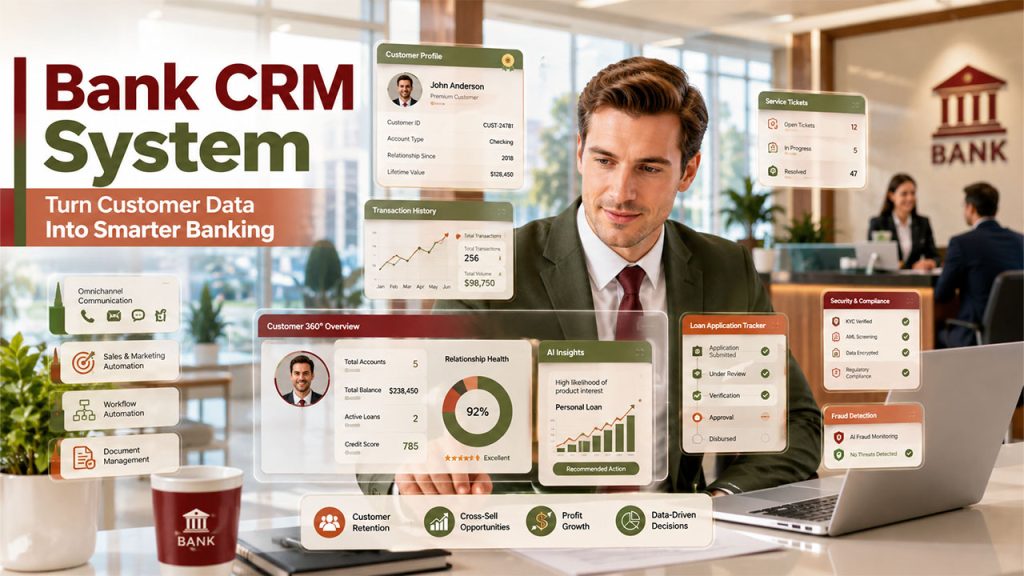






Banking CRM solutions are purpose-built to centralize customer data, streamline processes, improve customer service, and drive business success in the financial domain. It enables banks to collect and store data related to their customers, such as customer details, transaction history, and communication preferences. This data can then be utilized to ensure tailored experiences for customers, enhance customer interactions, and improve customer loyalty. A bank CRM system also keeps track of customer trends and behaviors. All of these can be utilized to recognize new sales opportunities and boost marketing strategies.
What Are the Main Challenges in the Banking Sector and How Does CRM Help?
The banking industry faces different challenges that impact growth and customer satisfaction.
- Customer Frustration- Conventional banking processes can be time-taking and cumbersome, causing customer frustration.
- Inefficient Processes- Manual tasks and disjointed platforms create inefficiencies, reducing productivity and protracting operations.
- Competition from Fintech Companies- The growth of fintech companies has made the competition more intense, causing the data flow.
- Difficulties in Technology Stack Integration- Incorporating distinct systems and tools can be expensive and complicated, impacting the data flow.
- Data Security Risks- Traditional banks generally struggle to remain up to date with the ever-evolving cyber threats, putting customer loyalty and trust at risk.
- Incapability to Scale- Conventional platforms generally lack the scalability to manage evolving customer demands and growing business processes.
- Regulatory Compliance- Banks must implement robust guidelines to secure customer data and avoid financial crime.
A customer relationship management platform addresses such challenges by ensuring simplified data management, streamlined processes, better customer service in banking, and more effective compliance and security support.
What Are the Features of the Bank CRM System?

Whether the CRM is built for general business functions or a specific team, it comes with powerful features. An efficient banking CRM platform must have the following characteristics:
- Centralized Management of Data: A central repository of customer information, including opportunity and lead management capabilities.
- Sales and Marketing Automation Tools: Simplified processes for tasks such as lead scoring, email marketing, and sales forecasting.
- Customer Services: Features for handling customer inquiries, fixing problems, and delivering customized support.
- Workflow Automation: AI-driven automation to quickly complete tasks, minimize manual work, and enhance efficiency.
- Incorporated Omni-channel Communications: Smooth customer interactions across different channels, including email, phone, chat, and social media.
- Document Management: Secure management and storage of customer-related documents, agreements, and contracts.
- Analytics and Reporting: Analytics and reporting tools to create crucial performance metrics and monitor performance.
- Compliance and Security Tools: Sophisticated measures and compliance characteristics to secure confidential data.
What Are the Advantages of a Bank CRM System?
CRM is beneficial for any business as it helps in retaining customers and boosting business growth. In banking, the key advantages of CRM are as follows-
1. Centralized Customer Data:
Having a unified repository of all customer-related data ensures that the data remains accessible and consistent across all platforms. This allows for a more complete view of every customer, enabling banks to better comprehend their requirements, behaviors, and preferences. With this data, banks can practice the art of customized financial engagement and provide customized products and services. Over time, this improves loyalty and satisfaction.
2. Better Customer Retention and Satisfaction:
Through a much better understanding of customers at a deeper level, banks can forecast possible issues and proactively address them. This not only leads to a higher experience level for customers but also reduces churn.
3. Improved Loan Sales and Profit Growth:
Creating the right marketing campaigns and effectively managing leads can grow clientele, market reputation, and overall revenue. A banking CRM makes this possible by delivering insights into preferences and customer behavior, empowering banks to accordingly personalize their strategies. This helps banks retain their available customers by providing them with customized services. CRM also plays a crucial role in effectively identifying upselling and cross-selling opportunities, further improving profits.
4. Streamlined Underwriting Process:

Automated workflows streamline the overall underwriting process, freeing banks from time-consuming and inefficient processes. With a CRM platform, banks can keep track of progress in each application, ascertain follow-ups in a timely manner, and provide top-level customer service. They can also go beyond pen and paper to adopt digital documentation for loan applications, digital client onboarding, and other financial processes. This not only saves resources and time but also minimizes the possibilities of manual errors.
5. Streamlined Process of Transaction Dispute:
A bank CRM system simplifies the transaction dispute by centralizing customer data and interaction history, enabling bank staff to access needed data quickly. This integration reduces resolution times and enhances customer satisfaction by making the transaction details readily available. Steps throughout the process of dispute resolution can be automated, like scheduled follow-ups and initial acknowledgements. The high level of automation ensures management of disputes is consistent and frees up staff to focus greatly on more complicated problems, enhancing productivity.
6. More Effective Employee Collaboration:
A centralized platform encourages better management of tasks, better communication, and collaboration among employees. With automated workflows, employees no longer need to spend time manually processing paperwork or monitoring missing details. This essentially means that they can emphasize more on top-value tasks such as establishing relationships with customers and setting up new opportunities for the bank. Furthermore, CRM makes it simple for employees to collaborate on projects because data is simplified in one platform.
7. Higher Compliance and Security:
With the overall threat of data breaches and cyberattacks, banks must have robust security measures in place. Automated workflows give you additional protection layers, like multi-factor authentication and encryption, to secure customer data. It ensures that both parties have a strong sense of security. Customers can keep their data private, and banks can maintain their reputation for doing so. Furthermore, compliance tools are incorporated into the system and enable banks to remain updated with evolving regulations around data security.
How to Get Started with a Bank CRM System: A Step-by-Step Guide

Deploying CRM in the banking industry requires careful strategy-building and execution. Let us see a detailed guide to deploying a bank CRM system.
- Assess Current Processes- Audit your present processes to recognize improvement areas.
- Recognize Bottlenecks- highlight specific bottlenecks that impact overall productivity.
- Measure the Impact: To justify the need for modification, quantify the operational and financial impact of any bottlenecks.
- Redefine Business Needs- Align business needs with the goals of your organization to ensure that the CRM software reaches those standards.
- Create As Well As Test New Workflows- Build a new workflow that integrates the CRM platform and thoroughly test it to make sure that the integration is smooth.
- Ascertain Complete Training- Train CRM software on the new workflow and CRM software.
Bank CRM System Pricing
The cost of deploying CRM in banking can change as per the size and complexity of the bank. Let us see a breakdown of numerous financial services pricing structures:
- Small Banks: Generally, small banks pay an amount between $20,000 and $50,000 for a CRM solution, with the current support and maintenance costs annually varying between $5,000 and $10,000.
- Mid-level Banks: Mid-level banks can expect to invest approximately $50,000 and $100,000 in a CRM system, with the annual support and maintenance costs varying between $10,000 and $20,000.
- Enterprise-level Banks: Enterprise-level banks can spend close to $100,000 on complete CRM solutions, with consistent support and maintenance costs going beyond $20,000 per year.
These are just approximate figures, and the exact amount can vary as per the particular requirements and vendors.
AI in Banking CRM
AI is fast changing how banks work and handle customer relationships. As per The Economist, approximately 80% of senior banking executives have a notion that integrating AI is important for success in the financial industry.
Modern banking CRM platforms driven by AI go far beyond standard contact management. AI in CRM allows financial institutions to automate repetitive tasks, get in-depth insights from customer data, and ensure tailored experiences that contribute to lasting loyalty.
AI tools can manage routine and time-consuming tasks like lead scoring, data entry, and follow-up reminders. This frees banks’ staff to pay more attention to key activities such as cultivating customer relationships. Banks can also leverage AI-driven chatbots to deliver 24/7 customer support to respond to questions frequently asked about transactions, accounts, and banks’ offers.
Financial institutions and banks can also leverage AI to improve fraud detection, cybersecurity, and risk management. AI-driven algorithms can detect unfamiliar patterns and real-time anomalies, recognizing possible threats much sooner than humans. Banks can also utilize AI to simplify compliance processes, generate reports automatically, and stay ahead of evolving regulatory requirements.
Conclusion
A bank CRM system is no longer an afterthought for modern banks. It is a core necessity for financial institutions to remain competitive. From simplifying customer data and automating workflows to enhance compliance and allowing AI-based insights, banking CRM solutions address the core customer experience and operational challenges banks face daily. Irrespective of whether you are an enterprise-level institution or a small bank, the best CRM investment ensures strong ROI in terms of efficiency, retention, and revenue.